Category | Quality Management
Last Updated On 18/09/2025
When it comes to safeguarding your organization and ensuring it runs smoothly even during crises, iso 27001 and iso 22301 certifications are game-changers. You might be wondering: what’s the real difference between ISO 27001 vs ISO 22301? Simply put, ISO 27001 focuses on protecting information, your data, secrets, and digital assets. ISO 22301, on the other hand, is all about keeping your business running when things go wrong, such as disasters, cyberattacks, or unexpected downtime. Both are critical, but they address different sides of organizational resilience.
So, is it worth learning about them? Absolutely. Understanding ISO 27001 vs ISO 22301 helps businesses and professionals build trust, security, and continuity. Plus, for lead auditors, mastering both standards opens doors to global opportunities in risk management, IT governance, and compliance.
ISO 27001 is the global standard for information security management. It revolves around the CIA triad: confidentiality, integrity, and availability, making sure your sensitive data is safe, accurate, and accessible only to the right people.
The goal of ISO 27001 is simple: identify, manage, and reduce information security risks. Organizations implement an Information Security Management System (ISMS), which includes policies, procedures, and controls to protect digital and physical assets.
Key elements include:
ISO 27001 is best suited for businesses handling sensitive data or operating in compliance-heavy industries such as finance, healthcare, cloud computing, and IT services. Companies that achieve certification not only strengthen their security posture but also gain a competitive edge, building trust with clients and stakeholders.
Learn more about how ISO 27001 strengthens security and compliance. Read our full blog to explore what ISO 27001 is actually about.
ISO 22301 is the international standard for business continuity management. Unlike ISO 27001, which is data-centric, ISO 22301 focuses on keeping critical operations running during disruptions.
The goal of ISO 22301 is to ensure continuity and minimize downtime, whether caused by cyberattacks, natural disasters, or technical failures. The standard equips organizations with a structured approach to recover quickly and maintain essential functions.
Key elements include:
Organizations where uptime is crucial, like banks, hospitals, IT services, and manufacturing, benefit most from ISO 22301 certification. It’s not just about bouncing back from disaster; it’s about being prepared, resilient, and trusted.
Curious about ISO 22301 and how it keeps businesses resilient? Explore our complete guide on ISO 22301 Certification to understand this global business continuity standard.
Now that we’ve looked at both standards individually, let’s compare them side by side. Understanding the ISO 27001 vs ISO 22301 difference helps leaders decide which certification to pursue and how to integrate them.
Aspect |
ISO 27001 (Information Security) |
ISO 22301 (Business Continuity) |
Focus |
Protecting data (confidentiality, integrity, availability) |
Ensuring continuity of critical operations |
Goal |
Reduce information security risks |
Minimize disruption impact, ensure recovery |
Key Elements |
Security controls, ISMS framework |
Business continuity strategy, BIA, recovery plans |
Best For |
Data-driven, compliance-heavy industries |
Organizations dependent on uptime |
Risk Management |
Detailed security-focused |
Broad operational resilience-focused |
Documentation |
Policies, risk assessments, logs |
Recovery plans, impact analyses, and test reports |
In short, ISO 27001 secures your information, while ISO 22301 secures your business operations. Companies aiming for comprehensive risk management often implement both to cover security + continuity.
Lead auditors are the backbone of certification. They ensure organizations meet compliance, follow standards, and continuously improve.
Both roles require attention to detail, strategic thinking, and strong communication skills. Lead auditors not only help companies achieve certification but also build trust and reliability, making them highly valued globally.
See how top auditors use both standards together
to save time and deliver stronger audits. Don’t miss out.
Becoming a lead auditor for ISO 27001 or ISO 22301 isn’t just a title; it’s a career accelerator.
Here’s why:
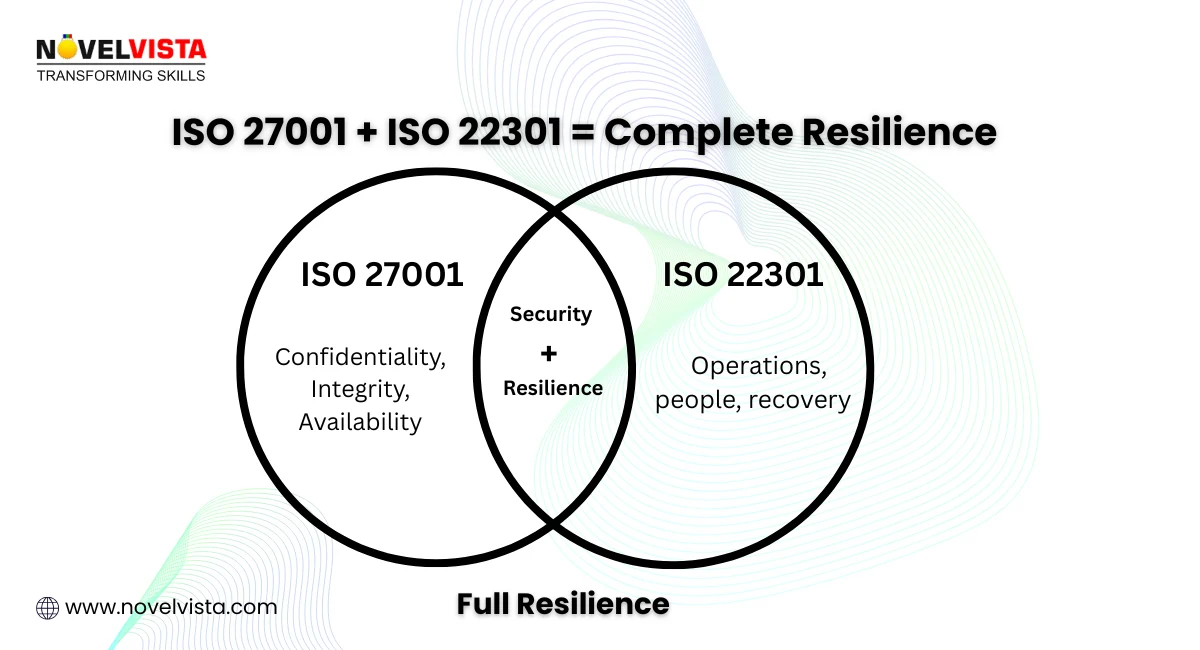
Often, organizations implement ISO standards in silos, but the real power lies in combining them. ISO 27001 and ISO 22301 complement each other perfectly:
For example, imagine a cyberattack that encrypts critical data. ISO 27001 controls reduce the likelihood and impact of an attack. If the breach still affects operations, ISO 22301 ensures continuity plans kick in, critical services continue, and downtime is minimized. This combination is what businesses call full-spectrum resilience.
Implementing ISO standards isn’t always smooth sailing. Organizations often face:
Shared Challenge: Cultural resistance to change. Employees may see security or continuity processes as extra work. Overcoming this requires strong leadership and change management initiatives.
Deciding between ISO 27001 vs ISO 22301 depends on organizational needs and career goals:
Combination: Mastering both standards opens doors to high-value auditing roles across industries
The need for ISO certifications is growing rapidly. Cybercrime costs are projected to hit $10.5 trillion annually by 2025 (Cybersecurity Ventures), making information security a top priority.
This means demand for professionals certified in ISO 27001 and ISO 22301 will continue to rise. Organizations seek auditors and consultants who can secure information and maintain operations during disruptions. For individuals, this is a chance to future-proof their career in governance, risk, and compliance (GRC).
Understanding ISO 27001 vs ISO 22301 is crucial for any business or professional aiming to minimize risk. ISO 27001 protects your data; ISO 22301 ensures operations continue when things go wrong. Together, they create a resilient, secure, and trusted organization.
Lead auditors are central to this process, helping companies implement, monitor, and improve these standards. The combination of knowledge, hands-on auditing experience, and certification makes you an invaluable asset in today’s risk-aware business landscape.
Ready to become a globally recognized expert in business continuity?
Enroll in NovelVista’s ISO 22301 Lead Auditor Certification. With real-world case studies, expert-led sessions, and hands-on training, you’ll gain the skills to:
Elevate your career in governance, risk, and compliance, and become a trusted leader who can handle both information security and business continuity challenges. Don’t wait, your next career milestone is just a certification away!
Author Details

Course Related To This blog
ISO 22301:2019 Lead Auditor
Confused About Certification?
Get Free Consultation Call
Stay ahead of the curve by tapping into the latest emerging trends and transforming your subscription into a powerful resource. Maximize every feature, unlock exclusive benefits, and ensure you're always one step ahead in your journey to success.