Category | Quality Management
Last Updated On 28/02/2026

Digital services are no longer a support function — they are the backbone of revenue, customer experience, and competitive advantage. Yet organizations still lose billions each year due to service disruptions, weak incident management, and inconsistent IT processes. At the same time, over 70% of enterprises are accelerating digital transformation, increasing operational complexity across cloud, hybrid, and global environments.
So how do businesses ensure their IT services stay reliable, scalable, and globally consistent?
This is exactly why ISO 20000 Is Gaining Popularity Globally. As organizations move from reactive IT support to structured service governance, ISO 20000 is emerging as a strategic standard for delivering measurable, audit-ready, and high-performance IT services worldwide.
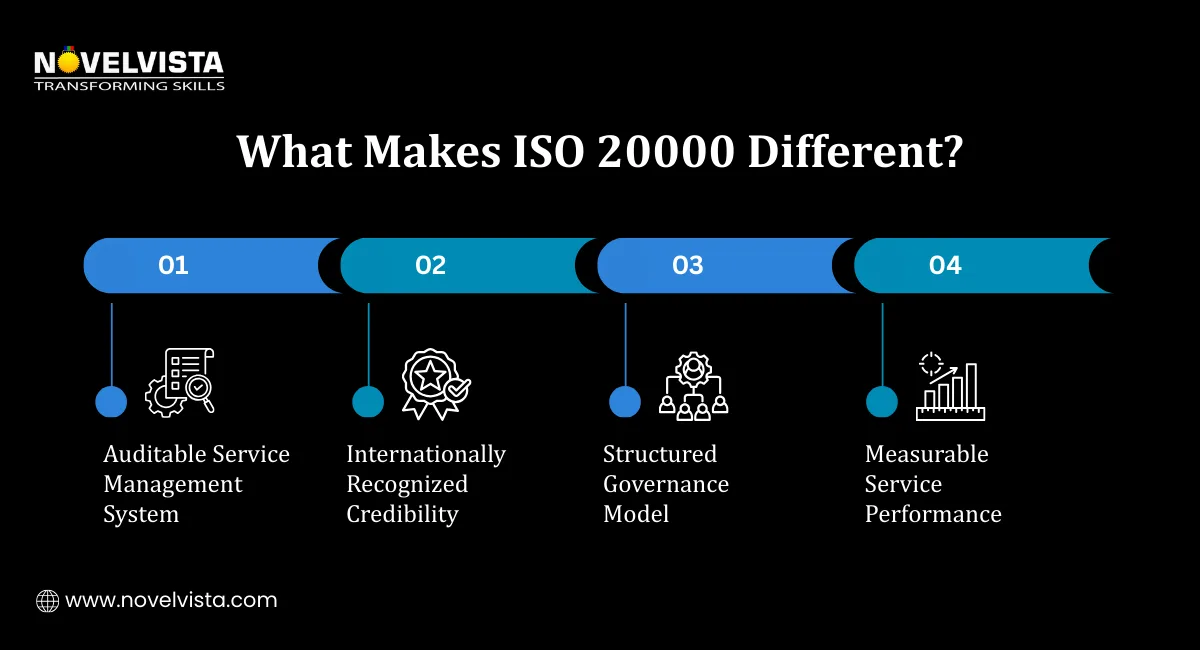
ISO/IEC 20000 is the international standard for IT Service Management (ITSM), published by the International Organization for Standardization (ISO) and the International Electrotechnical Commission (IEC). It defines the requirements for establishing, implementing, maintaining, and continually improving a Service Management System (SMS). In simple terms, it ensures that IT services are reliable, measurable, auditable, and continuously improving through a structured and controlled approach. Unlike best-practice frameworks that offer guidance alone, ISO 20000 is a certifiable standard, allowing organizations to formally demonstrate compliance through accredited audits. This certification-based credibility is a key reason ISO 20000 global adoption continues to rise across industries worldwide.
Cloud computing, AI, SaaS platforms, and remote work models have increased service complexity. Businesses now operate across borders, time zones, and hybrid infrastructures.
To manage this complexity, organizations need structured ITSM processes. That’s a major reason ISO 20000 Is Gaining Popularity Globally it brings structure and accountability.
Customers expect 24/7 availability, quick resolution times, and zero downtime. Poor service performance damages brand reputation instantly.
ISO 20000 ensures:
Defined SLAs
Incident management control
Problem management processes
Continuous service improvement
This reliability boosts customer trust, further accelerating ISO 20000 popularity worldwide.
Regulated industries such as banking, healthcare, and telecom must prove operational resilience. ISO 20000 integrates well with standards like ISO 27001 (information security) and ISO 9001 (quality management).
This integration capability strengthens ISO 20000 global adoption among compliance-driven organizations.
Let’s look at the tangible benefits.
Improved Service Quality
ISO 20000 requires documented processes, performance measurement, and service review mechanisms. This reduces errors, improves consistency, and enhances service reliability.
Standardized workflows reduce duplication and eliminate unnecessary manual processes. Organizations report better resource allocation and cost optimization.
Efficiency is a core reason ISO 20000 Is Gaining Popularity Globally across IT service providers.
Risk management is embedded within the Service Management System. Organizations proactively identify service risks instead of reacting to failures.
In global tenders, ISO 20000 certification is often a prerequisite. It demonstrates maturity in IT service management.
This competitive advantage explains the steady growth of ISO 20000 popularity worldwide. Explore our comprehensive ISO 20000 cost guide to understand certification expenses, audit fees, training investments, and long-term ROI benefits.
Many professionals ask: If ITIL exists, why pursue ISO 20000?
Here’s the distinction:
ITIL |
ISO 20000 |
| Best-practice framework | International certifiable standard |
| Guidance-based | Audit-based compliance |
| Individual certifications | Organizational certification |
| Flexible adoption | Structured mandatory requirements |
Organizations often implement ITIL practices internally, then pursue ISO 20000 certification for formal recognition.
This combination significantly drives ISO 20000 global adoption across enterprises.
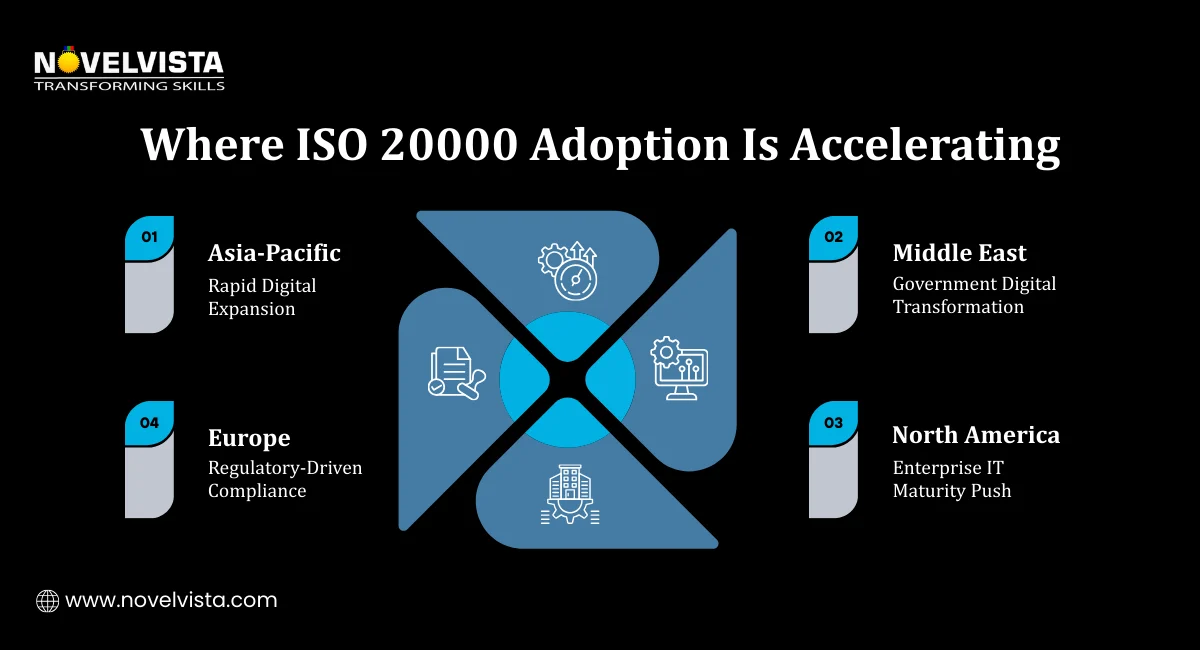
Several sectors are accelerating certification:
Clients demand proof of structured service delivery.
Operational resilience and risk control are critical.
Data sensitivity and service availability are life-critical.
High-volume service environments require strict SLA management.
Public accountability and audit transparency push adoption.
These industries collectively contribute to why ISO 20000 Is Gaining Popularity Globally at an unprecedented rate.Global companies face a unique challenge: maintaining service consistency across multiple regions, time zones, and operational environments. ISO 20000 helps address this by standardizing service management processes, aligning global teams under a single structured framework, improving vendor and supplier governance, and enabling seamless cross-border operations. By creating a unified Service Management System, organizations can ensure consistent service quality regardless of geography. For multinational corporations, ISO 20000 global adoption becomes a strategic enabler that supports scalability, operational control, and long-term business growth rather than serving merely as a compliance activity.
No transformation is effortless.
There are costs related to audits, documentation, and training.
Teams must adopt structured processes instead of ad-hoc workflows.
Maintaining service records and evidence requires consistency.
However, the long-term gains outweigh the initial effort. That’s precisely why ISO 20000 popularity worldwide continues to grow despite implementation challenges.
Organizations see it as an investment in operational maturity.
Several trends indicate continued growth:
Integration with cloud service management
Alignment with cybersecurity frameworks
Increased remote workforce governance
AI-driven service analytics
As service ecosystems become more interconnected, businesses need measurable control mechanisms.
That’s why ISO 20000 Is Gaining Popularity Globally and is expected to remain a dominant ITSM certification standard in the coming decade. Explore the comprehensive ISO 20000 Syllabus Guide to gain clarity on exam structure, audit principles, and core IT service management topics.
The modern enterprise runs on digital services. Downtime costs money. Poor service management damages reputation. Regulatory failures create legal exposure.
Against this backdrop, it’s clear why ISO 20000 Is Gaining Popularity Globally.
From operational efficiency to competitive advantage, from governance to customer trust, the drivers of ISO 20000 global adoption are strategic not temporary. As digital transformation accelerates, the rise in ISO 20000 popularity worldwide is not just a trend. It is a reflection of how seriously organizations now take IT service excellence.
For companies aiming to compete globally, ISO 20000 is no longer optional it is becoming a benchmark of credibility.

Join NovelVista’s ISO/IEC 20000:2018 Lead Auditor Certification Training and gain practical auditing skills, real-world service management insights, and globally recognized credentials. Designed for IT leaders, service managers, and ITSM professionals, this program equips you to confidently lead audits, ensure compliance, and drive measurable service excellence.
If ISO 20000 global adoption is shaping the future of IT governance, this is your opportunity to lead that change.
Start your ISO 20000 auditor journey today!
Author Details

Course Related To This blog
ISO 20000:2018 Lead Auditor
Confused About Certification?
Get Free Consultation Call
Stay ahead of the curve by tapping into the latest emerging trends and transforming your subscription into a powerful resource. Maximize every feature, unlock exclusive benefits, and ensure you're always one step ahead in your journey to success.