Category | Quality Management
Last Updated On 18/02/2026
In today’s digital-first economy, IT downtime is not just an operational issue it’s a business risk. Industry reports estimate that unplanned outages can cost enterprises between $5,600 and $9,000 per minute, while more than 70% of organizations admit they struggle with consistent IT service management (ITSM) practices.
That raises critical questions:
Is your IT service management system aligned with international standards?
Are your processes truly audit-ready?
Do you know exactly where your compliance gaps exist?
If you’re an IT manager, CIO, compliance officer, or service leader preparing for certification, these questions demand clear answers.
An ISO 20000 gap assessment provides that clarity. Before investing in certification or facing external auditors, it helps you understand your current position, identify weaknesses, and build a structured path toward service excellence.
Let’s break it down.
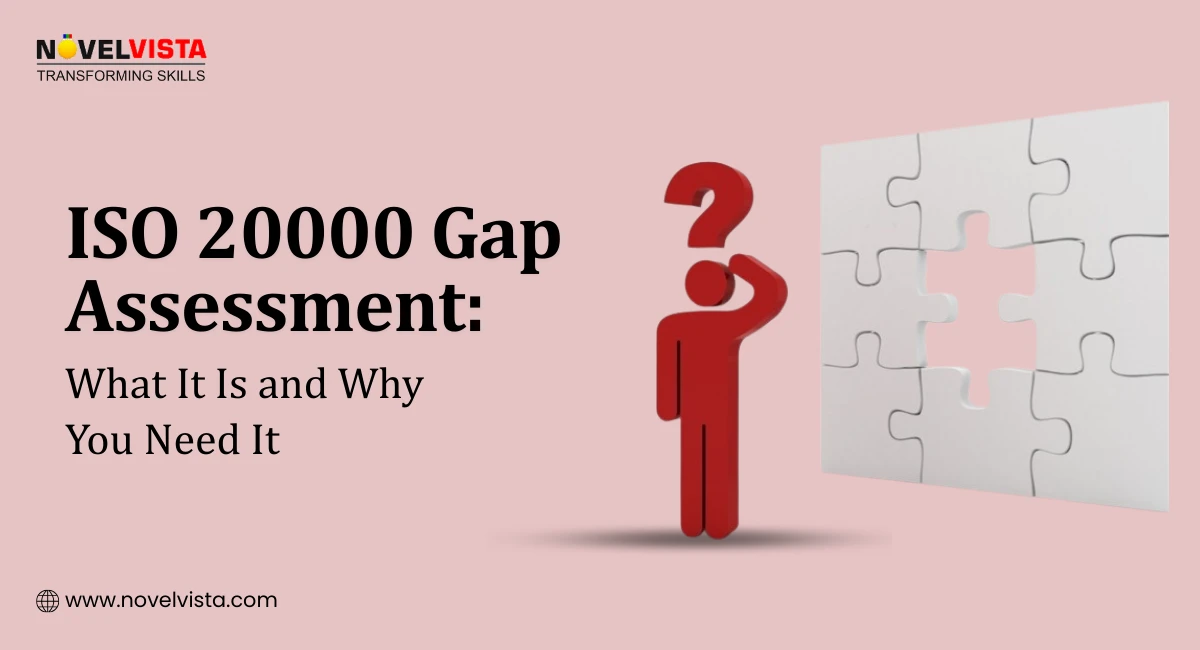
An ISO 20000 gap assessment is a structured evaluation of your current IT service management system against the requirements of ISO/IEC 20000, the internationally recognized standard for IT service management. In simple terms, it answers one fundamental question: Where are we today compared to where ISO 20000 requires us to be? This process, often referred to as an ISO/IEC 20000 gap analysis, systematically identifies discrepancies between your existing processes, controls, and documentation and the standard’s requirements. These discrepancies are known as compliance gaps, and they highlight areas that require improvement before certification.
It is important not to confuse an ISO 20000 assessment with a certification audit. An ISO 20000 gap assessment is typically an internal or pre-certification review designed to prepare your organization, whereas a certification audit is a formal external evaluation conducted by an accredited body. In essence, the gap assessment is diagnostic; it helps you understand and fix weaknesses, while the audit is decisive, determining whether you achieve certification.
An ISO 20000 gap assessment is not just about ticking compliance boxes. It’s about strengthening your IT service foundation.
Without an ISO 20000 compliance gap review, organizations often uncover critical weaknesses only during the certification audit when fixing them becomes expensive, time-consuming, and disruptive. A structured ISO 20000 assessment helps proactively identify missing documentation, weak service level management, inconsistent change management processes, and poor incident response workflows. By detecting these issues early, organizations reduce compliance risk, avoid costly rework, and improve overall audit readiness.
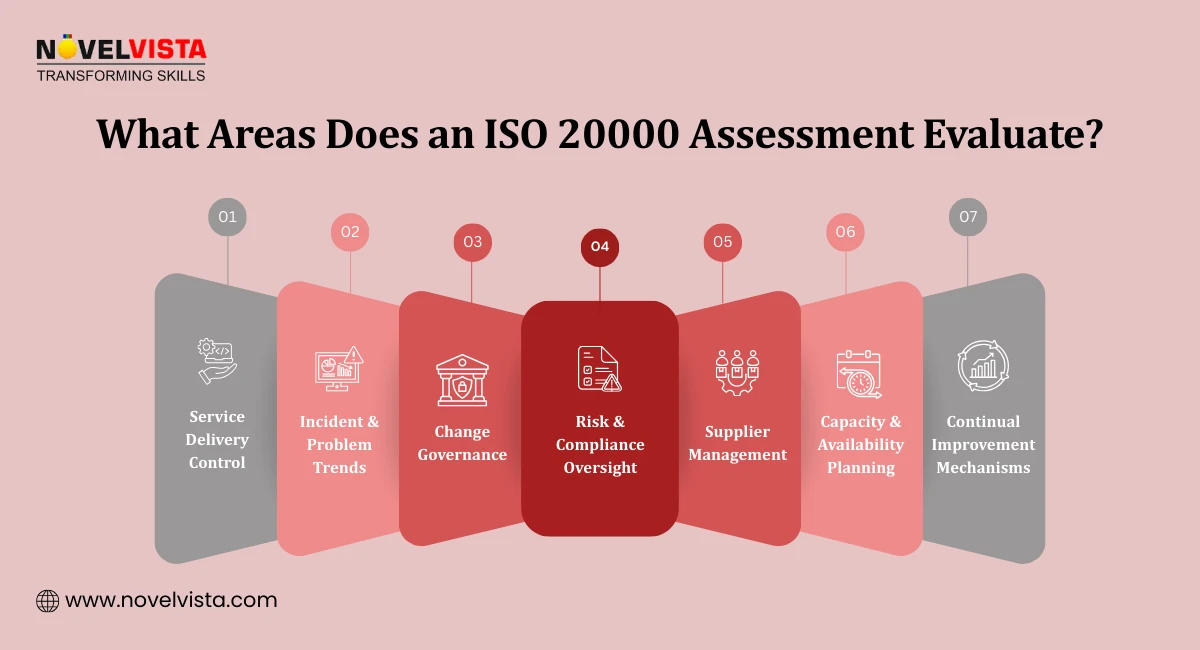
An ISO/IEC 20000 gap analysis evaluates your ITSM framework holistically by reviewing critical areas such as service delivery, capacity management, availability management, problem management, and configuration management. By examining these interconnected processes, the analysis strengthens operational discipline, improves process consistency, and ensures that IT services are strategically aligned with overall business objectives.
Today, IT services are directly tied to revenue, customer experience, and regulatory commitments, meaning a compliance failure can impact contracts, erode trust, and damage organizational credibility. An ISO 20000 gap assessment helps reduce the risk of audit failure, minimize service disruptions, and strengthen governance controls by identifying weaknesses before they escalate. Instead of reacting to incidents and audit findings, organizations shift from firefighting to proactive, structured service management.
Organizations embracing automation, cloud migration, DevOps, or AI-driven IT operations require strong and structured governance to manage complexity and risk. An ISO 20000 assessment ensures that your service management framework evolves alongside innovation, maintaining control, compliance, and process consistency while supporting modern IT transformation initiatives.
A professional ISO 20000 gap assessment typically covers several core areas:
Service management policies
Process documents
Service catalogs
SLAs and OLAs
Gaps often emerge when documentation exists but is outdated or inconsistent.
Each ITSM process is evaluated against ISO requirements, including:
Incident management
Change management
Problem management
Service continuity
The goal is to detect inefficiencies and compliance deviations.
An effective ISO 20000 compliance gap analysis evaluates:
Leadership involvement
Risk management frameworks
Performance monitoring
Internal audit mechanisms
Governance gaps are common and often overlooked.
ISO 20000 emphasizes measurable service performance.
A gap assessment reviews:
KPIs
Reporting frequency
Continual improvement mechanisms
Here’s how a typical ISO 20000 gap assessment is conducted:
Define:
Services covered
Organizational boundaries
Applicable clauses of ISO/IEC 20000
Through interviews, document reviews, and process walkthroughs, evaluators identify compliance levels.
This stage forms the foundation of the ISO/IEC 20000 gap analysis.
Each clause of ISO 20000 is compared with current practices.
Gaps are categorized as:
Major non-conformities
Minor non-conformities
Observations for improvement
The ISO 20000 assessment report includes:
Detailed compliance gap list
Risk prioritization
Recommended corrective actions
Implementation timeline
This transforms assessment findings into a strategic roadmap.
During an ISO 20000 gap assessment, certain issues appear repeatedly:
ISO standards require top management engagement. Many organizations treat ITSM as an operational issue rather than a strategic one.
Unstructured changes increase risk. Lack of documented change approvals often creates ISO 20000 compliance gaps.
Many companies track incidents but fail to analyze trends or root causes.
Policies may exist, but evidence of implementation is missing a common finding during any ISO 20000 assessment.
Conducting a formal ISO 20000 gap assessment before certification delivers measurable benefits:
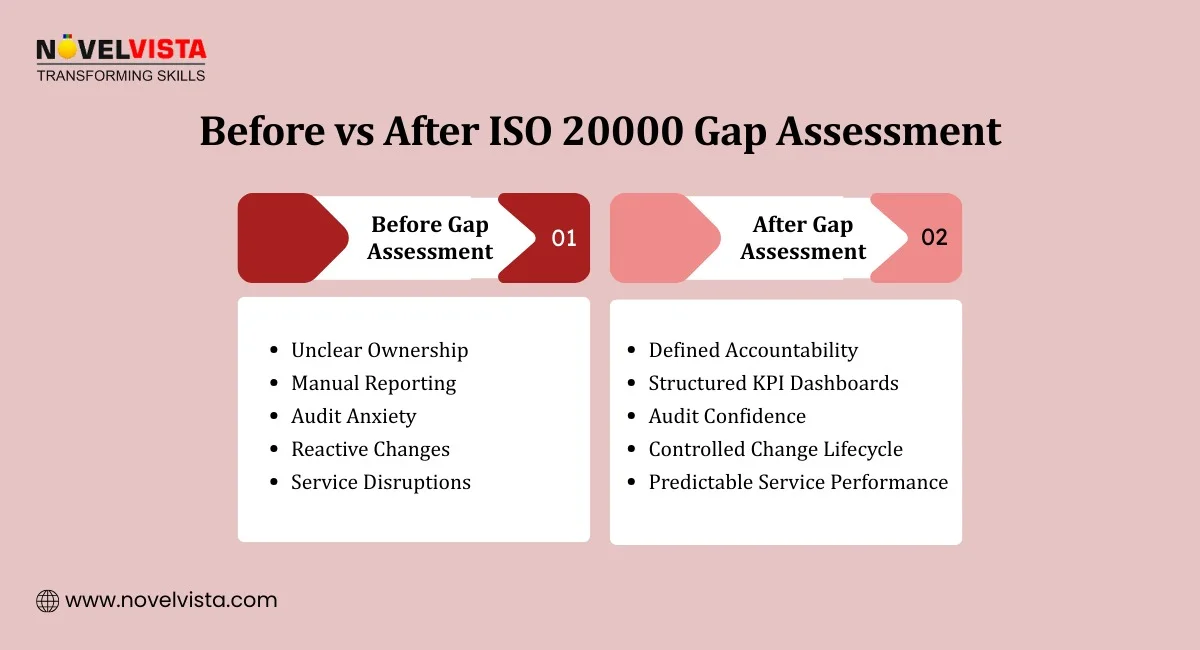
Fixing issues before the audit prevents repeat assessments.
Organizations that conduct ISO/IEC 20000 gap analysis have significantly higher first-time pass rates.
Clients increasingly request proof of IT service governance. Demonstrating structured assessment builds trust.
Teams gain clarity about roles, responsibilities, and accountability.
Best practice suggests:
Before initial certification
Before surveillance audits
After major organizational changes
When expanding service scope
Regular ISO 20000 compliance gap reviews ensure continual improvement a core principle of the standard.
Aspect |
ISO 20000 Gap Assessment |
Certification Audit |
Purpose |
Identify compliance gaps |
Formal certification decision |
Conducted By |
Internal team or consultants |
Accredited certification body |
Outcome |
Action plan |
Certification or non-conformity report |
Risk Level |
Low |
High |
An ISO 20000 assessment prepares you. The audit validates you. Explore our ISO 20000 Pricing Guide to understand certification costs, audit fees, and implementation investment required for achieving ISO/IEC 20000 compliance.
An ISO 20000 gap assessment is not just a compliance formality, it is a strategic move to protect your organization’s service credibility and operational stability. In today’s environment, where IT services directly impact revenue and customer trust, unnoticed gaps can quickly become costly risks. A structured ISO/IEC 20000 gap analysis gives you clarity, control, and confidence before facing certification.
It helps you identify ISO 20000 compliance gaps, strengthen governance, improve ITSM maturity, enhance audit readiness, and build stakeholder trust. Rather than waiting for auditors to uncover weaknesses, take a proactive approach. Start with an ISO 20000 assessment, close gaps strategically, and move toward certification fully prepared.

Join NovelVista’s ISO/IEC 20000:2018 Lead Auditor Certification Training and gain practical auditing skills, real-world service management insights, and globally recognized credentials. Designed for IT leaders, compliance professionals, and ITSM practitioners, this program equips you to confidently conduct ISO 20000 gap assessments, lead certification audits, and drive measurable service excellence across digital environments.
Don’t just prepare for audits — lead them with authority.
Start your ISO 20000 auditor journey today!
Author Details

Course Related To This blog
ISO 20000:2018 Lead Auditor
Confused About Certification?
Get Free Consultation Call
Stay ahead of the curve by tapping into the latest emerging trends and transforming your subscription into a powerful resource. Maximize every feature, unlock exclusive benefits, and ensure you're always one step ahead in your journey to success.