Category | Quality Management
Last Updated On 09/06/2026
Preparing for the iso 9001 lead auditor exam can feel overwhelming, especially when you’re faced with endless Exam Questions for ISO 9001 and unclear guidance on what truly matters. This certification doesn’t just test your memory of clauses — it evaluates how effectively you apply ISO 9001:2015 requirements in real audit situations.
Many candidates struggle not because they lack knowledge, but because they don’t understand how questions are framed from an auditor’s perspective. Scenario-based questions, risk-based thinking, and audit judgment play a major role in the exam.
That’s exactly where this guide helps. You’ll get clarity on key exam domains, practice with real-style ISO 9001 lead auditor exam sample questions, and learn a proven strategy to approach the exam with confidence. Whether you’re appearing for the first time or revising before exam day, this guide is designed to help you prepare smartly — without unnecessary stress.
Before diving into questions, it’s important to know what the ISO 9001:2015 Lead Auditor exam actually checks. It’s not just about memorizing clauses; it’s about understanding how to apply them during audits.
Here are the key exam domains you’ll face:
1. Quality Management Principles (QMPs): You’ll need to understand the seven QMPs like customer focus, leadership, and evidence-based decision-making — and how they influence quality systems in an organization.
2. Clause-wise Understanding (Clauses 4–10): This covers ISO 9001’s main framework from context and leadership to support, operations, and improvement. Each clause builds on the other, forming the backbone of audit questions.
3. Audit Process & Techniques: Know the full audit cycle from planning and conducting to reporting and follow-up. Many ISO 9001:2015 exam questions and answers are scenario-based around audit roles and findings.
4. Risk-Based Thinking & PDCA Cycle: You’ll be tested on how risk management integrates into quality systems. Understanding the Plan-Do-Check-Act cycle helps you identify continuous improvement opportunities.
5. Roles & Responsibilities of an Auditor: Beyond technical knowledge, auditors must demonstrate objectivity, ethics, and effective communication. Expect questions around auditor behavior and audit team coordination.
These auditor competencies are not exclusive to quality management they're equally vital in ISO 27001 Lead Auditor Training, where auditors assess information security controls and ISMS compliance.
Mastering these areas not only improves your understanding but also makes tackling scenario-based Exam Questions for ISO 9001 much easier.
It’s practice time! Below are 10 ISO 9001 lead auditor exam sample questions designed to mirror the real exam pattern. These will help you test your readiness and get familiar with the question style.
(You can also download these ISO 9001 lead auditor exam questions and answers pdf for offline revision.)
A) Clause 4
B) Clause 5
C) Clause 6
D) Clause 7
Answer: A) Clause 4
Explanation: Clause 4 focuses on understanding internal and external issues that can affect the organization’s ability to achieve its quality objectives.
A) Certification
B) Supplier evaluation
C) Internal improvement
D) Customer requirement
Answer: C) Internal improvement
Explanation: First-party audits are internal audits performed to assess and improve the organization’s quality management performance.
A) Evidence-based decision making
B) Continuous improvement
C) Employee welfare
D) Leadership
Answer: C) Employee welfare
Explanation: Employee welfare isn’t an official QMP. The seven principles include customer focus, leadership, engagement of people, and others.
A) Identifying objectives
B) Implementing planned activities
C) Reviewing processes
D) Correcting nonconformities
Answer: B) Implementing planned activities
Explanation: The “Do” phase is about executing what was planned to achieve desired outcomes.
A) Correct it immediately
B) Report it to top management
C) Record it and verify evidence
D) Ignore it if minor
Answer: C) Record it and verify evidence
Explanation: Auditors must document and verify nonconformities with objective evidence before reporting them formally.
A) Clause 5
B) Clause 6
C) Clause 8
D) Clause 10
Answer: A) Clause 5
Explanation: Leadership commitment is outlined in Clause 5, ensuring management takes accountability for the QMS’s effectiveness.
A) Personal opinion of the auditor
B) Documents, records, or observations supporting findings
C) Verbal confirmations only
D) Past audit results
Answer: B) Documents, records, or observations supporting findings
Explanation: Objective evidence is factual information that supports audit conclusions.
A) Auditors can’t review everything
B) It ensures 100% accuracy
C) It replaces document review
D) It’s optional
Answer: A) Auditors can’t review everything
Explanation: Sampling allows auditors to check representative evidence efficiently within a limited time.
A) Reassign auditors
B) Review and improve the audit plan
C) Repeat audit
D) Stop auditing
Answer: B) Review and improve audit plan
Explanation: Unmet objectives indicate the need to re-evaluate audit planning and execution effectiveness.
A) Audit checklist
B) Audit plan
C) Audit report
D) Nonconformity report
Answer: B) Audit plan
Explanation: The audit plan defines objectives, scope, criteria, and responsibilities — a crucial guide for all audit activities.
These Exam Questions for ISO 9001 help you understand both the theory and the practical aspects of auditing. The more you practice, the more confident you become when facing ISO 9001:2015 exam questions and answers in real test scenarios.
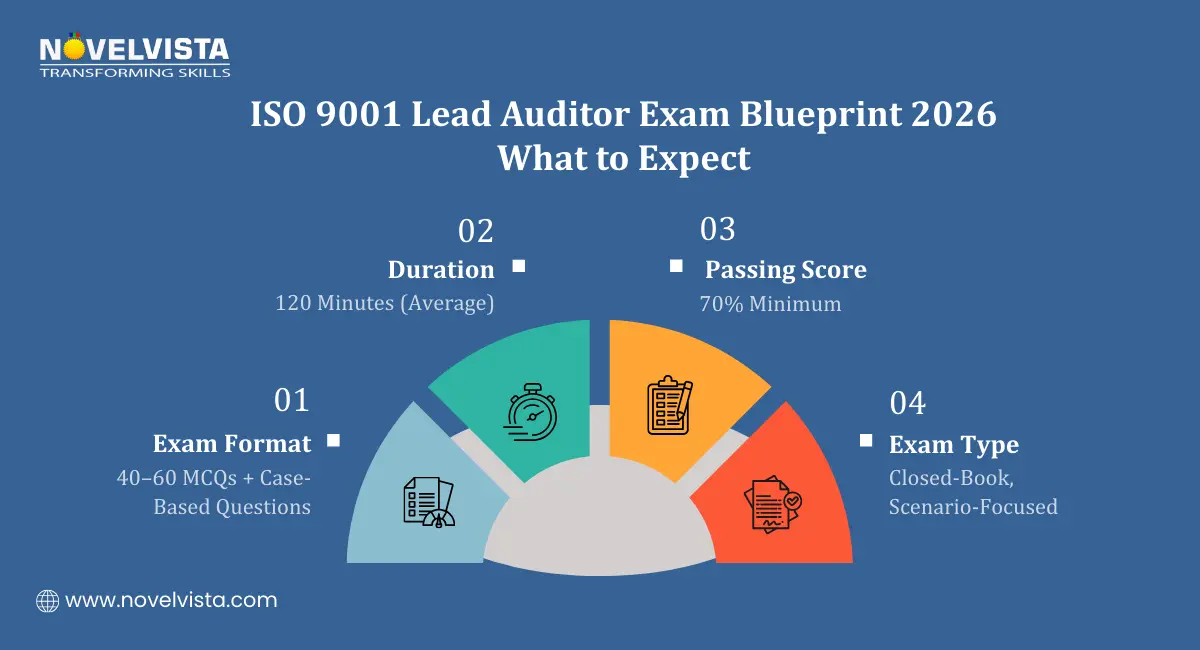
Now that you’ve seen how the Exam Questions for ISO 9001 look, let’s quickly understand how the real exam is structured. Knowing the pattern saves time and helps you plan better.
Here’s a quick breakdown of the ISO 9001 Lead Auditor Exam:
The exam doesn’t just test ISO knowledge — it checks your ability to think like an auditor. You might get a scenario such as:
“During an audit, you find a process that lacks documentation but functions efficiently. What should you do?”
These types of questions are where understanding the PDCA cycle, clause relationships, and audit techniques makes all the difference.
Also Read: ISO 9001 Certification Cost
For those preparing seriously, always check the official website of your certification body for the latest updates on structure, duration, or rules. You can also read our detailed guide on ISO 9001 Certification Cost and Training Details for an in-depth look at pricing and learning options.
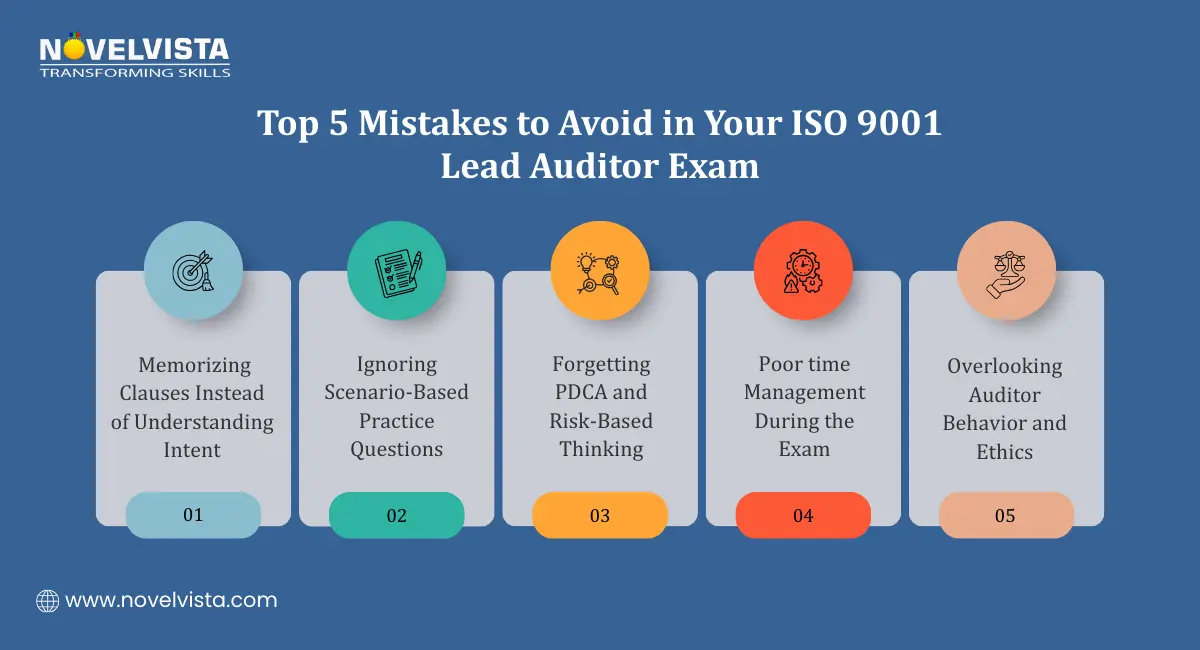
If passing the exam feels overwhelming — don’t worry. With the right plan and practice, you can absolutely ace it. Here’s a simple 5-step strategy that works:
Don’t just memorize clauses; know why they exist. Learn how each clause connects with others, especially 4–10. That’s what helps you solve Exam Questions for ISO 9001 with confidence.
The more you practice ISO 9001:2015 exam questions and answers, the more comfortable you become with the question logic. Use ISO 9001 lead auditor exam sample questions and timed tests to track your progress.
Auditor handbooks and standards interpretation guides are goldmines. They clarify confusing topics and show how real audits are conducted — something every question revolves around.
Understand how to plan audits, collect evidence, identify nonconformities, and write audit reports. Scenario-based Exam Questions for ISO 9001 often test your decision-making in these exact areas.
Read each question carefully. Avoid overthinking. Many wrong answers come from rushing or second-guessing yourself. Trust your understanding and stay calm.
Pro Tip: Enroll in a professional ISO 9001 training, like NovelVista’s, to learn through case studies, audit roleplays, and real-world simulations. That practical exposure makes theory stick — and makes exam day feel much easier.
Get 200 real exam-style questions with explanations.
Prepare smarter, master every clause,
and boost your chances of passing on your first attempt.
Becoming a certified ISO 9001 Lead Auditor is more than just passing a test by doing the ISO 9001 course. it’s about developing the mindset of a true auditor. These Exam Questions for ISO 9001 and practice tips help you move beyond memorization to understanding the intent behind every clause and principle.
Keep revising, stay consistent, and make sure you’re practicing real ISO 9001 Lead Auditor Exam questions and answers pdf resources. With the right guidance, your certification won’t just be a badge — it’ll be proof of your commitment to quality and excellence.
Ready to take your quality management career to the next level?
Join ISO 9001 Training learn directly from certified industry experts, gain practical auditing experience, and earn a globally recognized credential that demonstrates your expertise in Quality Management Systems (QMS) and continuous improvement leadership.

Author Details

Course Related To This blog
ISO 9001:2015 Lead Auditor Training and Certification
Confused About Certification?
Get Free Consultation Call
Stay ahead of the curve by tapping into the latest emerging trends and transforming your subscription into a powerful resource. Maximize every feature, unlock exclusive benefits, and ensure you're always one step ahead in your journey to success.