Category | Quality Management
Last Updated On 02/02/2026

Did you know that over 60% of audit nonconformities raised during certification audits are linked not to missing procedures but to weak or insufficient evidence? In many cases, the root cause isn’t the organization’s system. It’s the auditor’s sampling decision.
Lead auditors face a quiet but critical challenge in every ISO 9001 audit:
How much evidence is enough to confidently conclude conformity?
Am I sampling too little or unnecessarily too much?
This is where audit sampling techniques for ISO 9001 play a defining role. Sampling is not about checking random documents and hoping for the best. It’s a structured, risk-based approach that directly impacts audit credibility, accuracy, and value.
Before we explore sampling methods and sample size decisions, let’s briefly anchor ourselves in what an ISO 9001 audit is really about and why sampling is unavoidable.
An ISO 9001 audit is a systematic, independent, and documented process used to obtain and evaluate audit evidence to determine whether an organization’s quality management system meets ISO 9001 requirements. The purpose of an ISO 9001 audit is to verify process effectiveness, confirm conformity to standard requirements, evaluate risk-based thinking, and support continual improvement. In practice, auditors cannot review every record, transaction, or activity due to time and operational constraints. This is why audits rely on representative samples to form reliable conclusions about the entire system making effective sampling, rather than checklists alone, the true backbone of evidence-based ISO 9001 auditing. An ISO 9001 Guide helps auditors strengthen their understanding of sampling techniques, audit evidence, and risk-based evaluation for more effective audits.
Sampling is not a shortcut. It’s a professional necessity.
Effective sampling allows auditors to:
Poor sampling, on the other hand, leads to:
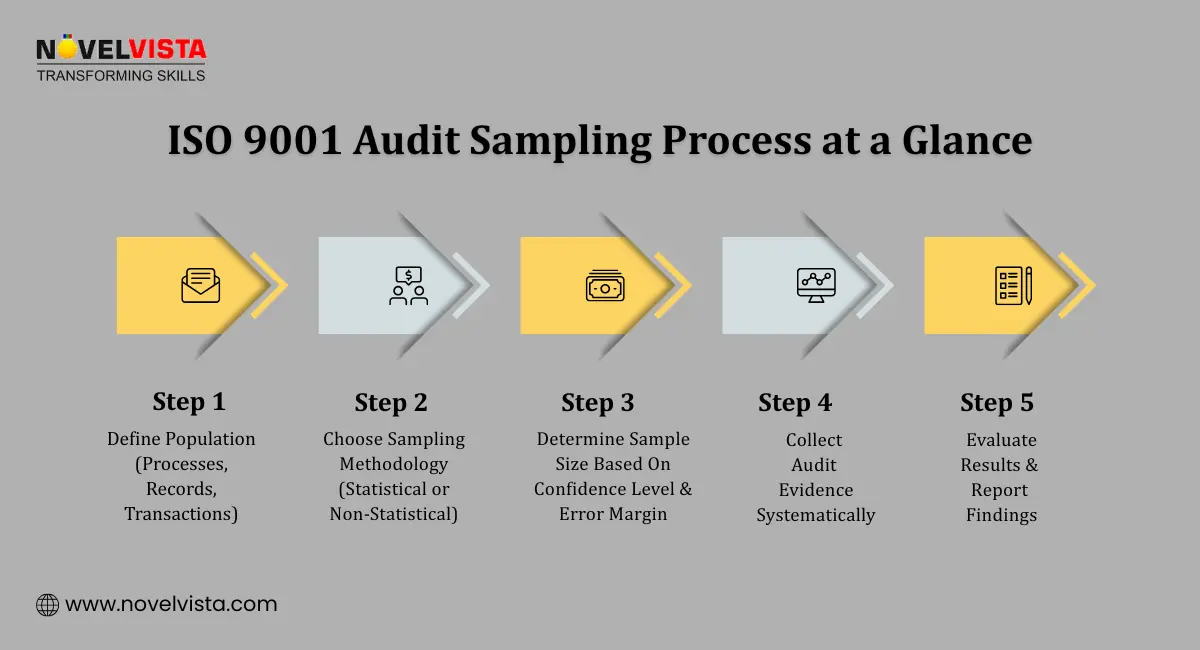
Audit sampling involves applying audit procedures to less than 100% of items in a population, enabling auditors to draw conclusions about the entire system. ISO 19011 recommends that sampling should be planned, risk-based, and provide reasonable confidence rather than absolute certainty. Effective audit sampling techniques for ISO 9001 rely on three key foundations: clear audit objectives, understanding process risks, and professional judgment. Sampling is valuable only when it generates relevant, sufficient, and reliable audit evidence.
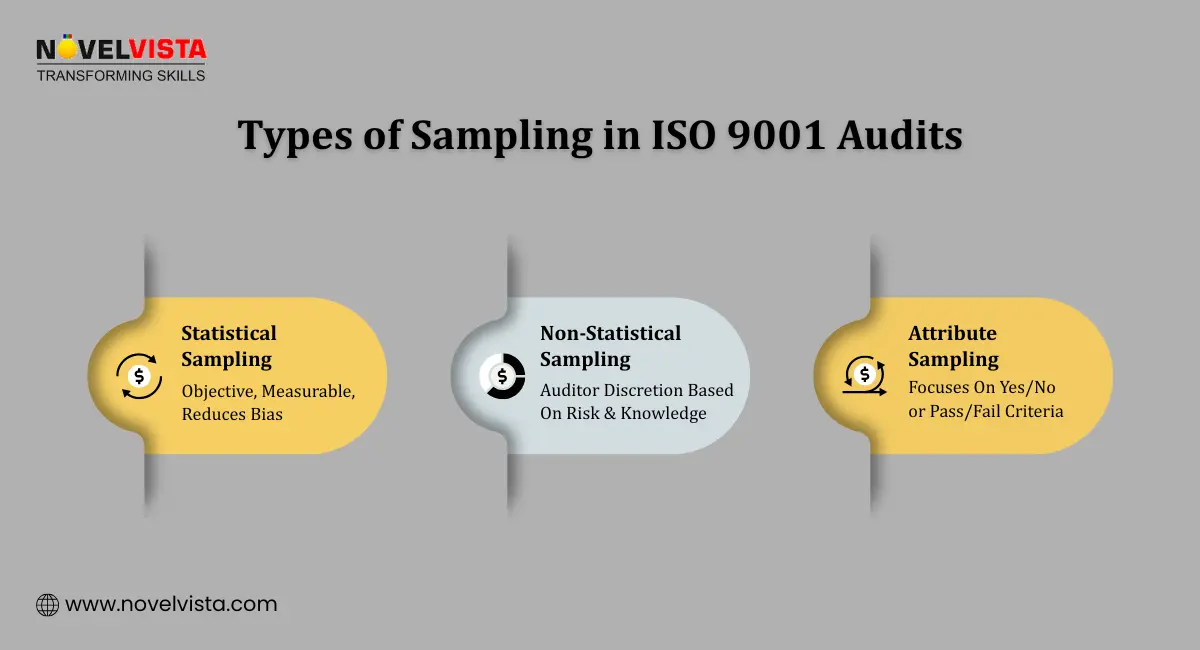
Statistical sampling uses probability theory to:
While useful in manufacturing and data-heavy environments, statistical sampling is rarely mandatory in ISO 9001 audits.
Non-statistical sampling relies on:
This approach is widely accepted and commonly used in certification and internal audits. When applied correctly, non-statistical sampling is fully compliant with ISO auditing principles and often more practical.
Most audit sampling techniques for ISO 9001 used in the real world fall into this category.
Attribute sampling checks whether specific requirements are met, with outcomes usually being yes/no or conforming/nonconforming. Examples include verifying if procedures are approved, records are complete, and training is documented. This method is especially effective for clause compliance checks, internal audit records, and corrective action verification. It remains one of the most frequently applied sampling methods for ISO 9001 audits, providing reliable audit evidence for assessing conformity.
Variable sampling evaluates measurable data such as time, quantity, or defect rates. While it is useful for analyzing process performance, it is less commonly applied in ISO 9001 audits that focus on conformity, where the primary goal is to gather reliable evidence of compliance with standard requirements.
One of the most common questions auditors ask is:
“What is the right sample size?”
The honest answer: there is no fixed number.
Instead, sample size depends on several critical factors:
Processes that are more complex or span multiple locations require larger and more diverse samples. This ensures auditors gather sufficient audit evidence to accurately assess system conformity.
High-risk processes, such as customer complaints, design activities, or supplier controls, require more extensive sampling to collect for accurate ISO 9001 audit conclusions.
Processes with a history of nonconformities require larger sample sizes to ensure auditors collect enough audit evidence to verify improvements and compliance with ISO 9001 requirements.
Larger populations generally require bigger samples to ensure sufficient evidence is obtained, while keeping the sampling practical and focused for ISO 9001 audits.
Stable and well-controlled processes often allow auditors to use smaller samples, while still gathering reliable audit evidence for ISO 9001 compliance verification.
The goal of audit sampling techniques for ISO 9001 is not statistical perfection but reasonable assurance supported by professional judgment.
ISO 9001 emphasizes risk-based thinking, and sampling should reflect that.
Risk-based sampling means:
For example:
This approach strengthens both efficiency and audit credibility.
Common Sampling Mistakes Lead Auditors Should Avoid
Even experienced auditors fall into these traps:
To apply audit sampling techniques for ISO 9001 effectively, lead auditors should plan sampling during audit preparation, define the rationale for each sample, remain flexible to expand samples if needed, correlate samples with risks and audit objectives, and clearly document all sampling decisions. When done correctly, strong sampling seamlessly supports reliable audit evidence, though poor sampling quickly becomes apparent in audit outcomes.
Build a structured and effective ISO 9001 internal audit program
Apply risk-based auditing with confidence and clarity
Strengthen audit planning, execution, and reporting skills
Effective audit sampling techniques for ISO 9001 are more than a procedural step they are a critical tool for sound judgment, risk-based decision-making, and collecting high-quality audit evidence. When applied correctly, sampling enables auditors to draw accurate conclusions, uncover true system weaknesses, enhance the value of audits, and reinforce organizational confidence in audit results. Mastering sampling allows lead auditors to move beyond merely checking records to evaluating entire processes, ensuring audits are not just compliant, but truly impactful and credible.
Ready to take your audit sampling skills to the next level?
If you want to confidently apply audit sampling techniques for ISO 9001 in real audits not just understand them in theory professional training makes a real difference. NovelVista’s ISO 9001 Lead Auditor Certification Course is designed to help auditors build strong judgment, apply risk-based sampling, and collect high-quality audit evidence in line with ISO standards. The course combines practical audit scenarios, real-world examples, and globally recognized certification to prepare you for leading audits with confidence and credibility.
Whether you are an aspiring lead auditor or an experienced professional looking to sharpen your skills, this program equips you to move beyond checklist-based auditing and deliver audits that are truly impactful.
Start your ISO 9001 Lead Auditor journey today!

Author Details

Course Related To This blog
ISO 9001:2015 Lead Auditor Training and Certification
Confused About Certification?
Get Free Consultation Call
Stay ahead of the curve by tapping into the latest emerging trends and transforming your subscription into a powerful resource. Maximize every feature, unlock exclusive benefits, and ensure you're always one step ahead in your journey to success.