Category | Quality Management
Last Updated On 02/06/2026

Did you know that over 1.3 million organizations worldwide are certified to ISO standards, with ISO 9001 being the most widely adopted? As organizations continue to implement multiple standards like ISO 27001, ISO 20000, and ISO 14001, the complexity of auditing has increased significantly.
Now, imagine auditing each standard with completely different structures, terminology, and requirements. Sounds exhausting, right?
This is exactly the challenge auditors faced before the introduction of the Annex SL high level structure.
So, who is this blog for?
If you’ve ever wondered:
Then this guide will decode everything you need to know about the Annex SL high-level structure and why it’s a game-changer for auditors.
The Annex SL high-level structure is a standardized framework introduced by ISO to ensure that all management system standards follow a consistent format. In simple terms, it acts as a universal blueprint for ISO standards by defining a common clause sequence, unified terminology, and consistent core requirements. This ISO common structure enables alignment across multiple standards, making them easier to understand and implement. For example, standards like ISO 9001, ISO 27001, and ISO 20000 now follow the same structure due to Annex SL. As a result, once you understand one standard, you already understand a significant portion of others, simplifying both implementation and auditing.
Before the introduction of the Annex SL high-level structure, each ISO standard had its own unique format. This created several challenges:
To solve this, ISO introduced the ISO common structure to bring alignment across all management system standards.
The goal?
To enable organizations to build harmonized management systems that work seamlessly together.
For auditors, this was a breakthrough.
One of the most powerful aspects of the Annex SL high-level structure is the inclusion of shared ISO clauses.
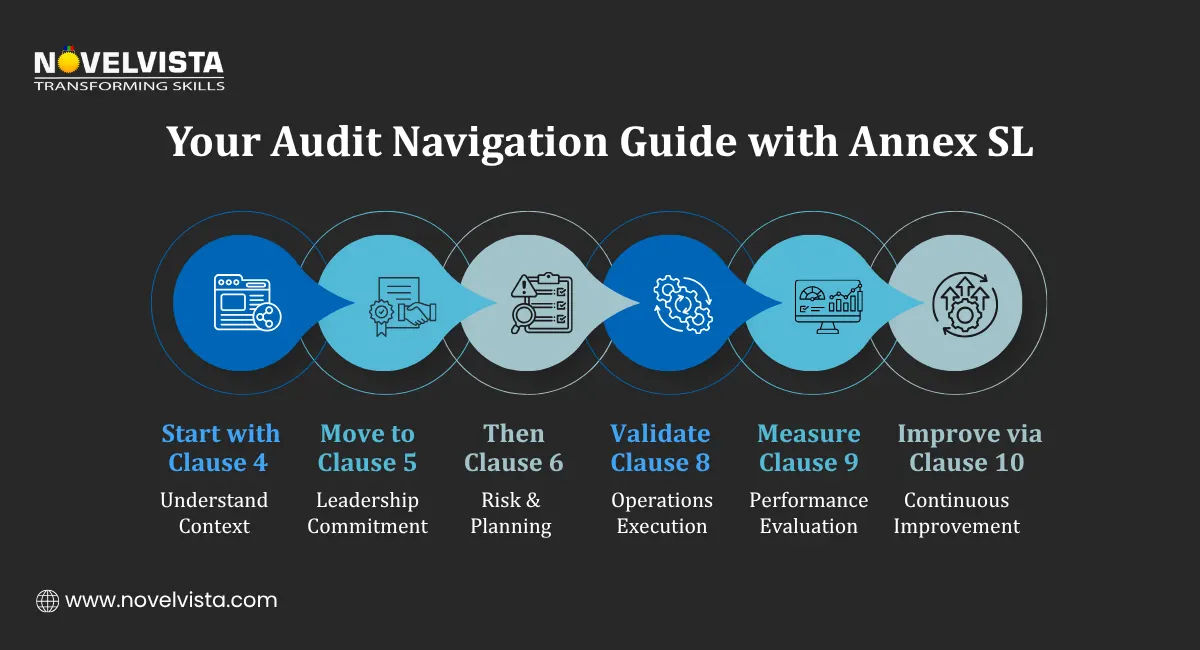
All major ISO standards now follow these 10 clauses:
These shared ISO clauses ensure consistency across standards, making it easier for auditors to navigate requirements.
For example:
This uniformity reduces confusion and increases audit efficiency. Build a strong ISO 9001 Career by mastering quality management principles and becoming a certified lead auditor.
The Annex SL high-level structure has transformed the auditing landscape in several ways.
Auditors no longer need to learn completely different frameworks for each ISO standard, which significantly reduces the time and effort required to get up to speed. Thanks to the ISO common structure, the core concepts, clause sequence, and terminology remain consistent across standards. This means understanding one standard provides a strong foundation for others, making it easier to audit multiple systems with confidence.
With harmonized management systems, auditors can evaluate multiple standards simultaneously.
Instead of conducting separate audits for:
You can perform a single integrated audit using the shared ISO clauses.
Documentation now follows a consistent structure, making it easier to:
Because requirements are aligned under the Annex SL high-level structure, auditors can quickly assess whether an organization meets multiple standards at once. The use of shared ISO clauses and a consistent framework reduces duplication in verification and speeds up the audit process. This allows auditors to identify compliance gaps more efficiently while ensuring thorough and accurate evaluations.
The concept of harmonized management systems is central to the Annex SL high-level structure.
Organizations today don’t operate in silos. They need integrated systems that cover:
With the ISO common structure, these systems can be seamlessly aligned.
For auditors, this means:
Let’s consider a real-world scenario.
Before Annex SL:
An auditor reviewing ISO 9001 and ISO 27001 would deal with:
After Annex SL high-level structure:
Both standards follow the same shared ISO clauses, allowing:
This dramatically reduces audit time and effort.
Pro Tip: Practice with real-world Exam Questions for ISO 9001 to strengthen your audit knowledge and boost certification confidence.
Here’s why mastering the Annex SL high-level structure is essential:
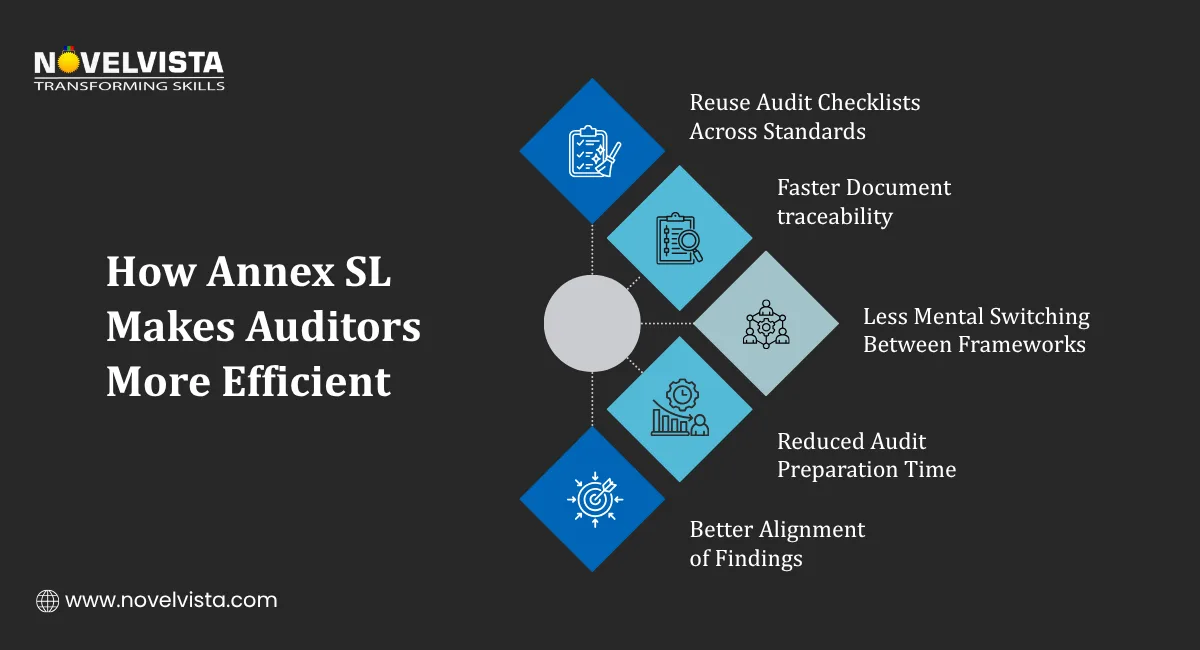
Audits become faster due to standardized processes.
Uniform shared ISO clauses ensure consistent audit outcomes.
Clause 6 across all standards emphasizes risk-based thinking.
The ISO common structure reduces the need for extensive retraining.
With harmonized management systems, auditors gain a holistic view of the organization.
The Annex SL high-level structure is far more than a simple formatting update it represents a fundamental shift in how organizations approach ISO standards and how auditors deliver value. By establishing an ISO common structure, standardizing shared ISO clauses, and enabling truly harmonized management systems, Annex SL has transformed auditing into a more streamlined, consistent, and scalable process.
For today’s auditors, mastering the Annex SL high-level structure is not just an advantage it’s a necessity for staying relevant in a multi-standard environment. Whether you're auditing ISO 9001 or conducting integrated audits across multiple frameworks, this structure empowers you to work smarter, reduce complexity, and deliver deeper, more strategic insights with confidence.

Ready to advance your auditing expertise and confidently navigate modern ISO frameworks?
Join NovelVista’s ISO 9001 Lead Auditor Certification Training and gain practical auditing skills, real-world quality management insights, and globally recognized credentials. Designed for quality professionals, auditors, and compliance leaders, this course equips you to master the Annex SL high-level structure, apply the ISO common structure, and effectively audit using shared ISO clauses across harmonized management systems.
Start your ISO 9001 auditor journey today!
Author Details

Course Related To This blog
ISO 9001:2015 Lead Auditor Training and Certification
Confused About Certification?
Get Free Consultation Call
Stay ahead of the curve by tapping into the latest emerging trends and transforming your subscription into a powerful resource. Maximize every feature, unlock exclusive benefits, and ensure you're always one step ahead in your journey to success.