Category | Project Management
Last Updated On 13/08/2026
People often ask what does a project manager do all day. Is it just meetings, status updates, and chasing deadlines? That’s the surface view, and honestly, it’s misleading.
A project manager is the person who turns ideas into results. They guide a project from the first conversation to final delivery, making sure work is completed on time, within budget, and at the expected quality level. The real value lies in decision-making, coordination, and leadership when things don’t go as planned, which is most of the time.
In project management training sessions, we often see learners surprised by how much of a project manager’s role involves decision-making under uncertainty. Real projects rarely follow the original plan, and this is where trained project managers add the most value.
This guide breaks down what does a project manager do in real-world projects. You’ll clearly understand the roles and responsibilities of a project manager, the thinking behind their decisions, and how they balance planning, people, risk, and delivery without losing control of the project.
Project management is not just task tracking. The project management roles and responsibilities of a project manager sit at the center of every successful project.
A project manager plays multiple roles at the same time:
Planner – Sets direction and defines how the work will move forward
Leader – Guides the team and keeps everyone aligned
Controller – Manages scope, budget, risks, and timelines
Communicator – Connects stakeholders, teams, and sponsors
The roles and responsibilities of a project manager change slightly depending on the industry or methodology, but the core purpose stays the same: deliver outcomes, not just activities. This balance between strategy and execution is what separates effective project managers from coordinators.
Understanding these project management roles and responsibilities helps explain why project managers are involved in almost every major decision during the project lifecycle.
In IT and digital projects, project management roles and responsibilities often operate within Agile or Scrum frameworks rather than traditional linear models. Instead of relying on a fixed long-term plan, work is delivered in short cycles called sprints, allowing teams to adapt quickly to changing requirements.
In these environments, the project manager’s role shifts from detailed task control to facilitation and coordination, with responsibilities such as:
Removing blockers that slow down team progress
Managing dependencies across teams and functions
Supporting sprint planning, reviews, and retrospectives
Ensuring steady delivery without disrupting team flow
While traditional project management often follows a Waterfall approach (Plan → Design → Build → Test), modern IT projects focus on incremental delivery, collaboration, and rapid feedback. As a result, many organizations use hybrid or Agile models rather than rigid long-term schedules, making adaptability a core part of the project manager’s role.
The key responsibilities of a project manager can be grouped into a few practical areas. Each one plays a critical role in keeping projects under control.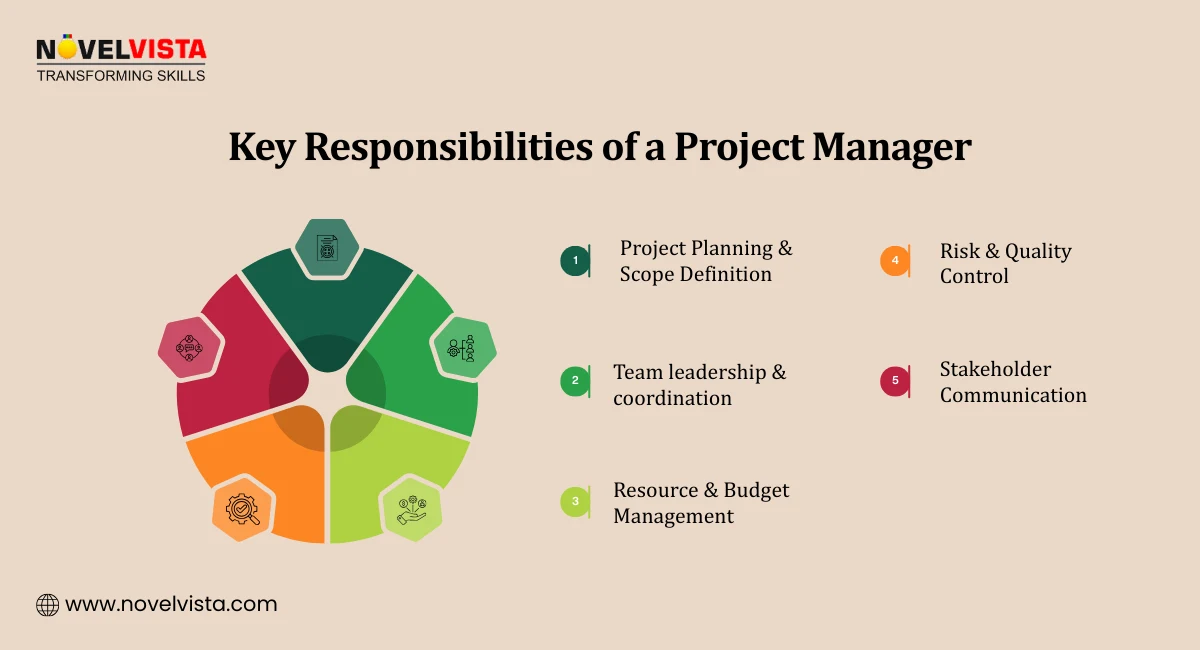
This planning forms the foundation of the roles and reduces chaos later in the project. In real-world projects, unclear scope is one of the most common causes of delays and conflict. Experienced project managers spend significant time upfront clarifying expectations to avoid costly rework later.
The Triple Constraint explains the relationship between scope, time, and cost. These elements are interconnected, and a change in one will usually affect the others.
It includes:
For example, shortening a deadline may increase costs or reduce scope, while adding requirements often impacts both schedule and budget. Managing these trade-offs is a core responsibility of a project manager across all industries.
Leadership is one of the most visible key responsibilities of a project manager, especially when teams are cross-functional or remote.
Across industries, budget overruns are rarely caused by a single mistake. They usually result from small, unmanaged changes. Effective project managers monitor costs continuously rather than waiting for formal reviews. Strong control over resources is central to effective project management roles and responsibilities.
Risk handling is a core part of the roles and responsibilities of a project manager, especially in complex or high-visibility projects.
Clear communication ties together all key responsibilities of a project manager and keeps the project moving smoothly.
The roles and responsibilities of a project manager begin before planning and continue after delivery.
During Initiating, the project manager:
During Closing, the project manager:
Strong initiation ensures the right project starts, while proper closure improves accountability and future project success.
See what project managers really do beyond plans
and meetings real decisions, tough trade-offs,
and daily pressures that define the role.
Once planning is complete, execution begins, and this is where the roles and responsibilities of a project manager become highly visible. Execution is not about doing the work personally. It’s about making sure the right work happens at the right time.
Key execution and monitoring duties include:
Overseeing daily project activities to ensure tasks align with the approved plan
Tracking progress using milestones, KPIs, and performance indicators
Identifying delays, bottlenecks, or resource conflicts early
Making adjustments to schedules, scope, or priorities when required
This phase answers another common question: what does a project manager do when things go off track? They step in, analyze the situation, make decisions, and guide the team back on course. Monitoring ensures problems are controlled before they become project failures.
Many people are curious about the daily routine behind the title. In reality, no two days look exactly the same, but the core activities stay consistent.
Typical day-to-day work includes:
Running project meetings, daily stand-ups, and review sessions
Reviewing emails, progress reports, timesheets, and workload charts
Coordinating with team members, vendors, and stakeholders
Using tools such as Gantt charts, Kanban boards, Jira, Asana, or MS Project to track progress
Monitoring dependencies and resolving blockers
Conducting post-project reviews and lessons learned sessions
These daily activities reflect globally accepted project management practices used across industries such as IT, construction, healthcare, and finance, reinforcing the consistency of the project manager role worldwide. They also show that what does a project manager do is less about paperwork and more about decision-making, coordination, and keeping momentum strong.
Strong execution depends on more than plans and tools. Project managers rely on a mix of technical and people skills to handle their responsibilities effectively.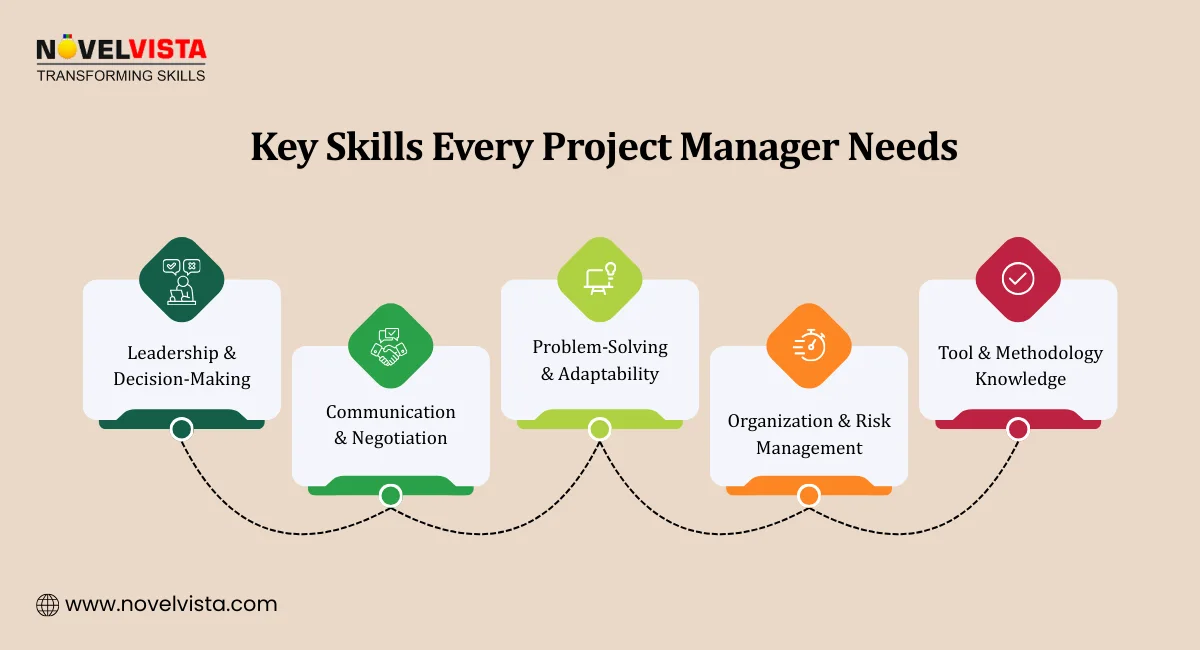
These skills support the project management roles and responsibilities and allow project managers to manage pressure without losing control of the project.
Also Read: Our detailed blog on PMP jobs in 2026 to see emerging roles, expected salary trends, and where PMP-certified professionals will find the strongest career opportunities.
Even with strong skills, project managers face challenges regularly. Understanding these challenges helps explain the true scope of the roles and responsibilities of a project manager.
Common issues include:
Scope creep caused by unclear requirements or frequent changes
Delays and budget overruns due to unrealistic timelines or resource constraints
Team conflicts and communication gaps
Stakeholder misalignment on goals, priorities, or expectations
Successful project managers handle these challenges through clear planning, structured change control, frequent communication, and proactive risk management. This ability to manage uncertainty is a core part of the key responsibilities of a project manager.
So, what does a project manager do? They plan, lead, control, and communicate, often all at once. The roles and responsibilities of a project manager go far beyond schedules and meetings. They are about turning goals into outcomes, managing people and risks, and keeping projects on track even when conditions change.
Understanding the real responsibilities of a project manager helps professionals make informed career decisions. Structured training and hands-on experience together build the confidence required to manage projects successfully.
If you’re ready to grow from understanding project work to leading it with confidence, NovelVista’s Project Management Professional (PMP)® Certification Training Course can help. The program focuses on real-world scenarios, leadership skills, and exam readiness. You’ll gain practical knowledge, structured guidance, and the confidence to manage complex projects successfully and advance your career.
One of the most important responsibilities is maintaining clear communication among all stakeholders. By connecting team execution with business objectives, project managers can minimize misunderstandings and keep projects aligned with expectations.
While not strictly required, a PMP certification is highly valued by many employers and can significantly increase average earning potential for professionals in the field.
A project risk is a potential future event that could negatively affect project objectives, while a project issue is an existing problem that is currently impacting the project.
A project manager leads the team through five key phases—initiation, planning, execution, monitoring and controlling, and closure—to ensure project goals and deliverables are successfully achieved.
Project managers control scope creep by establishing clear project boundaries from the start, following formal change control procedures, and assessing each new request’s impact on the project timeline and budget.
Author Details

Confused About Certification?
Get Free Consultation Call
Stay ahead of the curve by tapping into the latest emerging trends and transforming your subscription into a powerful resource. Maximize every feature, unlock exclusive benefits, and ensure you're always one step ahead in your journey to success.