Category | Other
Last Updated On 09/06/2026
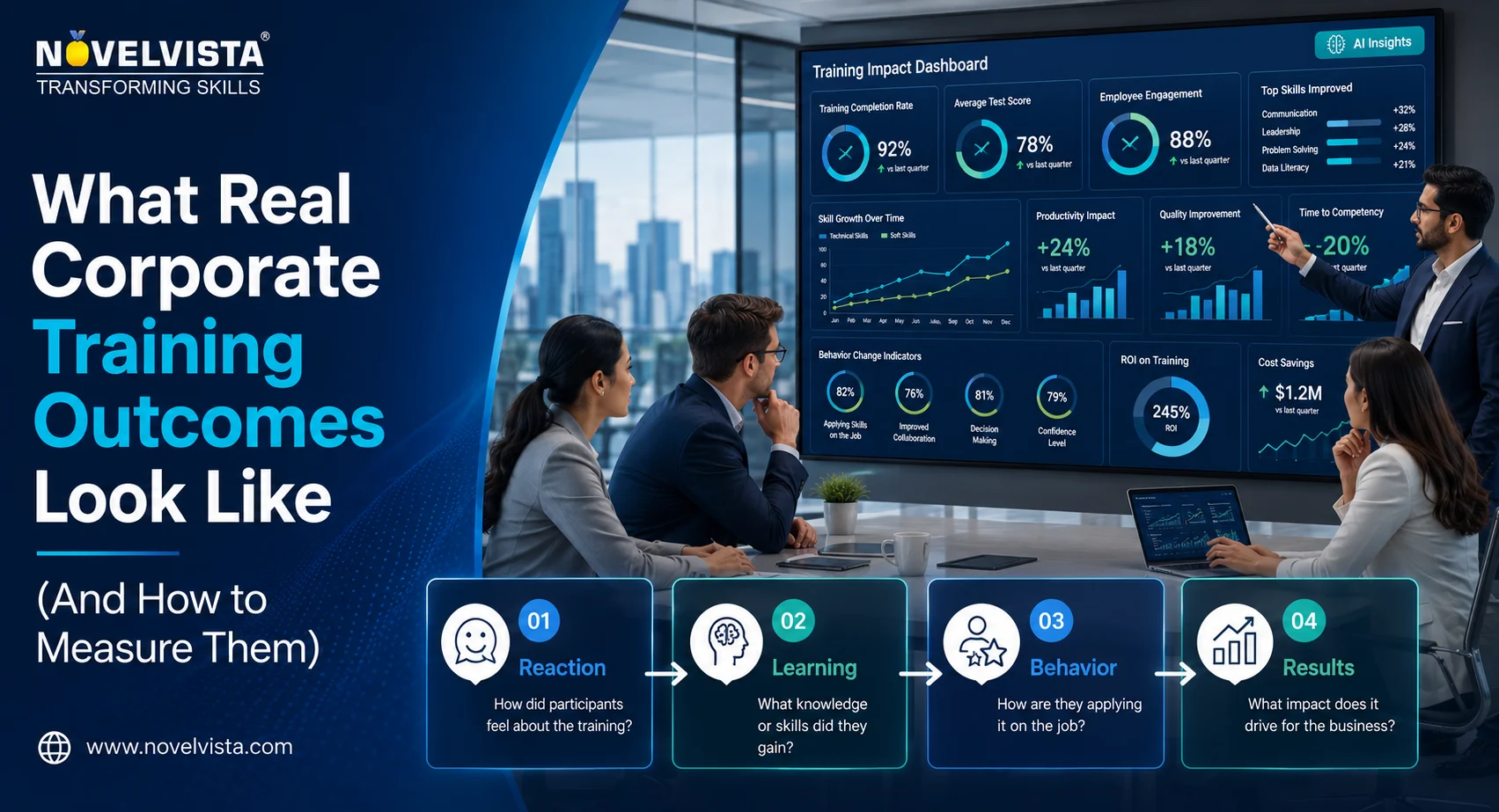
Corporate training is not successful because people attended a workshop, completed a module, or rated the session highly. Real success appears when employees apply new skills, teams perform better, and business outcomes improve.
This blog explains what real corporate training outcomes look like, how the kirkpatrick evaluation model helps measure them, which metrics matter at every stage, and how organizations can connect training data with performance, productivity, and training roi.
Many organizations still measure training by attendance, completion rate, or learner satisfaction. These numbers are easy to collect, but they rarely prove business impact.
A sales team may complete negotiation training, but the real question is: did conversion rates improve? A cloud team may finish certification training, but did incident resolution become faster? A leadership team may attend coaching sessions, but did employee retention improve?
That is where the kirkpatrick evaluation model becomes useful. It helps L&D teams move from surface-level reporting to evidence-based training evaluation.
The kirkpatrick evaluation model is a four-level framework used to measure learning impact. It evaluates training through reaction, learning, behavior, and results.
The real value of the model is not in reporting all four levels after training ends. The smarter approach is to start with Level 4 business results, then work backward.
Level 1 measures how learners respond to the training experience. This includes satisfaction, relevance, engagement, content quality, trainer effectiveness, and confidence to apply the learning.
Useful Level 1 questions include:
This stage supports training effectiveness, but it should not be treated as final proof.
Level 2 measures whether employees actually learned what they were supposed to learn. This can include knowledge, skill, confidence, attitude, and commitment.
Common Level 2 methods include pre-training and post-training assessments, role-based quizzes, simulations, case-study exercises, hands-on labs, scenario-based evaluations, and practical assignments.
For technical programs, this may involve cloud labs, AI tool exercises, security simulations, or service management case studies. This is where learning and development metrics become sharper because they show capability improvement, not just participation.
Level 3 is where training starts proving operational value. It measures whether learners apply new skills on the job.
This stage requires manager involvement, observation, and follow-up. Without behavior change, training remains a classroom event.
Examples include managers observing improved team communication, engineers following better incident response practices, sales teams applying new discovery questions, and project managers improving risk documentation.
To understand how to measure training effectiveness, organizations must define the target behavior before the program begins.
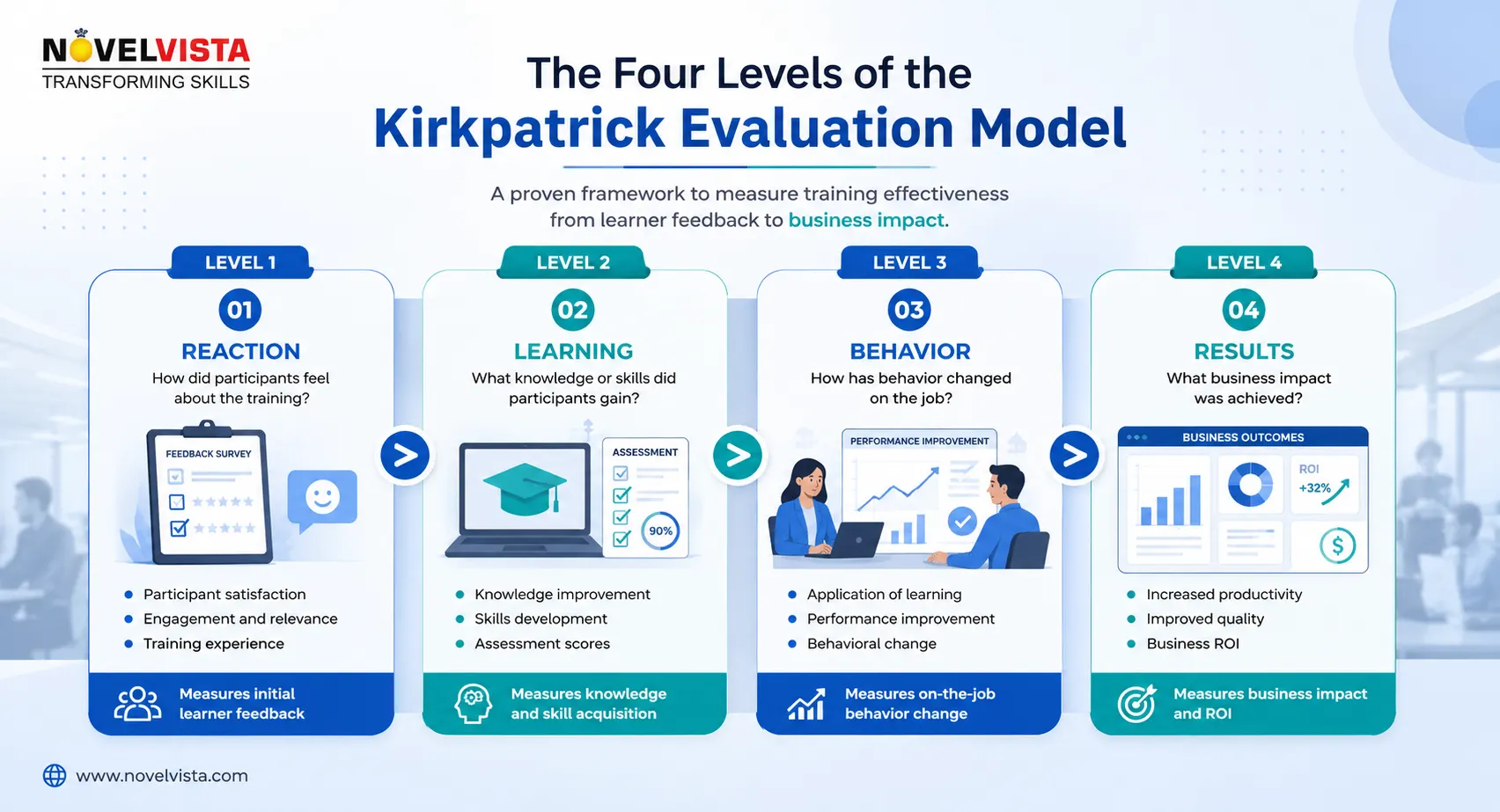
Level 4 measures the final business impact. This may include productivity, quality, revenue, cost savings, compliance, customer satisfaction, retention, innovation, or risk reduction.
| Training Area | Expected Behavior Change | Business Outcome |
|---|---|---|
| Sales Training | Better discovery calls and objection handling | Higher conversion rate |
| Cloud Training | Improved troubleshooting and deployment quality | Reduced downtime |
| AI Tools Training | Smarter use of automation and prompts | Time saved on repetitive work |
| Cybersecurity Training | Better threat awareness and reporting | Reduced security incidents |
| Leadership Training | Stronger feedback and coaching habits | Improved retention and engagement |
This is where training roi becomes more credible because improvement is tied to measurable business movement.
Not all metrics carry the same weight. Completion rate is useful, but it is not a performance metric. The best measurement plans combine learning data with business data.
The strongest learning and development metrics are those that connect directly with business priorities.
Organizations can make training evaluation practical by using a structured measurement plan.
This approach helps answer how to measure training effectiveness without turning evaluation into a complex analytics project.
Training fails to show measurable impact when it is disconnected from business needs. Common gaps include no baseline data, no clear business objective, no manager accountability, no post-training reinforcement, metrics limited to attendance, no follow-up after the session, and training designed around content instead of performance.
The kirkpatrick evaluation model helps avoid these mistakes by forcing clarity at every level. It also helps L&D teams ask a sharper question: what business problem should this learning solve?
A measurement-ready training program starts before the first learner enters the classroom. L&D, business leaders, and managers must agree on outcomes in advance.
This makes training effectiveness easier to prove because success criteria are not invented after the fact.
Suppose an enterprise runs cloud operations training for 200 employees.
Weak measurement would report 200 employees trained, 94% completion rate, and a 4.6/5 satisfaction score.
Strong measurement would report 31% improvement in assessment scores, 68% of managers observing better troubleshooting behavior, 18% reduction in repeated incidents, 12% improvement in average resolution time, and faster onboarding for new cloud support engineers.
The second report tells a business story. It proves performance movement, not just activity.
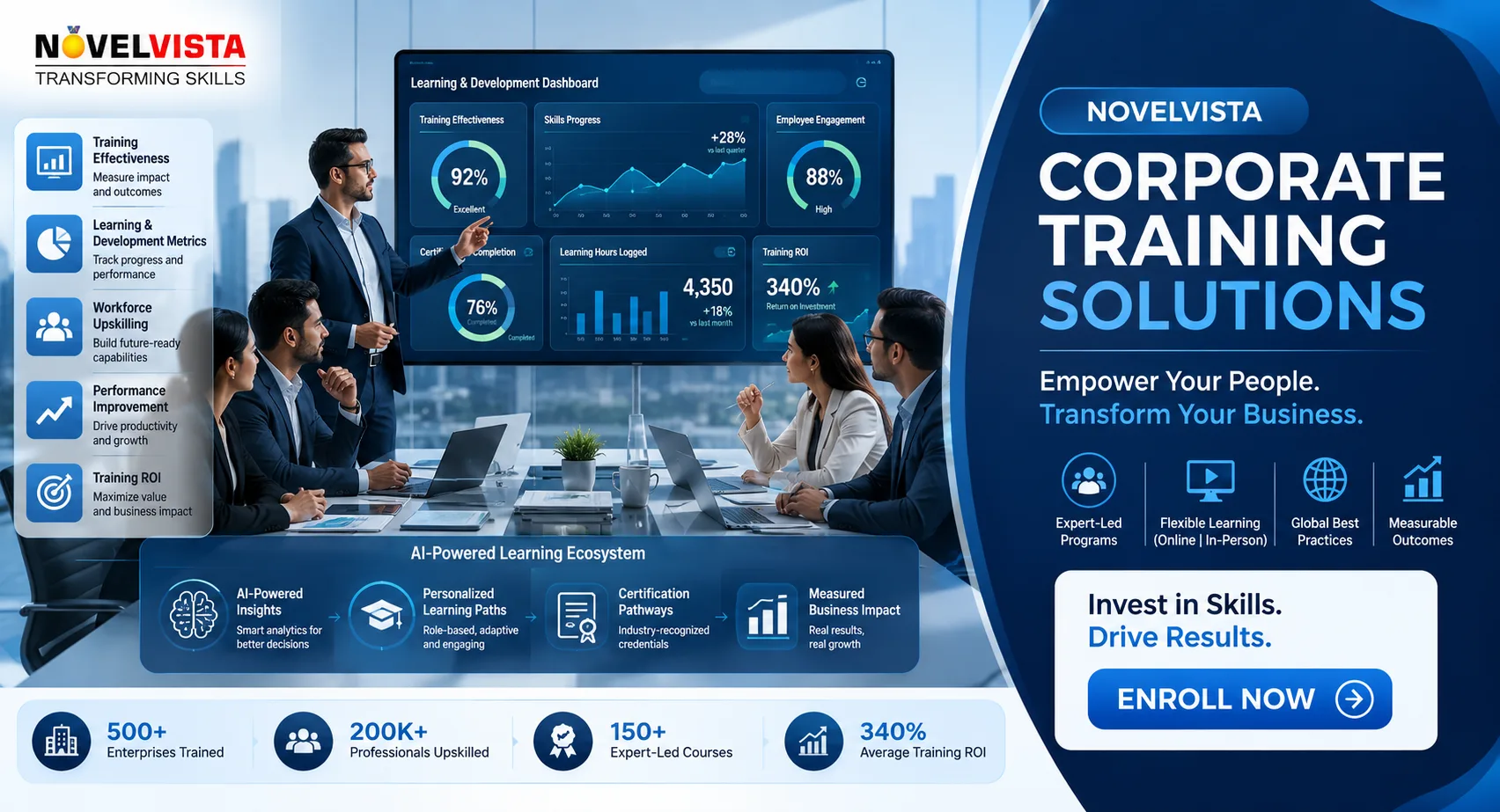
Real corporate training outcomes are visible in behavior, performance, and business improvement. Attendance and feedback matter, but they are only the starting line.
The kirkpatrick evaluation model gives organizations a practical way to measure whether learning created capability, whether capability changed workplace behavior, and whether that behavior improved business results.
For enterprises that want measurable workforce development, NovelVista’s corporate training solutions help align learning programs with role-based skills, business goals, and performance outcomes.
With the right design, measurement, and follow-through, corporate training becomes more than an L&D activity. It becomes a performance engine.
Author Details

Confused About Certification?
Get Free Consultation Call
Stay ahead of the curve by tapping into the latest emerging trends and transforming your subscription into a powerful resource. Maximize every feature, unlock exclusive benefits, and ensure you're always one step ahead in your journey to success.