Category | Other
Last Updated On 20/04/2026
Artificial Intelligence has rapidly evolved from a competitive advantage to a business-critical necessity. Today, more than 80% of organizations are investing in AI, yet nearly 60% face challenges with unpredictable cloud expenses driven by AI workloads. The result? Innovation is accelerating—but so are costs.
So ask yourself:
Are your AI initiatives delivering real business value, or simply inflating your cloud bills?
This is exactly where finops for AI steps in as a game changer.
Unlike traditional applications, AI workloads are inherently complex—driven by massive datasets, high-performance computing, and continuous experimentation. Without a structured approach to AI cost management in cloud, organizations often struggle with limited visibility, uncontrolled spending, and poor cost-to-value alignment.
This guide is built for:
If you’ve been asking:
Then mastering finops for AI is no longer optional—it’s essential.
At its core, finops for AI is the practice of bringing financial accountability to AI-driven cloud operations. It combines engineering, finance, and business teams to manage and optimize AI costs effectively.
Unlike traditional FinOps, AI introduces new complexities such as:
This makes AI cost management in cloud far more dynamic and challenging.
In simple terms:
FinOps for AI ensures you spend smarter—not just less.
AI workloads can silently drain budgets if left unchecked. Here’s why AI cost management in cloud is more important than ever:
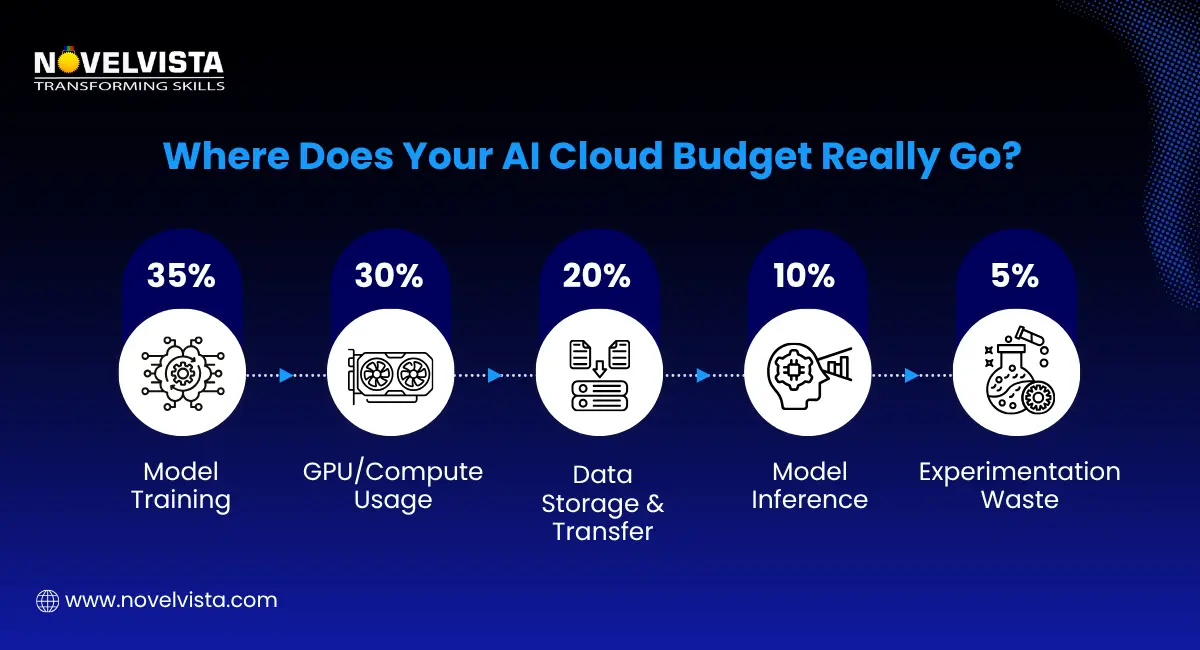
Modern AI systems rely on GPU/TPU-accelerated compute, distributed training frameworks, and high-throughput data pipelines. Key cost contributors include:
Since these components scale dynamically, costs often grow non-linearly with data volume and model complexity, making AI cost management in cloud essential.
AI workloads span multiple layers—data ingestion, preprocessing, training, inference, and monitoring—often across different services and teams.
Organizations struggle with:
This fragmented visibility makes it difficult to implement effective cloud cost optimization for AI strategies.
AI/ML development is inherently iterative, involving:
Each experiment consumes compute and storage resources, often without strict cost controls. Without governance, this leads to unbounded experimentation costs, making how to manage AI costs in cloud step by step a critical capability.
A common issue in AI environments is resource underutilization, such as:
These inefficiencies directly impact cloud cost optimization for AI, leading to unnecessary spend without performance gains.
Unoptimized AI workloads don’t just affect engineering—they directly impact business outcomes:
This is why adopting finops for AI is no longer optional—it is a strategic enabler for sustainable AI growth, ensuring that innovation is aligned with financial accountability.
To implement finops for AI, organizations must focus on four key pillars:
You cannot optimize what you cannot see.
Track:
This involves improving efficiency through:
Set policies for:
FinOps is not just a finance function. It requires:
Working together ensures effective AI cost management in cloud.
Effective cloud cost optimization for AI requires a combination of technical and financial strategies.
Avoid over-provisioning GPUs and compute instances.
Use only what is necessary for workloads.
Not every use case needs a large model.
Smaller, optimized models can reduce costs significantly.
Data storage and transfer costs can be huge.
Use auto-scaling to ensure resources match demand.
Real-time monitoring helps detect anomalies early.
By applying these strategies, finops for AI ensures better control over cloud spending.
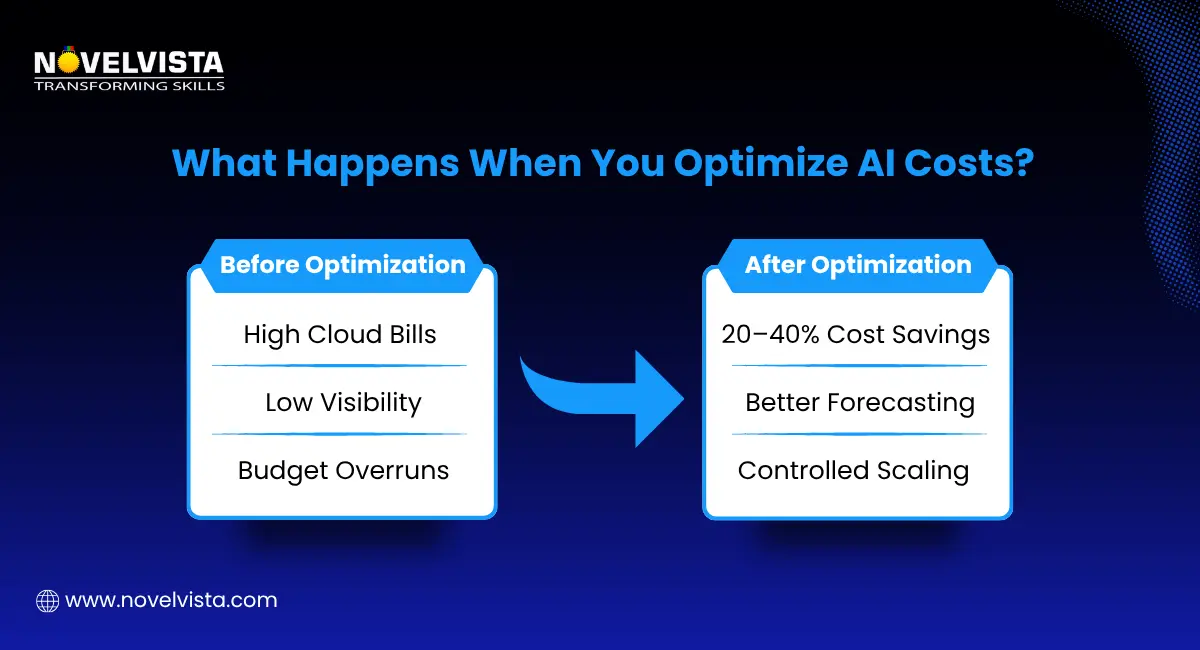
Here’s a practical approach to how to manage AI costs in cloud step by step:
Use tools to track:
This is the foundation of finops for AI.
Define:
This prevents unexpected spikes.
Apply techniques like:
This is key to cloud cost optimization for AI.
Set rules such as:
AI systems evolve, and so should your cost strategy.
Regularly review and optimize.
To maximize the impact of finops for AI, follow these best practices:
Encourage teams to take ownership of costs.
Adopt platforms for:
Ensure finance, engineering, and leadership are aligned on goals.
AI workloads are dynamic—optimization must be ongoing.
Investing in finops for AI brings measurable advantages:
Reduce unnecessary cloud spending.
Data-driven insights improve budgeting and planning.
Control costs while scaling AI initiatives.
Maximize value from AI investments.
Organizations that adopt structured AI cost management in cloud see faster innovation and better financial control.
Artificial Intelligence is unlocking unprecedented innovation—but without financial discipline, it can just as quickly erode budgets and ROI. As AI adoption accelerates, organizations must move beyond experimentation and focus on sustainable, cost-efficient scaling.
This is where finops for AI becomes a critical capability. It brings together financial accountability, engineering efficiency, and business alignment to ensure that every AI initiative delivers measurable value. With the right approach to AI cost management in cloud, organizations gain the visibility needed to track spending, the control to prevent overruns, and the insight to make smarter investment decisions.
By applying proven strategies for cloud cost optimization for AI, businesses can eliminate waste, improve resource utilization, and confidently scale their AI workloads without financial uncertainty. More importantly, adopting a structured approach to how to manage AI costs in cloud step by step enables continuous optimization in an environment where costs are dynamic and ever-evolving.
In a competitive, AI-driven landscape, success isn’t just about building powerful models—it’s about building them efficiently and responsibly.
The ultimate goal remains simple: Make every AI dollar count while maximizing innovation and impact.
Ready to take control of your AI cloud spending and build future-ready financial expertise?
Join NovelVista’s Certified FinOps for AI Course and gain practical skills in managing AI workloads, optimizing cloud costs, and implementing real-world FinOps strategies. Designed for IT leaders, cloud professionals, and AI practitioners, this course equips you with the knowledge to align AI innovation with financial efficiency and drive measurable business value.
Start your FinOps for AI journey today!
Author Details

Confused About Certification?
Get Free Consultation Call
Stay ahead of the curve by tapping into the latest emerging trends and transforming your subscription into a powerful resource. Maximize every feature, unlock exclusive benefits, and ensure you're always one step ahead in your journey to success.