Category | Other
Last Updated On 09/06/2026
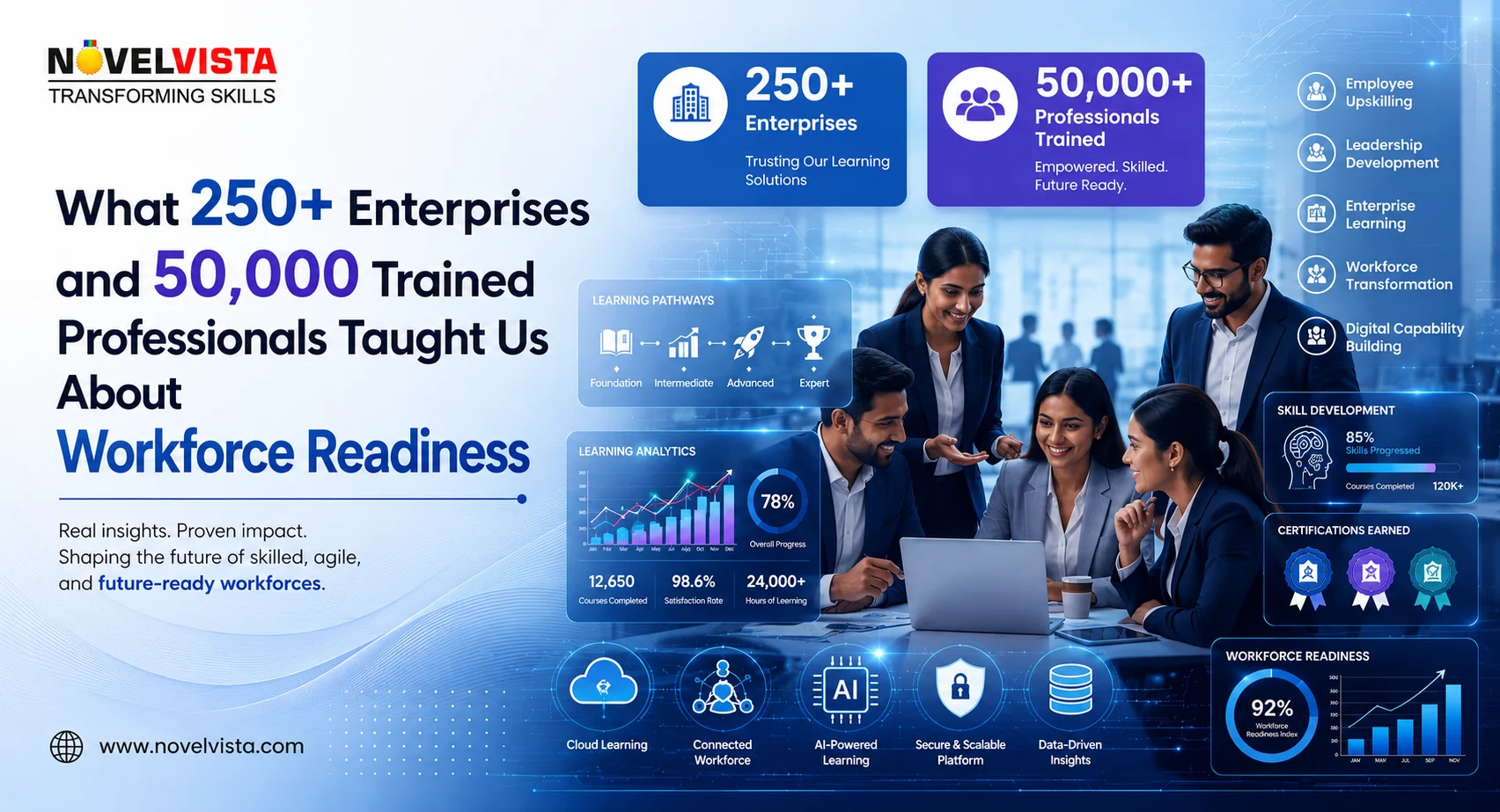
After working with 250+ enterprises and training more than 50,000 professionals, one lesson is clear: workforce readiness is no longer about conducting more training sessions. It is about building capability that shows up in real work.
This blog covers what large organizations have taught us about skills, training design, learner engagement, business alignment, measurement, and long-term workforce development. It also explains why enterprise teams need structured learning models, not scattered one-time workshops, to stay ready for changing technology, customer expectations, compliance needs, and business priorities.
For years, many companies treated training as an annual HR calendar item. A few workshops, a certification batch, a leadership session, and the box was checked. That model no longer works.
Modern workforce development must connect directly to business goals. When enterprises invest in cloud, AI, cybersecurity, IT service management, DevOps, or leadership capability, the question is not how many employees attended. The real question is what changed after the training.
Across enterprise projects, we have seen that readiness improves when learning is linked to role-specific skill gaps, project delivery requirements, compliance expectations, internal mobility plans, leadership pipeline development, and technology adoption roadmaps. The strongest organizations do not train people randomly. They build capability maps.
One of the biggest lessons from 250+ enterprises is that standard content rarely solves strategic capability gaps. A developer moving into cloud architecture does not need the same learning path as a project manager understanding AI use cases.
Effective workforce development begins with role clarity. Before designing any program, enterprises should ask which roles are changing, which skills are becoming obsolete, which capabilities are needed in the next six to twelve months, and what level of proficiency is required.
This is where structured enterprise learning makes a difference. It allows organizations to move from broad training delivery to targeted performance enablement.
Training succeeds when managers are involved before, during, and after the learning experience. In many organizations, L&D teams do the heavy lifting, but managers are missing from the learning cycle. That creates a transfer gap.
For real workforce transformation, managers must help define learning goals, nominate the right participants, provide practice opportunities, and review post-training outcomes.
Without manager involvement, training remains an event. With manager involvement, it becomes execution muscle.
Employees do not want theory overload. They want practical knowledge they can apply quickly. Across thousands of trained professionals, the highest engagement comes from programs that include real-world case studies, hands-on labs, scenario-based discussions, tool-based exercises, role-play, simulations, and industry examples.
This matters especially for technology and process-driven subjects such as AI, cloud, cybersecurity, ITSM, Agile, DevOps, and project management.
An enterprise learning platform can support this by centralizing content, tracking progress, and enabling access. But the platform alone is not the strategy. The learning experience must still be designed around business application.
Certifications are valuable. They validate knowledge, create career motivation, and give organizations a structured benchmark. But certification alone does not guarantee readiness.
The most successful enterprises use certifications as part of a broader capability journey. A cloud certification may be combined with architecture workshops, internal project assignments, and mentoring. An ITIL certification may be followed by service improvement projects.
This approach turns learning into performance. For long-term workforce development, certifications should answer a business need, not just decorate a resume.
Attendance is easy to measure. Readiness is harder. Yet enterprises that want real impact must go beyond completion rates. They need employee training metrics that show whether learning changed confidence, behavior, productivity, quality, or project performance.
When organizations measure only participation, they optimize for volume. When they measure application, they optimize for impact.
Large enterprises often need to train hundreds or thousands of employees across locations, functions, and experience levels. Scale is important, but scale without personalization leads to low relevance.
Strong enterprise learning models combine standardization with flexibility. The core structure remains consistent, but the examples, labs, assessments, and learning depth change by audience.
| Audience | Learning Need | Best Approach |
|---|---|---|
| Senior Leaders | Strategic awareness | Executive workshops and business use cases |
| Managers | Team adoption | Scenario-based learning and coaching tools |
| Technical Teams | Hands-on skills | Labs, certification, and project simulation |
| Business Users | Tool adoption | Short modules, demos, and guided practice |
This balance helps organizations deliver enterprise learning solutions that are scalable without becoming shallow.
AI has changed the workforce readiness conversation. Earlier, digital skills were mainly expected from IT teams. Today, almost every function needs AI awareness, automation literacy, data confidence, and responsible technology usage.
HR teams use AI for talent analytics. Sales teams use AI for lead research and communication. Finance teams use automation for reporting. IT teams use AI for monitoring, coding, and service management. Leaders use AI to improve decision-making.
This shift is driving workforce transformation across industries. The challenge is not only technical. Employees need judgment. They must know when to use AI, when not to use it, how to validate outputs, how to protect data, and how to align usage with company policy.
Enterprises that build readiness consistently do not depend only on scheduled training days. They create learning cultures where employees are encouraged to ask questions, explore tools, update skills, share knowledge, and apply learning without fear.
This is where enterprise learning solutions become more powerful. They help organizations move from isolated programs to continuous capability development.
The most effective training programs are not built in isolation by L&D or vendors. They are co-created with business leaders, functional heads, managers, and learners. This ensures the learning path reflects real challenges, not assumed problems.
This collaborative approach improves relevance, learner buy-in, and business impact. It also prevents a common issue: buying training because it is popular, not because it is necessary.
The half-life of skills is shrinking. Tools change. Regulations change. Customer expectations change. Technology stacks change. That means workforce readiness cannot be achieved through one annual training cycle.
Enterprises need continuous workforce transformation models where employees regularly upgrade skills based on business priorities. This does not always mean long programs. Sometimes, short refreshers, guided labs, microlearning, and role-based bootcamps are more effective.
A strong enterprise learning platform can help track this journey, but strategy comes first. Organizations must define which capabilities matter, how proficiency will be measured, and how learning will be reinforced over time.
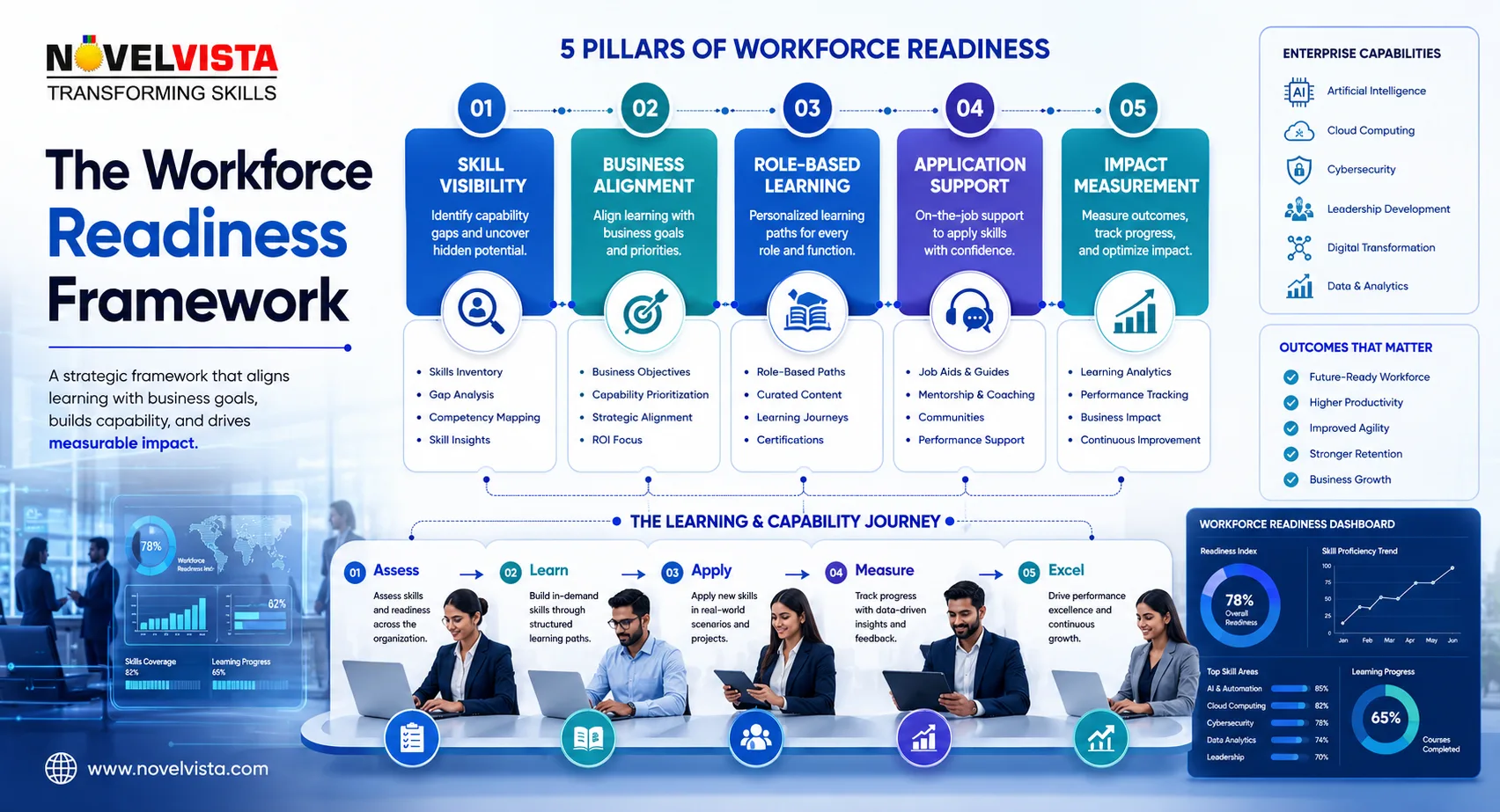
Based on our experience with enterprises and professionals, workforce readiness can be viewed through five layers.
| Layer | Purpose | Key Question |
|---|---|---|
| Skill Visibility | Understand current capability | What skills do we have today? |
| Business Alignment | Connect learning to strategy | Which skills support business goals? |
| Role-Based Learning | Train by job need | What does each role need to perform better? |
| Application Support | Enable transfer to work | Where will employees apply the skill? |
| Impact Measurement | Track outcomes | What improved after training? |
This framework keeps workforce development practical, measurable, and aligned with enterprise outcomes.
Organizations that want future-ready teams should start with a simple but disciplined roadmap. First, identify the top business priorities for the next twelve months. Then map the skills required to achieve them.
Next, segment employees by role, experience, and learning need. After that, design learning paths that include training, practice, assessment, and manager reinforcement. Most importantly, review outcomes.
A company does not become ready because it trained 500 employees. It becomes ready when those employees can solve problems faster, use tools better, serve customers smarter, reduce risk, and support business growth.
The biggest lesson from 250+ enterprises and 50,000 trained professionals is simple: workforce readiness is built by design, not by chance.
Modern organizations need structured workforce development, role-based learning, practical application, leadership involvement, and measurable outcomes. Training should not sit outside business strategy. It should become part of how the organization grows, adapts, and competes.
As technology, AI, automation, and digital operating models continue to evolve, workforce transformation will remain a boardroom priority. Enterprises that act early will build confidence, capability, and resilience before the next disruption arrives.
To help organizations build scalable and measurable learning journeys, NovelVista offers corporate training programs designed for enterprise teams, leaders, and professionals across key business and technology domains. Explore NovelVista Corporate Training and start building a workforce that is not just trained, but truly ready.
Author Details

Confused About Certification?
Get Free Consultation Call
Stay ahead of the curve by tapping into the latest emerging trends and transforming your subscription into a powerful resource. Maximize every feature, unlock exclusive benefits, and ensure you're always one step ahead in your journey to success.