Category | News
Last Updated On 10/02/2026
If you’re a CEO in 2026, technology is no longer something you “review” once a quarter. It’s something you actively steer, often while dealing with economic uncertainty, cost pressure, and faster competition than ever before.
AI acceleration hasn’t slowed down. What has changed is how companies are using it. According to insights shared by firms like Deloitte and ABI Research, we’re moving out of the experimentation phase. The focus is now on scalable business impact, real productivity gains, stronger resilience, and measurable ROI.
This blog breaks down the latest technology trends for CEOs. Not because they’re exciting, but because they directly affect how your organization operates, protects itself, and grows over the next few years.
For years, AI and robotics lived in pilot projects and innovation labs. That era is ending.
Today, AI is merging with physical robotics and moving straight into core operations. Manufacturing, logistics, and field services are leading the charge, not because it looks impressive, but because the numbers finally make sense.
What’s changed:
From a CEO’s point of view, this is no longer about futuristic automation. It’s about:
The winning companies aren’t building flashy demos. They’re embedding AI into daily workflows where efficiency gains show up on the balance sheet.
How CEOs Should Adapt:
CEOs should shift focus from experimentation to operational deployment. Prioritize use cases with clear efficiency gains, integrate AI with existing systems, and track ROI through measurable outcomes like uptime, quality, and throughput. The goal is not innovation theater, but embedding intelligence where it directly improves daily operations.
Another quiet but important shift is happening inside organizations: processes are becoming agent-first.
Instead of people manually moving work between systems, AI agents now handle entire workflows end to end, from intake to execution to reporting. These aren’t chatbots. They’re software agents that plan, act, and adapt.
What CEOs should know:
This shift is also changing leadership roles. CIOs are evolving into AI evangelists, supported by modular, flexible architectures that allow agents to be added or removed as needs change.
How CEOs Should Adapt:
Leaders should treat AI agents as part of the workforce, not tools. Start by identifying process-heavy areas where agents can own workflows end-to-end. Invest in governance, clean data, and flexible architectures so humans and agents collaborate smoothly without creating new silos or control gaps.
For CEOs, the real question is no longer “Should we use AI agents?”
It’s “Which parts of our business should be agent-driven first?”
Cybersecurity has officially moved into the boardroom.
As AI-driven threats increase, companies are shifting from reactive security to Continuous Threat Exposure Management (CTEM). The goal is simple: identify and reduce risk before an incident happens.
What’s changing at the leadership level:
This means cybersecurity is no longer just an IT problem. It’s a business risk conversation, covering revenue protection, operational continuity, and customer trust.
How CEOs Should Adapt:
CEOs must reframe cybersecurity as a business risk decision. Focus on reducing exposure, not eliminating threats. Align security investments with financial impact, operational continuity, and customer trust. Zero Trust should be treated as a baseline assumption across the organization, not a standalone initiative.
While cloud computing remains critical, more intelligence is moving closer to where data is created.
Edge AI enables real-time decision-making in:
At the same time, work on 6G is starting, but the focus is practical, not hype-driven. Instead of chasing headline speeds, the emphasis is on hybrid models that combine:
For CEOs, this trend raises an important alignment issue. Data strategy can no longer be one-size-fits-all. It must reflect industry-specific edge deployments, not just centralized cloud plans.
How CEOs Should Adapt:
Executives should align data strategy with where decisions actually happen. Identify operations that require real-time intelligence and move processing closer to the edge. Balance cloud and edge investments based on latency, privacy, and resilience needs rather than assuming centralized models fit every business.
Quantum computing is still early, but it’s no longer theoretical. Quiet progress is happening in areas that matter to business leaders, especially simulation and security.
Where early value is emerging:
This isn’t about immediate deployment. It’s about option value. Organizations that start learning now, through pilots, partnerships, and talent development, will be better positioned when quantum advantages become practical. Those who wait may find the learning curve steep and expensive.
How CEOs Should Adapt:
CEOs don’t need immediate adoption, but they should build awareness early. Support small pilots, partnerships, and internal learning focused on simulation, optimization, and security. The objective is preparedness, so the organization is ready when quantum capabilities move from experimental to commercially viable.
Sustainability has moved beyond compliance and reporting. In 2026, it’s increasingly treated as portfolio optimization.
What technology leaders are doing differently:
The key shift for CEOs is perspective. Sustainability is no longer a cost center. It’s a way to:
How CEOs Should Adapt:
Leadership should integrate sustainability into the core business strategy. Treat energy efficiency, carbon-aware computing, and greener infrastructure as risk and cost management levers. When sustainability goals are tied to productivity and resilience, organizations can reduce exposure while maintaining financial performance.
Immersive technology is finally growing up.
AR, VR, and mixed reality are finding real traction in:
Autonomous mobility is also expanding beyond controlled environments. For example, Waymo is moving robotaxis from city streets to highway operations, signaling growing confidence in real-world autonomy.
The takeaway is simple: immersive tech is shifting from experimentation to operational use. The question is no longer “Is this real?” but “Where does this fit into our value chain?”
How CEOs Should Adapt:
CEOs should look beyond novelty and focus on operational value. Prioritize immersive technologies where they reduce training errors, improve design accuracy, or enhance customer engagement. Scale only where outcomes are measurable and aligned with business processes, not where technology looks impressive.
Technology leadership itself is changing.
Today’s CIOs are deploying:
According to industry surveys, about 66% of CIOs now justify technology budgets using business capability mapping instead of raw IT metrics. That’s a big shift.
For CEOs, this matters because digital transformation is no longer about tools. It’s about:
The operating model, not the tech stack, is increasingly the differentiator.
How CEOs Should Adapt:
Executives should focus on operating models, not just tools. Encourage flexible teams, outcome-based budgeting, and AI-assisted workflows. Measure technology success through business capabilities like speed, adaptability, and revenue impact, ensuring digital transformation supports growth rather than adding complexity.
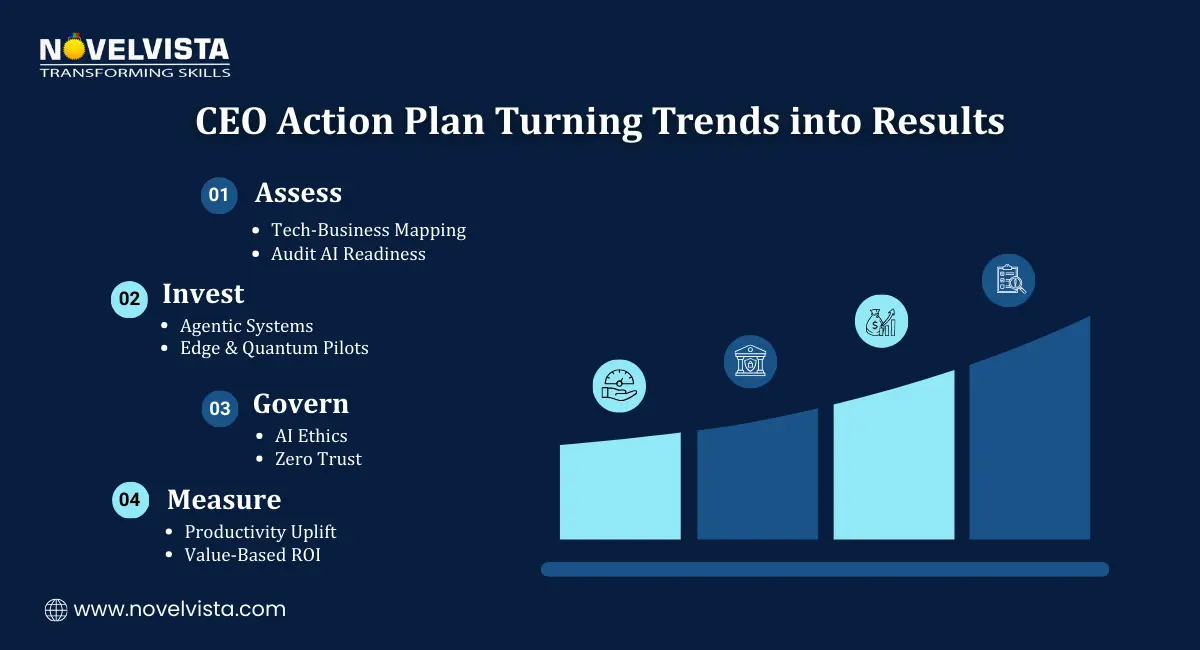
Technology Trends for CEOs only matter if they turn into outcomes. Here’s a practical way to move from insight to action.
For quick reference, here’s how leaders are prioritizing:
None of these trends works without people who understand them.
CEOs increasingly need teams that can:
The NovelVista Generative AI Professional Certification builds strong foundations in business-ready AI use cases and AI-driven decision-making. It’s well-suited for leaders, architects, consultants, and strategists.
The Agentic AI Certification goes deeper into agent-first operating models, covering multi-agent orchestration, autonomous workflows, and safety mechanisms, skills that align directly with how organizations are evolving.

Technology leadership in 2026 is no longer about experimentation. It’s about execution.
Leaders must understand these technology trends for CEOs and invest in the right skills to build organizations that are resilient, AI-enabled, and ready for what comes next. The future belongs to leaders who treat technology as a core business capability, not a support function.
Understand how today’s CEOs are learning to lead with agentic AI, not by coding, but by mastering decision boundaries, governance, and accountability in autonomous systems.
Author Details

Course Related To This blog
Generative AI Professional
Agentic AI Certification
Confused About Certification?
Get Free Consultation Call
Stay ahead of the curve by tapping into the latest emerging trends and transforming your subscription into a powerful resource. Maximize every feature, unlock exclusive benefits, and ensure you're always one step ahead in your journey to success.