Category | AI And ML
Last Updated On 13/10/2026
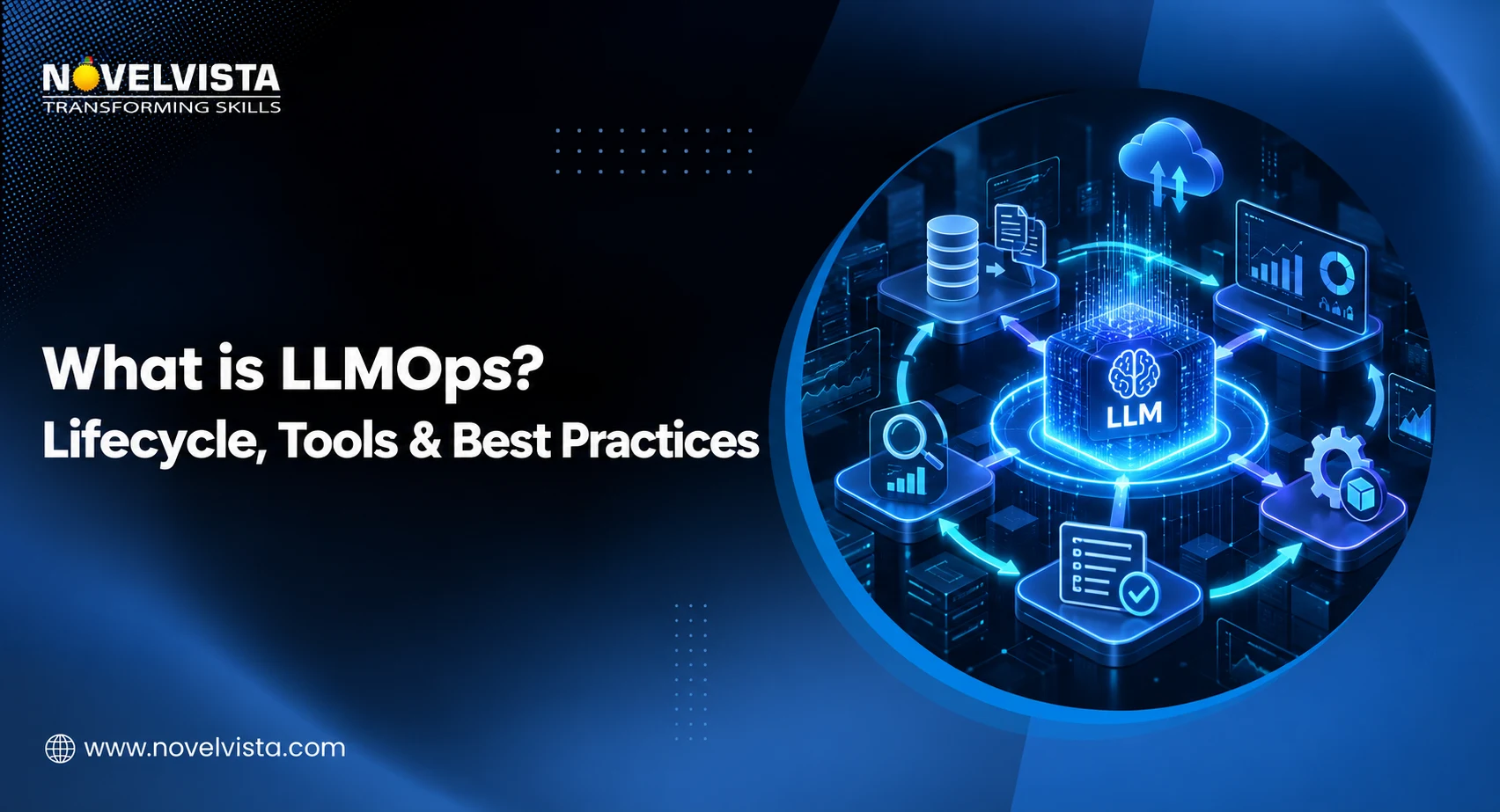
Building an AI chatbot is one thing. Keeping it accurate, secure, fast, and affordable when thousands of people start using it is another challenge entirely. That's where Large Language Model Operations comes in.
If you're wondering what is LLMOps, this guide explains how organizations manage large language models beyond experimentation. We'll cover the complete LLMOps lifecycle, differences from MLOps and DevOps, essential tools, evaluation and monitoring techniques, production challenges, and best practices for 2026.
Whether you're an AI engineer, DevOps professional, or technology leader, understanding these processes will help you move generative AI applications from promising prototypes to dependable business solutions.
LLMOps stands for Large Language Model Operations. It refers to the practices, workflows, and technologies used to develop, deploy, monitor, maintain, and continuously improve applications powered by large language models.
Think of it as the operational framework that helps AI applications perform consistently after they leave the development environment.
Unlike a traditional software application, an LLM-powered system can generate different responses to similar questions. It may also produce inaccurate information, expose sensitive data, or consume unpredictable computing resources.
LLMOps addresses these challenges through:
For example, a customer support chatbot that works perfectly with 100 test questions might struggle with thousands of real customer conversations. An operational framework helps teams identify those failures, reproduce them, and deploy verified improvements.
Organizations are moving beyond basic generative AI demonstrations toward applications integrated with business systems, internal knowledge bases, and automated workflows.
That shift makes production reliability essential.
A language model might answer common questions correctly but fail when a customer submits incomplete information, an employee requests confidential data, or a connected service becomes unavailable.
LLMOps helps organizations manage these situations by establishing measurable quality standards and repeatable operational processes.
Its major benefits include:
These capabilities are increasingly relevant to retrieval-augmented generation (RAG) systems and AI agents that interact with enterprise documents, APIs, and business applications.
The goal isn't simply to make AI generate answers. It's to make those answers dependable within real operational constraints.
LLMOps builds on established software engineering and machine learning practices, but introduces additional requirements for generative AI.
DevOps focuses on software development, deployment automation, and infrastructure reliability.
MLOps extends operational practices to machine learning systems, including datasets, model training, model registries, and performance monitoring.
LLMOps specializes in language-model applications, where prompts, retrieved context, model responses, and safety requirements need continuous testing.
| Comparison | DevOps | MLOps | LLMOps |
|---|---|---|---|
| Primary focus | Software delivery | ML model lifecycle | Language-model applications |
| Core assets | Code and infrastructure | Models and datasets | Models, prompts, context, and evaluations |
| Testing | Functional and integration tests | Accuracy and model metrics | Response quality, safety, and task success |
| Monitoring | Availability and system performance | Prediction quality and drift | Quality, latency, tokens, cost, and failures |
| Common challenges | Deployment failures | Data drift and reproducibility | Hallucinations, prompt injection, inconsistent outputs |
| Typical applications | Web services and APIs | Fraud detection and forecasting | Chatbots, copilots, and AI agents |
The three disciplines complement one another.
For instance, a production AI assistant may use DevOps to deploy its application, MLOps to manage a customized prediction model, and LLMOps to evaluate generated responses and monitor prompt behavior.
A successful LLMOps lifecycle connects development, testing, production operations, and continuous improvement. Each stage produces information that supports the next.
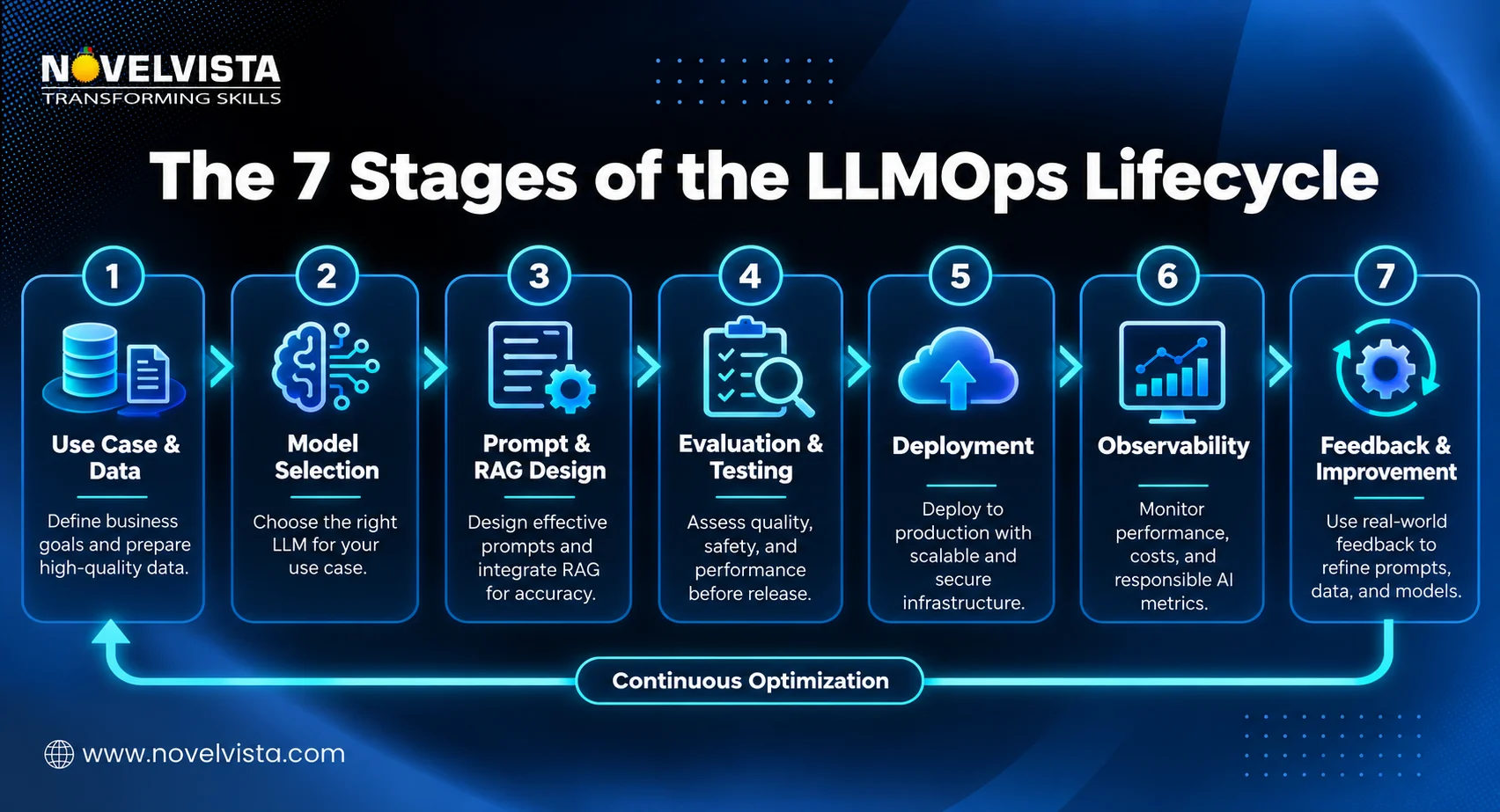
Start by defining the business problem and expected outcome.
For a company knowledge assistant, success might mean answering employee policy questions accurately using approved internal documents.
Teams should identify:
Data preparation may involve cleaning documents, removing duplicates, managing confidential information, and organizing content for retrieval.
Choose a model based on task performance rather than popularity alone.
Consider context-window requirements, language support, hosting options, latency, licensing, security, and cost.
A smaller model may be suitable for classification or simple support queries, while complex reasoning tasks may require more capable models.
Record model versions and inference settings so results can be reproduced.
Develop instructions that define the model's role, expected output, constraints, and available context.
For RAG applications, connect the model to a retrieval system that supplies relevant enterprise information.
Version prompts, retrieval configurations, and document indexes. A seemingly minor change to retrieval chunk size or system instructions can affect output quality.
Before releasing an application, test it using representative questions and expected behaviors.
Evaluate:
Use automated scoring alongside human review, particularly for high-risk business tasks.
Maintain regression datasets so changes can be compared against previously accepted performance.
A consistent llm evaluation process also makes it easier to compare model versions before production releases.
LLM deployment involves making the application available through a scalable, reliable serving environment.
Teams may use managed model APIs or host models on their own infrastructure.
Production workflows should include authentication, rate limiting, timeout handling, retries, configuration management, and rollback procedures.
Canary releases allow a limited group of users to test a new version before broader adoption.
Once the application is live, collect operational traces and response-quality signals.
Track latency, error rates, token usage, costs, model versions, retrieval behavior, and user feedback.
When a response fails, engineers should be able to identify whether the problem originated in retrieval, prompt instructions, tool execution, or the model itself.
Monitoring must respect privacy requirements and avoid unnecessarily storing confidential prompts or responses.
Production activity provides valuable evidence about real-world behavior.
Review failed requests, categorize recurring issues, improve prompts or retrieval, and rerun evaluation datasets before releasing changes.
Continuous improvement doesn't always require fine-tuning a model. Sometimes updating outdated documents or correcting retrieval permissions produces a better result.
The lifecycle is therefore iterative, not a one-time development sequence.
Choosing the right llmops tools depends on your architecture, engineering capabilities, hosting preferences, and application requirements.
No single platform is necessary for every stage. Many teams combine specialized frameworks with existing cloud and DevOps infrastructure.
LangChain helps developers build language-model workflows involving prompts, models, tools, and integrations.
LlamaIndex focuses on connecting applications with external information, particularly document ingestion, indexing, and retrieval.
MLflow supports experiment tracking and model management, with capabilities for tracing and evaluating generative AI applications.
LangSmith provides tracing, datasets, testing, and evaluation workflows for debugging and improving AI applications.
Langfuse provides tracing, prompt management, evaluation capabilities, and usage analytics.
Arize Phoenix supports tracing and evaluation workflows for analyzing LLM and retrieval-based applications.
vLLM is an inference and serving engine commonly used for hosting supported language models.
Hugging Face Text Generation Inference (TGI) provides model-serving functionality for supported deployments.
| Tool | Primary Purpose | Suitable Use Case |
|---|---|---|
| LangChain | Application orchestration | Multi-step LLM workflows |
| LlamaIndex | Data integration and retrieval | Enterprise RAG applications |
| MLflow | Experiment and model lifecycle tracking | Model and application experimentation |
| LangSmith | Tracing and evaluation | Debugging application behavior |
| Langfuse | Observability and prompt management | Tracking production LLM requests |
| Arize Phoenix | Tracing and evaluation | Analyzing retrieval and response quality |
| vLLM | Model inference and serving | Self-hosted model applications |
| Hugging Face TGI | Text-generation serving | Managed infrastructure for supported open models |
When comparing platforms, examine integration support, security controls, hosting requirements, operational complexity, and total cost rather than selecting tools solely because they're popular.
Traditional infrastructure monitoring tells you whether an application is running. LLM observability helps explain whether the AI application is behaving as intended.
A system can maintain excellent uptime while regularly giving misleading answers.
That's why operational health and response quality must be measured separately.
Effective llm evaluation should consider:
Track indicators such as:
Combine three approaches.
Reference-based tests compare responses with approved examples. Human evaluation checks nuanced situations requiring expert judgment. LLM-as-a-judge evaluation uses another model to score responses against a defined rubric.
Automated judges can be useful, but their scores should be validated against human-reviewed examples.
A well-designed monitoring process connects these evaluation results with production traces, helping engineers locate problems and verify improvements.
Reliable applications require more than selecting an advanced model. The following practices create an operational foundation that teams can maintain as usage grows.
Track models, prompts, datasets, retrieval configurations, and application code together.
This makes failures reproducible and lets teams identify which change affected performance.
Run approved test datasets whenever prompts, retrieval logic, or model configurations change.
Set minimum acceptance criteria before allowing new versions into production.
Use role-based access controls, secret management, data minimization, and appropriate logging restrictions.
Treat retrieved documents and user messages as untrusted inputs. Defend against prompt injection and prevent AI tools from performing unauthorized actions.
Use staging environments, limited rollouts, and rollback plans.
Avoid deploying untested changes directly to all users, even when those changes appear to involve only prompt wording.
Define acceptable limits for latency, error rates, response quality, and spending.
Monitor whether expensive models are being used for simple tasks that less costly alternatives could handle.
Provide escalation paths for uncertain or sensitive responses.
In areas involving significant financial, legal, or operational consequences, important decisions should receive appropriate human verification.
Turn user complaints, failed requests, and evaluation findings into repeatable tests.
These llmops best practices help teams improve AI systems systematically instead of relying on occasional prompt adjustments.
Imagine a company building an internal assistant that answers questions about HR policies, IT procedures, and employee benefits.
The application retrieves relevant passages from authorized company documents and sends them to a language model to generate answers.
Its basic workflow looks like this:
Employee question → Access-controlled document retrieval → LLM → Grounded answer → Monitoring and feedback
During development, engineers create test questions with verified answers and supporting sources.
They evaluate retrieval relevance, factual accuracy, citations, and whether the assistant refuses questions outside the available evidence.
Before production, they configure access controls so employees cannot retrieve documents they aren't authorized to view.
After release, the team monitors token costs, response times, retrieval failures, and negative feedback.
Suppose employees report that the chatbot gives outdated leave-policy information. Engineers inspect retrieval traces, discover an obsolete document, correct the index, and run regression tests before releasing the update.
This is the operational value of LLMOps: identifying problems across the entire application rather than assuming every failure comes from the language model.
Even well-designed AI applications face operational challenges. The objective isn't to eliminate every possible failure, but to detect issues early and reduce their impact.
| Challenge | Why It Happens | Practical Solution |
|---|---|---|
| Hallucinations | Models generate unsupported information | Ground responses in trusted sources and evaluate factuality |
| Inconsistent outputs | Responses vary with prompts and context | Use regression tests and version controls |
| High inference costs | Large models and lengthy prompts consume tokens | Optimize context, cache suitable results, and select appropriate models |
| Security vulnerabilities | Untrusted inputs manipulate behavior | Apply least-privilege access and prompt-injection defenses |
| Slow responses | Model inference or retrieval introduces delays | Measure bottlenecks and optimize serving infrastructure |
| Model changes | Provider updates affect application behavior | Pin supported versions, retest, and maintain fallback plans |
A common mistake is trying to solve all these problems by switching models.
Often, the better fix involves improving retrieval, refining application logic, enforcing permissions, or establishing stronger testing procedures.
You don't need an elaborate platform to begin. Start with one measurable use case and establish the controls required to operate it safely.
Start small, prove that the process works, and expand the platform as your application's operational needs become clearer.

Understanding what is LLMOps is the first step toward building generative AI applications that businesses can confidently operate. A structured lifecycle, reliable testing, production monitoring, and continuous improvement help teams manage quality, security, and cost as applications scale.
For professionals who want to develop practical production AI skills, explore NovelVista's LLMOps AI Production Deployment training to strengthen your understanding of operational workflows, deployment strategies, and application management.
You can also start learning LLMOps free to begin building the foundational knowledge needed for real-world implementation.
Author Details

Course Related To This blog
LLMOps & AI Engineering for Production
Confused About Certification?
Get Free Consultation Call
Stay ahead of the curve by tapping into the latest emerging trends and transforming your subscription into a powerful resource. Maximize every feature, unlock exclusive benefits, and ensure you're always one step ahead in your journey to success.