Category | AI And ML
Last Updated On 11/10/2026
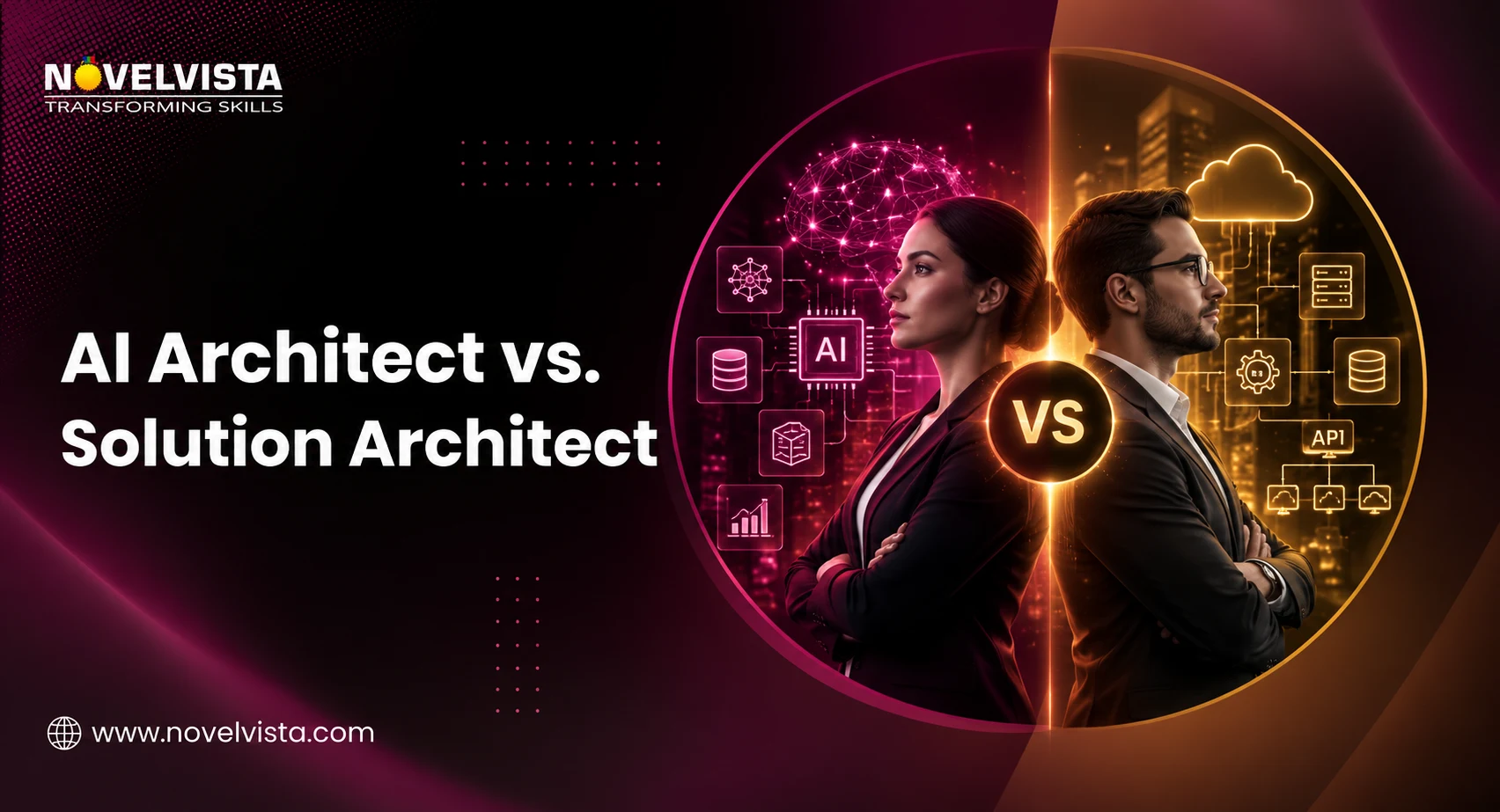
Artificial intelligence is changing how businesses design software, manage data, and solve complex problems. As organizations adopt AI-powered systems, a new question is emerging: do they need an AI architect, a traditional solution architect, or both?
The AI Architect vs. Solution Architect comparison goes beyond job titles. Although both professionals design enterprise technology solutions, their approaches differ in technical expertise, architecture decisions, system behavior, and risk management.
This article explores their responsibilities, essential skills, technologies, real-world applications, career opportunities, and how traditional architects can transition into AI-focused roles.
A traditional solution architect designs technology systems that meet business requirements. They select infrastructure, define integration patterns, plan application architecture, and ensure that different technology components work together efficiently.
An AI architect specializes in designing systems powered by artificial intelligence, machine learning, and generative AI. Their work involves selecting AI models, designing data pipelines, implementing AI capabilities, and monitoring model performance.
The AI Architect vs. Traditional Solution Architect distinction primarily concerns the type of systems they design.
Traditional solution architects focus on the overall technology ecosystem. AI architects concentrate on the intelligent components within that ecosystem.
For example, a solution architect may design an enterprise customer service platform, while an AI architect designs the AI assistant integrated into that platform.
Both roles require strong architectural judgment, security awareness, and business understanding.
For a deeper explanation of the AI-focused role, read What is an AI Solution Architect.
The fundamental difference lies in how each professional approaches technology design, decision-making, and operational challenges.
The following AI Architect vs. Solution Architect comparison highlights the responsibilities and requirements that typically distinguish these positions.
| Comparison Factor | AI Architect | Traditional Solution Architect |
|---|---|---|
| Primary focus | AI-powered applications and intelligent workflows | End-to-end enterprise technology solutions |
| Main objective | Deliver reliable, useful AI capabilities | Build integrated, scalable business systems |
| Core technologies | Machine learning, LLMs, RAG, vector databases | APIs, microservices, databases, cloud platforms |
| Data requirements | Training, inference, retrieval, and evaluation data | Application, transactional, and operational data |
| Architecture approach | Model-centric or AI-enabled design | Application and infrastructure-centric design |
| Performance measurement | Accuracy, groundedness, latency, and AI quality | Availability, response time, throughput, and scalability |
| Security concerns | Prompt injection, data leakage, model misuse | Authentication, authorization, network and application security |
| Operational practices | MLOps, LLMOps, model evaluation and monitoring | DevOps, infrastructure monitoring and release management |
| Typical deliverables | AI architecture, evaluation strategy, model integration | Solution architecture, integration design, deployment blueprint |
| Key stakeholders | Data scientists, ML engineers, application teams | Developers, cloud engineers, business and IT teams |
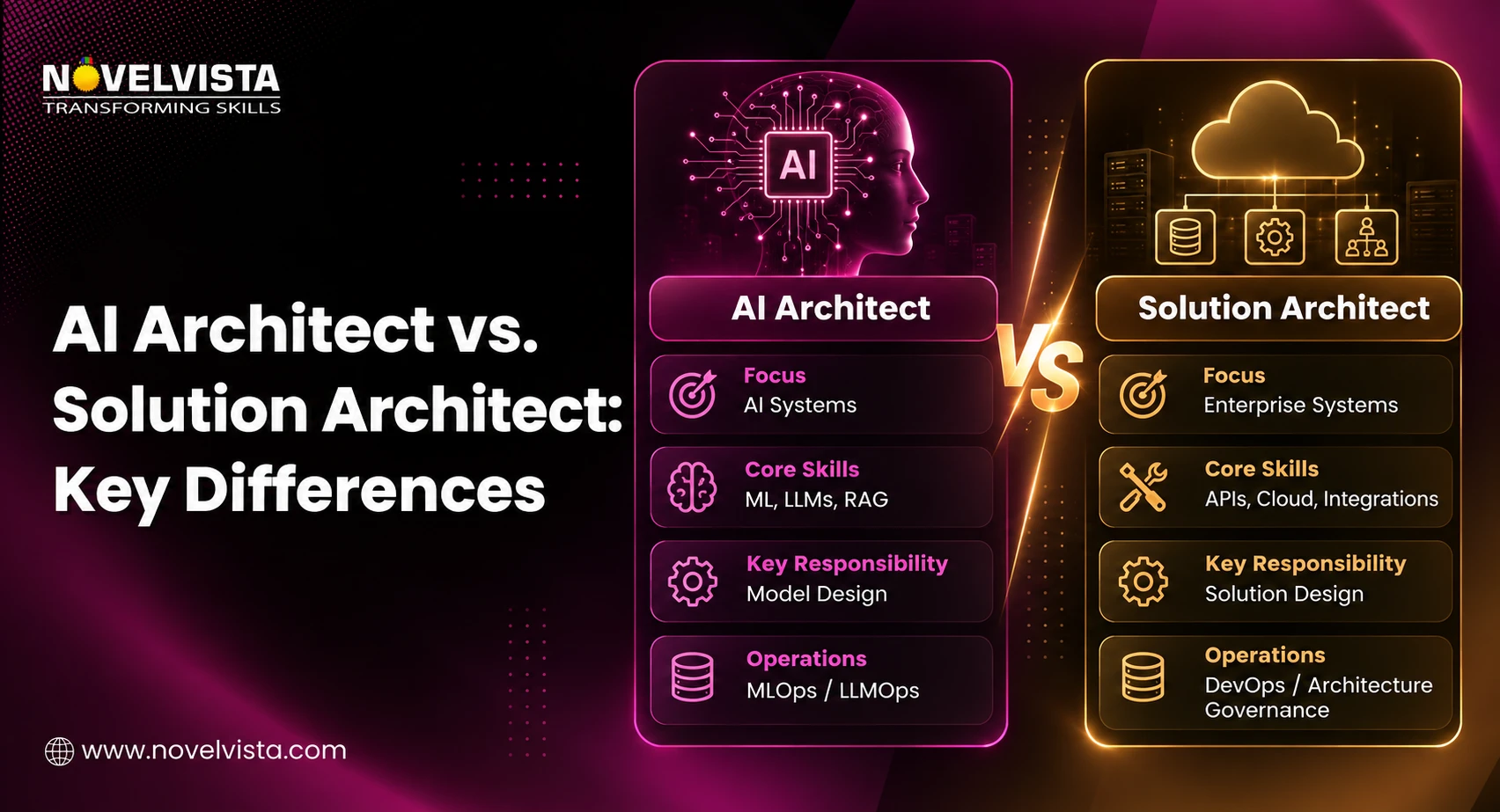
These differences aren't absolute. An experienced solution architect may design AI capabilities, and an AI architect must still understand cloud infrastructure, security, networking, and integration.
The distinction becomes clearer when examining their everyday responsibilities.
Both architects translate business requirements into technical solutions, but their responsibilities differ.
An AI architect typically:
In the AI Solution Architect vs. Traditional Solution Architect comparison, AI specialists take additional responsibility for the behavior and lifecycle of intelligent systems.
A traditional solution architect typically:
The traditional role is broader across enterprise IT, while the AI role brings deeper specialization in intelligent workloads.
Although their specializations differ, both positions demand strong technical foundations and communication skills.
A traditional solution architect should understand:
An AI architect generally needs additional expertise in:
The AI Solution Architect vs. Solution Architect skills comparison reveals substantial overlap.
An AI specialist cannot ignore traditional architecture principles. Even an advanced AI application requires dependable infrastructure, secure integrations, reliable APIs, and cost management.
The difference is the additional expertise needed to make AI capabilities dependable in production.
One of the most important aspects of AI Architect vs. Solution Architect is how artificial intelligence changes system behavior.
Traditional applications typically follow programmed rules. When the same validated input reaches the same deterministic process, the expected output remains consistent.
Generative AI systems behave differently. Their responses can vary depending on the model, prompt, retrieved information, and configuration.
Consider a simple customer support example.
Traditional application:
A customer requests their account balance. The application queries an authorized database and displays the returned amount.
AI-powered application:
A customer asks why their balance changed. An AI assistant retrieves permitted transaction information, interprets the question, and generates a natural-language explanation.
The second approach introduces additional architectural concerns:
Microsoft's RAG architecture guidance emphasizes evaluating retrieval quality and generated responses independently.
AI architecture therefore extends conventional software engineering rather than replacing it.
Imagine a bank introducing an AI-powered customer support assistant.
The assistant must answer account-related questions, retrieve authorized information, and connect with existing banking applications.
What does the traditional solution architect handle?
The solution architect designs the broader environment:
What does the AI architect handle?
The AI architect designs the intelligent capabilities:
This AI Architect vs. Solution Architect scenario demonstrates why collaboration matters.
Neither specialist should operate independently of the other. An accurate AI assistant is ineffective without secure integration, while a reliable application platform cannot compensate for unsafe or misleading AI responses.
Successful implementation requires both perspectives.
Organizations should make this decision based on project requirements rather than job titles.
Choose a traditional solution architect when:
Bring in an AI architect when:
For large projects, both roles may be necessary.
The AI Solution Architect vs. Traditional Solution Architect decision should reflect the complexity of AI capabilities and the expertise already available within the team.
A small AI integration might be managed by an experienced architect with sufficient AI knowledge. A highly regulated, AI-intensive platform may require dedicated specialists.
Traditional solution architects already possess many of the skills needed for AI architecture. The transition involves extending those capabilities rather than abandoning existing expertise.
Learn supervised and unsupervised learning, model evaluation, neural networks, and generative AI fundamentals.
Understand how training, inference, and model limitations affect architectural decisions.
Start with manageable projects such as an internal knowledge assistant.
Practice implementing:
Expand into production considerations once the core workflow is reliable.
Structured training can help architects connect AI concepts with architecture decisions, practical exercises, and enterprise implementation patterns.
The AI Solution Architect vs. Solution Architect career transition is especially suitable for professionals who already understand cloud infrastructure, distributed systems, and enterprise integration.
Their existing architecture experience provides a valuable foundation for building production-ready AI solutions.
The AI Architect vs. Solution Architect career choice depends on your interests, experience, and preferred specialization.
Choose traditional solution architecture if you enjoy designing complete enterprise systems, connecting applications, and solving broad infrastructure challenges.
Consider AI architecture if you're interested in machine learning, generative AI, intelligent automation, and managing the distinctive risks of AI applications.
Neither path is inherently better. Both require continuous learning and strong technical judgment.
For experienced solution architects, AI specialization can be a logical next step because enterprise AI projects still depend on traditional architecture principles.
The AI Architect vs. Solution Architect comparison highlights an important distinction: traditional solution architects design complete technology solutions, while AI architects specialize in incorporating intelligent capabilities into those solutions.
Both roles are essential for organizations adopting AI responsibly. The strongest enterprise AI systems combine reliable software architecture with effective model selection, evaluation, and governance.
For professionals planning this transition, NovelVista's AI Solution Architect Learning Roadmap offers a structured learning direction.
You can also explore the AI Solution Architect Certification to develop a stronger understanding of AI architecture principles, enterprise integration, and practical implementation.
Building on your existing architecture skills while developing AI-specific expertise can prepare you for the next generation of enterprise technology projects.
Author Details

Confused About Certification?
Get Free Consultation Call
Stay ahead of the curve by tapping into the latest emerging trends and transforming your subscription into a powerful resource. Maximize every feature, unlock exclusive benefits, and ensure you're always one step ahead in your journey to success.