Category | AI And ML
Last Updated On 09/10/2026
A customer-support chatbot reads an email containing hidden instructions. Moments later, it shares a confidential order history with someone who should never see it. No firewall was breached and no password was stolen. The AI simply did what the text told it to do.
That scenario shows why AI security has become a practical concern for every organization using AI tools. Chatbots, copilots, and AI agents now read company documents, call APIs, and act on behalf of users, and every new capability creates a new way for things to go wrong.
AI security is the practice of protecting AI systems from attacks, misuse, and failures that could compromise their data, models, infrastructure, or outputs. It spans the full lifecycle, from training data to the prompts and actions a model handles in production.
AI security builds on traditional cybersecurity rather than replacing it; access control, encryption, and monitoring still matter. The difference is that AI adds new attack surfaces. A conventional application follows fixed code paths, while an AI model interprets language and data, so an attacker can sometimes change its behavior with words alone.
AI systems often sit close to sensitive information. An internal assistant connected to HR files, customer records, or source code can expose that data if access is poorly controlled.
The consequences of weak AI security include:
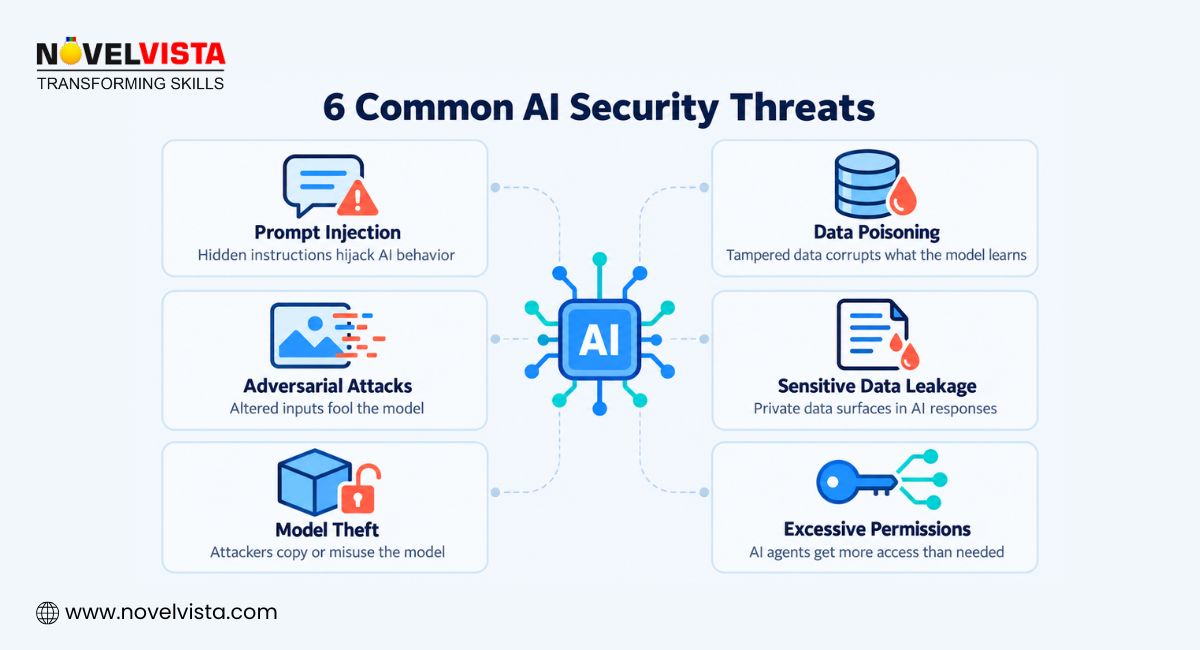
The OWASP Top 10 for LLM Applications (2025) is a widely used reference for generative AI security risks. The six below are a good place to start.
Prompt injection happens when someone crafts input that overrides an AI system's intended instructions. In direct injection, the attacker types the malicious instruction. In indirect injection, it is hidden in content the AI reads, such as a web page, PDF, or email, as in the chatbot example above.
Data poisoning means tampering with training, fine-tuning, or retrieval data so a model learns or repeats harmful patterns. A poisoned knowledge base could lead an assistant to recommend an unsafe configuration or a fraudulent payment link.
Adversarial attacks use carefully modified inputs to fool a model. A small, nearly invisible change to an image or document can cause a classifier to mislabel it, a real concern for fraud detection and content moderation.
AI systems can reveal personal data, credentials embedded in prompts, or confidential documents retrieved without permission checks.
Weak API controls or exposed model files can let attackers copy a model, imitate it through mass querying, or use it without authorization.
When an AI agent connects to email, databases, or payment systems, its permissions become part of the attack surface. OWASP calls this risk Excessive Agency: giving an AI more access or autonomy than its task requires. An agent holding delete rights it never needed turns one manipulated prompt into real damage.
These AI security best practices turn awareness into action.
A strong strategy doesn't need a large team on day one, only a clear sequence that grows with your AI adoption. The NIST AI Risk Management Framework organizes this work into four functions: Govern, Map, Measure, and Manage. The steps below follow similar logic.
A small business might start with an approved-tools list and data-handling rules, while a larger enterprise might add a formal AI governance and risk management board. Both follow the same cycle at different scales.
AI agents are taking on more autonomous, multi-step work, so a single manipulated instruction can pass through several tools before anyone notices. Attack techniques also keep evolving as attackers learn how models respond.
Governance is becoming as important as technical controls. As frameworks and regulations mature, organizations need clear ownership, documentation, and review. AI security is not a one-time project but a continuous discipline.
AI security is about protecting the data, models, integrations, and decisions that AI systems depend on. The core lessons are straightforward: understand AI-specific threats, limit what AI systems can access, test them before attackers do, and monitor them continuously.
Effective AI security combines technical safeguards, responsible data practices, governance, and ongoing oversight. For readers ready to go further, the natural next step is building hands-on skills.

Agentic AI security focuses on protecting AI agents, which are systems that plan tasks and act on their own using tools, APIs, and data. Because agents can send emails, change records, or run code, one manipulated instruction can trigger real actions. Key controls include tightly scoped permissions, a distinct identity for each agent, logging of every tool call, and human approval for high-impact steps.
AI security posture management is an approach, usually supported by dedicated tools, for continuously discovering the AI models, datasets, pipelines, and AI services an organization uses. It then checks them for risks such as misconfigured access, exposed sensitive data, or unapproved tools. It applies the idea behind cloud security posture management to AI assets.
Start by listing every AI system in use, then assess what data each one touches and what actions it can take. Apply controls such as least-privilege access and output validation to the highest-risk systems first, test them before deployment, and monitor them continuously. The NIST AI Risk Management Framework provides a useful structure for this work.
AI security reduces model theft by restricting who can access model files and APIs, requiring strong authentication, and encrypting stored model weights. Rate limits and monitoring for unusually high or patterned query volumes help detect model extraction, where attackers try to replicate a model through repeated API calls.
AI security governance is the set of policies, roles, and processes that decide how AI systems are approved, built, used, and monitored securely. It defines who owns each system, which data AI can access, and how risks are accepted or escalated. Good governance connects technical controls to business decisions, so security does not depend on individual teams acting alone.
Author Details

Confused About Certification?
Get Free Consultation Call
Stay ahead of the curve by tapping into the latest emerging trends and transforming your subscription into a powerful resource. Maximize every feature, unlock exclusive benefits, and ensure you're always one step ahead in your journey to success.

 "
border="0" alt="AI Architect vs. Solution Architect: What’s the Real Difference Between AI and Traditional Solution Architects? | Novelvista" style="height: 100% !important;">
"
border="0" alt="AI Architect vs. Solution Architect: What’s the Real Difference Between AI and Traditional Solution Architects? | Novelvista" style="height: 100% !important;">