LLMOps Course & Certification
The LLMOps Course from NovelVista helps AI and ML engineers take large language model applications from working prototype to reliable, secure and cost-controlled production. This practical LLMOps training covers model serving, RAG pipelines, evaluation, observability, guardrails and cost optimization, preparing you to earn a GSDC-accredited LLMOps certification with confidence.
- Industry Expert Trainers
- GSDC-accredited
- Online learning session
- Exam fee included
- Free study material for all modules
- Hands-on labs

LLMOps Certification Course Overview
The LLMOps Certification Course is designed for engineers who have built an LLM prototype and now need to run it in production. Most AI projects don't fail at the model; they fail after it. This LLMOps course closes that gap by teaching you to deploy, monitor, secure and scale large language model systems that survive real traffic, control their own cost and resist misuse.
Aligned with the globally recognized certification framework of the Global Skill Development Council (GSDC), this LLMOps training covers model selection and serving, prompt and context engineering, retrieval-augmented generation, fine-tuning, evaluation, production infrastructure, observability, and AI security and governance. You work with real production tooling, including vLLM, pgvector, Pinecone, LangSmith, Phoenix, NeMo Guardrails and LlamaGuard.
Delivered by NovelVista, this LLM deployment course combines free self-paced study material with a hands-on certification track: production labs, assessments, projects and a capstone that prove you can ship. It's the practical LLM engineering course for professionals moving into LLMOps, MLOps and AI Engineer roles.
Achieve your career goals faster with an LLM certification trusted by professionals across the USA, India, Canada, the UK, UAE, Saudi Arabia, Australia, Germany and beyond. Start with the free modules today, and enroll in the full LLMOps certification when you're ready.
What You Will Get?
Learning Outcome of LLMOps Certification Course
After the completion of the course, the participants would be able to:
Training Calendar
English
- Self paced videos, assessments, recall quizzes, more
- For more details, reach us at training@novelvista.com
Includes Training, Exam & Certification
Lifetime Access
- Self paced videos, assessments, recall quizzes, more
- For more details, reach us at training@novelvista.com
Includes Training, Exam & Certification
LLMOps course curriculum
This LLMOps course curriculum takes you from working prototype to production in 10 hands-on modules. Each module of this LLMOps training covers one stage of running large language models in production, from model selection and RAG pipelines to evaluation, observability, cost control and AI security. Study every module free, then add labs, assessments and projects to prepare for your LLMOps certification.
Module 1: Foundations: From MLOps to LLMOps+
This module of the LLMOps course builds a strong foundation by explaining what makes large language model systems operationally different from traditional machine learning.
MLOps vs LLMOps: What Changes in Production: Understand what carries over from classical MLOps and what changes when prompts, context and retrieval become production artifacts that need their own versioning and testing.
The LLMOps Lifecycle: Learn the define, develop, evaluate, deploy, monitor and optimize phases, and how feedback from production flows back into each stage.
Non-Determinism and Output Variability: Explore why the same prompt can produce different outputs, how sampling parameters affect behavior, and how to design systems that tolerate variability.
Token Economics and AI Cost Drivers: Understand tokenization, input versus output pricing and context window cost, and how usage patterns translate into the monthly AI bill.
Build vs Buy Decisions: Weigh building versus buying models, platforms and tooling, including vendor dependency, data control and total cost of ownership.
Core LLMOps Roles and Terminology: Master the essential vocabulary and understand how AI engineers, MLOps engineers and platform teams share responsibility for LLM systems.
Module 2: Model Selection & Serving Architecture+
This module of the LLMOps training builds the judgment to choose the right model and serving strategy for latency, cost and scale.
Proprietary APIs vs Open-Weight Models: Compare capability, cost, data control, licensing and operational effort between hosted model APIs and self-hosted open-weight models.
Model Evaluation for Selection: Shortlist candidate models with task-specific benchmarks and weigh response quality against latency and cost targets.
Local Inference Servers with vLLM: Stand up inference servers with OpenAI-compatible endpoints and configure them to handle real production traffic.
GPU Memory and Throughput Bottlenecks: Learn VRAM sizing, KV cache pressure, quantization and batching, and the levers that raise throughput per GPU.
Serving Strategy and Latency Budgets: Plan latency budgets, streaming responses and concurrency limits for user-facing AI features.
Managed, Dedicated and Hybrid Serving: Decide when to use managed endpoints, dedicated GPU capacity or a hybrid approach as usage grows.
Module 3: Prompt & Context Engineering at Scale+
This module of the LLMOps certification course turns prompts into versioned, testable production components that stay reliable as applications evolve.
Prompt Architecture and System Prompt Design: Structure roles, instructions, constraints and examples so models behave consistently across thousands of requests.
Dynamic Prompt Templating Systems: Build reusable, version-controlled prompt templates with variables, and promote prompt changes safely across environments.
Enforcing Structured JSON Outputs: Use schemas and function calling to get machine-readable outputs, validate them and retry automatically on malformed responses.
Context Assembly and Window Management: Select, order and compress the most relevant context so it fits within token limits without losing accuracy.
Few-Shot Design and Prompt Optimization: Choose and maintain examples that improve output quality, and measure the impact of each prompt change.
Automated Prompt Regression Testing: Build test suites and expected-behavior checks that catch prompt breakage before it reaches production.
Module 4: Retrieval-Augmented Generation (RAG) Pipelines+
This module of the LLM engineering course connects LLMs reliably to enterprise data through well-engineered ingestion, retrieval and grounding.
RAG Architecture End to End: Map ingestion, embedding, indexing, retrieval, generation and grounding as one production pipeline with clear failure points.
Document Ingestion and Parsing: Parse PDFs, web pages and structured sources cleanly, and enrich chunks with metadata that improves retrieval.
Chunking Strategies: Apply fixed-size, semantic and structure-aware chunking, and test which approach works best for your content.
Embeddings and Vector Databases: Select embedding models, integrate pgvector and Pinecone, and choose index types and similarity metrics.
Hybrid Search and Re-Ranking: Combine keyword and vector search, add re-ranking models and use query rewriting to improve context relevance.
Debugging RAG in Production: Diagnose silent retrieval failures, detect stale data and track retrieval quality metrics over time.
Scaling and Incremental Indexing: Keep indexes fresh with incremental updates, and plan retrieval capacity as data and traffic grow.
Module 5: Fine-Tuning & Customization+
This module of the LLMOps course helps you decide when customization is worth the cost and how to apply it efficiently.
Fine-Tune vs Prompt vs RAG: Use clear decision criteria and cost-benefit reasoning to choose the least complex method that meets your quality goals.
Parameter-Efficient Fine-Tuning with LoRA: Train lightweight adapters with LoRA and related methods to customize models with minimal compute.
Training Configuration and Compute Planning: Set key training parameters and estimate the GPU time and cost a fine-tuning run needs.
Dataset Curation and Quality Control: Collect, format and clean training examples, removing duplicates and low-quality data before training.
Synthetic Data Generation: Generate synthetic training data responsibly, and check it for bias and accuracy before use.
Evaluating and Deploying Customized Models: Compare fine-tuned models against baselines, serve adapters efficiently and version them in a model registry.
Module 6: Evaluation & Quality Assurance+
This module of the LLMOps training replaces guesswork with measurable quality and release gates that protect production.
Evaluation Strategy for LLM Applications: Combine offline and online evaluation, and set quality thresholds that match business risk.
Golden Dataset Construction: Build representative test sets with edge cases and expected outputs, and keep them current as the product changes.
LLM-as-a-Judge Evaluation Patterns: Design scoring rubrics, calibrate automated judges and check them for bias against human review.
Human Evaluation and Feedback Loops: Decide when human review is needed, and turn user feedback into new test cases.
RAG and Output Quality Metrics: Track groundedness, faithfulness, relevance and hallucination rate across releases.
CI Quality Gates: Run automated evaluations in CI pipelines and block releases that degrade performance.
Module 7: Production Infrastructure & MLOps Integration+
This module of the LLM deployment course packages LLM systems into repeatable, orchestrated deployments that fit existing engineering workflows.
Containerizing LLM Applications: Build Docker images for LLM services, manage dependencies and create GPU-enabled containers for inference.
Kubernetes Orchestration for LLM Workloads: Configure deployments, resource requests, GPU scheduling and autoscaling for variable traffic.
Caching Strategies: Apply response, semantic and prompt caching, and measure cache hit rates and invalidation.
Model Registries and Artifact Management: Version models, prompts and adapters, and promote approved artifacts between environments.
CI/CD for LLM Systems: Build pipelines that test and deploy prompt, RAG and model updates automatically.
Safe Rollouts and Rollback: Use canary releases and fast rollback so a bad change never reaches every user.
Module 8: Observability, Monitoring & Cost Management+
This module of the LLMOps certification course makes every request traceable and every dollar of inference spend visible.
Tracing LLM Applications with OpenTelemetry: Instrument chains, retrieval calls and agent steps with span-level traces.
Observability with LangSmith and Phoenix: Build live tracing dashboards and pinpoint whether a failure came from the prompt, retrieval or the model.
Drift, Error Rate and Latency Monitoring: Detect model and data drift, track error rates and latency, and set alert thresholds.
Hallucination Monitoring: Track hallucination signals in production and route risky responses for review.
Cost-per-Query Tracking: Attribute token spend by feature, team or user, and set budget alerts for inference cost.
Cost Optimization with Routing and Semantic Caching: Send simple queries to cheaper, faster models and cache repeated answers to cut spend.
Module 9: Security, Safety & Governance+
This module of the LLMOps course protects users, data and brand reputation with layered defenses built into the system.
The LLM Threat Landscape: Apply the OWASP Top 10 for LLM applications, map the attack surface and prioritize risks.
Prompt Injection and Jailbreak Defense: Defend against direct and indirect prompt injection, and handle untrusted content safely.
Guardrails with NeMo Guardrails and LlamaGuard: Implement input and output rails that block toxic, off-topic or off-brand responses.
Red-Teaming LLM Applications: Run structured adversarial testing to find vulnerabilities, and track fixes to closure.
PII Detection and Redaction: Detect and redact personal data in prompts, logs and outputs to protect user privacy.
AI Governance and Audit Trails: Set data handling policies, keep audit trails and align LLM operations with governance requirements.
Module 10: Scaling, Multi-Model Systems & Capstone+
This final module of the LLMOps training brings everything together in a production-scale, multi-model architecture.
Multi-Model Routing Architecture: Route queries by complexity and cost, with fallback cascades and provider abstraction layers.
Disaster Recovery and Resilience: Design multi-provider redundancy, failover, retries, timeouts and circuit breakers.
Scaling Agentic Systems: Run tool-using agents in production, and contain runaway loops and cost.
Performance and Cost at Scale: Balance quality, latency and cost as traffic grows across models and providers.
Production Readiness Review: Check a system against a production checklist covering evaluation, observability, security and cost.
Capstone: Production-Ready AI Application: Architect and deploy a complete agentic system with multi-model routing, disaster recovery, guardrails, evaluation and observability.
Course Details: LLMOps Course & Certification
What Will You Get?+
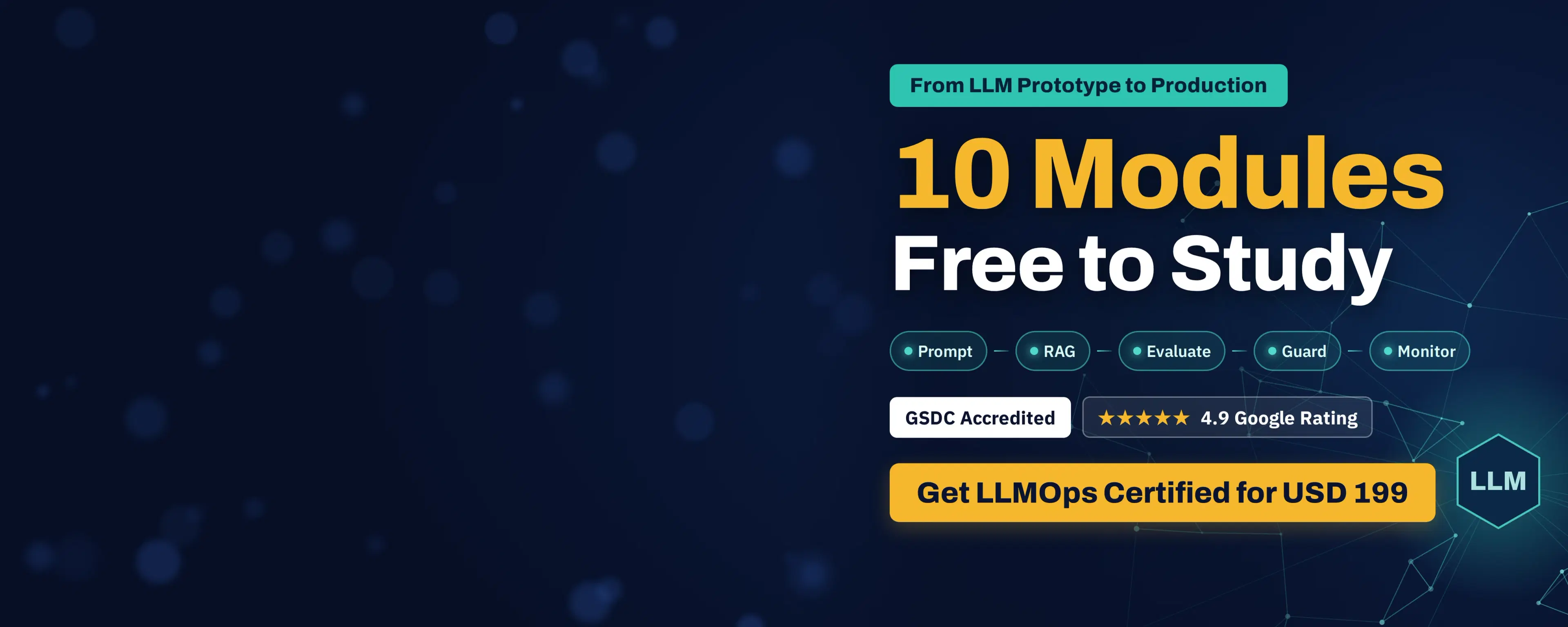
This LLMOps course gives you free study material for every module, a hands-on certification track, and the support you need to earn your LLMOps certification with confidence.
1. Free Self-Paced Learning
- Free study material for all 10 modules
- Slide decks, video lessons and real-world use cases
- Learn at your own pace, with no fixed schedule
2. Access Details
- Lifetime access to course content
- Multi-device access across laptop, tablet and mobile
- Structured learning roadmap from foundations to capstone
3. Certification Track Includes (USD 199)
- Hands-on production labs
- Quizzes, challenge zones and practice exams
- Production projects and a multi-model capstone
- AI tutor support for every module
4. Certification Support
- GSDC certification exam fee included
- Complimentary exam retake
- Practice exams that mirror the certification format
- Credential valid for 5 years
5. Career & Professional Value
- GSDC-accredited LLMOps credential, shareable on LinkedIn with a verifiable credential ID
- Production projects for your engineering portfolio
- Skills aligned with LLMOps, MLOps and AI Engineer roles in the US and global markets
6. Bonus Resources
- LLMOps best practices checklist
- Production deployment templates
- Private alumni network for peer learning and career opportunities
Eligibility+
This LLMOps certification course is ideal for engineers and technical professionals who build, deploy or support AI applications.
- AI and ML Engineers
- MLOps Engineers
- Platform Engineers
- Software and Backend Engineers
- GenAI and LLM Application Developers
- DevOps and SRE Professionals
- Data Engineers
- Cloud Engineers and Architects
- Solution Architects
- Technical Leads and Engineering Managers
- AI Product Owners
- Professionals moving into LLMOps Engineer roles
Whether you work at a fast-moving startup, a SaaS company or a large enterprise, this LLMOps training gives you skills you can apply to production AI systems right away.
Prerequisites+
There are no mandatory prerequisites for this LLMOps course, but it is built for learners with some hands-on AI experience.
- Familiarity with APIs and prompting
- Basic understanding of ML or AI concepts
- A working LLM prototype (RAG app, chatbot or agent) is ideal
- Basic Python and command-line skills will help in the labs
- No prior certification is required
If you are new to LLMs, start with our What is LLMOps guide, then move into the course.
Training Delivery Style+
This LLMOps training follows a flexible, practical, self-paced approach built for busy working professionals and engineering teams. Most learners complete the core modules in 4–8 weeks, studying 5–10 hours per week.
Flexible Self-Paced Learning
- Fully online, self-paced learning with no fixed schedule
- Free study material for all 10 modules
- Expert Studio videos, slide decks and use cases
- Multi-device access from home, office or while traveling
Practical Hands-On Learning
Every module helps you apply concepts to real production problems, not just understand the theory.
- Hands-on production labs in the Playground
- Real-world use cases and production scenarios
- Building and debugging RAG pipelines
- Setting up evaluation, tracing and guardrails
- Production projects throughout the course
- Capstone deployment of a complete AI application
Certification-Focused Preparation
- Quizzes and gamified knowledge checks
- Challenge zones with themed assessments
- Practice exams that mirror the certification format
- AI tutor support whenever you get stuck
Tools & Technologies+
Learners gain hands-on experience with the production tools AI teams use to deploy, monitor and secure LLM applications.
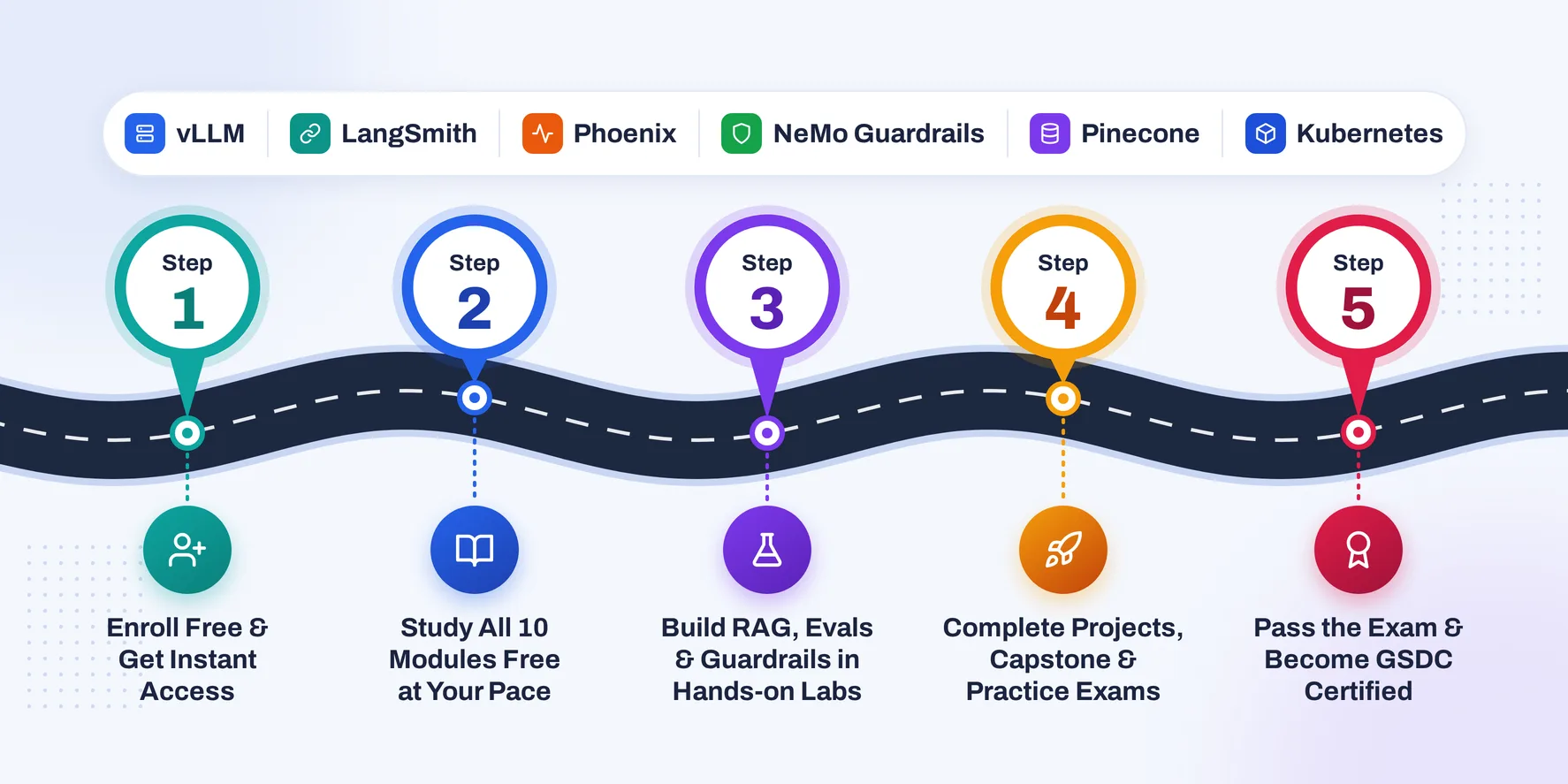
- vLLM for model serving
- pgvector and Pinecone vector databases
- LangSmith and Phoenix for tracing and observability
- OpenTelemetry for instrumentation
- NeMo Guardrails and LlamaGuard for AI safety
- LoRA for parameter-efficient fine-tuning
- Docker and Kubernetes for deployment
- CI/CD pipelines for LLM releases
Key Benefits+
Practical LLMOps Skills Develop hands-on expertise in model serving, RAG pipelines, evaluation, observability and guardrails using the same tools production AI teams rely on.
Strong Career Growth Opportunities LLMOps is a fast-growing AI skill area as companies move generative AI from pilot to production. This certification strengthens your profile for LLMOps Engineer, MLOps Engineer and AI Engineer roles in the US and global markets.
Industry-Recognized Certification Earn a GSDC-accredited LLM certification that validates your ability to run AI systems in production, with a credential valid for 5 years.
Real-World Implementation Exposure Work with vLLM, LangSmith, Phoenix, NeMo Guardrails, pgvector and Pinecone through labs, projects and a capstone.
Cost and Quality Control Learn to cut inference spend with routing and caching, and protect quality with golden datasets and CI release gates.
Free to Start, Flexible to Finish Study every module free at your own pace, and upgrade to the certification track only when you are ready.
LLMOps Certification Exam Details+
- Exam Type: Multiple-choice questions
- Total Questions: 42
- Exam Duration: 90 minutes
- Passing Score: 70%
- Proctored: Yes
- Language: English
- Certification: GSDC LLMOps & AI Production Deployment Certification
- Validity: 5 years
- Retake: Complimentary
Learning Support+
The program combines free study material, hands-on practice and on-demand support to take you from your first module to certification.
- Structured learning roadmap across 10 modules
- Slide decks, video lessons and use cases
- Expert Studio videos and guided reflections
- Hands-on "learn by doing" production labs
- AI tutor for questions on any module
- Quizzes, challenge zones and practice exams
- Production projects and capstone support
- Community access for peer discussion
- LLMOps checklist and deployment templates
- End-to-end journey from free learning to certification
LLMOps Certification Exam Format
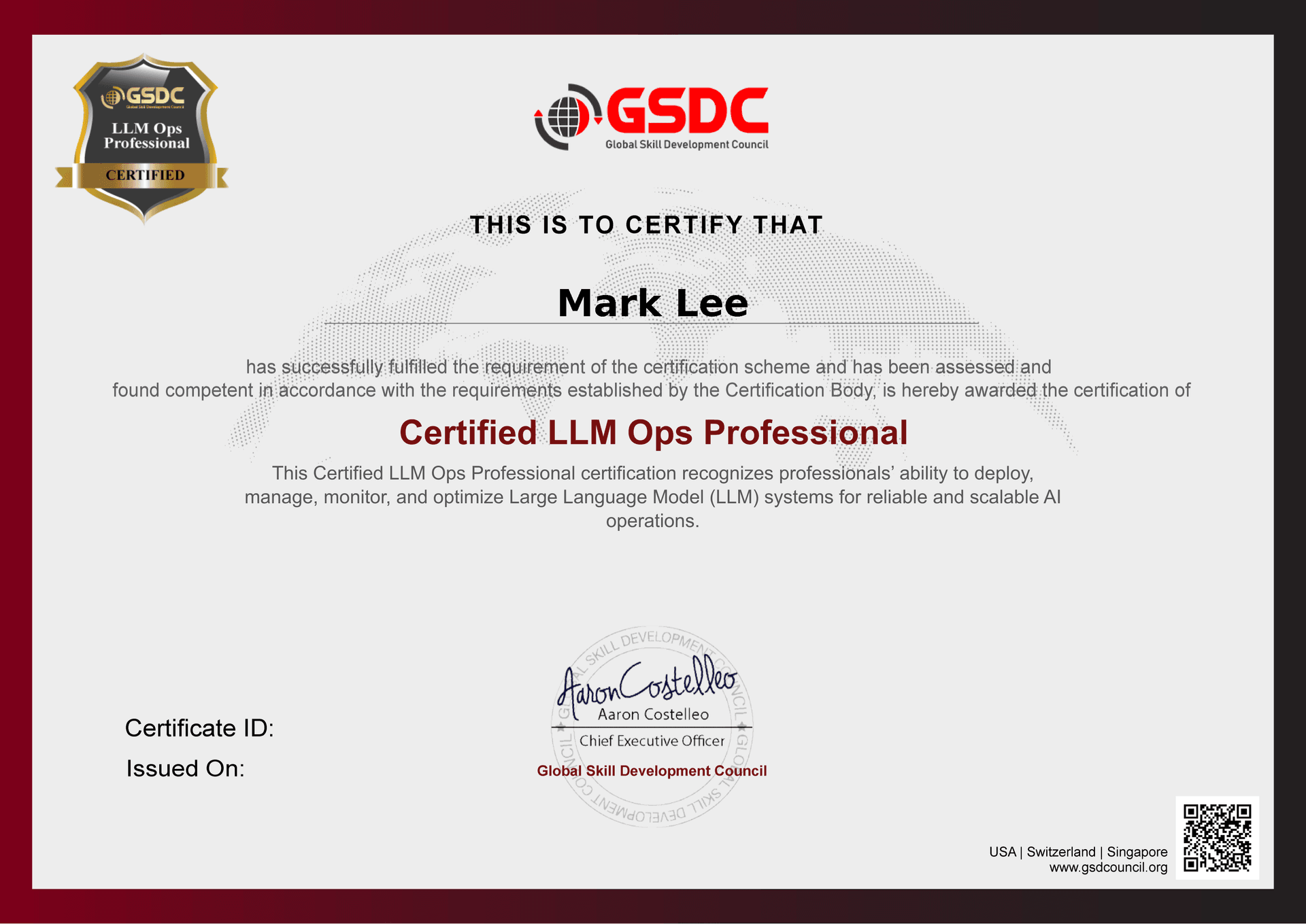
Exam Format - Objective Type, Multiple Choice
Exam Duration - 90 minutes
No. of Questions - 42 (multiple-choice questions)
Passing Criteria - 70%
Certificate - Within 5 business days
Result - Within 4–5 business days
Open Book: No
LLMOps Course & Certification Roadmap