Category | AI And ML
Last Updated On 13/10/2026
Building an AI chatbot is one thing. Designing an AI system that securely serves thousands of employees, integrates with enterprise applications, and delivers measurable business value is a different challenge altogether.
This AI Solution Architect Roadmap explains how to progress from foundational programming and AI knowledge to cloud architecture, generative AI, enterprise integration, production deployment, and technical leadership. You'll discover which skills to prioritize, what technologies to practice, which projects to build, and how to organize your learning over 12 months.
Whether you're a beginner or an experienced IT professional looking to move into AI architecture, this guide provides a practical route toward enterprise-ready capabilities in 2026.
An AI Solution Architect designs end-to-end AI systems that solve business problems while meeting security, performance, integration, and operational requirements.
Unlike someone focused exclusively on building machine learning models, an architect determines how models, data, applications, infrastructure, and governance controls work together.
If you're unfamiliar with the position, start with our guide on What is an AI Solution Architect.
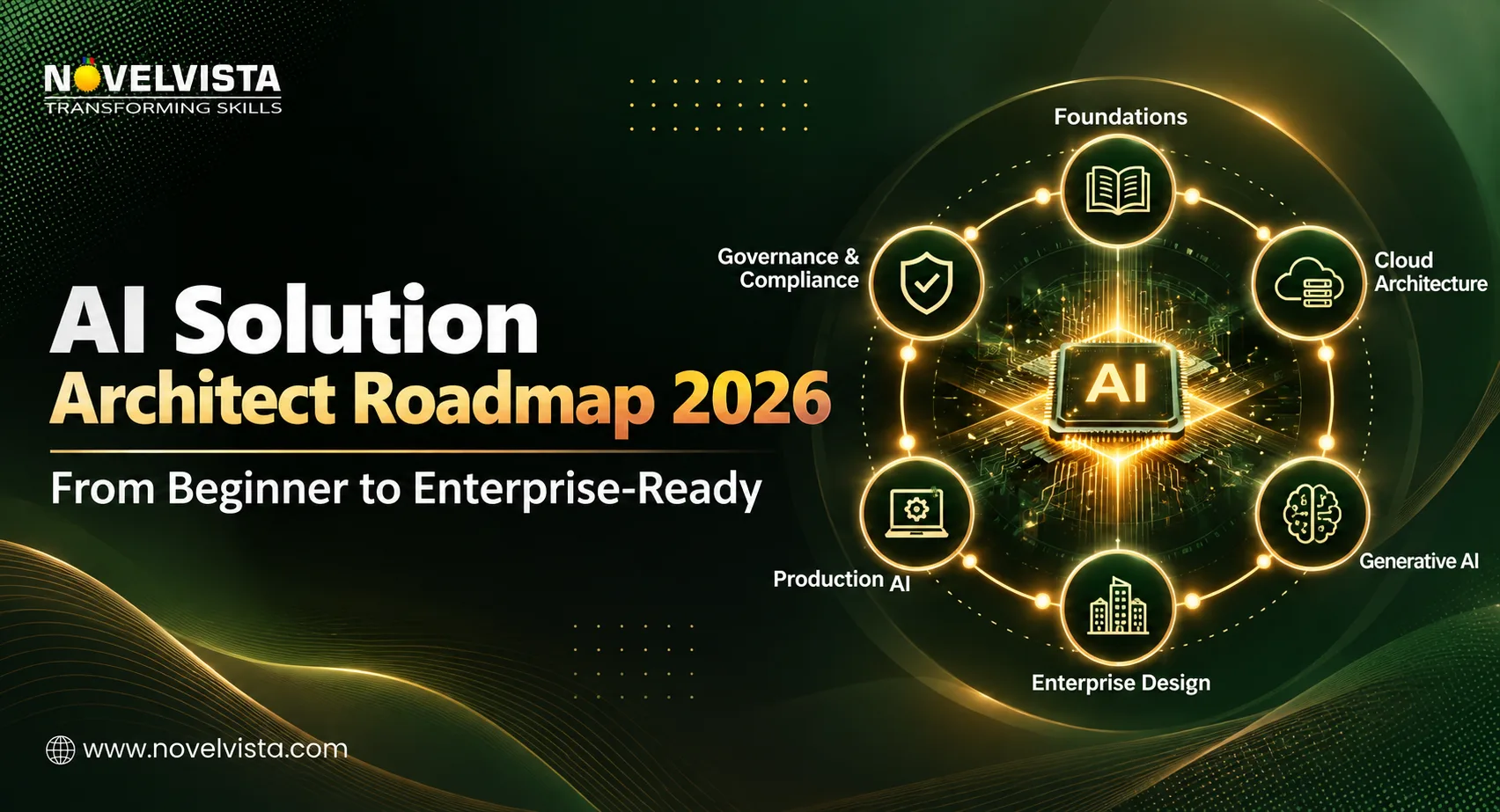
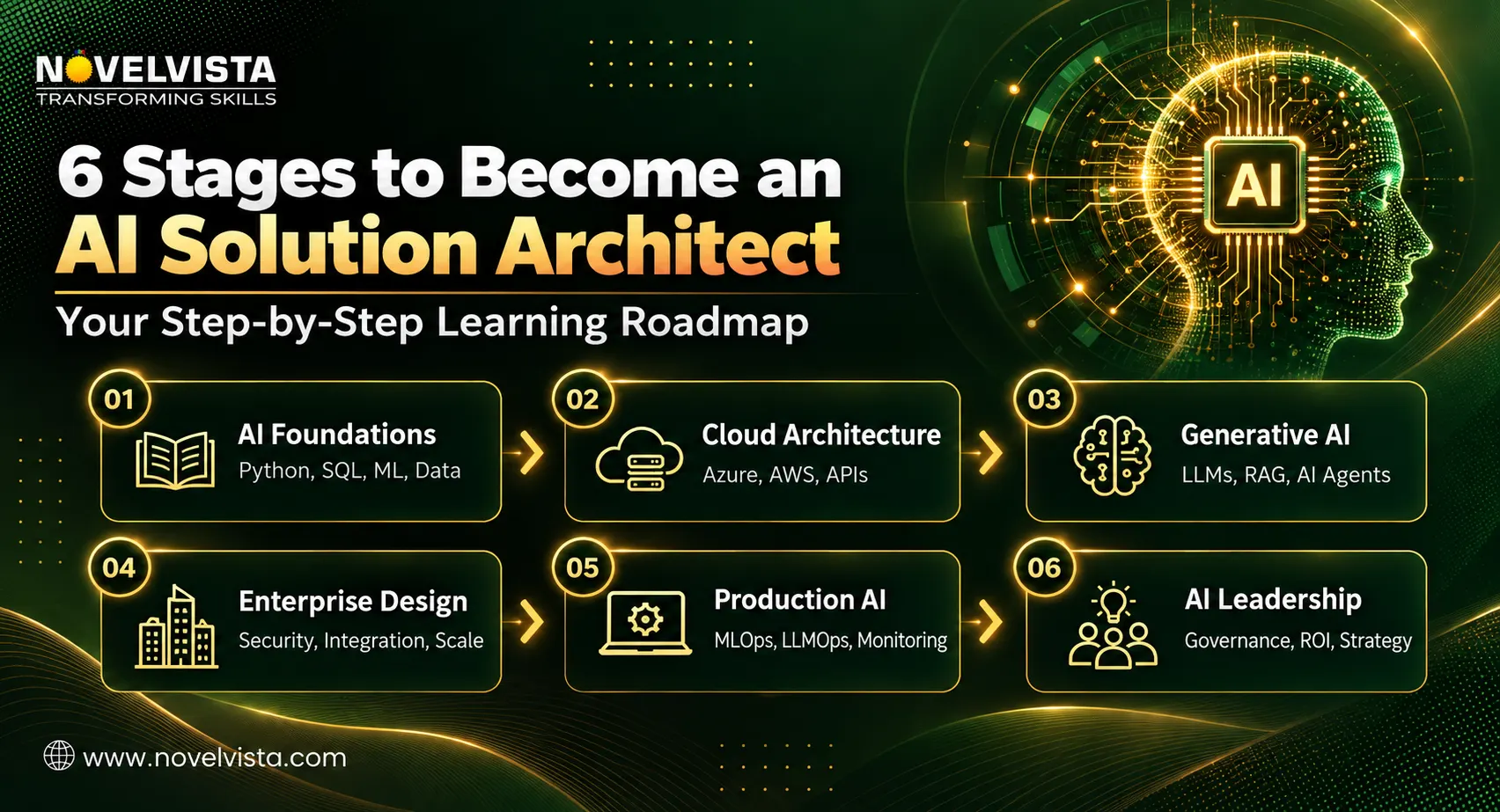
The AI architecture roadmap can be organized into six progressive stages.
| Stage | Main Learning Focus | Expected Outcome |
|---|---|---|
| 1. Foundations | Python, AI, ML, and data | Build a basic AI application |
| 2. Cloud Architecture | Cloud services, APIs, and system design | Create an architecture diagram |
| 3. Generative AI | LLMs, RAG, and AI agents | Build a knowledge assistant |
| 4. Enterprise Design | Integration, governance, and scalability | Design an enterprise AI solution |
| 5. Production Operations | MLOps, LLMOps, and monitoring | Deploy and monitor an AI service |
| 6. Leadership | Business strategy, risk, and communication | Defend architecture decisions |
These stages build on one another. However, professionals with existing software, data, or cloud experience can accelerate through the areas they already understand.
A successful AI architect learning path begins with understanding how software processes information and how AI systems learn from data.
You don't need to become a research scientist. You do need enough technical knowledge to recognize model limitations, evaluate engineering decisions, and communicate effectively with development teams.
Prioritize four practical skills:
Practice using Pandas, NumPy, and a lightweight API framework such as FastAPI.
Learn the differences between supervised, unsupervised, and reinforcement learning.
Understand classification, regression, neural networks, training, validation, overfitting, and model evaluation. Explore transformers and how large language models generate responses.
Learn why dataset quality, data leakage, and evaluation methods directly affect the reliability of AI solutions.
Practical milestone: Build a small classification application, expose its predictions through an API, and document how you evaluate its accuracy.
Modern AI solutions rarely operate independently. They connect to databases, cloud services, identity systems, existing applications, and external APIs.
That's why cloud and system design are essential components of the AI Solution Architect roadmap for beginners.
The AI Solution Architect Roadmap becomes more practical when you connect cloud services to real application requirements.
Explore the foundations of three major providers:
Choose one cloud platform for hands-on practice before expanding to others.
Study microservices, event-driven architecture, containers, load balancing, caching, and message queues.
Understand how applications communicate through APIs and how to design systems that remain available when components fail.
An AI architect must also consider network boundaries, authentication, encryption, logging, and disaster recovery.
Practical milestone: Create a cloud architecture diagram for an AI-powered customer support application, showing how requests move through APIs, AI models, databases, and security services.
Generative AI is a major part of the AI Solution Architect Roadmap in 2026. Enterprises increasingly need systems that can work with organizational information, support employees, and automate controlled workflows.
Learn how large language models process prompts and why their outputs require evaluation.
Study embeddings, vector search, document chunking, retrieval, and reranking.
Retrieval-Augmented Generation, or RAG, connects a language model to external knowledge, allowing applications to generate answers grounded in relevant documents.
For example, an internal HR assistant could retrieve approved policy documents before answering employee questions.
Microsoft's Azure Architecture Center recommends structured evaluation of retrieval quality, system behavior, and the final user experience when developing RAG applications.
AI agents can select tools, retrieve information, and execute permitted actions.
Practice with frameworks such as LangChain, LangGraph, or equivalent orchestration tools.
Focus on:
Start with a predictable workflow before attempting complex multi-agent systems.
Practical milestone: Build a document-grounded assistant with citations, access controls, an evaluation dataset, and a clear fallback when the answer cannot be verified.
An enterprise architect must make decisions that extend beyond model performance.
Your AI Solution Architect skills roadmap should now focus on balancing technical capability with operational cost, compliance, maintainability, and business outcomes.
Study how AI applications interact with ERP platforms, CRM systems, data warehouses, identity providers, and internal services.
Consider synchronous APIs, asynchronous messaging, event-driven pipelines, and hybrid-cloud deployments.
An architecture should define where information is stored, which services can access it, and what happens when dependencies become unavailable.
Enterprise architecture requires answering questions such as:
Use architecture decision records to explain the options, constraints, assumptions, and reasons behind each choice.
The AWS Well-Architected Generative AI Lens provides guidance across operational excellence, security, reliability, performance efficiency, cost optimization, and sustainability.
Practical milestone: Produce a complete architecture proposal for a secure enterprise knowledge assistant, including a system diagram, cost assumptions, security controls, and design tradeoffs.
A prototype that performs well during a demonstration may behave differently with real employees, changing data, and production traffic.
Following the AI architecture roadmap means learning how to operate AI systems throughout their lifecycle.
Learn continuous integration and deployment, automated testing, containerization, infrastructure as code, and version management.
Explore Docker, Kubernetes, MLflow, and cloud-native deployment services.
Understand how teams manage model versions, prompts, datasets, application releases, and rollbacks.
Production AI systems need more than server uptime monitoring.
Track:
Define acceptable thresholds before deployment and establish procedures for investigating failures.
Practical milestone: Deploy an AI API with monitoring dashboards, automated tests, version control, and documented rollback procedures.
Technical competence alone doesn't make someone enterprise-ready.
An AI architect must translate business requirements into technology choices and explain those choices to engineering teams, executives, and risk stakeholders.
Learn to identify suitable use cases, estimate implementation costs, and define measurable success criteria.
For a customer service solution, relevant metrics might include resolution time, escalation rate, user satisfaction, and cost per interaction.
Explain what the system can realistically achieve and where human intervention remains necessary.
Study privacy, fairness, transparency, accountability, model risk, and access management.
The NIST AI Risk Management Framework and its Generative AI Profile offer useful guidance for identifying, evaluating, and managing AI risks.
For agent-based systems, pay particular attention to restricted permissions, traceable actions, and human oversight.
Practical milestone: Present your architecture proposal as if you were seeking approval from a company's technical architecture and risk review board.
The right tools help you turn architectural knowledge into working solutions. However, the objective isn't to master every framework. It's to understand which technologies fit particular requirements.
The following technology matrix makes the AI architect learning path easier to prioritize.
| Skill Category | Example Technologies | What You Should Be Able to Do |
|---|---|---|
| Programming | Python, SQL, FastAPI | Build and integrate services |
| AI and ML | PyTorch, scikit-learn | Understand and evaluate models |
| Cloud Platforms | Azure, AWS, Google Cloud | Design cloud-native solutions |
| Generative AI | LLM APIs, LangChain, LangGraph | Build AI workflows |
| Retrieval | FAISS, pgvector, managed vector search | Implement grounded retrieval |
| Containers | Docker, Kubernetes | Package and deploy applications |
| MLOps and LLMOps | MLflow, CI/CD pipelines | Manage releases and evaluation |
| Security | IAM, encryption, secrets management | Protect systems and data |
| Monitoring | OpenTelemetry, cloud monitoring | Trace requests and investigate failures |
Start with one tool from each essential category. Add alternatives when a specific project requires them.
The following AI Solution Architect roadmap for beginners divides the learning journey into manageable milestones.
It assumes consistent part-time study and hands-on practice. Completing the plan does not automatically qualify someone for a senior enterprise role. Actual readiness depends on previous experience, project complexity, and opportunities to work with production systems.
| Timeline | Learning Priorities | Practical Deliverable |
|---|---|---|
| Months 1–3 | Python, SQL, APIs, ML fundamentals | Basic AI application |
| Months 4–6 | Cloud design, LLMs, RAG, system integration | Cloud-hosted AI assistant |
| Months 7–9 | Enterprise security, MLOps, evaluation, monitoring | Production-style deployment |
| Months 10–12 | Governance, architecture decisions, portfolio reviews | Enterprise architecture case study |
A practical schedule might include:
If you already work as a cloud engineer, software architect, or data engineer, spend less time repeating foundational material and more time on missing AI competencies.
Employers need evidence that you can move beyond tutorials and evaluate real engineering constraints.
Your portfolio should demonstrate not only working applications but also design reasoning, security considerations, testing, and operational planning.
A strong AI Solution Architect Roadmap should produce portfolio evidence that shows both working systems and sound architecture decisions.
Build a RAG system that answers questions using approved company documents.
Include document ingestion, permission-aware retrieval, source citations, evaluation tests, and an architecture diagram.
Design a workflow that extracts information from invoices or other structured documents, validates results, and integrates with a business application.
Include error handling, human review for uncertain extractions, and monitoring.
Create an AI workflow that reads a support ticket, retrieves relevant information, suggests an action, and requests human approval before performing sensitive operations.
Document the agent's tool permissions, audit trail, and failure handling.
For every project, prepare a concise case study explaining the business problem, architecture, tradeoffs, security model, cost assumptions, and test results.
These materials help reviewers understand how you think as an architect.
The AI Solution Architect career path isn't identical for everyone.
Software developers may transition through AI engineering. Data engineers often expand into machine learning platforms. Cloud engineers and existing solution architects may already understand infrastructure and enterprise integration.
The distinction between specialized AI architecture roles and broader solution architecture responsibilities is explained in AI Architect vs Solution Architect.
Relevant options include cloud architecture certifications, cloud AI engineering credentials, security education, and specialized AI solution architecture training.
Certifications can validate structured knowledge, but they should complement practical projects and professional experience.
Before applying for architecture responsibilities, use this readiness checklist.
If you can demonstrate these abilities through documented work, you'll have stronger evidence of architectural readiness.
Becoming an enterprise-ready AI Solution Architect requires more than familiarity with AI tools. You need a combination of programming, cloud architecture, generative AI, system design, production operations, governance, and business communication.
This AI Solution Architect Roadmap provides a structured progression, but the most valuable learning comes from solving real problems, documenting design choices, and testing solutions under practical constraints.
For guided development, explore NovelVista's AI Solution Architect Learning Roadmap and its AI Solution Architect Certification program.
Both resources can support your learning goals as you build the technical and architectural capabilities required for AI-focused enterprise solutions.
Start with one stage, complete a meaningful project, and build toward the next level of responsibility.
Author Details

Confused About Certification?
Get Free Consultation Call
Stay ahead of the curve by tapping into the latest emerging trends and transforming your subscription into a powerful resource. Maximize every feature, unlock exclusive benefits, and ensure you're always one step ahead in your journey to success.