Category | AI And ML
Last Updated On 26/08/2026
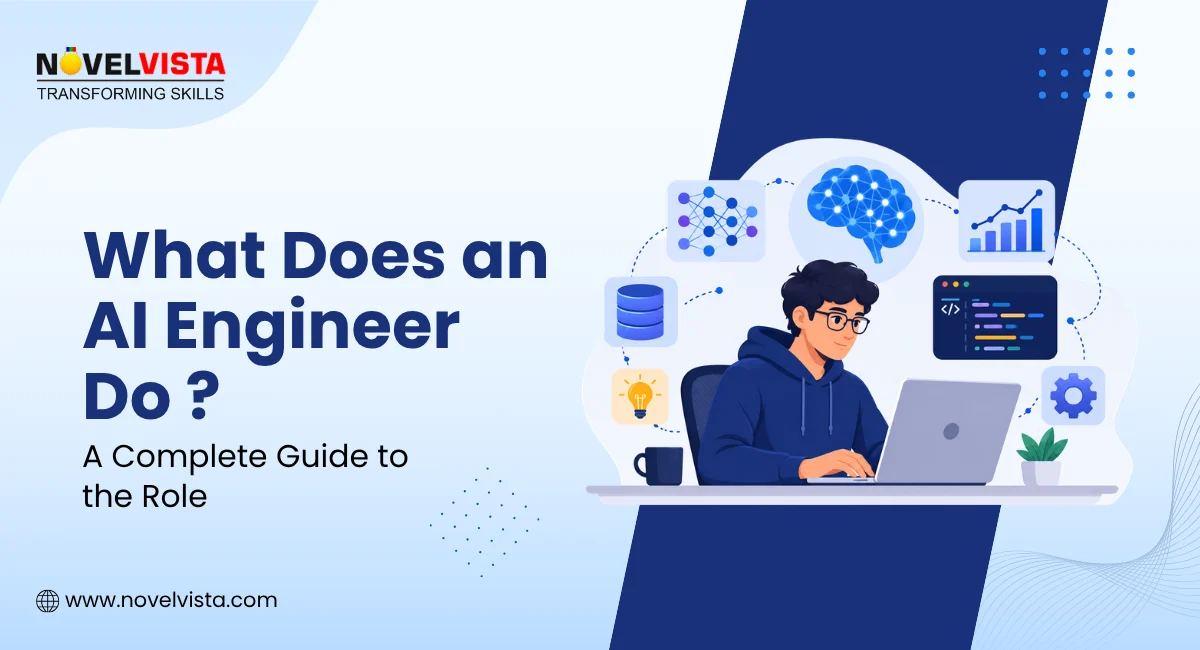
If you are researching what does an ai engineer do, this guide covers the role from end to end: what AI engineers build, their daily responsibilities, the skills and tools they use, how they work with data and models, how the role differs from adjacent AI jobs, and how professionals can prepare for this career.
AI engineering has moved well beyond experimentation. Organizations now need professionals who can transform AI models into secure, scalable, reliable, and measurable applications that work in real production environments.
This guide explains the complete AI engineering lifecycle, from understanding business requirements and selecting models to integrating data, evaluating outputs, deploying applications, monitoring performance, and applying security and governance controls.
An AI engineer is a technical professional who designs, integrates, deploys, and maintains AI-powered systems. The role combines elements of software development, machine learning, data engineering, cloud computing, and increasingly generative AI engineering.
If you are asking what is an ai engineer in practical terms, think of someone who bridges the gap between an AI model and a usable business application.
A model alone is not a complete solution. It must be connected to data, application logic, APIs, security controls, monitoring systems, cloud infrastructure, and an appropriate user experience.
Modern AI engineers are therefore increasingly responsible for whether the complete system is:
The second part of understanding what is an ai engineer is recognizing that the job is not limited to model development. In many organizations, the engineer owns significant parts of the journey from prototype to production.
The question who is an ai engineer is best answered by looking at where this professional operates inside a modern technology team.
AI engineers commonly work between:
In many organizations, an AI engineer is not spending every day training a large model from scratch. Instead, the engineer may select an existing model, connect it to enterprise data, build retrieval pipelines, expose capabilities through APIs, create evaluation systems, apply guardrails, deploy the application, and monitor it after release.
This explains who is an ai engineer in the current enterprise environment: a professional responsible for converting AI capabilities into dependable systems that solve real business problems.
Understanding what does an ai engineer do becomes easier when the role is viewed through the complete AI application lifecycle.
AI engineers first determine whether AI is appropriate for the problem. They collaborate with product owners, analysts, domain experts, and business stakeholders to define expected outcomes, constraints, risks, and success metrics.
For example, a request to build a customer support chatbot must be translated into measurable requirements such as response quality, source grounding, escalation rules, latency targets, privacy controls, and acceptable operating cost.
An engineer may compare proprietary APIs, open-source models, smaller specialized models, or conventional machine learning approaches.
Production decisions typically balance:
The architecture may include a model endpoint, retrieval system, vector database, application layer, authentication, caching, monitoring, tool integrations, and fallback logic.
AI applications depend on reliable and relevant data. Engineers may clean datasets, build ingestion pipelines, define document chunking strategies, create embeddings, manage indexes, connect APIs, and validate data quality.
For generative AI applications, this frequently includes Retrieval-Augmented Generation, or RAG, where trusted enterprise information is retrieved and provided to the model when answering a request.
AI engineers often use Python, SQL, REST APIs, application frameworks, and cloud platforms to integrate AI capabilities into websites, internal tools, mobile applications, automation systems, customer-service platforms, and enterprise workflows.
Production applications may also require structured outputs, function calling, retry mechanisms, validation, rate-limit handling, model routing, and error recovery.
Evaluation is a major part of modern AI engineering. Engineers build test datasets, define quality metrics, compare model or prompt changes, evaluate retrieval accuracy, track hallucination risks, and identify regressions before release.
Useful metrics may include:
After deployment, engineers monitor availability, latency, model errors, token consumption, infrastructure utilization, retrieval performance, output quality, API failures, and cost.
They may use containers, CI/CD pipelines, cloud infrastructure, automated tests, and observability platforms to keep the application stable as models, prompts, data, and business requirements change.
Production AI introduces risks involving sensitive information, prompt injection, excessive agent permissions, biased outputs, hallucinations, and unsafe automated actions.
AI engineers therefore implement controls such as authentication, authorization, input validation, output validation, audit logs, least-privilege access, AI guardrails, source restrictions, and human approval workflows where required.
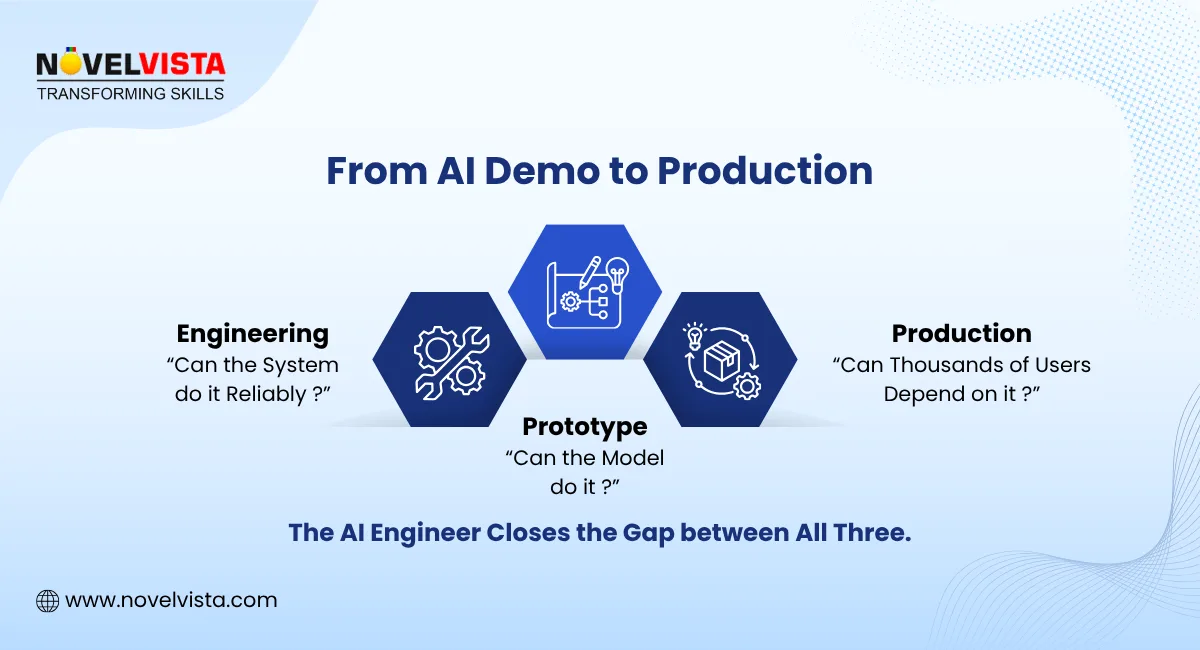
A practical way to understand ai engineer roles and responsibilities is to organize them across the complete AI lifecycle rather than treating them as isolated programming tasks.
| Responsibility Area | Typical Activities | Business Outcome |
|---|---|---|
| Problem Definition | Translate business use cases into technical requirements and measurable success criteria | Clear scope and measurable value |
| Model Selection | Compare models based on quality, latency, cost, security, and deployment constraints | Fit-for-purpose AI solution |
| Data and Retrieval | Build data pipelines, embeddings, indexes, and enterprise data connections | Relevant and trusted context |
| Application Engineering | Develop APIs, workflows, tool calls, integrations, and application logic | Usable AI-powered products |
| Evaluation | Test accuracy, relevance, reliability, safety, and regressions | More dependable outputs |
| Deployment | Containerize, release, scale, automate, and manage infrastructure | Production readiness |
| Observability | Track latency, errors, output quality, usage, and cost | Faster issue identification |
| Security and Governance | Implement permissions, privacy controls, guardrails, validation, and auditability | Reduced security and compliance risk |
The exact ai engineer roles and responsibilities depend on company size and AI maturity.
In a startup, one engineer may own nearly the entire lifecycle. In a large enterprise, responsibilities may be distributed across AI engineering, machine learning engineering, data engineering, platform engineering, cybersecurity, governance, and LLMOps teams.
A modern ai engineer job description typically combines software engineering fundamentals with practical AI delivery capabilities.
Employers increasingly look for professionals who can move beyond experimentation and build AI applications that can be deployed, tested, secured, monitored, and improved over time.
A representative role may include responsibilities such as:
However, candidates should read each ai engineer job description carefully because the same title can describe different levels of responsibility for model development, software integration, cloud infrastructure, data pipelines, and production operations.
The answer to what skills does an ai engineer need is much broader than simply learning Python and machine learning.
Modern AI engineering requires a balanced combination of software development, AI fundamentals, data engineering, generative AI, cloud deployment, security, and communication skills.
Python is widely used for AI development, while SQL remains essential for working with operational and analytical data.
Important software engineering capabilities include:
AI engineers should understand core concepts such as:
They should also be able to recognize situations where conventional machine learning may solve a problem more efficiently than a large language model.
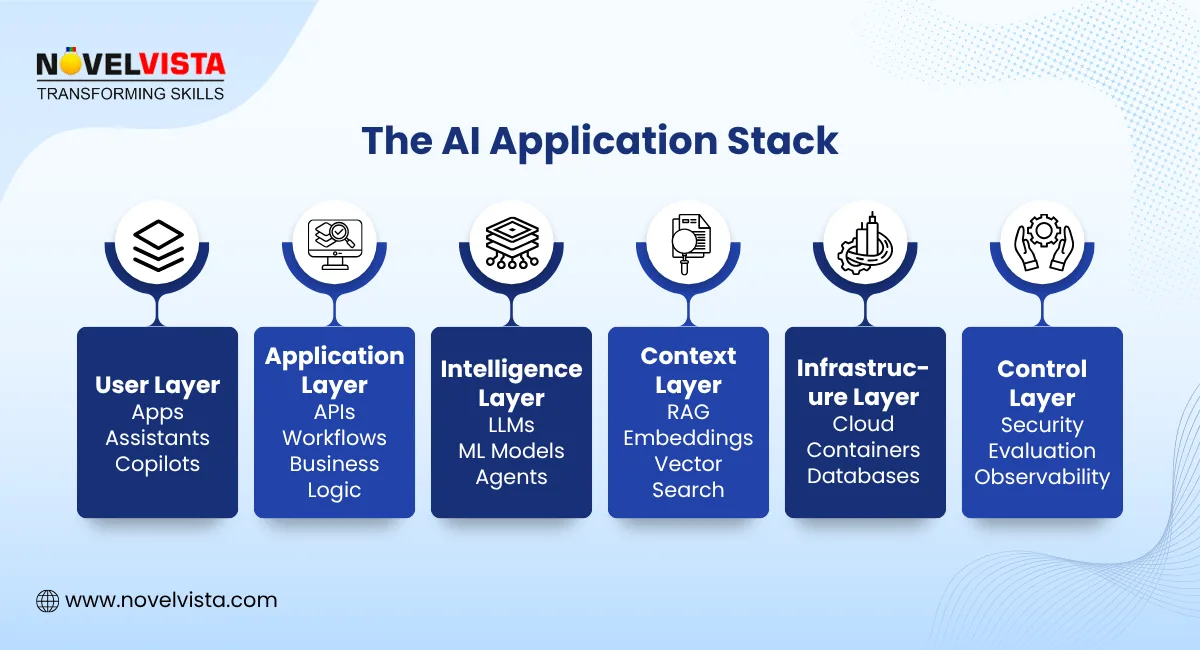
Modern roles increasingly involve:
This demonstrates why generative AI engineering extends far beyond writing prompts.
Professionals should be comfortable handling structured and unstructured data through preprocessing, database querying, ETL workflows, document processing, indexing, data validation, and pipeline development.
Knowledge of AWS, Microsoft Azure, or Google Cloud is valuable because production AI workloads are frequently deployed using cloud infrastructure.
Relevant operational capabilities include:
Engineers should understand data privacy, authentication, authorization, prompt injection, sensitive-data handling, output validation, auditability, responsible AI principles, and human oversight.
Technical expertise alone is not enough. AI engineers must explain model limitations, communicate risk, define measurable outcomes, and negotiate technical trade-offs with both technical and non-technical stakeholders.
Therefore, anyone asking what skills does an ai engineer need should think in terms of complete production ownership rather than one programming language or framework.
The AI engineering tool ecosystem changes quickly, but the major technology categories remain relatively stable.
| Category | Common Examples |
|---|---|
| Programming | Python, SQL, JavaScript, Java, Go, C++ |
| Machine Learning | PyTorch, TensorFlow, scikit-learn, Keras |
| LLM Development | Hugging Face, model-provider APIs, LangChain, LlamaIndex |
| Retrieval | Vector databases, embedding models, semantic search systems |
| Application Layer | FastAPI, Flask, REST APIs, microservices |
| Data | Pandas, NumPy, Spark, Airflow, SQL and NoSQL databases |
| Deployment | Docker, Kubernetes, serverless platforms, cloud AI services |
| Operations | MLflow, monitoring, tracing, logging, CI/CD and evaluation frameworks |
The strongest engineers focus less on memorizing every framework and more on understanding the engineering problem each tool solves.
Frameworks will continue to change, but strong software, AI, data, security, and production engineering principles remain transferable.
AI engineering overlaps with machine learning engineering, data science, and software development, but the primary focus of each role is different.
| Role | Primary Focus | Typical Output |
|---|---|---|
| AI Engineer | Integrating, deploying, and operating AI inside products and workflows | Production AI applications and services |
| Machine Learning Engineer | Training, optimizing, serving, and maintaining machine learning models | High-performing models and ML pipelines |
| Data Scientist | Analysis, experimentation, statistical modeling, and prediction | Insights, experiments, prototypes, and predictive models |
| Software Engineer | General software and platform development | Reliable applications, APIs, services, and product features |
A machine learning engineer may spend more time optimizing training pipelines and model performance.
A data scientist may spend more time exploring datasets, testing hypotheses, analyzing patterns, and developing predictive models.
An AI engineer generally focuses more heavily on transforming AI capabilities into complete operational services by combining models with software, data, APIs, cloud systems, evaluation, security, and monitoring.
However, organizations define these titles differently, so actual job responsibilities and technology requirements are often more informative than the title itself.
Consider an organization that wants to create an internal AI assistant capable of answering employee questions about company policies and procedures.
An AI engineer might:
The responsibility does not end after launch.
If company policies change, the engineer must ensure updated documents are ingested, indexes remain current, evaluation tests still pass, and the application does not continue returning outdated information.
This example demonstrates why AI engineering is fundamentally systems engineering. Success depends on the complete application, not simply the underlying model.
AI engineers are increasingly required across industries as artificial intelligence becomes embedded in mainstream products, enterprise platforms, analytics systems, and automated workflows.
Common industries include:
The applications can vary considerably. A bank may develop fraud-detection or document-processing applications, while a retailer may create recommendation systems. Manufacturers may apply AI to predictive maintenance, while SaaS companies may integrate AI agents and copilots into their products.
Across these industries, the engineering objective remains similar: connect AI with real systems and business data while meeting reliability, performance, security, governance, and cost requirements.
A practical preparation strategy is to build AI engineering capabilities in layers rather than trying to master every framework at once.
A strong AI engineering portfolio should demonstrate more than a notebook or basic chatbot.
For each project, document:
The ability to explain why you designed a system in a particular way can be just as valuable during an interview as the final application itself.
Not necessarily. Many applied AI roles use existing foundation models or managed AI services and spend considerably more time on integration, evaluation, retrieval, deployment, security, and production reliability.
Prompting is useful, but production applications also require APIs, data pipelines, retrieval, validation, evaluation, monitoring, observability, security, and lifecycle management.
A demonstration proves that an idea can work under controlled conditions. Production requires reliability, scalability, governance, failure handling, monitoring, security, and cost management.
Successful engineers also need product thinking, stakeholder communication, risk awareness, documentation, and the ability to connect technical decisions with measurable business outcomes.
Understanding what does an ai engineer do means looking beyond model development. The role is about converting AI capability into dependable business applications by selecting appropriate models, connecting them with data, designing application architecture, creating integrations, evaluating outputs, deploying services, monitoring performance, controlling costs, and implementing security and governance.
As organizations move from AI experimentation toward enterprise deployment, professionals who can manage the complete AI application lifecycle are becoming increasingly important.
For developers, data professionals, machine learning practitioners, and technology professionals who want to build production-level AI capabilities, NovelVista's Certified AI Engineering Professional Course provides structured learning across modern AI engineering areas including LLM applications, RAG, embeddings, vector databases, AI agents, MCP, evaluation, guardrails, LLMOps, observability, Docker, cloud deployment, and CI/CD.
The objective is not simply to understand AI concepts but to develop the practical skills required to build, secure, evaluate, deploy, and operate modern AI applications in real-world environments.
Building expertise across the complete AI lifecycle can help professionals move beyond prototypes and become capable of creating AI systems that remain useful, reliable, secure, and measurable in production.
Author Details

Confused About Certification?
Get Free Consultation Call
Stay ahead of the curve by tapping into the latest emerging trends and transforming your subscription into a powerful resource. Maximize every feature, unlock exclusive benefits, and ensure you're always one step ahead in your journey to success.