Category | AI And ML
Last Updated On 13/08/2026
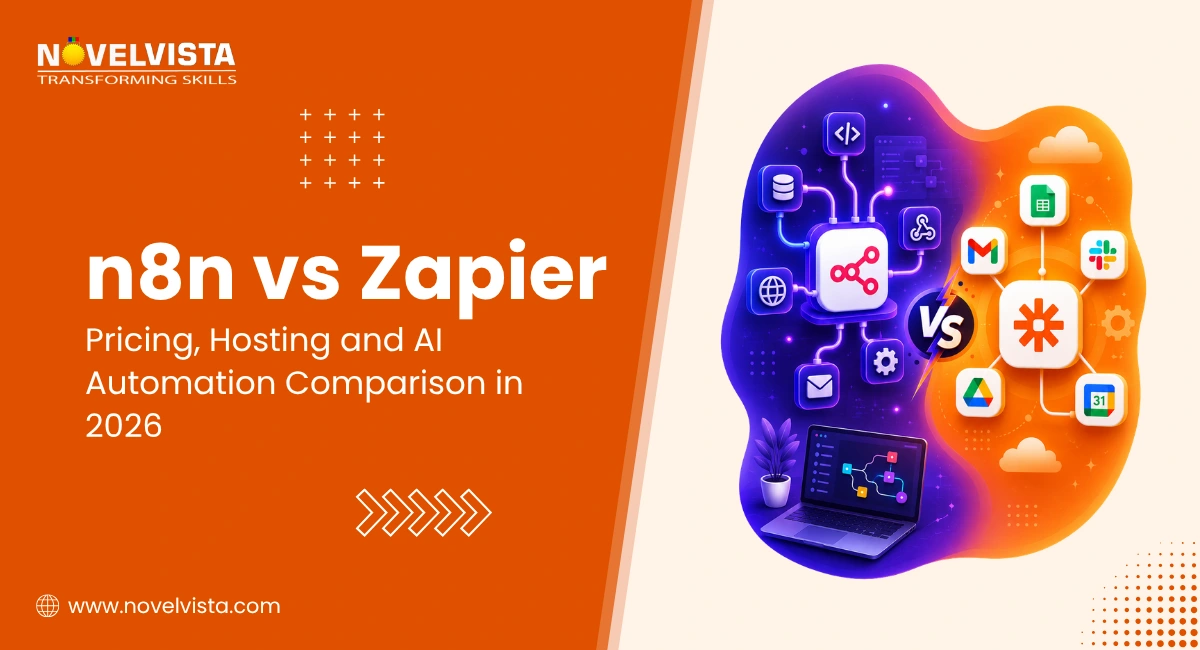
Automation is no longer just about connecting two apps and sending a notification. In 2026, businesses are using automation platforms to move customer data, orchestrate AI agents, transform documents, trigger business processes, connect APIs, and even build production-grade data pipelines.
That raises a practical question: n8n vs Zapier, which automation platform makes more sense for your business?
The answer is not simply about which tool is cheaper.
Zapier currently connects to 9,000+ apps, giving business teams an enormous no-code integration ecosystem. n8n, meanwhile, has evolved into a technical workflow automation platform with 1,900+ integrations listed in its ecosystem and support for custom API-based connections.
So, should you choose the simplicity of Zapier or the flexibility of n8n?
What happens when your workflow grows from three steps to 20? Does pricing remain predictable? How important is self-hosting? And when AI agents become part of the workflow, which platform gives technical teams more control?
This n8n vs Zapier comparison explores the differences that actually matter in 2026, including pricing, workflow execution models, integrations, hosting, data sovereignty, AI automation, and technical flexibility.
At a high level, both platforms solve the same problem: they connect applications and automate repetitive processes.
The difference is how they approach automation.
Zapier is primarily designed around accessible, managed automation. A user can select a trigger, add actions, configure fields, and launch a workflow without writing code.
n8n takes a more programmable approach. Its visual workflow builder still supports low-code development, but technical users can introduce APIs, JavaScript, custom logic, webhooks, data transformations, databases, AI components, and complex branching.
In simple terms:
Area | Zapier | n8n |
Core approach | Managed SaaS automation | Low-code, programmable automation |
Primary audience | Business and operations teams | Technical teams and developers |
Billing metric | Tasks | Workflow executions |
Hosting | Cloud-based SaaS | Cloud or self-hosted |
Integrations | 9,000+ apps | 1,900+ integrations in ecosystem |
Custom APIs | Available | Strong HTTP/API capabilities |
Complex logic | Good | Excellent |
AI workflows | AI steps, Agents, MCP | AI nodes, agents, RAG-oriented workflows |
Data control | Managed by provider | Greater control with self-hosting |
Infrastructure responsibility | Low | Higher when self-hosted |
This difference becomes especially important as automation volume increases.
Pricing is one of the biggest reasons businesses research n8n vs Zapier.
However, comparing the headline monthly price alone can be misleading. You first need to understand what each platform counts. If you want a deeper breakdown of plans, usage limits, and costs, our guide to n8n Pricing 2026 provides a closer look at what businesses should consider before choosing a plan.
Zapier uses a task-based model. A successful action generally consumes a task. For example, if a workflow receives a lead and then:
the workflow can consume multiple tasks even though the trigger occurred only once.
Zapier's current pricing page lists the Professional plan from $19.99/month, while Team starts from $69/month. The free plan includes 100 tasks per month.
Zapier has also expanded its pricing model in 2026. AI steps can consume different numbers of tasks depending on the model tier: Standard uses 1x, Advanced 3x, and Premium 5x task usage.
That means AI-heavy workflows need particularly careful cost forecasting.
n8n approaches usage differently.
One workflow execution represents a complete workflow run, with the number of steps inside the workflow not changing the basic execution count. n8n explicitly states that its pricing is based on monthly workflow executions regardless of workflow complexity.
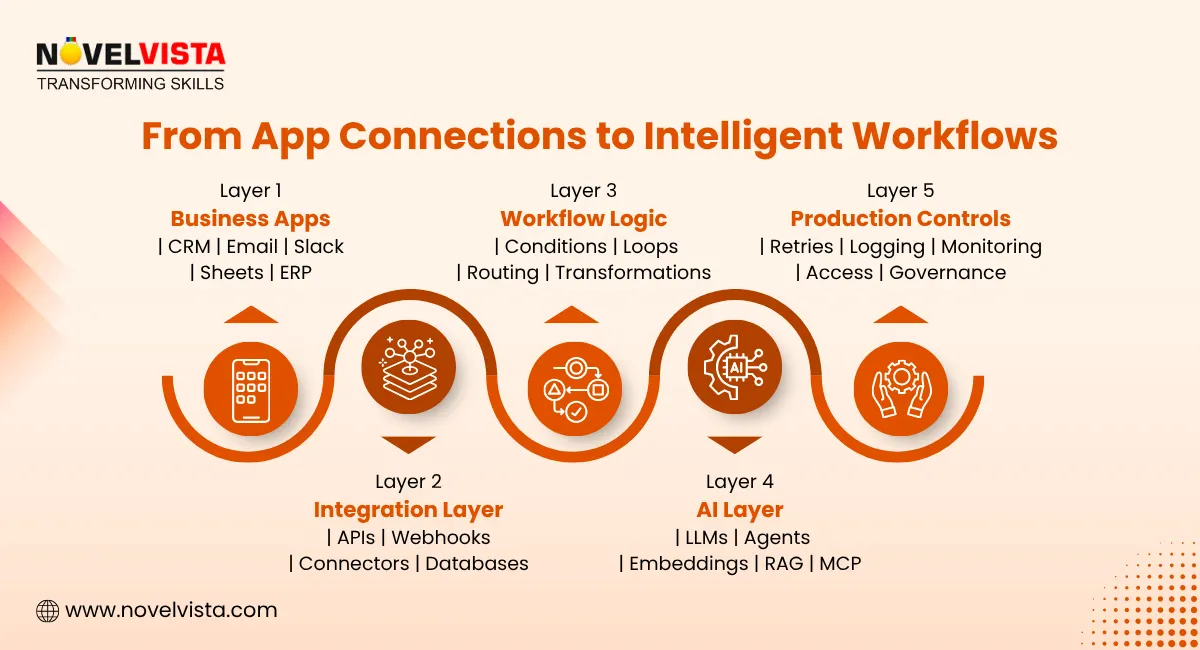
For example, consider a workflow containing 15 nodes:
Webhook → Validation → Database → API → Data transformation → AI model → Conditional logic → CRM → Email → Logging
If it runs once, n8n counts one workflow execution rather than charging separately for every workflow step.
That makes the n8n vs Zapier pricing comparison particularly interesting for complex workflows.
| Plan/Metric | Zapier | n8n Cloud |
| Free | $0, 100 tasks/month | Free trial |
| Entry paid plan | From $19.99/month | €20/month billed annually |
| Entry usage | 750 tasks on the listed Professional starting configuration | 2,500 executions/month |
| Next tier | Team from $69/month | Pro €50/month |
| Pro usage | Task-based | 10,000 executions/month |
| Higher tier | Enterprise, custom | Business €667/month, self-hosted |
| Billing basis | Tasks | Workflow executions |
n8n's current Starter plan lists 2,500 workflow executions for €20/month, while Pro lists 10,000 executions for €50/month, with unlimited steps.
The important lesson is that neither platform is automatically cheaper for every business.
A five-step automation running a few hundred times per month may be inexpensive on either platform. A complex workflow processing thousands of records can produce a very different cost profile.
Hosting is another major difference in the n8n vs Zapier decision.
Zapier is a managed SaaS platform. Your organization does not need to provision servers, manage Docker containers, configure Kubernetes, patch infrastructure, or maintain the automation platform.
That is a major advantage for teams that want automation without infrastructure management.
n8n provides both managed cloud and self-hosting options. Its documentation and pricing information support deployment through your own infrastructure, including Docker-based deployment.
Self-hosting can provide greater control over:
For example, an enterprise might want an automation workflow to process internal customer information without routing the workflow environment through a third-party SaaS architecture.
In that situation, self-hosted n8n can provide a significantly different control model.
But there is an important trade-off.
Self-hosting is not free in the operational sense.
Even if the software licensing economics are attractive, your organization may need to manage servers, backups, upgrades, security, availability, scaling, monitoring, and incident response.
Therefore, the real calculation is:
n8n self-hosting cost = infrastructure + operations + engineering time + maintenance
rather than simply:
software cost = $0
This is one of the most important considerations when evaluating n8n vs Zapier for enterprise automation.
Zapier has a significant advantage when the priority is breadth of ready-made integrations.
Its ecosystem currently includes more than 9,000 apps, covering CRM, marketing, productivity, communication, finance, project management, AI and many other categories.
That breadth matters because the fastest automation is often the one that already has a connector.
For example, a marketing team might want:
Typeform → CRM → Email → Slack → Google Sheets
If all the required connectors are available, a business user can build the workflow rapidly.
n8n approaches connectivity differently.
Its integration ecosystem has grown substantially, with its current integration directory showing more than 1,900 integrations. It also supports HTTP Request functionality for connecting services that do not have a dedicated node.
That distinction is important.
Zapier generally wins on pre-built SaaS coverage.
n8n can win on custom integration flexibility.
For a developer comfortable with REST APIs, GraphQL, JSON and authentication, an unavailable native connector does not necessarily stop an n8n workflow.
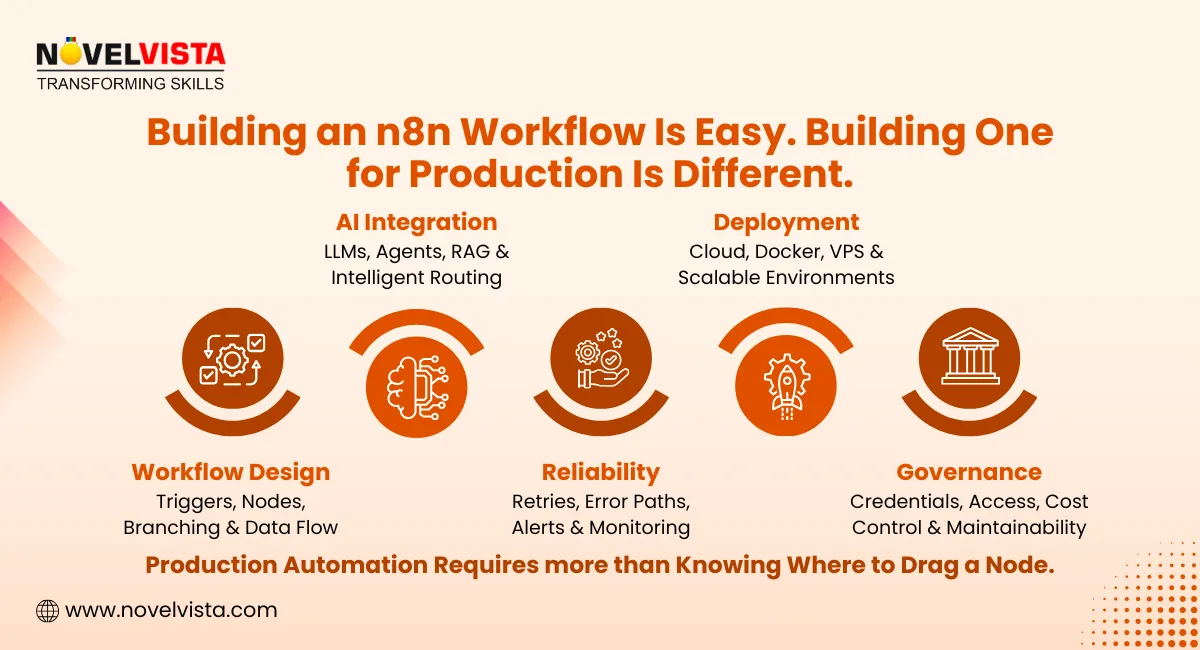
AI has changed the automation conversation.
Traditional automation followed a predictable pattern:
Trigger → Rule → Action
AI automation introduces another layer:
Trigger → Retrieve information → Interpret → Decide → Use tools → Validate → Act
This is where the n8n vs Zapier comparison becomes more technical.
Zapier has expanded beyond traditional Zaps with AI-powered capabilities, Agents, AI steps, MCP and SDK functionality. Its current platform connects AI assistants to its large application ecosystem through Zapier MCP, with the company describing access to more than 9,000 integrations.
This makes Zapier attractive when a company wants AI automation without building much infrastructure.
n8n takes a more modular approach to AI workflows. Its integration ecosystem includes AI agents, language models, memory, retrievers, embeddings, vector stores, tools and Model Context Protocol components.
That makes it particularly interesting for technical teams building workflows such as:
Document ingestion → Chunking → Embedding → Vector database → Retrieval → LLM → Validation → Business system
It can also support agentic workflows where an AI model determines which tools or workflow branches should be used.
Which Is Better for AI Automation?
It depends on your objective.
Choose Zapier when the priority is:
Choose n8n when the priority is:
Neither platform should automatically be labelled the "best AI automation tool." The better question is whether your organization needs managed AI automation or programmable AI orchestration.
This is perhaps the simplest way to understand the n8n vs Zapier debate.
Zapier is designed to reduce the technical barrier.
A marketing manager, HR professional or operations specialist can often build a useful workflow without understanding APIs, authentication protocols or JavaScript.
n8n has a visual interface too, but its capabilities encourage deeper technical involvement.
A developer can manipulate JSON, call APIs, transform datasets, introduce custom code, connect databases and create complex workflow branches.
So the choice can be viewed as:
Zapier = faster time to first automation
n8n = greater control over complex automation
For organizations with a strong engineering team, that distinction can become strategically important.
There is no universal winner.
Use this decision framework:
| Business Requirement | Better Fit |
| Marketing automation | Zapier |
| HR workflows | Zapier |
| Simple SaaS integrations | Zapier |
| Non-technical users | Zapier |
| Rapid automation deployment | Zapier |
| Complex API workflows | n8n |
| Data transformation | n8n |
| Developer-led automation | n8n |
| Self-hosting | n8n |
| Custom AI pipelines | n8n |
| High workflow complexity | n8n |
| Strong infrastructure team | n8n |
A small business with straightforward workflows may value simplicity more than infrastructure control.
An engineering organization building hundreds of interconnected workflows may prioritize execution economics, custom logic and deployment flexibility.
The right platform is therefore determined by workflow complexity, technical capability, data requirements, volume and total cost of ownership, not simply the monthly subscription.

The n8n vs Zapier decision ultimately comes down to control versus convenience.
Zapier is a strong choice for organizations that prioritize simplicity, rapid no-code automation, and extensive SaaS integrations. n8n is better suited to technical teams that need complex workflows, custom APIs, AI automation, cost efficiency at scale, and greater infrastructure control.
Ultimately, the right platform depends on your team's skills, architecture, workload, and long-term automation strategy. For professionals looking to build practical expertise in n8n and AI-powered workflows, NovelVista's n8n AI Automation Course offers hands-on learning focused on real-world automation capabilities.
n8n can be more cost-efficient for complex workflows because its cloud plans are based on workflow executions rather than individual workflow steps. However, total cost also depends on hosting, infrastructure and engineering effort.
Zapier primarily uses task-based pricing, while n8n uses execution-based pricing. This can make a significant difference when a workflow contains many actions or processing steps.
n8n is well suited to technical AI automation, including agents, retrieval workflows, APIs and custom data pipelines. Zapier can be preferable when teams want simpler, managed AI automation across many SaaS applications.
n8n self-hosting provides greater control over infrastructure and data handling, but it also creates operational responsibilities. Zapier's managed hosting is easier for organizations that do not want to maintain automation infrastructure.
Choose Zapier for fast, no-code SaaS automation and n8n for complex, programmable and potentially self-hosted automation. The right choice depends on workflow complexity, technical skills, data requirements and long-term automation costs.
Author Details

Course Related To This blog
n8n — AI Workflow Automation & Agent Building
Confused About Certification?
Get Free Consultation Call
Stay ahead of the curve by tapping into the latest emerging trends and transforming your subscription into a powerful resource. Maximize every feature, unlock exclusive benefits, and ensure you're always one step ahead in your journey to success.