Category | AI And ML
Last Updated On 25/08/2026
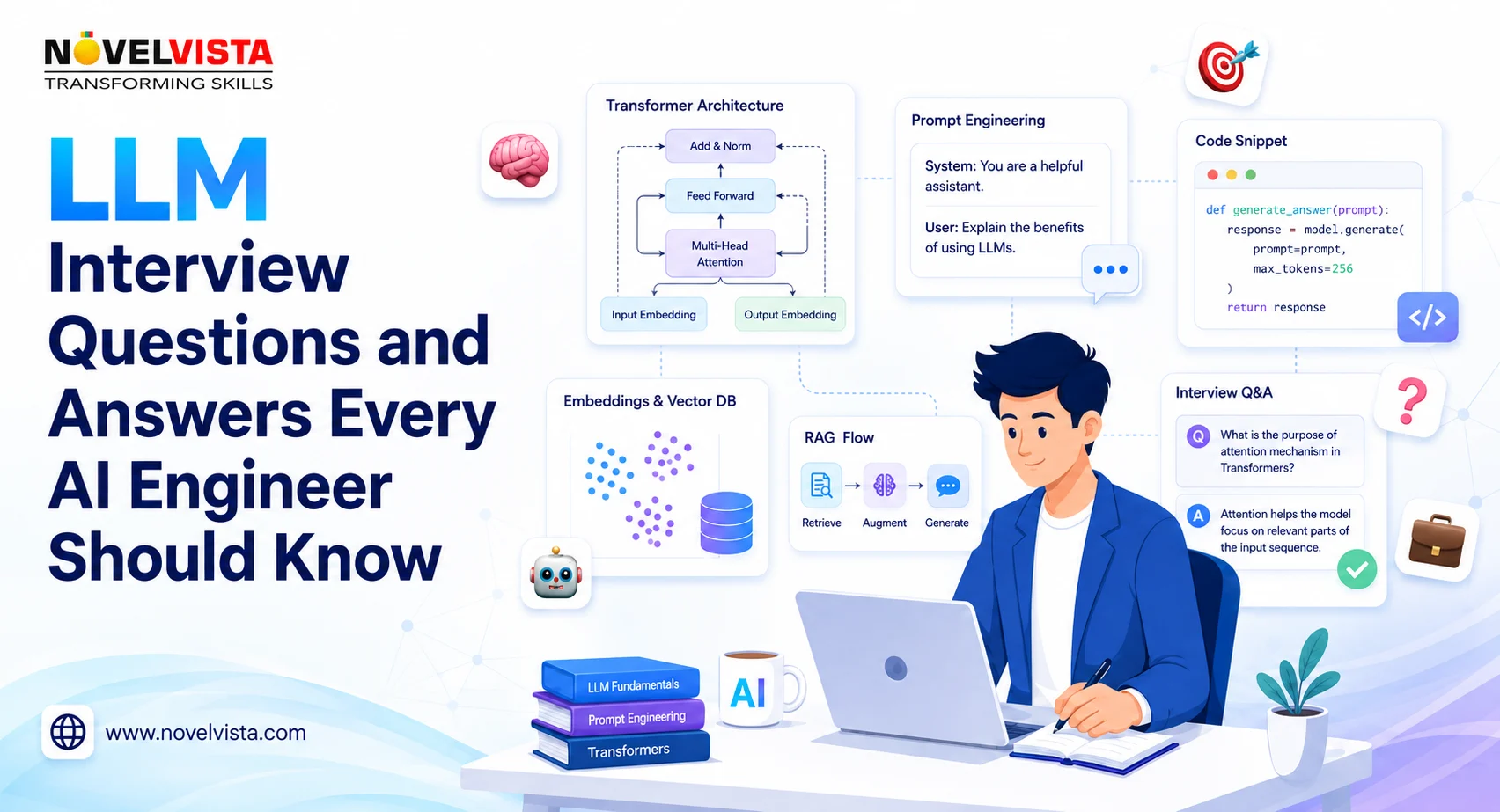
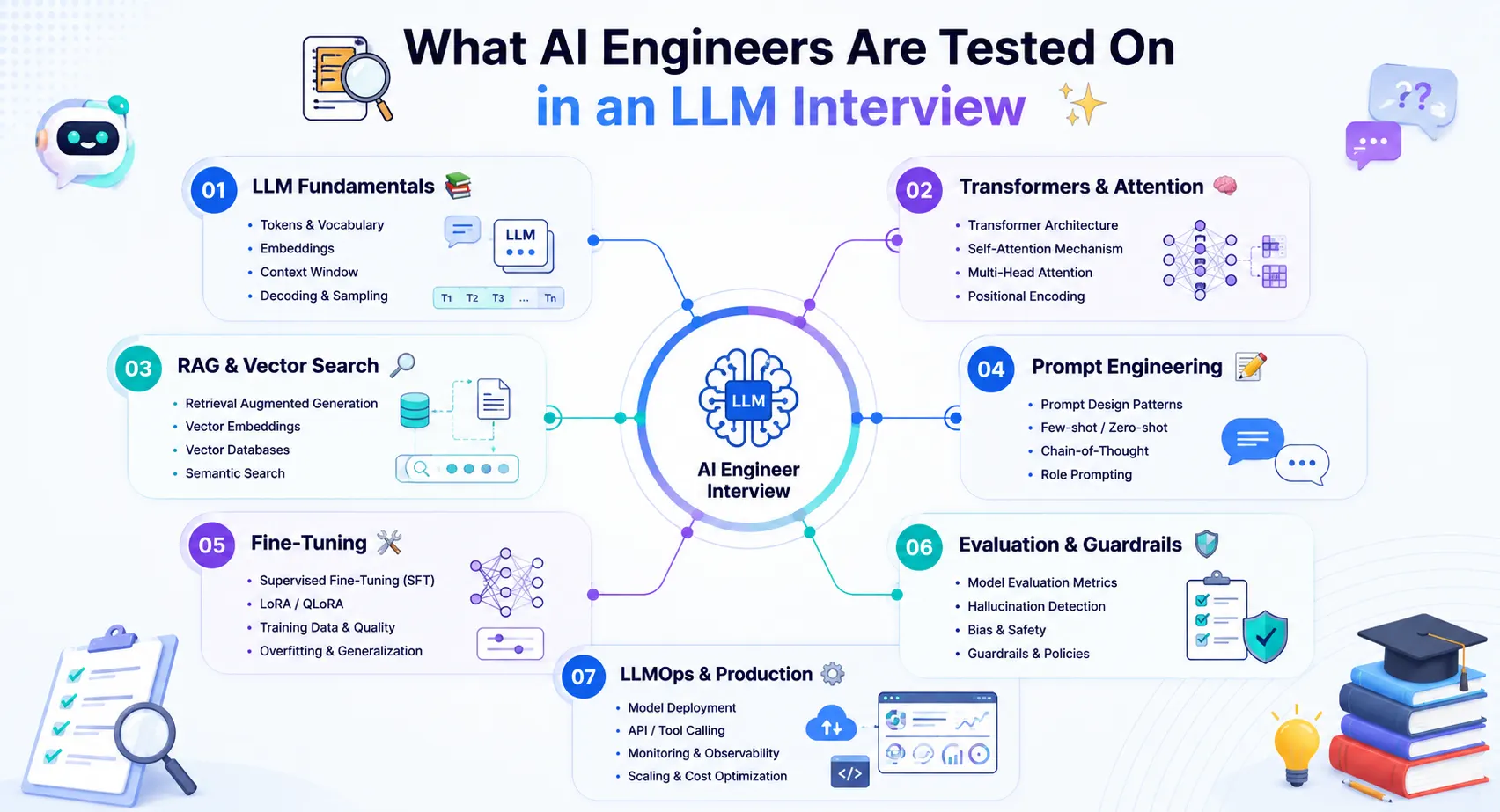
LLM engineering interviews have shifted from simple theory questions to practical discussions about designing, evaluating, securing, and operating LLM applications in production. This guide covers transformer fundamentals, tokenization, embeddings, RAG, fine-tuning, prompt engineering, hallucination control, evaluation, LLMOps, security, system design, and scenario-based answers.
If you are preparing around llm-interview-questions, focus on explaining engineering trade-offs instead of memorizing definitions. Modern interviews increasingly test whether candidates can connect model behavior with production decisions, reliability, latency, cost, and business requirements.
AI engineers are increasingly evaluated as application and systems engineers, not only as model specialists. A strong candidate should be able to explain how a model works, decide when to use prompting versus RAG or fine-tuning, build an evaluation strategy, control cost and latency, and design a safe production architecture.
| Interview Area | What the Interviewer Is Testing |
|---|---|
| LLM fundamentals | Whether you understand transformers, attention, tokens, context windows, and inference |
| RAG and retrieval | Whether you can ground models in enterprise data and diagnose retrieval problems |
| Model adaptation | Whether you understand prompting, fine-tuning, LoRA, and QLoRA trade-offs |
| Evaluation | Whether you can measure quality, factuality, groundedness, latency, and cost |
| Production engineering | Whether you can deploy, scale, monitor, version, and recover LLM applications |
| Security and governance | Whether you understand prompt injection, data leakage, permissions, and guardrails |
| System design | Whether you can combine models, APIs, vector stores, tools, caching, and observability |
These capabilities are becoming core ai engineer skills because employers need engineers who can move from a prototype to a reliable business system.
A large language model is a neural network trained on large amounts of text or multimodal data to learn statistical relationships between tokens. Most modern text-generation LLMs use transformer-based architectures and generate output by predicting the next token repeatedly.
A strong interview answer should go one step further: an LLM is not a database of guaranteed facts. It is a probabilistic model, which is why grounding, evaluation, and guardrails are necessary in production.
A transformer processes token representations through layers that combine attention with feed-forward neural networks.
For generative text models, causal masking prevents the model from attending to future tokens during next-token prediction.
Self-attention allows every token to weigh the relevance of other tokens in the sequence. The model creates Query, Key, and Value representations. A query is compared with keys to calculate attention scores, and those scores determine how strongly the model combines the corresponding values.
Multi-head attention repeats this operation in parallel so different heads can learn different relationships.
Tokenization converts raw text into units the model can process numerically. Depending on the tokenizer, one word may become one token or several subword tokens.
An AI engineer should monitor tokens because a prompt that looks short to a user can still be expensive or exceed the model's context limit.
The context window is the maximum amount of tokenized information a model can consider in a single request or generation cycle.
A larger context window is useful, but it does not remove the need for retrieval or context engineering. Long prompts can increase latency and cost, and useful evidence can become harder for the model to prioritize.
Temperature changes the sharpness of the token probability distribution. Lower values usually make outputs more predictable; higher values increase diversity.
Top-p, or nucleus sampling, limits token selection to the smallest group of tokens whose cumulative probability reaches a specified threshold.
For deterministic enterprise tasks such as structured extraction, engineers typically favor constrained generation and lower randomness. For brainstorming, more diversity may be acceptable.
Embeddings are dense numerical vectors that represent semantic information. Texts with related meanings tend to be positioned closer together in embedding space.
They are commonly used for semantic search, recommendation, clustering, duplicate detection, and Retrieval-Augmented Generation.
RAG combines retrieval with generation. Instead of asking an LLM to answer only from its model parameters, the system first retrieves relevant information from an external source and adds that information to the model context.
The biggest advantage is knowledge freshness and traceability without retraining the base model.
There is no universally correct chunk size. The strategy depends on document structure, query style, embedding model, and required evidence.
A good answer should mention testing retrieval quality rather than choosing a chunk size by habit.
Semantic search finds conceptually related content using embeddings. Keyword search is strong when exact terms, identifiers, names, or codes matter.
Hybrid search combines both. In enterprise RAG, it is often useful because user questions can contain both natural-language intent and exact product names, policy IDs, or technical terms.
Use prompting when the model already has the capability and you mainly need better instructions or output structure.
Use RAG when the system needs external, private, frequently updated, or traceable knowledge.
Use fine-tuning when you need repeatable behavior, domain-specific patterns, style, classification behavior, or task specialization that prompting alone does not reliably provide.
These approaches are complementary. A production system may use all three.
LoRA, or Low-Rank Adaptation, is a parameter-efficient fine-tuning technique. Instead of updating all model weights, it freezes the base model and trains small low-rank matrices inserted into selected layers.
This reduces training memory, compute, and storage requirements while allowing task-specific adaptation.
QLoRA combines quantization of the frozen base model with LoRA adapters. The quantized model consumes less memory while the adapters are trained at higher precision.
It is useful when you want to adapt a large model with limited GPU resources.
Quantization represents model weights or activations with lower numerical precision, such as 8-bit or 4-bit instead of 16-bit or 32-bit.
The trade-off is that aggressive quantization can reduce model quality, so engineers should benchmark the target workload before deployment.
The best prompt engineering interview questions llm candidates face are no longer about clever wording alone. Interviewers increasingly want to see controlled prompting, structured outputs, tool use, evaluation, and security.
A production prompt normally defines the task, relevant context, constraints, allowed sources, output schema, failure behavior, examples where useful, and success criteria.
The prompt should also be versioned and tested against an evaluation set. Prompt engineering becomes engineering when changes are measurable and reproducible.
Zero-shot prompting provides instructions without examples. Few-shot prompting includes representative examples to demonstrate the desired mapping between input and output.
Few-shot prompting is useful when format, edge cases, or decision boundaries are difficult to express through instructions alone.
A system prompt defines higher-level behavior, constraints, role, or policy. A user prompt contains the specific task or request.
In production, engineers should not treat the system prompt as a security boundary. Untrusted content still needs isolation, validation, permissions, and defensive controls.
Structured outputs constrain a model response to a schema, often JSON. They are useful when another application needs machine-readable data.
Function or tool calling allows a model to select and populate an external tool request, such as searching a database, creating a support ticket, or querying an API.
The application, not the model, should enforce permissions, validate arguments, execute the action, and decide what results are returned to the model.
These prompt engineering interview questions llm candidates practice should always be connected to reliability, security, and measurable output quality.
Many generative ai interview questions now focus on whether you can prove a system is reliable, not whether it produced one impressive demo.
An LLM predicts plausible next tokens; it does not inherently verify every generated claim against a trusted source.
The correct answer is rarely to set temperature to zero. Lower temperature can reduce output variation, but it does not guarantee factual correctness.
Start with the actual business task. Then create a representative evaluation dataset and define metrics for the parts of the system that can fail.
| Evaluation Layer | Example Metrics |
|---|---|
| Generation quality | Correctness, relevance, completeness, factuality |
| RAG retrieval | Recall, precision, ranking quality, context relevance |
| Grounding | Faithfulness to retrieved evidence, citation accuracy |
| Safety | Policy violations, prompt-injection resistance, data leakage |
| Operations | Latency, throughput, error rate, token usage, cost |
| Business outcome | Resolution rate, conversion, analyst time saved, task success |
Combine automated evaluation with human review. For high-impact use cases, use domain experts and clear rubrics.
LLM-as-a-judge uses another model to score outputs against a rubric.
It is scalable for large evaluation sets, but it can introduce bias, inconsistency, position effects, or preference for certain writing styles.
It should therefore be calibrated against trusted human judgments rather than treated as unquestionable ground truth.
These generative ai interview questions test whether candidates can move from model experimentation to measurable production reliability.
A practical architecture may look like this:
User → API Gateway → Authentication → Conversation Service → Retrieval/Tools → Model Router → LLM → Output Validation/Guardrails → Response
Supporting components may include a vector database, document-ingestion pipeline, cache, secrets management, logging and tracing, evaluation service, cost monitoring, rate limiting, and human escalation.
A strong candidate explains not only the components but also failure handling, privacy boundaries, tenant isolation, and observability.
Always measure quality after optimization. A cheaper system that fails the task is not an optimization.
For debugging, distributed traces should make it possible to follow a request through retrieval, model calls, tools, and validation.
Version prompt templates, model names and configurations, embedding models, retrieval settings, vector indexes, fine-tuned adapters, tool schemas, evaluation datasets, and guardrail policies.
Run regression evaluations before promotion, and keep rollback paths for model or prompt changes.
Treat retrieved documents, web content, tool outputs, and user messages as untrusted inputs.
The key principle is that the model should never become the sole authorization layer.
Scenario-based ai engineer interview questions often separate candidates who understand concepts from candidates who can troubleshoot real systems.
Start by separating retrieval failure from generation failure.
Do not fine-tune the LLM before proving the retrieval layer is working.
First measure where cost is generated: model choice, input tokens, output tokens, retrieval, tool calls, retries, or infrastructure.
Then prioritize context compression, caching, output limits, routing to smaller models, batch inference, more efficient retrieval, or self-hosting where volume justifies it.
The decision should be based on cost per successful task, not simply cost per API call.
Not automatically. Evaluate the new model on your own workload for task quality, latency, cost, context requirements, structured-output reliability, tool-calling behavior, safety, regional availability, data-handling requirements, and operational stability.
Public benchmarks are useful signals, but production selection should be workload-specific.
For technical interviews, use a four-part structure:
For example, if asked about RAG, do not stop at saying that RAG retrieves documents before generation. Explain retrieval, chunking, embeddings, ranking, grounding, evaluation, and the trade-off between improved freshness and added latency or system complexity.
Candidates should also practice drawing architectures on a whiteboard and explaining why each component exists. This approach is particularly useful for broader ai engineer interview questions where interviewers want to see structured engineering thinking.
Use this llm-interview-questions checklist before the interview:
Candidates should especially practice turning vague tasks into prompts with explicit instructions, context boundaries, schemas, and measurable evaluation criteria.
Strong llm interview questions reward systems thinking. Knowing attention, tokenization, embeddings, and fine-tuning gives you the foundation, but production-ready candidates also understand retrieval, evaluation, security, observability, cost, and reliability. That is the difference between knowing the theory and demonstrating that you can engineer an AI product.
For candidates building a structured study plan around llm-interview-questions, NovelVista's AI Engineering Professional Certification covers transformers, LLM application engineering, prompt engineering, RAG, agents, evaluation, guardrails, LLMOps, and deployment in one applied learning path.
Practicing these topics will also prepare you for broader llm interview questions where interviewers expect you to connect model behavior with production decisions and explain how an AI system creates reliable business value.
Author Details

Confused About Certification?
Get Free Consultation Call
Stay ahead of the curve by tapping into the latest emerging trends and transforming your subscription into a powerful resource. Maximize every feature, unlock exclusive benefits, and ensure you're always one step ahead in your journey to success.