

Certified AI Engineering Professional
The Certified AI Engineering Professional course is designed for professionals who want to build, deploy, secure, and manage production-ready AI applications powered by Large Language Models. The program moves beyond basic AI concepts and focuses on the practical engineering skills required to develop modern LLM, Retrieval-Augmented Generation, and AI agent solutions.
- In-detailed Learning Materials
- Important IT Service Management Practices.
- Real World Application Via Case Studies
- Global Recognition For IT Services.

Certified AI Engineering Professional Course Overview
The Certified AI Engineering Professional course is designed for professionals who want to build, integrate, secure, and deploy modern AI applications in real-world environments. It focuses on the practical skills required to work with Large Language Models (LLMs), Retrieval-Augmented Generation (RAG), AI Agents, Model Context Protocol (MCP), embeddings, vector databases, and production AI systems.
The course progresses from AI engineering foundations and transformer architecture to advanced application development, including structured outputs, tool calling, context engineering, fine-tuning, advanced RAG, agentic workflows, and multi-agent systems. Learners also gain exposure to critical production topics such as AI evaluation, guardrails, prompt injection protection, data privacy, LLMOps, observability, cost monitoring, Docker, cloud deployment, and CI/CD for AI applications.
Training Calendar
English
- Self paced videos, assessments, recall quizzes, more
- For more details, reach us at training@novelvista.com
Includes Training, Exam & Certification
Lifetime Access
- Self paced videos, assessments, recall quizzes, more
- For more details, reach us at training@novelvista.com
Includes Training, Exam & Certification
Certified AI Engineering Professional Syllabus
Module 1: AI Engineering Foundations+
Topic 1.1: Artificial Intelligence Foundations
Artificial Intelligence fundamentals
Machine Learning fundamentals
Deep Learning fundamentals
Generative AI fundamentals
Neural Networks overview
Foundation Models
Topic 1.2: Role of an AI Engineer Subtopics
Responsibilities of an AI Engineer
AI Engineer vs ML Engineer
AI Engineer vs Data Scientist
Skills required for modern AI Engineering Topic
Topic 1.3: Modern AI Engineering Ecosyste
Large Language Models
RAG and AI Agents
AI Engineering lifecycle
Modern AI application architecture
AI engineering tools and platforms
From prototype to production AI
Module 2: Transformers & Large Language Models+
Topic 2.1: Transformer Fundamentals
Why transformers changed modern AI
Encoder, decoder and transformer data flow
Positional information and token order
Topic 2.2: Attention & Self-Attention
Attention, query, key and value concepts
Self-attention and multi-head attention
Causal attention for text generation
Topic 2.3: Tokens & Context Windows
Tokens and tokenization
Context windows and long-context limits
Token usage, latency and cost impact
Topic 2.4: Large Language Models
Pretraining, instruction tuning and inference
Open-weight vs proprietary models
Reasoning and multimodal models
Topic 2.5: Model Selection
Model selection by quality, latency and cost
Benchmarking models for a real workload
When to use small vs large models
Module 3: LLM Application Engineering+
Topic 3.1: Working with LLM APIs
LLM API request-response lifecycle
Authentication, streaming and rate limits
Retries, errors and resilient API integration
Topic 3.2: Model Parameters
Temperature, top-p and output length
Parameter settings for different workloads
Topic 3.3: System & User Prompts
System prompts and user prompts
Instruction hierarchy and prompt structure
Topic 3.4: Structured Outputs
JSON and schema-based outputs
Validation and recovery from malformed output
Topic 3.5: Function & Tool Calling
Function schemas and tool definitions
Tool selection, execution and result handling
Safe error handling for tool calls
Topic 3.6: Context Management
Conversation history and context trimming
Memory vs temporary context
Topic 3.7: Routing & Fallbacks
Model routing and fallback patterns
Building a reliable multi-model application
Module 4: Prompt Engineering & Model Adaptation+
Topic 4.1: Prompt Engineering Fundamentals
Anatomy of a strong production prompt
Instructions, constraints and success criteria
Prompt testing and iterative improvement
Topic 4.2: Zero-Shot & Few-Shot Prompting
Zero-shot prompting
Few-shot prompting with representative examples
Choosing examples and avoiding bias
Topic 4.3: Prompt Templates & Chaining
Reusable prompt templates
Prompt chaining for complex tasks
Conditional and multi-step prompt workflows
Topic 4.4: Context Engineering
Selecting and ordering useful context
Managing conflicting and untrusted context
Topic 4.5: Fine-Tuning Fundamentals
What fine-tuning changes
When fine-tuning is appropriate
Training data and evaluation considerations
Topic 4.6: LoRA & PEFT
LoRA and parameter-efficient fine-tuning
Prompting vs RAG vs fine-tuning decision framework
Module 5: Embeddings & Vector Databases+
Topic 5.1: Understanding Embeddings
Embeddings and semantic meaning
Vector dimensions and semantic similarity
Common embedding use cases
Topic 5.2: Embedding Models
Choosing an embedding model
Embedding versioning and re-indexing implications
Topic 5.3: Semantic & Similarity Search
Semantic search workflow
Cosine similarity and top-k retrieval
Similarity thresholds and relevance
Topic 5.4: Vector Databases
How vector databases store and index data
Collections, namespaces and indexes
Selecting a vector database
Topic 5.5: Metadata Filtering
Metadata design and filtering
Tenant and access-aware retrieval
Topic 5.6: Dense, Sparse & Hybrid Search
Dense vs sparse retrieval
Hybrid search and rank fusion
Module 6: RAG Engineering+
Topic 6.1: RAG Fundamentals & Architecture
Why RAG is needed
RAG components and end-to-end request flow
Offline indexing vs online retrieval
Common RAG failure points
Topic 6.2: Document Loading & Parsing
Loading PDF, DOCX, HTML and structured content
Preserving headings, tables and metadata
Handling poor-quality or malformed documents
Topic 6.3: Document Chunking
Fixed, recursive and structure-aware chunking
Chunk size, overlap and information continuity
Choosing chunking by document type
Topic 6.4: Embedding & Indexing
Embedding documents and storing metadata
Index creation, updates and re-indexing
Topic 6.5: Vector Retrieval
Query embedding and top-k retrieval
Metadata-aware retrieval and thresholds
Diagnosing irrelevant retrieval
Topic 6.6: Context Augmentation
Formatting and ordering retrieved evidence
Reducing duplicated or conflicting context
Topic 6.7: Source Citations
Tracking source provenance
Generating traceable cited answers
Topic 6.8: End-to-End RAG Build
Build the ingestion-to-answer pipeline
Evaluate a working RAG application
Module 7: Advanced RAG Engineering+
Topic 7.1: Advanced Chunking
Semantic and hierarchical chunking
Parent-child retrieval patterns
Topic 7.2: Query Rewriting
Query expansion and rewriting
Multi-query and conversation-aware retrieval
Topic 7.3: Hybrid Retrieval
Combining semantic and keyword retrieval
Rank fusion and weighting strategies
Topic 7.4: Metadata-Based Retrieval
Business, tenant and access filters
Time and category-aware retrieval
Topic 7.5: Reranking
Why reranking improves retrieval quality
Cross-encoder and model-based reranking
Topic 7.6: Context Optimization
Removing redundancy and compressing context
Selecting the best evidence for generation
Topic 7.7: Conversational & Multi-Source RAG
RAG with conversation history
Retrieving from multiple repositories
Topic 7.8: Corrective, Adaptive & GraphRAG
Corrective and adaptive RAG patterns
Graph RAG and knowledge graph overview
Module 8: AI Agents & Tool Use+
Topic 8.1: AI Agent Fundamentals
AI agents vs chatbots and workflows
Goals, observations, actions and feedback loops
Enterprise agent use cases
Topic 8.2: Agent Architecture
Model, tools, memory, state and controller
Planner-executor and orchestration patterns
Topic 8.3: Agent Planning & Decision Making
Task decomposition and action selection
Stopping conditions and loop prevention
Topic 8.4: Tool & Function Calling
Designing safe agent tools
Validation, permissions and tool failures
Topic 8.5: Agent Memory & State
Short-term and long-term memory
Structured state and memory retrieval
Topic 8.6: Agent Workflows
Sequential, conditional and parallel workflows
Retries, timeouts and compensation patterns
Topic 8.7: Human-in-the-Loop
Approval gates for sensitive actions
Escalation and auditability
Topic 8.8: Multi-Agent Systems
Specialist and supervisor agent patterns
Multi-agent coordination risks and trade-offs
Topic 8.9: Build a Tool-Using Agent
Implement a bounded tool-using agent
Test agent success, failure and safety scenarios
Module 9: Agentic RAG & MCP+
Topic 9.1: Traditional vs Agentic RAG
Traditional RAG vs agentic RAG
When agent-controlled retrieval adds value
Topic 9.2: Agent-Controlled Retrieval
Agent decides whether and where to retrieve
Iterative retrieval and stopping criteria
Topic 9.3: Dynamic Knowledge Retrieval
Retrieval from APIs, databases and live systems
Freshness, caching and failure handling
Topic 9.4: Tool-Based Retrieval
Exposing search and retrieval as agent tools
Validating tool-retrieved evidence
Topic 9.5: MCP Fundamentals
What Model Context Protocol standardizes
MCP hosts, clients and servers
MCP tools, resources and prompts
Topic 9.6: MCP Integration
Connecting agents to MCP servers
Discovering and using MCP capabilities
Designing a practical multi-MCP architecture
Topic 9.7: MCP Production Architecture & Security
Stateless MCP architecture and scalable request handling
MCP authorization, identity and least-privilege access
MCP Tasks and long-running operations
Module 10: AI Evaluation, Security & Guardrails+
Topic 10.1: LLM Evaluation
Task-specific evaluation criteria
Evaluation datasets and regression testing
Human, rubric and semantic evaluation
Topic 10.2: RAG Evaluation
Retrieval relevance and precision
Faithfulness, groundedness and answer quality
Topic 10.3: Agent Evaluation
Task success and tool-selection accuracy
Action correctness, loops and recovery
Topic 10.4: Hallucination & Groundedness
Types of hallucination
Grounding responses in evidence
Topic 10.5: LLM-as-a-Judge
Model-based evaluation and rubrics
Bias and calibration of model judges
Topic 10.6: AI Guardrails
Input, output and policy guardrails
Layered guardrail architecture
Topic 10.7: Prompt Injection Protection
Direct and indirect prompt injection
Protecting RAG and tool-enabled applications
Topic 10.8: Data Privacy, Responsible AI & Risk Management
Sensitive data, secrets and tenant isolation
Bias, transparency, human oversight and AI risk-management checkpoints
Topic 10.9: AI Application Security Risks
OWASP Top 10 for LLM Applications 2026 overview
Excessive agency, improper output handling and unbounded consumption
Vector, embedding, hidden-context and supply-chain security risks
Module 11: LLMOps & Production AI+
Topic 11.1: LLMOps Fundamentals
LLMOps lifecycle and production concerns
Development, staging and production environments
Topic 11.2: Prompt & Model Versioning
Versioning prompts, models and configurations
Rollback and change-control strategy
Topic 11.3: Logging & Tracing
Request logging and correlation IDs
Tracing RAG, agent and tool execution
Topic 11.4: AI Observability
Quality, retrieval and agent monitoring
Continuous evaluation, AI health monitoring and alerting
Topic 11.5: Token, Latency & Cost Monitoring
Token and latency metrics
Cost per request and budget monitoring
Topic 11.6: Model Serving
Hosted vs self-hosted model serving
Concurrency, batching and caching
Topic 11.7: Docker & Cloud Deployment
Containerizing an AI application
Secrets, configuration and cloud deployment
Topic 11.8: CI/CD for AI Applications
Automated evaluation as a quality gate
Progressive deployment and rollback
Topic 11.9: Performance, Cost & Reliability
Model routing and token optimization
Retries, timeouts, fallbacks and circuit breakers
Module 12: Capstone Project+
Topic 12.1: Project Architecture
Define the enterprise AI use case
Design the end-to-end architecture
Topic 12.2: RAG Implementation
Build ingestion, retrieval and cited answers
Evaluate RAG quality
Topic 12.3: Agent & Tool Integration
Connect external tools and APIs
Add bounded agent actions and approvals
Topic 12.4: MCP Integration
Connect the application to an MCP server
Use MCP tools or resources in the workflow
Topic 12.5: Evaluation & Guardrails
Create evaluation scenarios
Add guardrails and prompt-injection tests
Topic 12.6: Deployment & Final Demo
Containerize and deploy the application
Demonstrate production readiness, observability and safe operation
Certified AI Engineering Professional Exam Format
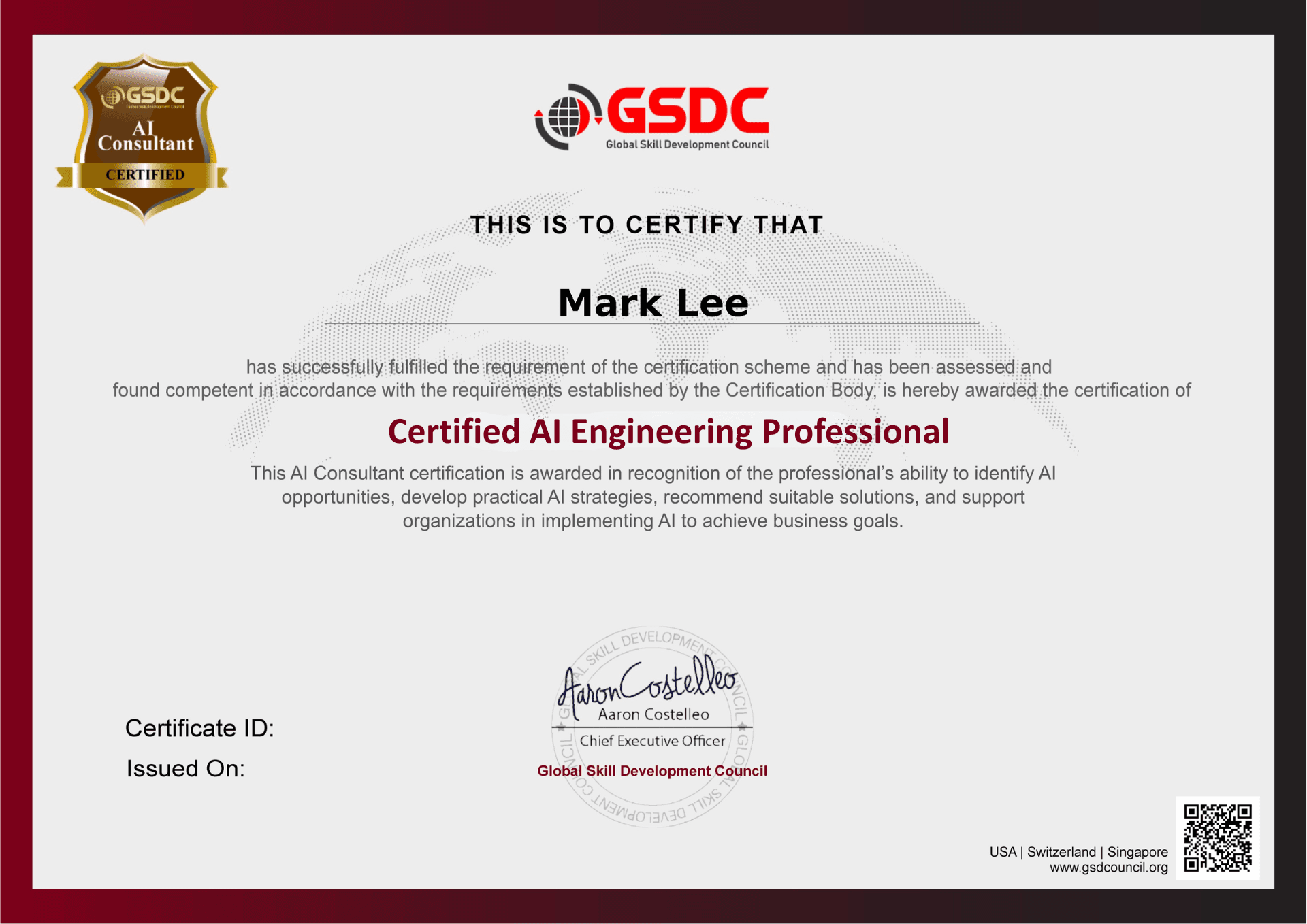
Exam Format - Objective Type, Multiple Choice & true/false
Exam Duration - 90 minutes
No. of Questions - 40 (multiple-choice questions)
Passing Criteria - 65%
Certification Validity 5 Years
Complimentary Retake Yes
Start Learning For Free
Explore the Learning Hub, our free resource center with:
- A full LMS to track your progress
- Tutorials and video lessons
- Quizzes to test yourself
- An AI tutor available when you're stuck