Category | AI And ML
Last Updated On 24/08/2026
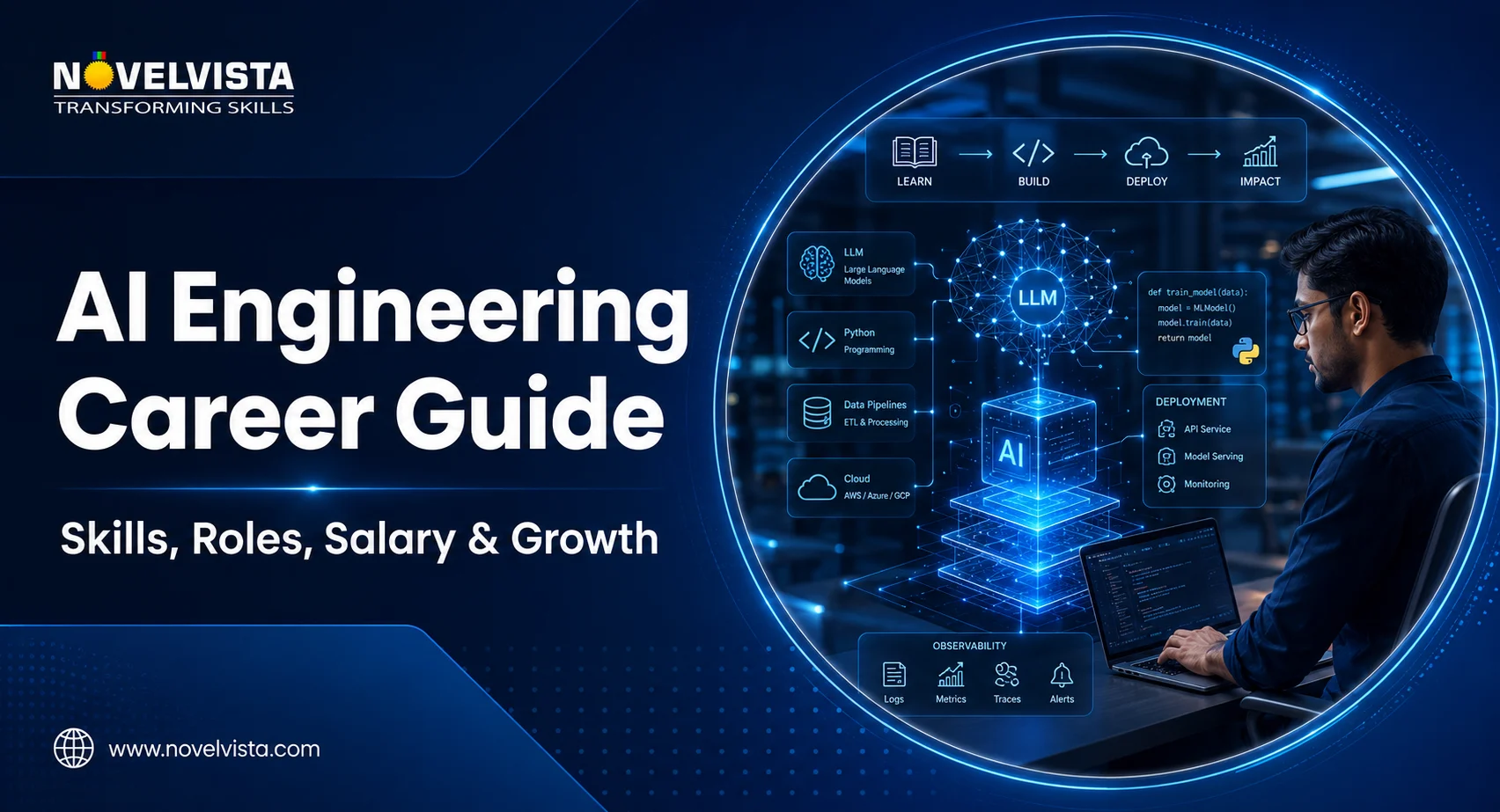
AI engineering has moved from a niche specialization to a mainstream technology career track. This guide covers the work AI engineers actually do, the skills employers expect, major role options, salary ranges in India, a step-by-step learning plan, portfolio strategy, interview preparation, and long-term career growth.
This ai engineer roadmap is designed for software developers, cloud professionals, data practitioners, students, and working professionals who want a practical route into production AI rather than a theory-only learning plan.
An AI engineer turns models, data, APIs, and infrastructure into usable AI products. The job sits at the intersection of software engineering, machine learning, data engineering, cloud platforms, and increasingly, generative AI.
The ai engineer roles and responsibilities vary by company size and product maturity, but the core mission is consistent: move AI from experiment to reliable business application.
Typical work includes:
These titles overlap, but employers usually expect different primary outputs. Understanding the distinction helps you choose the right learning path.
| Role | Primary Focus | Typical Output | Strongest Skill Emphasis |
|---|---|---|---|
| AI Engineer | Integrating AI into applications and business workflows | Production AI applications, APIs, agents and RAG systems | Software engineering, LLMs, cloud and deployment |
| ML Engineer | Building and optimizing predictive models | Training pipelines and production ML models | ML algorithms, deep learning and model optimization |
| Data Scientist | Discovering insights and experimenting with models | Analysis, experiments, prototypes and forecasts | Statistics, SQL and experimentation |
| Data Engineer | Building reliable data foundations | Pipelines, warehouses and streaming systems | SQL, Spark, ETL/ELT and data platforms |
| AI Solutions Architect | Designing enterprise AI systems | Architecture, platform and integration blueprints | Cloud, security, governance and scalability |
The distinction matters because learning AI is too broad a goal. Someone targeting AI application engineering needs stronger software, API, RAG, deployment, and evaluation capabilities than someone focused mainly on statistical modeling.
The most valuable capability is not knowing one framework. It is being able to assemble a dependable system from multiple components.
Python remains the default language for AI development. Build confidence with:
AI engineers increasingly work like production software engineers. A model that performs well inside a notebook but cannot be securely exposed, tested, scaled or monitored has limited enterprise value.
You do not need research-level mathematics for every role, but you should understand:
Modern AI roles increasingly require practical familiarity with neural networks, PyTorch or TensorFlow, embeddings, attention, transformer architecture, tokens, context windows, inference, model selection, and multimodal models.
You do not necessarily need to train foundation models from scratch. You should understand how their architecture affects quality, latency, context limits, deployment decisions and cost.
Current ai engineer skills increasingly include:
A notebook demonstration is not a production system. Learn FastAPI or an equivalent service framework, Docker, Kubernetes fundamentals, AWS, Azure or Google Cloud, CI/CD, model and prompt versioning, observability, distributed tracing, cost monitoring, performance optimization, and latency management.
Enterprise systems require more than accuracy. Engineers increasingly need awareness of prompt injection, sensitive data leakage, authentication and authorization, privacy controls, model misuse, bias, unsafe output, auditability, human review, tool permissions, and escalation mechanisms.
AI engineers who can translate business problems into measurable technical outcomes are more valuable than engineers who only know tools. Analytical thinking, collaboration, communication, and continuous learning remain critical.
Responsibilities become more specialized as AI teams mature. The following roles represent common directions inside the field.
Builds user-facing applications around AI models, APIs, copilots, assistants and automation workflows. This role typically requires strong software development skills combined with practical LLM integration.
Works with foundation models, prompting, context design, model selection, evaluation, fine-tuning, RAG and agentic patterns.
Focuses on document ingestion, parsing, chunking, embeddings, retrieval, reranking, grounding, citations, and retrieval evaluation.
Builds deployment pipelines, model lifecycle controls, CI/CD, monitoring, observability and scalable AI infrastructure.
Designs, trains, evaluates, optimizes and serves machine learning or deep-learning models. This specialization usually requires stronger depth in algorithms and model optimization.
Designs enterprise AI platforms and integrations while balancing security, performance, governance, scalability, reliability, integration complexity, and cost.
Implements and experiments with new architectures or research techniques. This career direction generally demands stronger mathematical and deep-learning depth.
Combines product-oriented software engineering with rapid AI experimentation to ship customer-facing capabilities.
Across all of these specializations, the ai engineer roles and responsibilities increasingly extend beyond models into architecture, deployment, evaluation, security and measurable business outcomes.
If you are deciding how to become an ai engineer, avoid trying to master every AI discipline at once. Build skills in layers and produce evidence of capability at each stage.
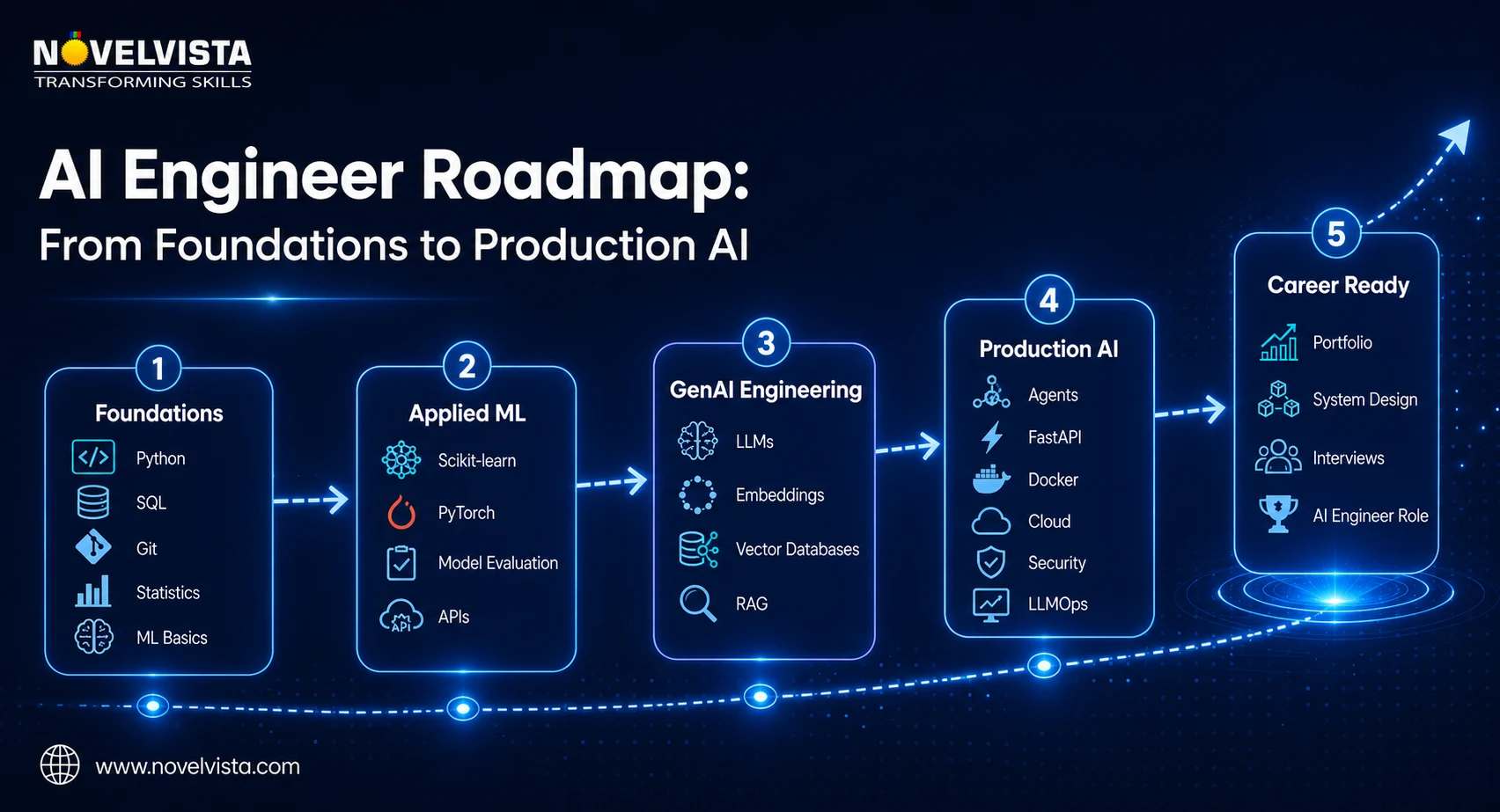
A useful ai engineer roadmap should move from foundations to production systems instead of stopping at model training.
| Phase | Timeline | Learning Focus | Portfolio Outcome |
|---|---|---|---|
| Foundation | Weeks 1–6 | Python, SQL, Git, statistics, ML basics | Data processing and prediction project |
| Applied ML | Weeks 7–12 | Scikit-learn, PyTorch, evaluation | End-to-end ML API |
| GenAI Engineering | Months 3–5 | LLM APIs, prompting, embeddings, RAG, vector DBs | RAG assistant with citations |
| Agents & Production | Months 5–7 | Tool calling, agents, FastAPI, Docker, cloud | Multi-tool AI agent |
| Reliability & Career | Months 7–9 | Observability, security, cost, CI/CD and interviews | Production-style capstone |
Start with Python, SQL, Git, APIs, basic statistics and machine learning concepts. Your objective is to write readable code, work with datasets, consume and build APIs, debug errors, use source control, and explain fundamental model behavior.
Train a small model, evaluate it, expose it through an API, containerize it, and document how another developer can use it. This connects data science with software engineering.
Create a RAG project over a realistic document set. Include document parsing, chunking, embeddings, vector storage, retrieval, answer generation, source citations, and evaluation.
Be prepared to explain trade-offs involving chunk size, context length, embedding model, retrieval depth, reranking, model selection, latency, and cost.
Build an agent capable of calling controlled tools or APIs. Add input validation, permissions, error handling, logs, fallback behavior, and stopping conditions. Then deploy the application using containers and a cloud platform.
For every major project, document the business problem, architecture diagram, technology choices, evaluation methodology, security considerations, deployment approach, cost trade-offs, performance decisions, known limitations, and future improvements.
A typical ai engineer career path is becoming less linear because engineers can specialize early in infrastructure, applications, models or architecture.
A practical progression might look like:
Transitions are also common from adjacent occupations such as software engineering, data science, data engineering, cloud engineering and analytics.
The strongest ai engineer career path may therefore look like: Software/Cloud/Data Role → Applied AI Projects → Production AI Ownership → AI Specialization → Architecture or Leadership.
Compensation varies significantly by city, company type, specialization, engineering depth and whether the role involves production GenAI systems.
Current ai engineer salary benchmarks in India span a wide range because the same title may refer to junior application work, advanced ML engineering, GenAI platform development, or enterprise AI architecture.
| Experience | Indicative India Range | Typical Profile |
|---|---|---|
| 0–2 years | ₹6–12 LPA | Junior AI/ML Engineer, AI Developer |
| 2–5 years | ₹10–22 LPA | Production AI Engineer, GenAI Engineer |
| 5–8 years | ₹20–40 LPA | Senior Engineer, MLOps/LLMOps Specialist |
| 8+ years | ₹35–55+ LPA | Staff Engineer, Architect, Engineering Lead |
| Niche/top-tier roles | ₹50–80+ LPA | Principal, advanced GenAI, leading product/GCC positions |
These figures should be treated as directional benchmarks rather than guaranteed compensation.
The ai engineer salary can rise significantly when a professional demonstrates hands-on depth in LLM engineering, scalable deployment, platform ownership, security, architecture, and measurable business impact.
Salary growth usually follows ownership, not tool count. Engineers become harder to replace when they can:
The market rewards engineers who can convert AI capability into dependable business systems, not simply demonstrate familiarity with fashionable tools.
Build projects that resemble work a company might actually fund. Three strong end-to-end projects can tell a more convincing engineering story than fifteen shallow notebooks.
Create a domain-specific assistant that answers from internal-style documents with citations and controlled retrieval.
Demonstrate: embeddings, vector search, chunking, reranking, evaluation, citations and security.
Build an agent capable of classifying requests, retrieving knowledge, calling a mock ticketing API and escalating when confidence is low.
Demonstrate: tool calling, state management, validation, observability and fallback logic.
Compare multiple models based on quality, latency, token usage, cost, and failure rate.
Demonstrate: evaluation thinking, model selection, metrics and production trade-offs.
Train and deploy a predictive model with a REST API, Docker, automated tests, CI/CD and monitoring.
Demonstrate: classic machine learning combined with software and operations discipline.
Expect interviews to evaluate considerably more than definitions. Prepare to discuss:
When describing projects, explain why you selected an architecture, how you measured success, what failed and what you changed. That is considerably more credible than listing frameworks on a résumé.
The growth case for AI engineering is larger than generative AI hype alone. AI, machine learning, data, cloud and automation are becoming embedded in enterprise technology strategies across industries.
Frameworks will change, but durable competencies include:
This makes continuous learning essential. Professionals who can repeatedly adapt these durable foundations to new models, frameworks and deployment patterns will be better positioned for long-term growth.
Prompting matters, but production AI also requires APIs, retrieval, data, evaluation, security and deployment.
Hiring teams need evidence that you can ship usable systems. Move at least some projects beyond experimentation into APIs, containers and deployed applications.
Knowing ten framework names is less useful than understanding data flow, failure modes and system trade-offs.
A technically impressive AI application can still fail if latency is unacceptable or inference costs are uncontrolled.
AI applications introduce risks involving sensitive data, prompt injection, unsafe tool execution, excessive agent permissions and access control. Security therefore needs to be part of the architecture rather than a final checklist item.
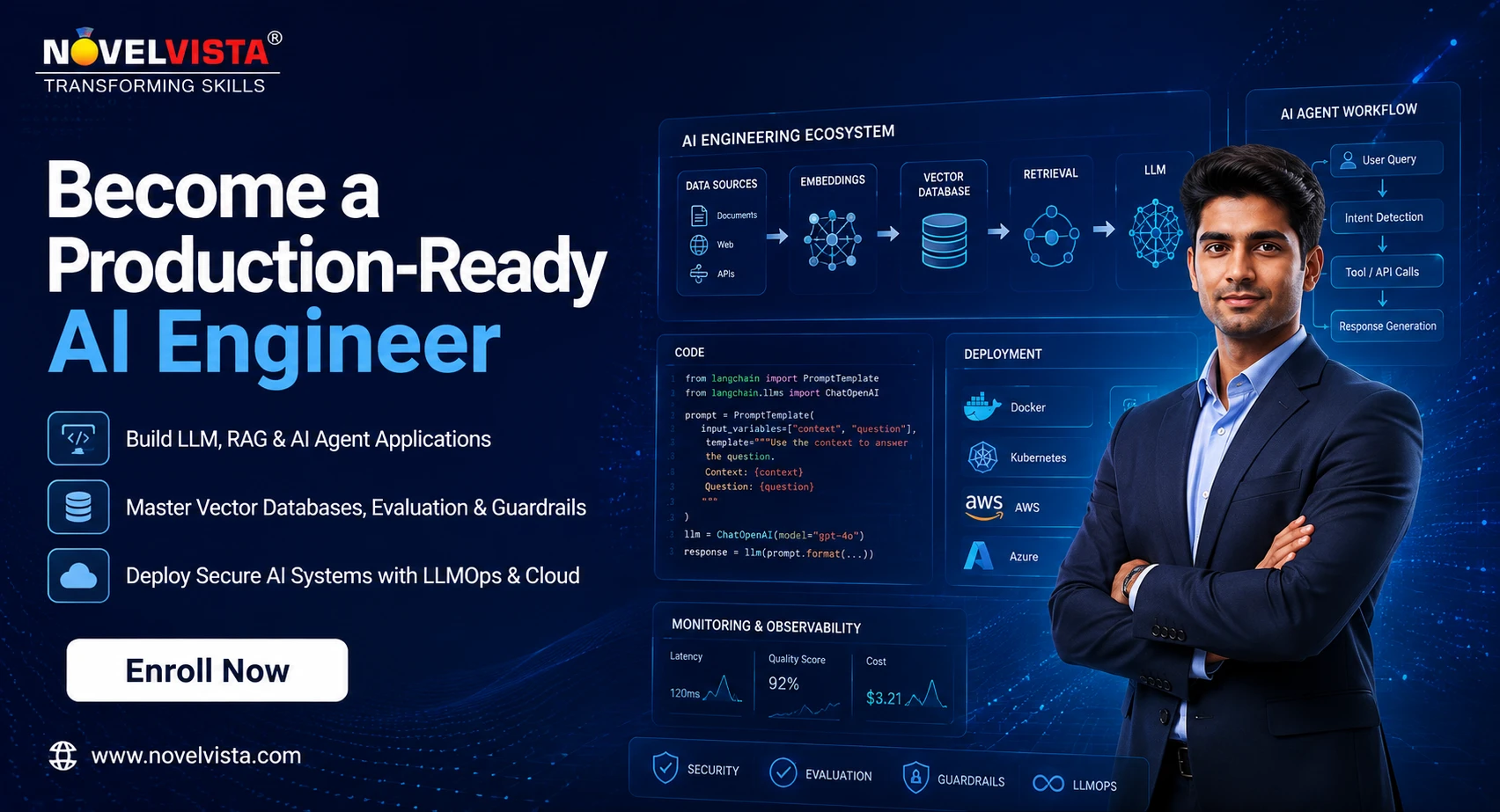
AI engineering is becoming a systems profession: part software engineering, part machine learning, part cloud engineering and part product problem-solving.
The ai engineer roadmap that works best in 2026 is one that moves quickly from foundations into RAG, agents, evaluation, deployment, security and measurable production outcomes.
For professionals deciding how to become an ai engineer, the priority should be practical depth. Build a small number of end-to-end projects, understand why they fail, deploy them, monitor them and learn how to explain technical trade-offs.
NovelVista’s Certified AI Engineering Professional course follows this production-focused direction. The program covers AI engineering foundations, transformers and LLMs, structured outputs, tool calling, context engineering, embeddings, vector databases, RAG, AI agents, evaluation, guardrails, LLMOps, observability, Docker, cloud deployment and CI/CD.
For learners who want a structured learning path rather than a collection of disconnected tutorials, the program provides a practical route from foundational AI knowledge toward job-relevant engineering capability.
Author Details

Confused About Certification?
Get Free Consultation Call
Stay ahead of the curve by tapping into the latest emerging trends and transforming your subscription into a powerful resource. Maximize every feature, unlock exclusive benefits, and ensure you're always one step ahead in your journey to success.