Category | AI And ML
Last Updated On 18/05/2026
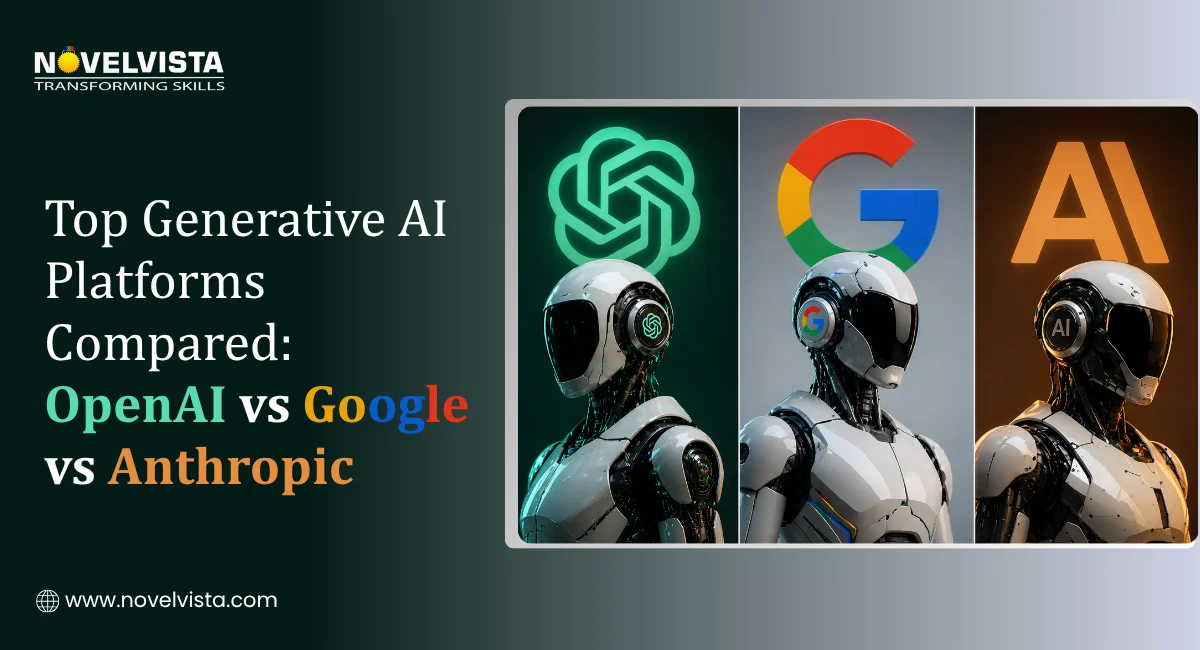
Generative AI is no longer experimental it is now a core part of how enterprises build products, automate workflows, and interact with customers. At the center of this shift are generative AI platforms: integrated software environments that let organizations develop, deploy, and manage models that create new content text, images, code, and even video using deep‑learning techniques.
Among the major players, OpenAI, Google (Gemini/Vertex AI), and Anthropic stand out as the most influential providers of large‑language models and AI‑development platforms. In this article, we’ll explore what generative AI platforms are, why they matter, and how OpenAI, Google, and Anthropic compare across capabilities, use cases, and enterprise fit.
In this blog, we’ll break down what generative AI platforms are and why they’ve become essential for modern enterprises. You’ll explore how leading providers like OpenAI, Google, and Anthropic compare across capabilities, integrations, and enterprise use cases. We’ll also dive into their strengths, limitations, and ideal scenarios to help you make an informed decision. Finally, you’ll learn how to choose the right platform based on your business goals, tech stack, and risk considerations.
| Aspect | OpenAI | Google (Gemini / Vertex AI) | Anthropic (Claude) |
| Core Strength | Advanced reasoning & flexibility | Deep ecosystem integration | Safety & controllability |
| Best For | Startups, developers, rapid prototyping | Enterprises using Google Cloud/Workspace | Regulated industries (finance, healthcare, legal) |
| Key Products | ChatGPT, GPT APIs, Agents | Gemini, Vertex AI | Claude models |
| Ecosystem | Largest third-party integrations | Strong Google-native integration | Smaller but growing |
| Context Handling | Up to 128K tokens | Up to 1M tokens | Up to 200K tokens |
| Privacy & Governance | Strong (via partners like Microsoft Azure) | Strong (Google compliance stack) | Very strong (privacy-first design) |
| Ideal Use Cases | Chatbots, coding assistants, AI apps | Productivity tools, document AI | Compliance-heavy workflows, secure AI |
| Pricing Trend | Mid to high | Often cost-efficient on Google Cloud | Competitive, premium safety features |
A generative AI platform is a managed environment that accelerates the entire lifecycle of AI application development from data preparation and model selection to deployment, monitoring, and integration. Instead of building everything from scratch, teams can tap into pre‑trained foundation models, guided workflows, and built‑in tooling to ship AI‑powered features faster.
These platforms typically support:
By combining infrastructure, tooling, and models in one place, generative AI platforms reduce time‑to‑market and lower the barrier to entry for non‑experts.
Leaders like Google Cloud Vertex AI, AWS Generative AI, and Databricks provide cloud‑native suites for building GenAI applications. These platforms offer:
They suit large enterprises that already run workloads on Google Cloud, AWS, or Databricks and want to keep everything in a single, governed environment.
Specialized platforms such as Persistent Systems GenAI Hub and AiseraGPT focus on deploying AI agents across workflows. These tools feature:
They are ideal for organizations that want to automate customer support, internal help desks, and enterprise operations without deep ML expertise.
Players like Anyword and Adobe Firefly optimize generative AI for specific domains.
These platforms appeal to marketers, designers, and creative teams who need results that align with brand and legal standards.
Productivity & Workflow Platforms
Tools such as monday.com and Tidio bake generative AI into collaboration and customer‑service workflows.
These platforms are attractive for teams that want off‑the‑shelf AI features tightly coupled with their existing work surfaces. From intelligent chatbots to AI-powered content creation and code generation tools, the Top Generative AI Examples showcase how these platforms are transforming real-world business operations and digital experiences.
To understand how these benefits play out, it helps to compare the three most influential players in the space.
OpenAI launched ChatGPT in 2022 and quickly became synonymous with generative AI. Its models GPT‑3.5, GPT‑4, and GPT‑4o‑class (and later GPT‑5‑class) systems set the bar for conversational ability, coding, and reasoning. OpenAI’s platform is built around:
OpenAI is often the first choice for teams that value speed, flexibility, and a rich ecosystem of integrations and third‑party tools.
Google integrates generative AI into its broader ecosystem: Search, Workspace, Android, and Google Cloud. Its main offerings include:
Google’s strength lies in its deep integration with existing tools, making it compelling for organizations already invested in Google Workspace or Google Cloud.
Anthropic built its models Claude Haiku, Sonnet, and Opus with a focus on safety, controllability, and “Constitutional AI.” Key offerings include:
Anthropic appeals especially to regulated industries such as finance, healthcare, and legal, where safety, reliability, and data governance are critical.
OpenAI entered the mainstream with ChatGPT, but its platform is now much more than a chatbot. At its core, OpenAI offers:
Strengths:
Best use cases:
OpenAI is ideal for startups, product teams, and agencies that want rapid experimentation, rich integrations, and powerful multi‑agent systems. It’s also a strong fit for internal tools that need sophisticated reasoning, such as code‑assistants, documentation search, and customer‑support triage.
Considerations:
OpenAI can be relatively expensive at scale, and its enterprise‑governance features often rely on integration with Microsoft Azure or partner platforms. Organizations that need tight data‑retention controls may need additional configuration.
Google’s approach to generative AI is tightly woven into its existing products. Gemini (formerly Bard) powers consumer and enterprise AI experiences, while Vertex AI provides the underlying platform for building and managing custom models.
Key capabilities:
Google’s strength is ecosystem integration. For organizations that already use Google Workspace and Google Cloud, Gemini‑based workflows can be rolled out quickly and with minimal friction.
Strengths:
Best use cases:
Google is ideal for enterprises already on Google Cloud or Workspace, especially those focused on productivity, collaboration, and data‑intensive tasks. Think internal knowledge assistants, search‑over‑documents, and AI‑powered customer‑service workflows tightly integrated into Gmail or Google Meet.
Considerations:
While Google’s ecosystem is powerful, its model ecosystem is narrower than OpenAI’s third‑party landscape. Teams that want to experiment with many models or agents may need to layer on additional platforms.
Anthropic takes a different philosophical stance: build AI that is safer, more controllable, and more predictable. Its Claude model family is designed for long‑context reasoning, low hallucination, and robust safety guardrails.
Key capabilities:
Anthropic’s models are particularly strong in coding, structured reasoning, and long‑document analysis, making them attractive for technical and compliance‑heavy domains.
Strengths:
Best use cases:
Anthropic is an excellent fit for finance, healthcare, legal, and regulated sectors, as well as engineering teams that need reliable, auditable AI assistance. It also works well for internal agents that handle sensitive customer data or regulated documentation.
Considerations:
The platform’s ecosystem is smaller than OpenAI’s, and tooling around agents and workflows is still evolving. Organizations that prioritize flexibility and third‑party integrations may need to supplement with additional tooling.
To clarify how these platforms differ, here’s a concise comparison table:
| Aspect | OpenAI (GPT‑class) | Google (Gemini / Vertex AI) | Anthropic (Claude) |
| Core focus | General‑purpose, high capability | Ecosystem‑integrated, data‑grounded | Safety‑first, controllable AI |
| Main products | ChatGPT, GPT‑4/5‑class API, Agents | Gemini, Gemini Enterprise, Vertex AI | Claude models, Claude for Work |
| Context window (typical) | Up to 128K tokens (GPT‑4o) | Up to 1M tokens (Gemini 1.5 Pro) | Up to 200K tokens (Claude 3.x) |
| Coding & reasoning | Very strong, broad tooling | Good, improving rapidly | Excellent, especially Claude Code |
| Enterprise safety & privacy | Strong via Microsoft‑linked controls | Strong via Workspace / Cloud compliance | Strong; zero data retention, privacy‑first |
| Integration ecosystem | Largest third‑party ecosystem and SDKs | Tight Google Workspace / Cloud tying | Model‑focused, MCP‑based agents |
| Pricing (2026 trend) | Mid‑to‑high, mature tooling | Often cheaper on Google Cloud infra | Competitive, premium for safety features |
| Best‑fit use cases | Startups, dev teams, multi‑agent systems | Google‑centric enterprises, Workspace users | Regulated industries, high‑stake applications |
Choosing between OpenAI, Google, and Anthropic depends on your primary use case, existing stack, and risk tolerance.
Many organizations are moving toward multi‑vendor strategies, using one model for customer‑facing chat (e.g., OpenAI), another for internal coding assistants (e.g., Anthropic), and a third for ecosystem‑integrated workflows (e.g., Google). Testing each platform on a small pilot (coding, customer‑support routing, or document summarization) can help clarify which fits your workflows best. There is no choosing the best generative AI platforms, but just what is the right AI platform for you. From content creation and customer support to coding assistance and data analysis, Generative AI Use Cases continue to expand as organizations adopt these platforms to drive efficiency, innovation, and smarter decision-making.
While generative AI platforms offer enormous benefits, they also come with important challenges:
Vendor lock‑in – Plan for model portability and API abstraction so you’re not overly dependent on a single provider.
Looking ahead, generative AI platforms are evolving toward multi‑model, agent‑driven, and hybrid stacks. Organizations will increasingly combine OpenAI, Google, and Anthropic models under unified orchestration layers, using each where it excels. Agents will handle more complex, multi‑step workflows, and platforms will place even greater emphasis on safety, explainability, and auditability.
For businesses today, the key is to start with a clear use case, pick a stack that aligns with your existing ecosystem, and iterate fast. Whether you choose OpenAI, Google, or Anthropic or a mix of all three the right platform can dramatically accelerate your move into the generative‑AI era.
Ready to elevate your expertise in next-generation technologies?
Join NovelVista’s Generative AI Professional Training and gain hands-on experience with real-world AI use cases, advanced tools, and industry-relevant frameworks. Designed for professionals and business leaders, this course helps you confidently apply generative AI to drive innovation, improve decision-making, and stay competitive in a rapidly evolving digital landscape.
Start your generative AI journey today!
Author Details

Course Related To This blog
Generative AI Certification
Confused About Certification?
Get Free Consultation Call
Stay ahead of the curve by tapping into the latest emerging trends and transforming your subscription into a powerful resource. Maximize every feature, unlock exclusive benefits, and ensure you're always one step ahead in your journey to success.