Category | AI And ML
Last Updated On 18/08/2026
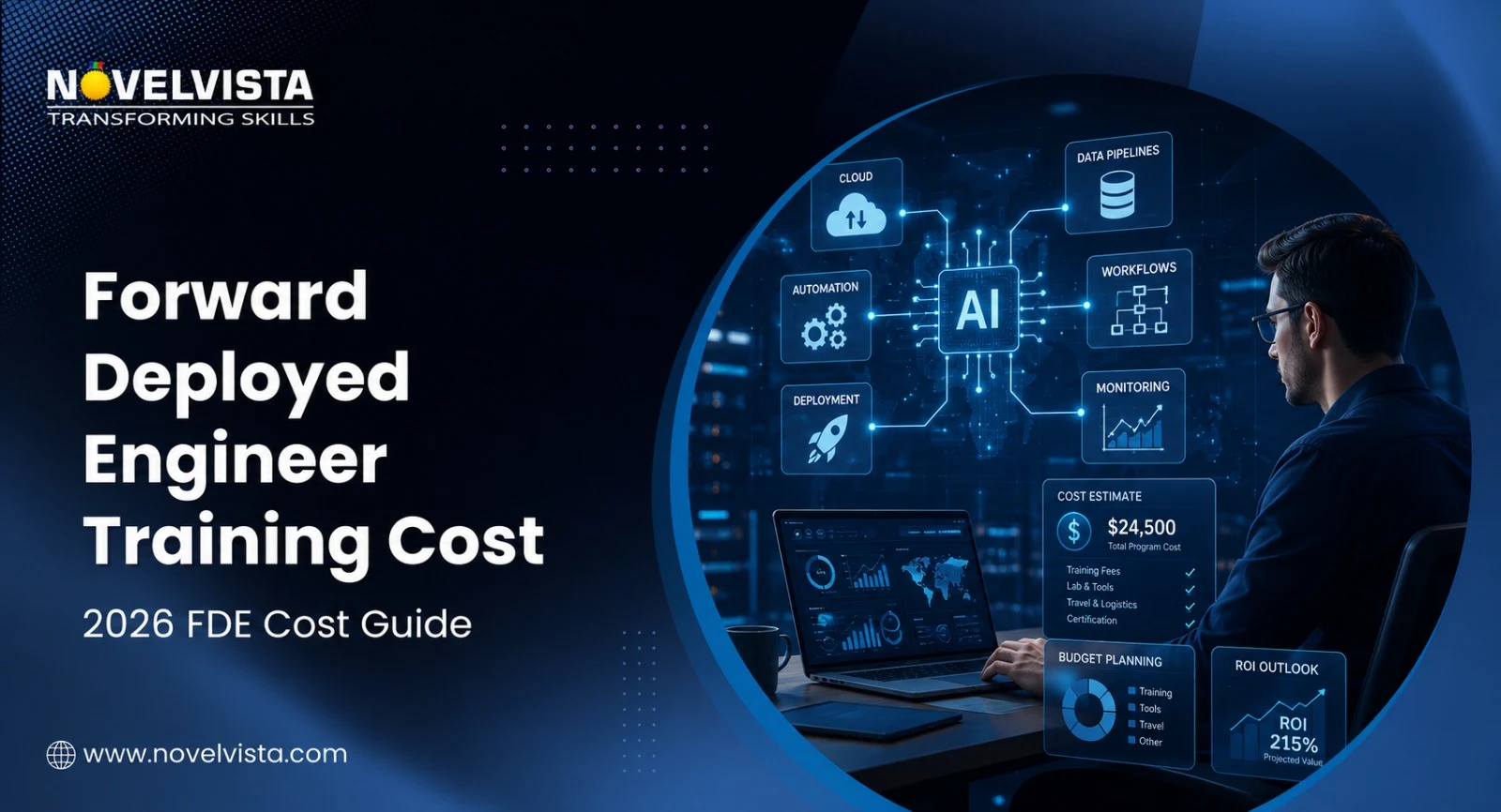
Forward deployed engineering has become one of the most practical ways to move AI from experiments into working business systems. As companies invest in AI agents, workflow automation, RAG systems, and customer-specific AI deployments, they need professionals who can understand business problems, build technical solutions, and work directly with stakeholders.
That is why many learners and corporate teams are now asking a very direct question: what is the real FDE Cost in 2026?
This guide breaks down FDE Cost for different training formats, why the pricing varies, what should be included in a good programme, what hidden expenses to check, and how companies can calculate ROI before investing. You will also learn how Forward Deployed Engineer Cost compares with hiring or contracting FDE talent, and how to choose training that builds practical deployment capability instead of only theoretical AI knowledge.
The average FDE Cost in 2026 depends on the format, learning depth, trainer involvement, and whether the programme is designed for individuals or corporate teams. A basic awareness workshop may be priced lower, while hands-on corporate training or university-backed programmes usually cost more because they include live sessions, labs, assessments, and project work.
For individual learners, FDE training can start from short introductory sessions and go up to structured certificate programmes. For organizations, pricing is usually customized because a corporate batch may need private delivery, industry-specific examples, assessment reports, and implementation-focused case studies.
| Training Type | Typical Cost Range | Best For | Notes |
|---|---|---|---|
| Short workshop | Low to moderate | Awareness and quick upskilling | Good for understanding the FDE role and AI deployment basics |
| Individual certification programme | Moderate | Professionals building role readiness | Cost depends on curriculum depth and project exposure |
| University-backed programme | Higher | Learners who want academic branding | Often longer, structured, and more expensive |
| Corporate FDE training | Custom pricing | Teams building enterprise AI capability | Depends on batch size, customization, and delivery model |
| Advanced hands-on programme | Higher | Engineers moving into client-facing AI roles | Should include labs, case studies, and deployment simulations |
The right FDE Cost question is not only “how much does it cost?” A better question is, “Will this training help me or my team deploy AI solutions in real business environments?”
For a learner, this difference matters because a cheaper course may teach the basics of AI, but not the working style of an FDE. For a company, it matters even more. If the training does not help teams identify use cases, communicate with stakeholders, and connect AI tools with business workflows, the low fee may not create much value.
Forward Deployed Engineer Cost varies because FDE training sits at the intersection of AI engineering, consulting, product thinking, customer discovery, data workflows, and deployment execution. A course that only explains AI concepts will naturally cost less than a programme that teaches learners how to work with messy business problems, integrate tools, and deliver AI systems safely.
The biggest pricing factors include:
This is why a lower FDE Cost is not always better. If the programme skips practical deployment, learners may understand AI terms but still struggle when asked to build, explain, or implement solutions for a real client or business team.
A serious FDE programme should not feel like a general AI awareness session. It should prepare learners to ask better business questions, understand constraints, choose suitable AI approaches, and work closely with technical and non-technical teams. That mix of skills is exactly what makes Forward Deployed Engineer Cost different from ordinary AI training cost.
Training an internal team is often far more cost-efficient than immediately hiring senior FDE talent. Hiring gives you direct expertise, but it also brings salary, recruitment, onboarding, retention, and productivity risks. Contracting can help when you need short-term execution, but it may not build long-term internal capability.
Before comparing options, it helps to understand the Role of Forward Deployed Engineer. FDEs are not just developers. They sit close to the business problem, translate stakeholder needs into technical solutions, and help move AI systems into production-ready use.
| Option | Cost Type | Pros | Limitations |
|---|---|---|---|
| Train existing engineers | Training investment | Builds internal capability and improves long-term readiness | Needs the right curriculum and leadership support |
| Hire FDE talent | Salary or CTC | Brings immediate expertise | Expensive, competitive, and harder to scale quickly |
| Contract FDEs | Hourly or monthly fee | Flexible for urgent projects | Knowledge may stay with the contractor |
| Corporate FDE training | Team training cost | Scales capability across multiple roles | Needs business-specific customization for best results |
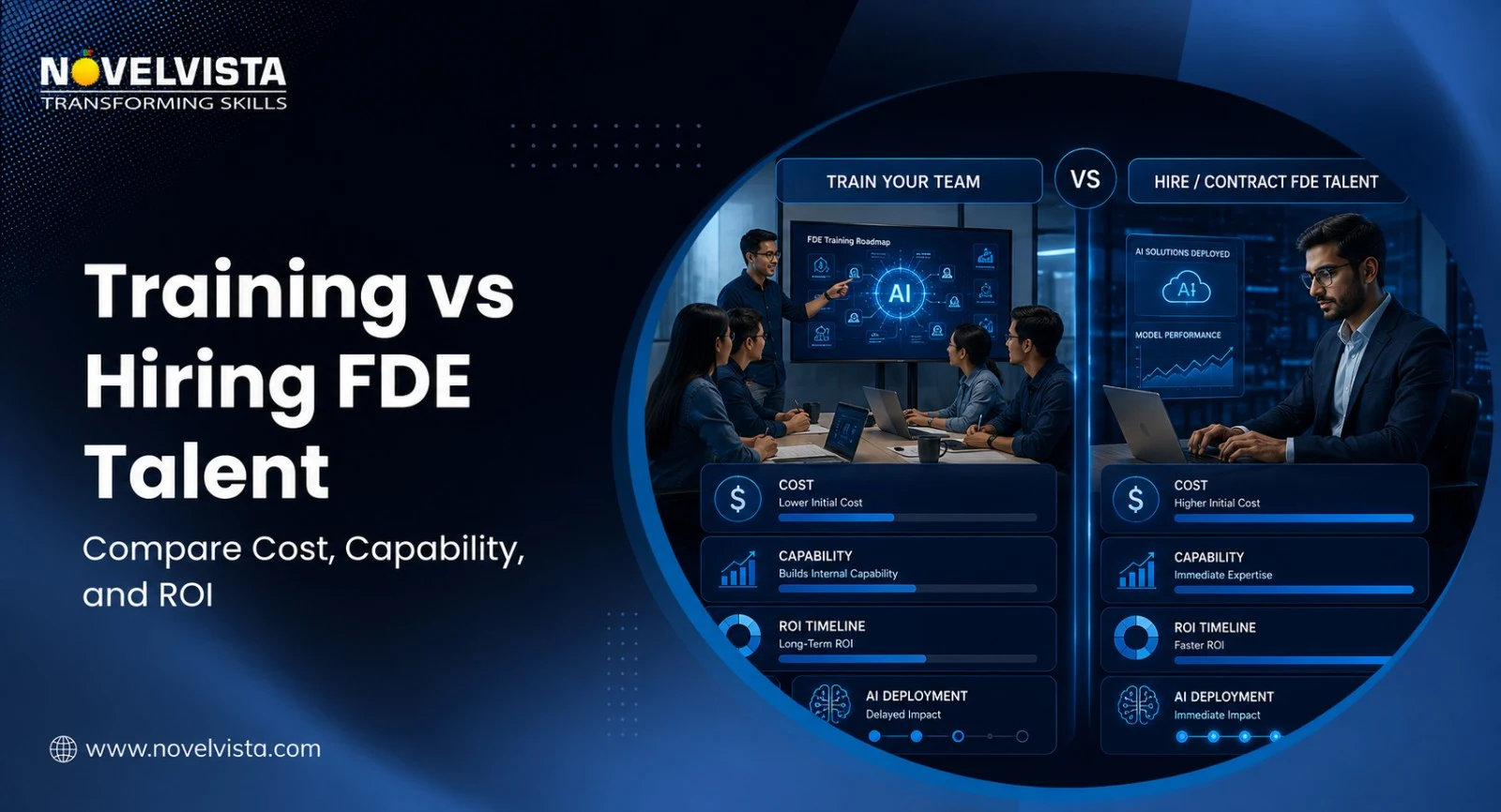
For many organizations, the smartest path is not choosing between training and hiring. It is building a core internal team first, then using external experts only where deeper support is needed.
This approach also gives companies more control. Existing employees already understand the organization’s processes, customers, systems, and business constraints. With the right training, they can become more useful in AI implementation conversations because they do not start from zero. They know what is realistic, what is risky, and where automation can create measurable value.
A good FDE programme should teach learners how to solve business problems with AI, not just explain models and tools. The curriculum should cover technical skills, deployment thinking, client communication, governance, and real-world implementation decisions.
At minimum, a strong programme should include:
| Must-Have Area | Why It Matters |
|---|---|
| AI deployment labs | Helps learners move beyond theory and apply concepts |
| Client-facing scenarios | Builds the consulting mindset expected from FDEs |
| RAG and agentic AI | Matches modern enterprise AI use cases |
| Governance and risk controls | Supports safer AI adoption across business teams |
| Capstone project | Shows whether learners can connect business, data, and AI execution |
This is where practical corporate training has an advantage. When the training is aligned with your organization’s tools, workflows, and business cases, the learning becomes easier to apply after the session.
A strong programme should also make learners comfortable with ambiguity. In real FDE work, the problem is not always clearly defined. A client may say they want an AI assistant, but the real need could be reducing response time, improving quality checks, summarizing complex documents, or helping teams make better decisions. Training should prepare learners to identify the actual business problem before jumping into tools.
The advertised FDE Cost may not include every expense. Before paying for any programme, check what is included and what may be charged separately.
Common hidden costs include:
Before you enroll, ask these questions:
A clear provider will explain the full FDE Cost upfront so learners and companies can plan without surprises.
For working professionals, time is also a real cost. If the course is too long, too theoretical, or difficult to apply, it can become hard to complete. For corporate teams, the time cost multiplies because multiple employees may be away from project work. That is why well-structured training with focused sessions, practical labs, and clear outcomes often gives better value than a programme that simply has more hours.
For HR, L&D, engineering leaders, and transformation teams, FDE Cost should be evaluated as a capability-building investment. The goal is not only to train employees. The goal is to help teams understand how AI can be deployed inside real business workflows.
Corporate pricing usually depends on:
| Corporate Requirement | Impact on Cost |
|---|---|
| Private batch | Usually increases relevance and customization value |
| More learners | Can reduce the per-learner cost |
| Industry-specific projects | May increase design effort but improves application |
| Assessment reports | Adds measurable L&D value |
| Post-training support | Improves implementation success after training |
This is where NovelVista’s Foraward Deployed Engineer Training fits well for corporate teams. Instead of treating FDE training as a generic AI course, it can be positioned around business use cases, enterprise AI workflows, and role-based capability building for teams that need practical outcomes.
For example, a product team may need FDE training to understand AI feature discovery and customer-facing implementation. A delivery team may need it to improve solution deployment. A consulting team may need it to convert vague client requirements into AI workflows. A leadership team may want a practical understanding of where FDE skills reduce AI project risk.
In all these cases, Forward Deployed Engineer Cost should be judged against the business value of faster implementation, better internal collaboration, and fewer stalled AI initiatives.
A low FDE Cost may look attractive at first, but ROI depends on what learners can do after training. If the programme helps your team reduce failed AI pilots, improve stakeholder communication, build internal prototypes, or speed up deployment, the value can be much higher than the fee.
Use this simple ROI framework:
| ROI Question | Why It Matters |
|---|---|
| Are AI pilots getting delayed? | Training can help teams move from idea to execution faster |
| Are engineers unclear about business requirements? | FDE training improves problem discovery and translation |
| Are business teams overdependent on vendors? | Internal capability reduces external dependency |
| Are AI tools being used without governance? | Training helps teams apply risk controls and responsible AI practices |
| Are projects failing after proof of concept? | FDE skills help connect prototypes with real workflows |
Forward Deployed Engineer Cost should be compared with the cost of delays, failed AI projects, rework, and dependency on external consultants. If a trained team prevents even one poorly scoped AI implementation, the investment can become easier to justify.
For corporate buyers, the ROI is strongest when training is linked to actual business scenarios. A team working on customer support automation, for example, should learn through examples connected to tickets, knowledge bases, escalation workflows, and quality checks. Generic learning may create awareness, but contextual learning creates action.
A practical way to evaluate ROI is to list the AI initiatives already planned for the next 6 to 12 months. Then ask which teams will be responsible for discovery, design, implementation, testing, governance, and stakeholder communication. If those teams do not currently have the skills to manage these areas confidently, training becomes a lower-risk investment than learning only through failed pilots.
Not every learner needs the most expensive programme. If your goal is basic awareness, a low-cost workshop or short course may be enough. But if your goal is to prepare teams for real enterprise AI deployment, premium training usually offers better value.
| Factor | Low-Cost Training | Premium FDE Training |
|---|---|---|
| Depth | Basic | Advanced and applied |
| Projects | Limited | Hands-on and enterprise-focused |
| Trainer interaction | Low | High |
| Corporate relevance | Generic | Customizable |
| Best use | Awareness | Capability building |
Forward Deployed Engineer Cost should match your outcome. A student exploring the field may start with a lower-cost option. A company preparing AI, product, delivery, consulting, or engineering teams should look for structured training with labs, use cases, and practical guidance.
The most affordable option can be a good starting point, but the best-value option is the one that helps learners perform better in real projects.
There is also a middle ground. Some teams do not need an academic-style programme with long timelines, but they do need more than a basic overview. In that situation, a focused corporate programme can work well because it balances time, relevance, and application. This is especially useful when the company wants to upskill teams quickly without losing the practical depth needed for AI deployment.
When comparing programmes, do not judge only by the fee. Compare the learning experience, business relevance, trainer quality, practical exposure, and post-training usefulness.
Use this checklist before deciding:
Forward Deployed Engineer Cost becomes easier to evaluate when you compare it with the outcome you expect. If you only need awareness, keep the budget lean. If you need a team that can identify use cases, communicate with stakeholders, and support AI deployment, choose a programme built for applied learning.
Also check whether the training provider understands corporate learning realities. A good corporate training partner should know how to handle mixed learner backgrounds, limited time availability, business-specific examples, and outcome-based reporting. This is one reason NovelVista is a practical fit for companies that want structured FDE learning without making the programme unnecessarily academic or disconnected from business goals.
FDE training has become more relevant because companies no longer want AI demos that stay in slides. They want people who can understand workflows, solve business problems, integrate systems, and help AI projects move into real use.
If you're exploring careers in AI, don't miss our YouTube video explaining the Forward Deployed Engineer (FDE) role and how it fits into modern enterprise AI teams.
The right FDE Cost depends on your goal. For beginners, a short programme may be enough to understand the basics. For engineers, product teams, consultants, and corporate learners, a deeper programme with labs and enterprise scenarios is a better investment. For organizations, Forward Deployed Engineer Cost should be measured against faster AI deployment, reduced vendor dependency, stronger internal capability, and fewer failed pilots.
If your organization wants to build practical FDE capability with a corporate-focused approach, NovelVista’s Foraward Deployed Engineer Training is a strong option to consider. It is especially useful for teams that need structured learning, real business context, and AI deployment readiness without turning the training into an overly academic programme.
In 2026, the cheapest FDE training may help you learn the vocabulary. The right FDE training helps your team turn AI into working business outcomes.
Author Details

Course Related To This blog
Forward Deployed Engineer (AI)
Confused About Certification?
Get Free Consultation Call
Stay ahead of the curve by tapping into the latest emerging trends and transforming your subscription into a powerful resource. Maximize every feature, unlock exclusive benefits, and ensure you're always one step ahead in your journey to success.