Category | AI And ML
Last Updated On 09/07/2026
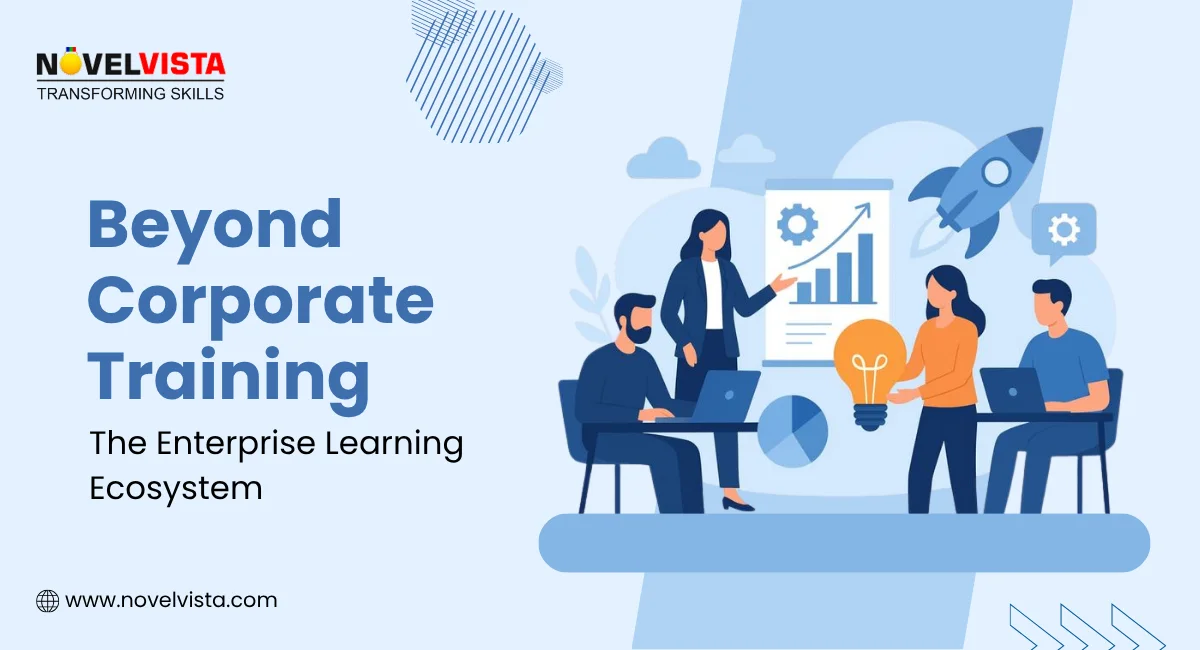
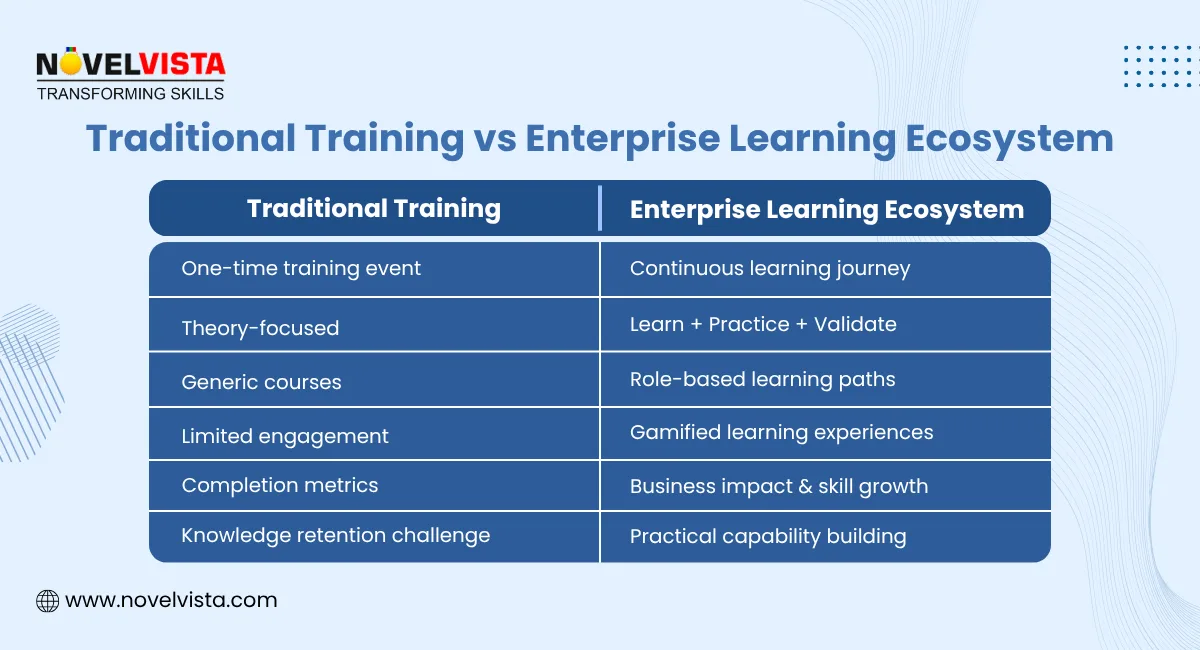
Corporate training has changed significantly over the last decade. Organizations no longer need employees to simply complete courses or earn certifications they need them to apply new skills, solve real business problems, and adapt to rapidly evolving technologies.
However, many enterprise training programs still rely on a traditional approach: learners attend a classroom session or complete an online course, take an assessment, and receive a certificate. While this may satisfy compliance or certification requirements, it often falls short when it comes to building lasting capabilities.
Today's enterprises require something much more comprehensive. They need a learning ecosystem that combines structured learning, practical experience, assessments, collaboration, and continuous engagement into one seamless journey.
An integrated enterprise learning ecosystem transforms training from a one-time event into an ongoing capability-building process. It enables employees to learn concepts, practice skills in realistic environments, validate their knowledge, and stay engaged throughout their learning journey.
Let's explore the four essential components that make an enterprise learning ecosystem truly effective.
Organizations invest heavily in workforce development, yet many struggle with low knowledge retention and limited skill application after training.
The reason is simple.
Learning doesn't happen by listening alone.
Employees need opportunities to practice, experiment, make mistakes, receive feedback, and demonstrate their capabilities before applying new skills in real projects.
Modern learning therefore extends beyond instructor-led sessions. It requires an ecosystem where every stage of the learner's journey is connected—from learning and practicing to assessment and continuous engagement.
Every successful learning journey begins with a strong foundation.
A Learning Management System (LMS) acts as the central hub where employees access learning paths, course materials, assignments, recordings, assessments, and progress tracking.
Unlike generic learning platforms, an enterprise LMS supports role-based learning journeys tailored to different job functions. A cloud engineer, project manager, cybersecurity analyst, or DevOps professional can each follow customized learning paths aligned with their responsibilities.
An effective LMS also provides:
For organizations managing hundreds or thousands of employees, the LMS becomes the single source of truth for workforce learning and skill development.
But learning concepts alone isn't enough.
Employees need practical experience.
Reading documentation or watching videos cannot replace practical experience.
Hands-on labs provide learners with access to real cloud environments, enterprise software, operations tools, automation platforms, and technology stacks where they can safely experiment without affecting production systems.
Instead of simply learning how Kubernetes works, learners deploy clusters.
Instead of reading about cloud security, they configure security controls.
Instead of studying DevOps pipelines, they build and troubleshoot them.
This practical approach bridges the gap between theory and workplace performance.
Enterprise labs typically include:
Hands-on learning significantly improves confidence because employees gain experience solving real-world challenges before encountering them on actual projects.
The result is faster onboarding, improved productivity, and greater job readiness.
Learning without assessment makes it difficult to determine whether employees are actually ready to apply their knowledge.
Modern enterprises need more than simple quizzes.
They need assessment systems that accurately measure competence.
An advanced ExamEngine simulates real certification and workplace assessment experiences through multiple evaluation formats, including:
These assessments help organizations evaluate not just theoretical understanding but also problem-solving ability and decision-making skills.
Pre-assessments identify existing knowledge gaps before training begins, enabling personalized learning paths.
Post-assessments measure skill improvement after training and provide measurable evidence of learning outcomes.
For organizations investing in certifications, realistic exam simulations also increase learner confidence while improving certification success rates.
Managers benefit from detailed analytics that highlight individual progress, team readiness, and overall training effectiveness.
Assessment therefore becomes more than a score it becomes a tool for continuous improvement.
One of the biggest challenges in corporate learning is maintaining learner engagement over time.
Employees often balance training alongside project deadlines, customer commitments, and daily responsibilities.
Gamification helps overcome this challenge by making learning interactive, collaborative, and enjoyable.
A platform like PlayArena transforms traditional learning into an engaging experience through:
Rather than learning in isolation, employees participate with colleagues, creating healthy competition and stronger collaboration.
Recognition through badges, rankings, and achievements motivates learners to continue progressing while encouraging consistent participation.
Gamification also creates a culture of continuous learning, where skill development becomes part of everyday work instead of an occasional training event.
When employees enjoy learning, engagement naturally increases and so do learning outcomes.
While each component delivers value individually, their true strength lies in working together.
Imagine an employee beginning a cloud certification journey.
They start with structured modules inside the LMS.
Next, they apply concepts through hands-on labs using real cloud environments.
Their progress is measured through realistic assessments and certification simulations in the ExamEngine.
Finally, PlayArena keeps them motivated through team challenges, badges, and friendly competition.
Instead of disconnected learning activities, employees experience one continuous journey—from learning to practice, validation, and ongoing engagement.
This integrated approach creates better knowledge retention, higher certification success, stronger skill application, and measurable business outcomes.
Organizations today face constant technological change.
Cloud computing, artificial intelligence, cybersecurity, DevOps, agile practices, and digital transformation continue to reshape workforce requirements.
Keeping employee skills current requires more than occasional training sessions.
An enterprise learning ecosystem enables organizations to:
Instead of viewing learning as a compliance activity, organizations can build a culture where employees continuously develop the capabilities needed to meet evolving business demands.
The future of corporate learning is no longer defined by standalone courses or one-time training events. Organizations that want to build resilient, future-ready teams need an integrated learning ecosystem that combines structured learning, practical experience, realistic assessments, and continuous engagement.
When Learning Management Systems, hands-on labs, assessment platforms, and gamified experiences work together, employees don't just complete training they build confidence, develop real-world skills, and contribute more effectively to business success.
This is why forward-thinking organizations are moving beyond traditional training models and investing in learning experiences that deliver measurable business outcomes. A well-designed corporate training ecosystem empowers teams to learn faster, apply skills with confidence, and continuously adapt to evolving technologies and business demands.
At NovelVista, our corporate training programs are built around this integrated approach combining expert-led learning with hands-on labs, structured learning paths, realistic assessments, and gamified engagement to help organizations develop workforce capabilities at scale. If your goal is to build a future-ready workforce that can drive innovation and business growth, explore how our corporate training solutions can support your learning transformation.
Author Details

Confused About Certification?
Get Free Consultation Call
Stay ahead of the curve by tapping into the latest emerging trends and transforming your subscription into a powerful resource. Maximize every feature, unlock exclusive benefits, and ensure you're always one step ahead in your journey to success.