Category | AI And ML
Last Updated On 20/07/2026
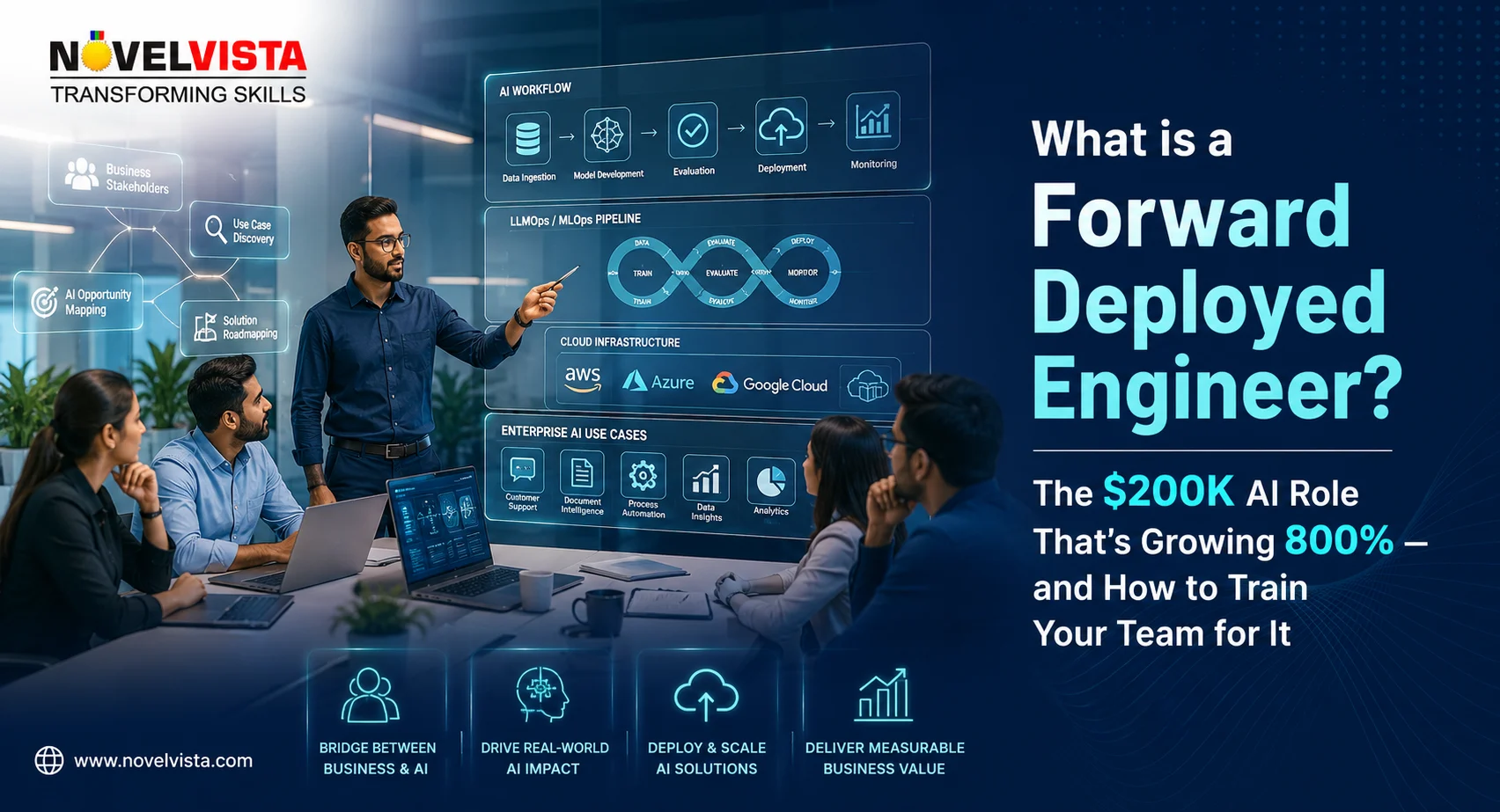
The AI hiring market is shifting fast. Companies no longer need only backend engineers, ML engineers, or prompt engineers working in isolation. They need professionals who can sit close to business teams, understand messy operational problems, build working AI solutions, and take them into production.
That is why the Forward Deployed Engineer role is becoming one of the most valuable AI career paths for enterprise teams. This blog explains the forward deployed engineer definition, salary trends, job demand, llmops vs mlops relevance, and a practical training roadmap for organizations.
A Forward Deployed Engineer, often called an FDE, is a technical professional who works directly with customers, internal business units, or enterprise teams to build software and AI solutions inside real operating environments. This blog explains what is a forward deployed engineer, how the role differs from traditional engineering, why forward deployed engineer jobs are growing, what skills matter, how llmops vs mlops fits into the role, and how organizations can train their teams for this emerging AI career path.
The forward deployed engineer definition is simple: an engineer who does not stay far away from the business problem. Instead, they sit close to users, understand workflows, connect data sources, build prototypes, and help take solutions into production. In AI projects, this role becomes even more important because success depends on integration, governance, adoption, and business context—not only model quality.
The rise of generative AI has created a large execution gap. Many companies now have access to LLMs, copilots, automation platforms, and AI agents, but they still struggle to turn these tools into measurable productivity gains. Forward deployed engineer jobs are growing because enterprises need people who can move AI from demo mode to business impact.
This is where the llmops vs mlops conversation becomes practical. Traditional MLOps supports predictive models, while LLMOps supports large language model applications, AI agents, RAG pipelines, prompt management, guardrails, and user feedback loops. A strong FDE needs working knowledge of both.
A forward deployed software engineer is still a software engineer, but the delivery model is different. Traditional engineers usually build features for a product roadmap. Forward deployed engineers work closer to the client or business unit and focus on solving a specific operational problem.
| Area | Traditional Software Engineer | Forward Deployed Engineer |
|---|---|---|
| Main focus | Build product features | Solve customer or business problems in live environments |
| Primary users | Product users at scale | Specific enterprise teams, clients, or business units |
| Success metric | Code quality, delivery speed, scalability | Adoption, business impact, production outcomes |
| Working style | Central engineering roadmap | Embedded execution with stakeholders |
| AI responsibility | Build AI components | Deploy AI into real workflows with governance |
This role is not a replacement for product engineering. It is a bridge between product, platform, data, AI, and business execution. In AI-first companies, that bridge can decide whether a project becomes another abandoned proof of concept or a scalable business capability.
Forward deployed engineer salary levels are increasing because the role combines multiple high-value capabilities. Companies are not paying only for coding. They are paying for someone who can understand business workflows, build AI-enabled systems, manage stakeholders, and convert investment into working outcomes.
In global AI product companies and enterprise technology firms, senior FDE compensation can cross the $200K mark depending on location, experience, equity, and business impact. In India and other fast-growing technology markets, forward deployed engineer salary ranges are also rising as AI startups, GCCs, SaaS companies, and consulting firms hire professionals who can deploy AI solutions at scale.
Common job titles include Forward Deployed Engineer, Forward Deployed Software Engineer, Forward Deployed AI Engineer, Applied AI Engineer, AI Solutions Engineer, Enterprise AI Engineer, Deployment Strategist, and Customer Engineer for AI Platforms.
The main keyword llmops vs mlops is directly connected to the FDE role because forward deployment is not only about building applications. It is about operating AI systems safely, reliably, and repeatedly inside real enterprise workflows.
| Factor | MLOps | LLMOps |
|---|---|---|
| Primary use case | Predictive machine learning systems | Generative AI, copilots, agents, and RAG apps |
| Data type | Structured datasets, labels, features | Prompts, documents, embeddings, user context |
| Monitoring focus | Drift, accuracy, latency, model performance | Hallucination, relevance, safety, token cost |
| Common tools | Model registry, feature store, CI/CD pipelines | Vector databases, prompt registry, guardrails |
| FDE value | Operationalize ML use cases | Turn LLM pilots into production AI workflows |
MLOps is valuable for use cases such as fraud detection, forecasting, classification, and recommendation systems. LLMOps is essential for enterprise search, AI copilots, document intelligence, customer support automation, and agentic workflows. A future-ready FDE should understand where llmops vs mlops differs and where both overlap: governance, evaluation, monitoring, security, and lifecycle management.
The best FDEs are not only framework experts. They are practical builders who can ask sharp questions, design workable systems, and communicate trade-offs clearly. The role rewards people who can move between code, architecture, business process, and stakeholder expectations.
For corporate teams, this skill mix is powerful because it creates professionals who can execute AI strategy instead of only discussing it.
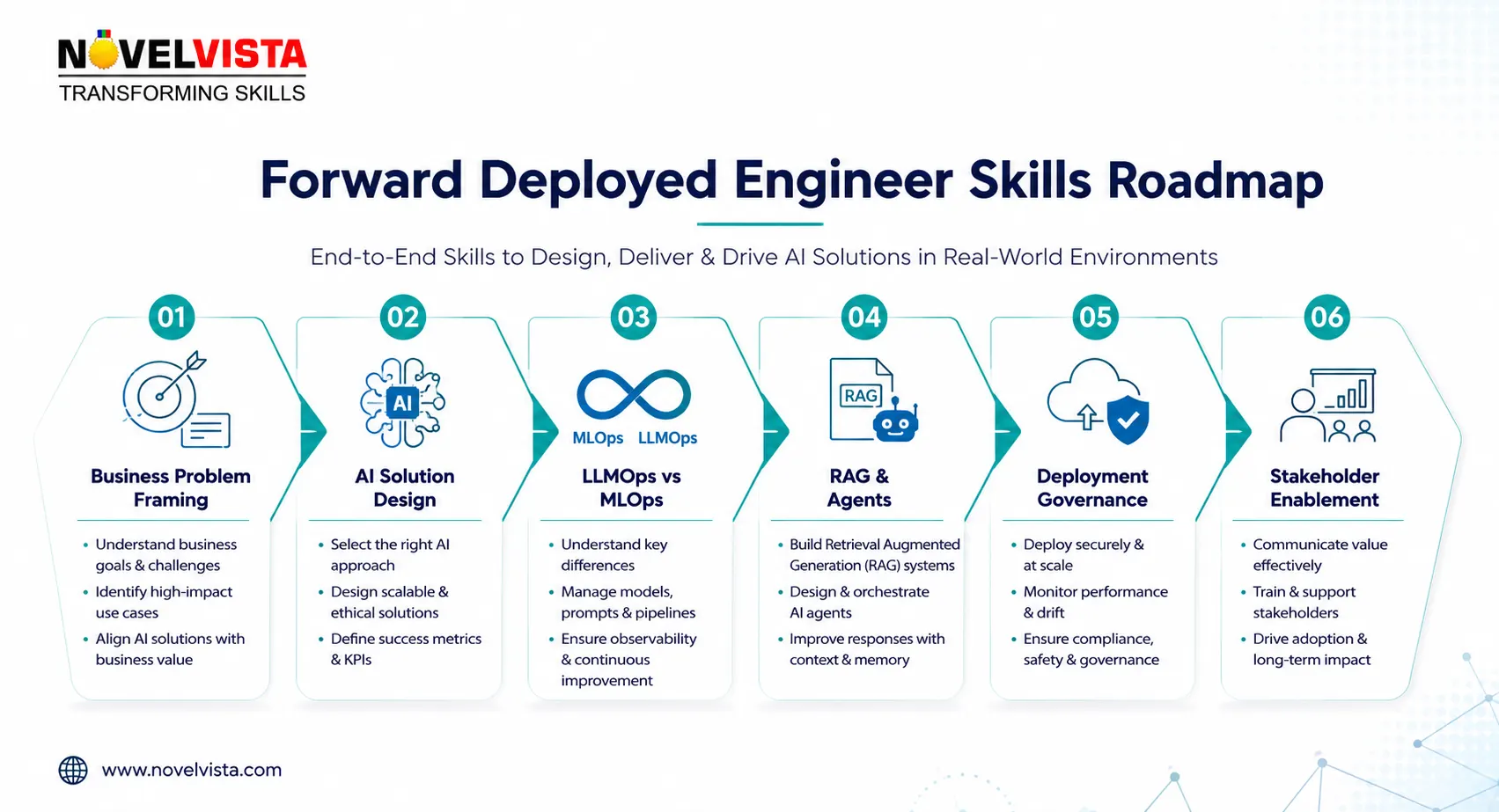
Organizations do not always need to hire every FDE externally. Many can build this capability by upskilling software engineers, cloud engineers, solution architects, data analysts, automation specialists, and technical consultants.
Teams should learn how to identify business problems where AI can create measurable value. This includes workflow mapping, stakeholder discovery, ROI estimation, and risk analysis.
Professionals should understand model monitoring, prompt lifecycle management, RAG evaluation, guardrails, and production reliability.
Training should include enterprise chatbots, document search, workflow automation, AI agents, API integrations, and internal copilots.
FDEs must know how to move beyond demos with access control, audit trails, logging, privacy controls, and responsible AI practices.
The final layer is communication. FDEs must run workshops, gather requirements, manage feedback, and convert business language into technical delivery.
AI adoption is moving from experimentation to execution. The winners will not be the companies with the most AI tools. They will be the companies with teams that can deploy AI responsibly across business functions.
Forward Deployed Engineers help close that gap. They bring engineering closer to the user, shorten feedback loops, reduce failed pilots, and turn AI from a boardroom ambition into a working business system. For L&D leaders, this is a major opportunity to create role-based AI capability instead of one-size-fits-all tool training.
The Forward Deployed Engineer is becoming one of the most valuable AI roles because it sits exactly where enterprises need help: between business problems and production-grade AI systems. Understanding what is a forward deployed engineer is only the first step. The real value comes from building the capabilities behind the role: software engineering, AI implementation, stakeholder management, llmops vs mlops, cloud integration, and deployment governance.
If you're exploring careers in AI, don't miss our YouTube video explaining the Forward Deployed Engineer (FDE) role and how it fits into modern enterprise AI teams.
If your organization wants to prepare teams for this next wave of AI execution, explore NovelVista’s Forward Deployed Engineer (AI) Training. The course helps enterprise teams build practical FDE capability and turn AI adoption into real operational impact.
Author Details

Confused About Certification?
Get Free Consultation Call
Stay ahead of the curve by tapping into the latest emerging trends and transforming your subscription into a powerful resource. Maximize every feature, unlock exclusive benefits, and ensure you're always one step ahead in your journey to success.