Category | AI And ML
Last Updated On 26/09/2026
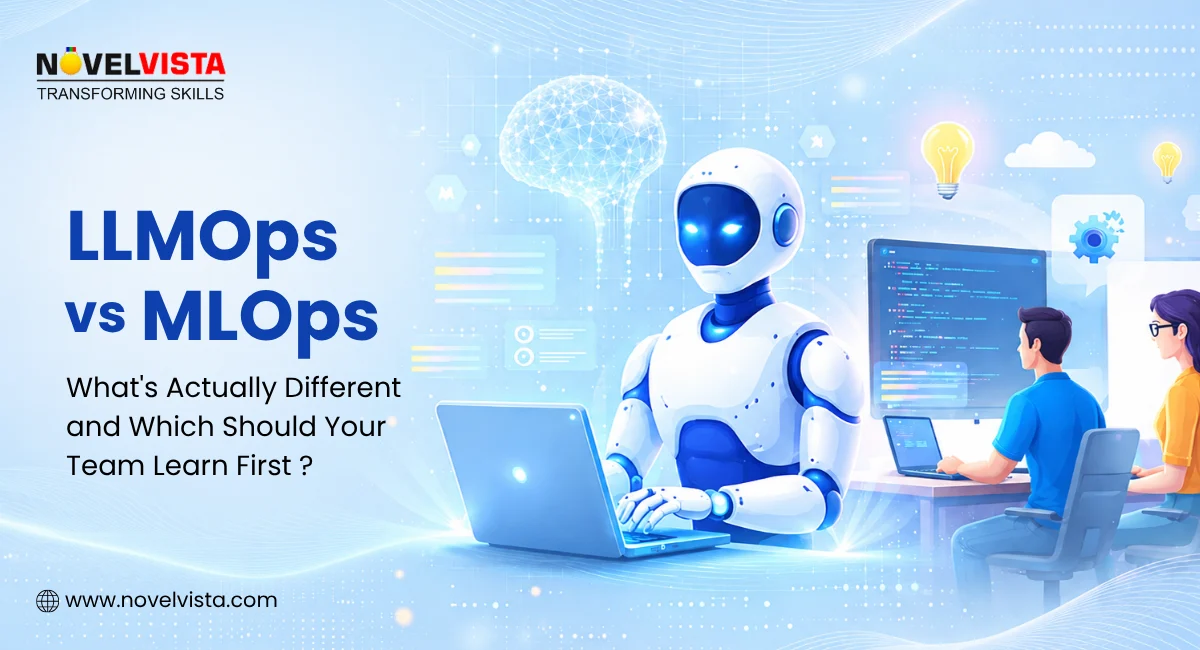
Artificial Intelligence has moved far beyond traditional machine learning models. Today, organizations are building AI-powered chatbots, copilots, document assistants, autonomous agents, and enterprise search applications using Large Language Models (LLMs). But with this shift comes a common question:
Is MLOps still enough, or do teams need LLMOps?
If you've searched for LLMOps vs MLOps, you're not alone. According to industry reports, over 80% of enterprises are actively experimenting with generative AI, yet many struggle with deploying and managing these applications in production. While traditional MLOps has helped organizations operationalize machine learning for years, LLM-powered applications introduce entirely new challenges from prompt engineering and vector databases to hallucination monitoring and AI governance.
So, does LLMOps replace MLOps? Is it simply a new name for existing practices? And more importantly, which one should your team learn first?
In this guide, we'll break down the LLMOps vs MLOps debate, explain where each fits, highlight the difference between MLOps and LLMOps, and help you decide the right learning path based on your organization's AI maturity.
Before understanding LLMOps vs MLOps, it's important to understand what MLOps actually does.
MLOps (Machine Learning Operations) is a set of practices that combines machine learning, DevOps, and data engineering to automate the development, deployment, monitoring, and maintenance of machine learning models.
Instead of manually training and deploying models, MLOps creates repeatable pipelines that ensure models remain accurate, scalable, and reliable over time.
Typical MLOps workflows include:
MLOps has become essential for organizations building predictive AI systems such as fraud detection, recommendation engines, demand forecasting, predictive maintenance, and customer churn prediction.
To understand LLMOps vs MLOps, you also need to know what is LLMOps.
LLMOps (Large Language Model Operations) refers to the processes, tools, and best practices used to deploy, monitor, evaluate, secure, and improve applications powered by Large Language Models.
Unlike traditional ML systems, LLM applications often rely on:
Rather than retraining models frequently, LLMOps focuses on improving application performance through prompts, retrieval quality, safety mechanisms, and evaluation frameworks.
This makes LLMOps and MLOps related but not identical disciplines.
The easiest way to understand LLMOps vs MLOps is to compare how each manages AI systems.
Feature | MLOps | LLMOps |
Primary focus | Machine learning models | Large Language Models |
Data | Structured datasets | Documents, text, knowledge bases |
Model updates | Retraining | Prompt tuning and retrieval optimization |
Infrastructure | ML pipelines | LLM orchestration pipelines |
Monitoring | Accuracy, drift | Hallucinations, latency, token usage |
Key tools | MLflow, Kubeflow, SageMaker | LangChain, LangGraph, vector databases, observability platforms |
Common applications | Prediction systems | Chatbots, copilots, AI assistants |
This comparison clearly illustrates the difference between MLOps and LLMOps. While both aim to operationalize AI, they solve different operational challenges.
One misconception in the LLMOps vs MLOps discussion is that LLMOps simply replaces MLOps.
That's not true.
Traditional machine learning focuses on predicting numerical outcomes or classifications.
Large Language Models generate human-like responses, summarize documents, answer questions, write code, and perform reasoning tasks. These capabilities introduce unique operational concerns such as:
Because these challenges didn't exist in conventional ML systems, organizations require specialized operational practices beyond traditional MLOps.
Many professionals also compare MLOps vs DevOps while exploring AI operations.
Here's a simplified comparison.
DevOps | MLOps | LLMOps |
Automates software delivery | Automates ML lifecycle | Automates LLM application lifecycle |
Focuses on application code | Focuses on ML models | Focuses on prompts, retrieval, and LLM behavior |
CI/CD pipelines | ML pipelines | LLM evaluation and deployment pipelines |
Software monitoring | Model monitoring | Response quality, hallucination, and safety monitoring |
Similarly, organizations increasingly discuss AIOps vs MLOps vs LLMOps.
Each serves a different business purpose, although they often complement one another within enterprise AI ecosystems.
Learning LLMOps involves acquiring skills that traditional MLOps engineers may never have needed.
Some important LLMOps capabilities include:
These skills make LLMOps especially valuable as organizations expand their generative AI initiatives.
Choosing between LLMOps vs MLOps depends entirely on your organization's AI goals.
Your Organization Needs... | Recommended Learning Path |
Predictive analytics | MLOps |
Fraud detection | MLOps |
Demand forecasting | MLOps |
Customer recommendation engines | MLOps |
AI chatbots | LLMOps |
Enterprise search | LLMOps |
AI copilots | LLMOps |
Document intelligence | LLMOps |
For organizations just beginning their AI journey, understanding machine learning fundamentals before moving into LLMOps often provides a stronger technical foundation.
However, if your immediate focus is deploying ChatGPT-style enterprise applications, learning LLMOps first can accelerate business value.
Many organizations eventually invest in both MLOps and LLMOps because predictive AI and generative AI frequently coexist.
As enterprises adopt increasingly sophisticated AI systems, the boundary between MLOps and LLMOps will continue to evolve.
Future AI platforms will likely combine:
Rather than competing disciplines, MLOps and LLMOps are becoming complementary building blocks of modern AI engineering.
Deciding how MLOps and LLMOps fit together across an organization is ultimately a solution architecture decision. AI Solution Architect helps professionals design that combined AI operating model end-to-end, from model orchestration to deployment pipelines and governance.
Teams that understand both will be better equipped to design scalable, secure, and production-ready AI solutions capable of delivering long-term business value.

The debate around LLMOps vs MLOps isn't about choosing a winner it's about understanding the right operational approach for the AI solutions your organization is building.
Traditional MLOps continues to serve as the foundation for predictive machine learning systems, while LLMOps addresses the unique challenges of deploying and managing Large Language Models, including prompt management, retrieval optimization, AI safety, observability, and response evaluation. Understanding the difference between MLOps and LLMOps enables organizations to make smarter technology decisions, strengthen AI governance, and build production-ready AI systems with confidence.
As generative AI adoption accelerates, organizations that invest in developing both MLOps and LLMOps capabilities will be better positioned to innovate faster and scale AI initiatives successfully. Upskilling your engineering and AI teams in modern LLMOps practices can help bridge the gap between experimentation and enterprise deployment, ensuring your organization is prepared for the next generation of AI applications. Successfully moving from AI pilots to enterprise-scale deployments requires more than the right tools it requires the right capabilities. Investing in LLMOps upskilling for your teams can help build the expertise needed to deploy, monitor, and optimize Large Language Model applications with confidence.
Whether you're building recommendation engines, AI copilots, or intelligent enterprise assistants, investing in the right operational practices and empowering your teams with the skills to implement them will keep your AI systems reliable, scalable, and future-ready.
What is LLMOps refers to the operational practices used to deploy, monitor, evaluate, and improve applications powered by Large Language Models. It includes prompt management, AI observability, and retrieval optimization.
The difference between MLOps and LLMOps is that MLOps manages traditional machine learning models, while LLMOps focuses on operating Large Language Model applications, including prompts, RAG pipelines, and hallucination monitoring.
No. In the LLMOps vs MLOps comparison, LLMOps complements rather than replaces MLOps. Organizations often use both depending on their AI use cases.
In MLOps vs DevOps, DevOps focuses on software delivery, while MLOps manages the lifecycle of machine learning models, including training, deployment, and monitoring.
In AIOps vs MLOps vs LLMOps, AIOps automates IT operations, MLOps manages predictive ML systems, and LLMOps supports generative AI applications powered by Large Language Models.
Author Details

Confused About Certification?
Get Free Consultation Call
Stay ahead of the curve by tapping into the latest emerging trends and transforming your subscription into a powerful resource. Maximize every feature, unlock exclusive benefits, and ensure you're always one step ahead in your journey to success.