Category | AI And ML
Last Updated On 08/08/2026
What happens when an AI pilot works perfectly in a presentation but fails the moment it enters a real enterprise environment?
This is one of the biggest problems facing organizations investing in generative AI today. Companies can build impressive proofs of concept, experiment with foundation models, and launch internal AI initiatives. Yet turning those experiments into secure, scalable, production-ready systems remains difficult.
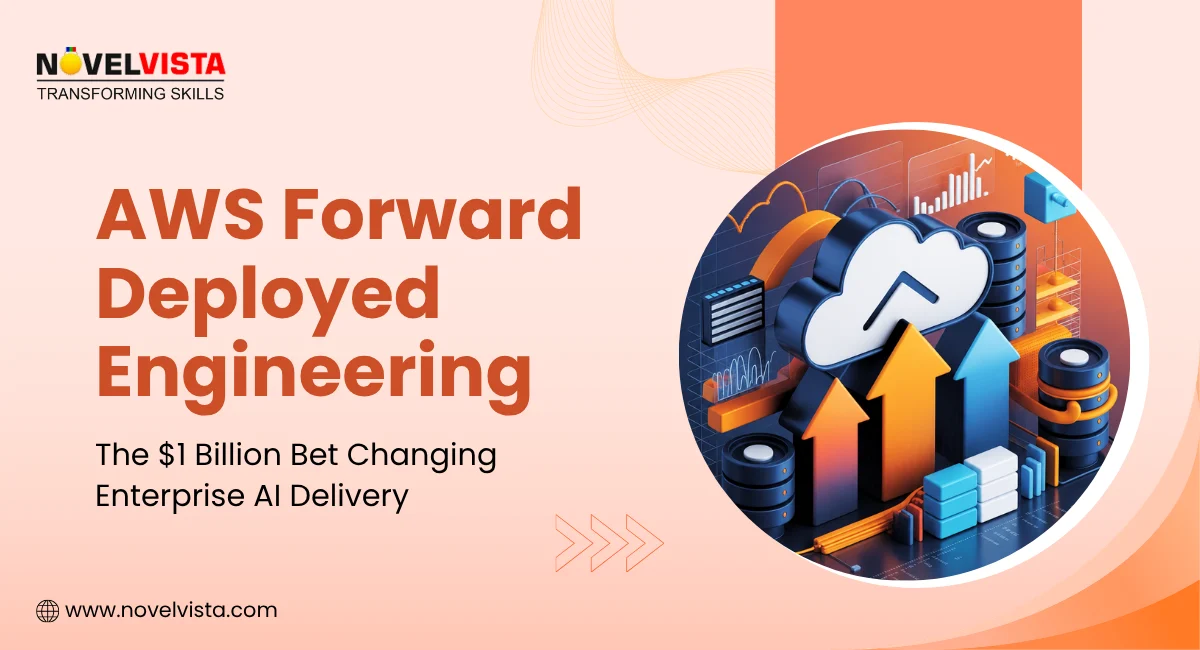
This is where AWS Forward Deployed Engineering (FDE) is becoming particularly significant.
AWS has committed $1 billion to its internal Forward Deployed Engineering initiative, with the unit launching on June 30, 2026, with hundreds of engineers and ambitions to scale into the thousands. Rather than operating as traditional consultants working from a distance, FDE teams embed directly with customers to solve technical problems and accelerate production deployment.
But what exactly is Forward Deployed Engineering? Why is AWS investing at this scale? And why are FDE roles becoming one of the fastest-growing categories in the AI engineering labor market?
The answers point toward a broader change in how enterprises will build and deploy AI.
AWS Forward Deployed Engineering is an engineering-led customer delivery model in which technical specialists work closely with enterprise teams to take emerging technologies from experimentation to production.
Instead of simply recommending an architecture or handing over documentation, forward deployed engineers work alongside customer teams to:
The distinction is important.
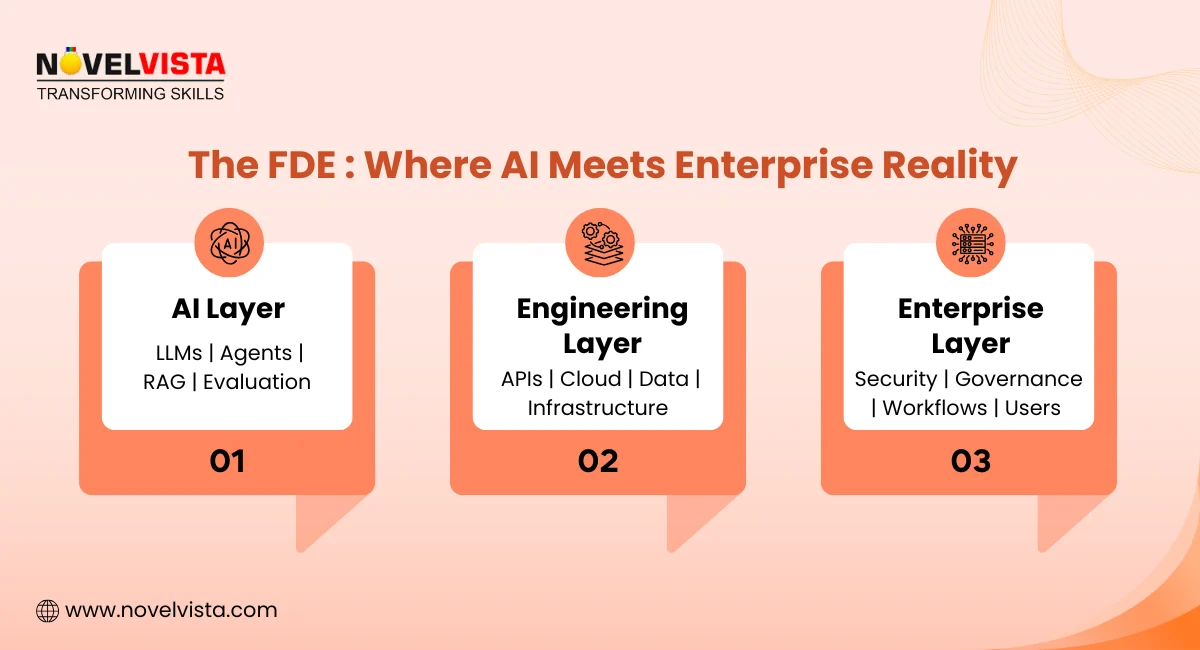
Traditional consulting often focuses on advising. Traditional software engineering focuses primarily on building products. Forward deployed engineering combines software engineering, AI implementation, cloud architecture, customer collaboration, and technical problem-solving.
The result is an engineer who operates at the intersection of technology and business outcomes.
The scale of the AWS investment suggests that the company sees customer implementation as a strategic growth opportunity rather than simply another professional service.
AWS AI services reportedly generated $37.5 billion in Q1 2026, representing approximately 28% year-over-year growth. With enterprises continuing to adopt cloud infrastructure and generative AI, the next challenge is not simply convincing organizations to use AI.
It is helping them successfully deploy it.
This creates what can be called the AI deployment gap.
Organizations may have access to foundation models, cloud platforms, vector databases, AI agents, and development tools. However, connecting those technologies to legacy applications, proprietary data, security controls, compliance requirements, and business workflows is considerably harder.
Forward deployed engineers address this gap directly.
Consider the difference:
Traditional AI Adoption | Forward Deployed Engineering |
Build a proof of concept | Build toward production |
Separate consulting and engineering | Engineering embedded with customers |
Technology-focused | Business-outcome focused |
Recommendations and architecture | Hands-on implementation |
Customer receives solution | Customer works alongside engineers |
Deployment may happen later | Production is a core objective |
This model becomes especially valuable when an enterprise already knows that AI can create value but does not have the internal engineering capacity to implement it quickly.
One of the most important statistics in the FDE discussion is the reported 95% failure rate for enterprise AI pilots reaching production or delivering measurable P&L value.
Even if individual estimates vary by industry and methodology, the broader problem is real: creating an AI demonstration is significantly easier than operating an AI system at enterprise scale.
Why?
Enterprise AI deployment introduces challenges such as:
A model may perform well in a controlled experiment but behave differently when exposed to real users, changing data, operational constraints, and production workloads.
This is precisely where AWS Forward Deployed Engineering becomes strategically important.
By embedding engineers into customer environments, organizations can shorten the distance between experimentation and implementation.
A particularly interesting operational concept associated with AWS FDE is the 45/45/45 cadence:
45 minutes → Ideate
The team identifies a business problem and determines whether AI or another emerging technology can realistically address it.
45 hours → Validate
Engineers build a proof of concept to test technical feasibility and potential value.
45 days → Ship
The objective is to move the validated solution into a production environment.
The underlying philosophy is simple: reduce the time between an idea and measurable business value.
This approach reflects a broader movement toward rapid AI engineering, where teams emphasize experimentation, validation, deployment, and continuous improvement rather than spending months designing theoretical solutions.
One common misconception is that forward deployed engineers are simply highly technical support professionals.
They are not.
An FDE may need to understand software development, cloud architecture, APIs, distributed systems, AI models, data pipelines, security, DevOps, and customer operations.
At the same time, they need strong communication skills because they are working directly with business stakeholders and engineering teams.
The role therefore sits somewhere between several established disciplines.
| Role | Primary Focus | FDE Difference |
| Software Engineer | Build software | Builds directly around customer problems |
| Solutions Architect | Design architecture | More deeply involved in implementation |
| Consultant | Advise organizations | Stronger hands-on engineering component |
| ML Engineer | Build ML systems | Often operates within customer environments |
| Sales Engineer | Technical pre-sales | FDE extends beyond the sale into deployment |
| Forward Deployed Engineer | Solve and deploy | Combines engineering with customer execution |
This hybrid skill set explains why the FDE role is attracting attention across the technology industry.
The growth is not limited to AWS.
Industry data provided for July 2026 indicates approximately 1,206 live FDE-titled positions across 669 companies globally. When broader customer-embedded engineering and delivery roles are included, the opportunity exceeds 20,000 positions.
Demand for FDE and related roles reportedly increased 42-fold between 2023 and 2025, while FDE vacancies experienced approximately 729% year-over-year growth by mid-2026.
The distribution is also revealing.
Approximately 73% of FDE roles are concentrated at startups and scale-ups, while frontier AI companies and major public technology companies represent smaller but highly visible portions of the market.
This suggests that FDE is becoming a broader organizational pattern rather than an AWS-specific experiment.
The compensation reflects the unusual combination of technical and customer-facing skills required.
Based on the July 2026 labor-market data supplied, the median global base salary for FDE roles is approximately $185,000.
Compensation Indicator | Reported Figure |
Global FDE base salary median | $185,000 |
Coastal-market median | $188,000 |
Heartland-market median | $163,000 |
Senior frontier-lab base | Up to $345,000 |
Senior frontier-lab total compensation | $560,000–$1M+ |
Geography also matters. Coastal technology hubs such as Seattle, New York City, and the San Francisco Bay Area reportedly command around a 15% premium compared with heartland markets.
At frontier AI companies, equity can represent 44–70% of total compensation, making senior FDE packages substantially higher than their base salaries suggest.
The reason is straightforward: companies are paying for engineers who can translate emerging technology into production outcomes.
AWS is not alone in pursuing large-scale customer deployment capabilities.
The broader industry is moving toward models where organizations combine AI technology with specialized implementation teams.
Reported competitor initiatives include:
Company | Reported Initiative | Reported Scale |
AWS | Forward Deployed Engineering | $1 billion |
Microsoft | Frontier Company | $2.5 billion / 6,000 experts |
OpenAI | DeployCo | $10 billion JV |
Anthropic | Ode | $1.5 billion JV |
These investments highlight an important strategic shift.
The AI market may no longer be defined only by who has the best model.
Increasingly, competitive advantage may depend on who can successfully deploy AI into the enterprise fastest and at scale.
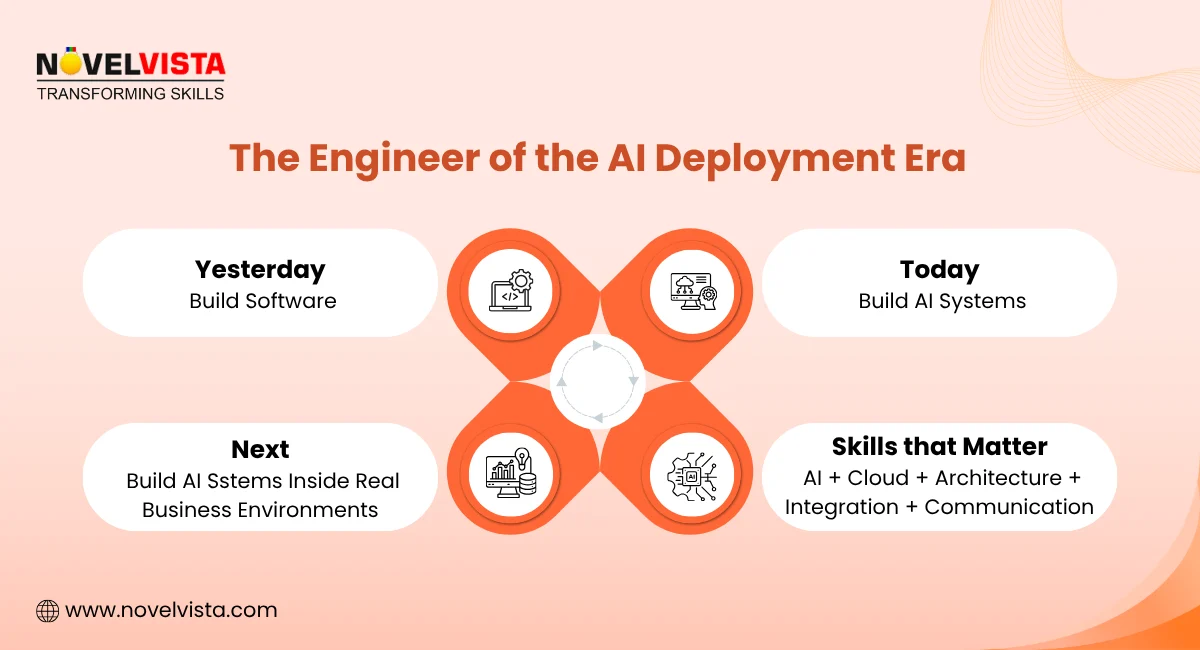
The next generation of FDE professionals will need a broader skill set than conventional software engineers.
Key capabilities include:
This is why FDE training cannot focus exclusively on programming.
Engineers also need to understand production AI architecture, enterprise integration, cloud platforms, AI governance, observability, and value measurement.
The most important lesson may not be about hiring thousands of engineers.
It is about organizational design.
Enterprises struggling with AI adoption should ask:
If the answer to several of these questions is no, the organization may have an AI capability gap, not an AI technology gap.
That distinction is critical.
Buying another AI tool does not automatically create AI capability. Building internal engineering expertise does.
The future FDE is unlikely to be simply an engineer who writes code at a customer's location.
Instead, the role is evolving toward a technical problem solver who can take emerging technologies, particularly AI, and turn them into reliable, measurable enterprise capabilities.
AWS's $1 billion investment demonstrates the potential scale of this model. The rapid growth in FDE job postings demonstrates that other organizations are recognizing the same opportunity.
For technology professionals, this creates a new career path combining AI engineering, cloud engineering, software development, architecture, and customer-facing problem solving.
For enterprises, it offers a different approach to AI adoption: stop treating production deployment as the final step after experimentation and make engineering execution part of the AI strategy from day one.

AWS Forward Deployed Engineering represents more than a new engineering job title. It reflects a fundamental change in how enterprises are approaching AI implementation.
With AWS reportedly investing $1 billion, hiring at significant scale, and deploying small engineering pods directly into customer environments, the model places production delivery at the center of AI adoption. The wider market is moving in the same direction, with rapidly increasing demand for forward deployed engineers, significant compensation premiums, and growing investment in customer-embedded AI delivery.
The message for enterprises is clear: the next AI advantage will not come simply from having access to powerful models. It will come from having the engineering capability to turn those models into secure, scalable production systems that deliver measurable business value.
For organizations looking to build this capability internally, NovelVista’s Forward Deployed Engineer AI Training can help teams develop the practical AI, engineering, cloud, and customer problem-solving skills required to move from AI experimentation to enterprise deployment.
And for engineers, AWS Forward Deployed Engineering creates an emerging career category where technical depth, AI expertise, cloud engineering, and customer problem-solving converge.
AWS Forward Deployed Engineering is an embedded engineering model where specialists work directly with customers to build, validate, and deploy technology solutions into production.
The investment helps address the gap between AI experimentation and production deployment by providing customers with hands-on engineering expertise.
FDE professionals need software development, cloud engineering, AI, data, security, DevOps, system architecture, and strong customer collaboration skills.
The reported global median base salary is around $185,000, while senior roles at frontier AI companies can reach substantially higher total compensation.
Yes. Reported FDE job demand has increased sharply, with more companies hiring engineers who can connect AI technologies with real-world enterprise deployment.
Author Details

Course Related To This blog
Forward Deployed Engineer (AI)
Confused About Certification?
Get Free Consultation Call
Stay ahead of the curve by tapping into the latest emerging trends and transforming your subscription into a powerful resource. Maximize every feature, unlock exclusive benefits, and ensure you're always one step ahead in your journey to success.