Category | AI And ML
Last Updated On 29/07/2026
Artificial intelligence has never been more powerful, yet most enterprise AI projects still fail to create meaningful business value. Industry estimates suggest that nearly 95% of enterprise AI pilots never reach full production because they struggle with integration, governance, security, and operational complexity.
That raises an important question: If AI models are improving so quickly, why are enterprises still unable to deploy them successfully?
The answer often lies in what technology leaders call the last-mile bottleneck. Enterprise environments contain decades of legacy systems, strict data residency requirements, industry-specific workflows, and compliance constraints that cannot be solved by software alone.
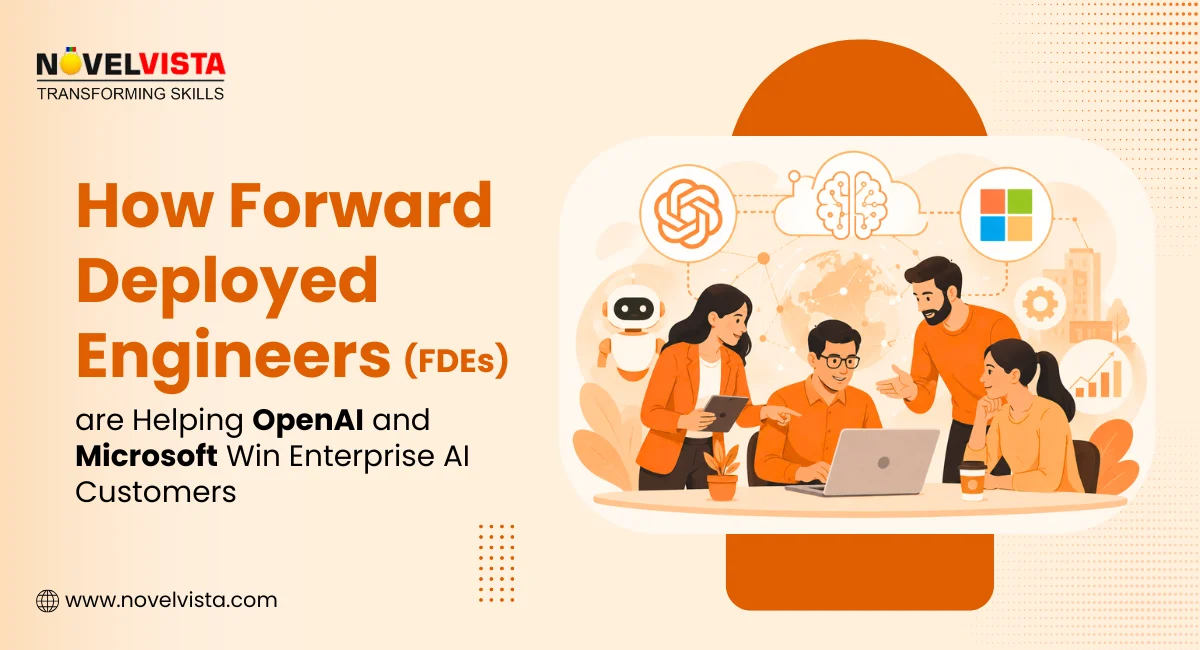
This is where Forward-Deployed Engineers (FDEs) are becoming a strategic differentiator. Rather than simply selling an AI platform, companies such as OpenAI and Microsoft are embedding engineering teams directly into customer operations to ensure AI delivers measurable business outcomes.
The result is a major shift from traditional software-as-a-service (SaaS) to services-led enterprise AI growth, where deployment expertise becomes just as important as the AI model itself.
Forward-Deployed Engineers (FDEs) are technical experts who work directly with enterprise customers to design, integrate, customize, and operationalize AI systems within real business environments.
Unlike traditional implementation consultants, FDEs do not stop at installation. They become deeply involved in:
In enterprise AI, FDEs act as a bridge between cutting-edge AI technology and operational reality. Their mission is to ensure that AI works inside the customer’s specific environment, not just in a demonstration.
Many organizations begin with promising AI pilots but struggle when moving to production. Common obstacles include:
A generic SaaS deployment rarely addresses these issues.
| Traditional SaaS Approach | FDE-Led Enterprise Deployment |
| Standard onboarding | Custom engineering engagement |
| Product support | Embedded technical collaboration |
| Limited customization | Enterprise-specific solutions |
| Vendor accountability ends at software delivery | Accountability extends to business outcomes |
| Remote implementation | On-site and operational integration |
This is the core reason Forward-Deployed Engineers (FDEs) are increasingly central to enterprise AI adoption strategies.
OpenAI has taken an aggressive services-led approach by creating the OpenAI Deployment Company, a standalone business unit focused specifically on enterprise customer success.
To accelerate enterprise delivery capability, OpenAI acquired Tomoro, an applied AI engineering firm (Source: Tomoro). The acquisition added approximately 150 experienced FDEs with experience building AI infrastructure for large global organizations.
This move allowed OpenAI to gain immediate deployment expertise rather than building enterprise engineering teams from scratch.
A major innovation in OpenAI’s strategy is the move away from traditional hourly consulting models. Instead, OpenAI emphasizes outcome-based pricing, where commercial arrangements are tied to business results.
For enterprise customers, this reduces perceived implementation risk because the vendor shares responsibility for delivering value rather than simply providing technical labor.
OpenAI’s deployment model goes beyond remote support. For customers such as John Deere, FDE teams have reportedly embedded directly within operations, including visits to agricultural sites in Iowa, to build localized AI evaluation systems.
This approach enables AI systems to provide context-aware guidance during critical operational periods such as planting and harvesting seasons.
The key insight is that enterprise AI value often depends on understanding operational context, and Forward-Deployed Engineers (FDEs) provide that context.
Microsoft responded with its own enterprise deployment initiative, the Microsoft Frontier Company (MFC), backed by significant investment and designed for global scale.
MFC reportedly brings together approximately 6,000 embedded industry and engineering experts into a unified organization (Source: CNBC). This allows Microsoft to combine cloud, AI, security, data, and industry expertise within a single customer engagement model.
One of Microsoft’s most important strategic decisions has been acknowledging that enterprises may not want to be locked into a single AI model.
MFC engineers can deploy solutions using:
All of these can operate through a governed semantic layer that supports enterprise governance and compliance.
This flexibility is attractive to organizations that want long-term control over their AI architecture.
Microsoft extends the reach of its Forward-Deployed Engineers (FDEs) through partnerships with major global systems integrators, including:
These partnerships enable Microsoft to scale enterprise AI delivery across industries and geographies much faster than a vendor-only model.
For the London Stock Exchange Group (LSEG), Microsoft engineers reportedly integrated multi-model AI capabilities that allow finance professionals to run semantic queries across large volumes of unstructured financial data while maintaining strict privacy controls.
This illustrates how FDE-led deployments combine AI capability with enterprise governance.
Area | OpenAI | Microsoft |
| Enterprise Initiative | OpenAI Deployment Company | Microsoft Frontier Company |
| Reported Investment | $14 billion | $2.5 billion |
| Talent Strategy | Acquisition of Tomoro | Consolidation of internal experts |
| AI Model Strategy | Deep GPT-centric deployments | Multi-model flexibility |
| Delivery Focus | Embedded operational integration | Scalable enterprise deployment |
| Ecosystem | Direct deployment teams | Broad partner ecosystem |
| Example | John Deere | LSEG |
Both organizations are investing heavily in Forward-Deployed Engineers (FDEs), but they are optimizing for different strengths: OpenAI emphasizes deep operational embedding, while Microsoft emphasizes scale and flexibility.
The immediate benefit of FDEs is faster deployment, but the long-term impact is much larger.
When FDEs help design enterprise data pipelines, AI agents, evaluation systems, and governance processes, those systems become closely aligned with the vendor’s broader technology ecosystem.
This creates:
In practice, Forward-Deployed Engineers (FDEs) often become trusted advisors rather than external vendors.
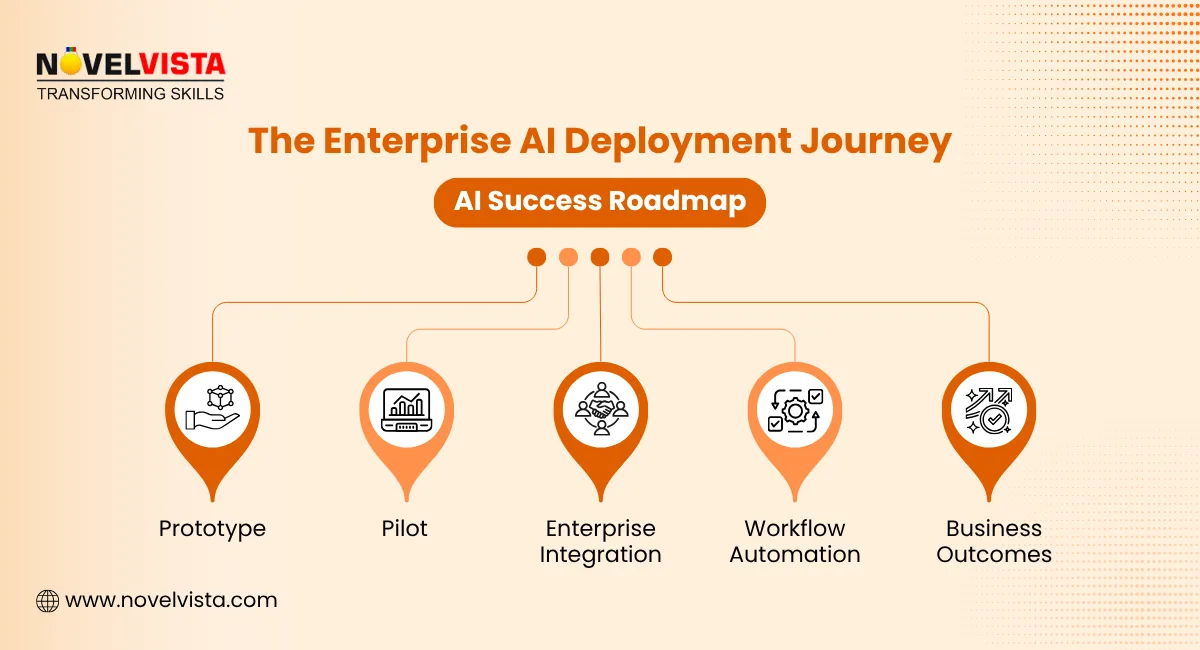
Both OpenAI and Microsoft are associated with a delivery philosophy that emphasizes business outcomes rather than software uptime.
The reported framework includes four stages:
Traditional Service Level Agreements (SLAs) focus on technical metrics such as uptime or response time.
Outcome-Level Agreements (OLAs) focus on business metrics such as:
This changes the customer relationship fundamentally because the deployment team shares accountability for business performance.
Enterprise leaders evaluating AI initiatives can draw several important lessons from the OpenAI and Microsoft approaches.
Advanced models do not automatically create business value. Deployment capability matters.
Organizations move faster when experienced engineers work directly with operational teams.
Multi-model strategies can provide resilience and reduce dependency on a single vendor.
Executives care more about productivity, cost reduction, and revenue impact than model benchmarks.
The ability to deploy AI successfully inside complex enterprises may become a stronger differentiator than model performance itself.

Forward-Deployed Engineers (FDEs) are rapidly becoming one of the most important roles in enterprise AI. OpenAI and Microsoft are demonstrating that winning enterprise customers requires far more than providing access to powerful AI models.
OpenAI’s strategy focuses on deep operational integration, outcome-based engagement, and embedded engineering teams. Microsoft’s strategy emphasizes scale, partner ecosystems, and multi-model flexibility. Despite these differences, both companies recognize the same reality: enterprise AI succeeds when expert engineers work directly alongside customer teams.
As enterprises move from experimentation to large-scale AI transformation, Forward-Deployed Engineers (FDEs) will likely become a core component of enterprise technology strategy. The companies that can combine advanced AI with deployment expertise and measurable business accountability will be the ones most likely to win the next wave of enterprise AI adoption.
For organisations looking to build these capabilities internally, investing in structured Forward-Deployed Engineer (FDE) corporate training can help teams develop the practical skills needed to deploy, integrate, and scale enterprise AI solutions with confidence.
Forward-Deployed Engineers are technical experts who work directly with enterprise customers to integrate, customize, and operationalize AI systems in real business environments.
FDEs help solve integration, security, compliance, and workflow challenges that often prevent enterprise AI projects from reaching production.
OpenAI uses embedded FDE teams, outcome-based engagement models, and deep operational collaboration to ensure AI delivers measurable business value.
Microsoft emphasizes large-scale enterprise delivery, partner ecosystems, and multi-model AI flexibility, while OpenAI focuses more on deep operational integration.
FDEs accelerate deployment, improve integration quality, support governance requirements, and help organizations achieve measurable operational outcomes.
Author Details

Course Related To This blog
Forward Deployed Engineer (AI)
Confused About Certification?
Get Free Consultation Call
Stay ahead of the curve by tapping into the latest emerging trends and transforming your subscription into a powerful resource. Maximize every feature, unlock exclusive benefits, and ensure you're always one step ahead in your journey to success.