Category | AI And ML
Last Updated On 01/08/2026
Machine learning systems can remain online while their predictions quietly become inaccurate, biased, slow, or too expensive. For a site reliability engineer, this expands the reliability boundary beyond infrastructure into data, models, and business outcomes.
This guide explains what is MLOps, how the lifecycle works, where SRE practices transfer, and how production teams manage observability, incidents, model releases, drift, governance, performance, and cost. It also compares MLOps with DevOps and AIOps before presenting a practical transition roadmap into AI operations.
MLOps is the engineering discipline used to build, validate, release, monitor, govern, and improve machine learning systems in production. It connects data engineering, model development, software delivery, infrastructure, security, and operational feedback within one controlled lifecycle.
The key distinction is that an ML service depends on code, data, features, and a trained model. Application code may remain unchanged while prediction quality deteriorates because real-world inputs have shifted. Understanding what is MLOps therefore requires looking beyond CI/CD to include experiment tracking, data validation, model registries, continuous training, quality gates, lineage, and drift monitoring.
The objective is not automation for its own sake. It is repeatable, observable, auditable, and recoverable AI delivery.
A site reliability engineer already works with availability, latency, capacity, observability, controlled releases, incident response, automation, and service-level objectives. MLOps keeps these disciplines but adds model and data behaviour to the production reliability boundary.
The transferable advantage is operational judgement. SREs know how to reduce toil, design safe change, isolate failure, and balance reliability against delivery velocity. The new learning requirement is recognising model-specific failure modes such as training-serving skew, data drift, prediction-quality decay, delayed ground truth, and unsafe retraining.
For SREs, the model should be treated as a versioned production dependency with measurable fitness, ownership, rollback criteria, and an evidence trail.
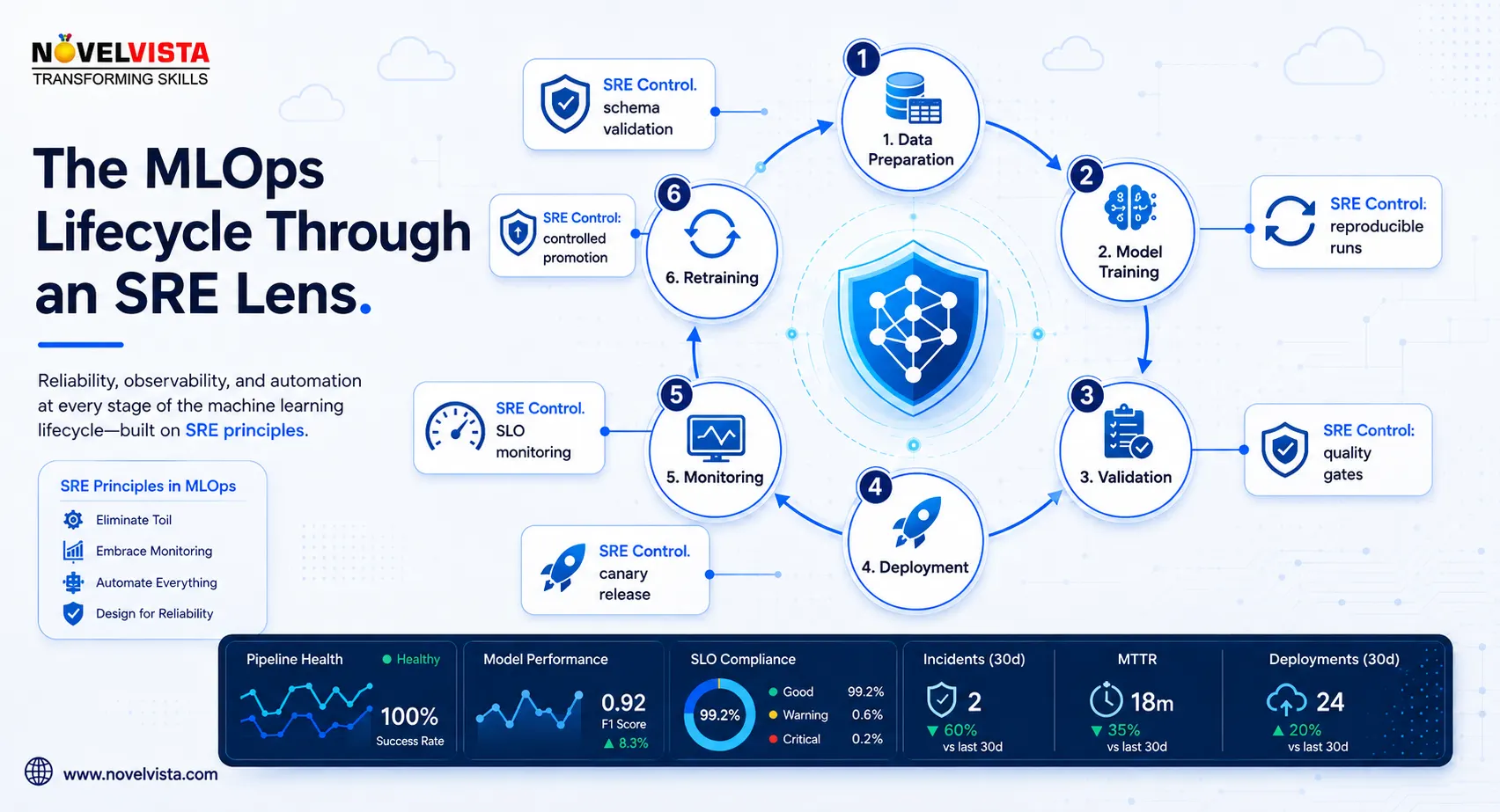
The lifecycle is a feedback loop rather than a one-way release process. Every stage needs an accountable owner, measurable output, automated control, and recovery path.
| Lifecycle stage | Operational objective | SRE control |
|---|---|---|
| Data preparation | Create valid, versioned inputs | Schema checks, lineage, freshness thresholds |
| Training | Produce reproducible candidates | Tracked runs, immutable artifacts, budget limits |
| Validation | Confirm technical and business fitness | Quality, bias, security, and policy gates |
| Model deployment | Release safely | Shadow, canary, approval, and rollback controls |
| Monitoring | Detect degradation | SLIs, drift alerts, and outcome metrics |
| Retraining | Restore relevance | Triggers, validation, and controlled promotion |
Production signals should feed evaluation and retraining decisions. A healthy platform makes every release reproducible and every recovery action predictable.
The mlops vs devops distinction is not about whether teams automate delivery. Both use version control, testing, CI/CD, infrastructure as code, observability, security controls, and disciplined release practices. The difference is the operational asset being governed.
| Dimension | DevOps | MLOps |
|---|---|---|
| Primary assets | Code, configuration, binaries | Code, data, features, models |
| System behaviour | Mostly deterministic | Probabilistic and data-dependent |
| Delivery loop | CI/CD | CI/CD plus continuous training |
| Monitoring | Availability, latency, errors, saturation | System health plus drift, quality, bias, outcomes |
| Rollback target | Application version | Code, model, feature, or dataset version |
In practice, this comparison is an extension decision: MLOps adds controls for experimental assets and changing data without discarding proven software operations.
Teams asking what is AIOps are usually examining the opposite relationship between AI and operations. AIOps applies machine learning and analytics to operational data so teams can correlate alerts, detect anomalies, identify likely causes, forecast capacity, and automate remediation.
MLOps makes AI systems operable; AIOps uses AI to improve IT operations. An organisation may use both. AIOps can reduce alert noise across infrastructure, while MLOps detects model-specific failures such as feature drift, prediction degradation, training pipeline defects, or unsafe model promotion.
Understanding the distinction prevents tooling confusion and helps teams assign the correct operating model, telemetry, and ownership boundaries.
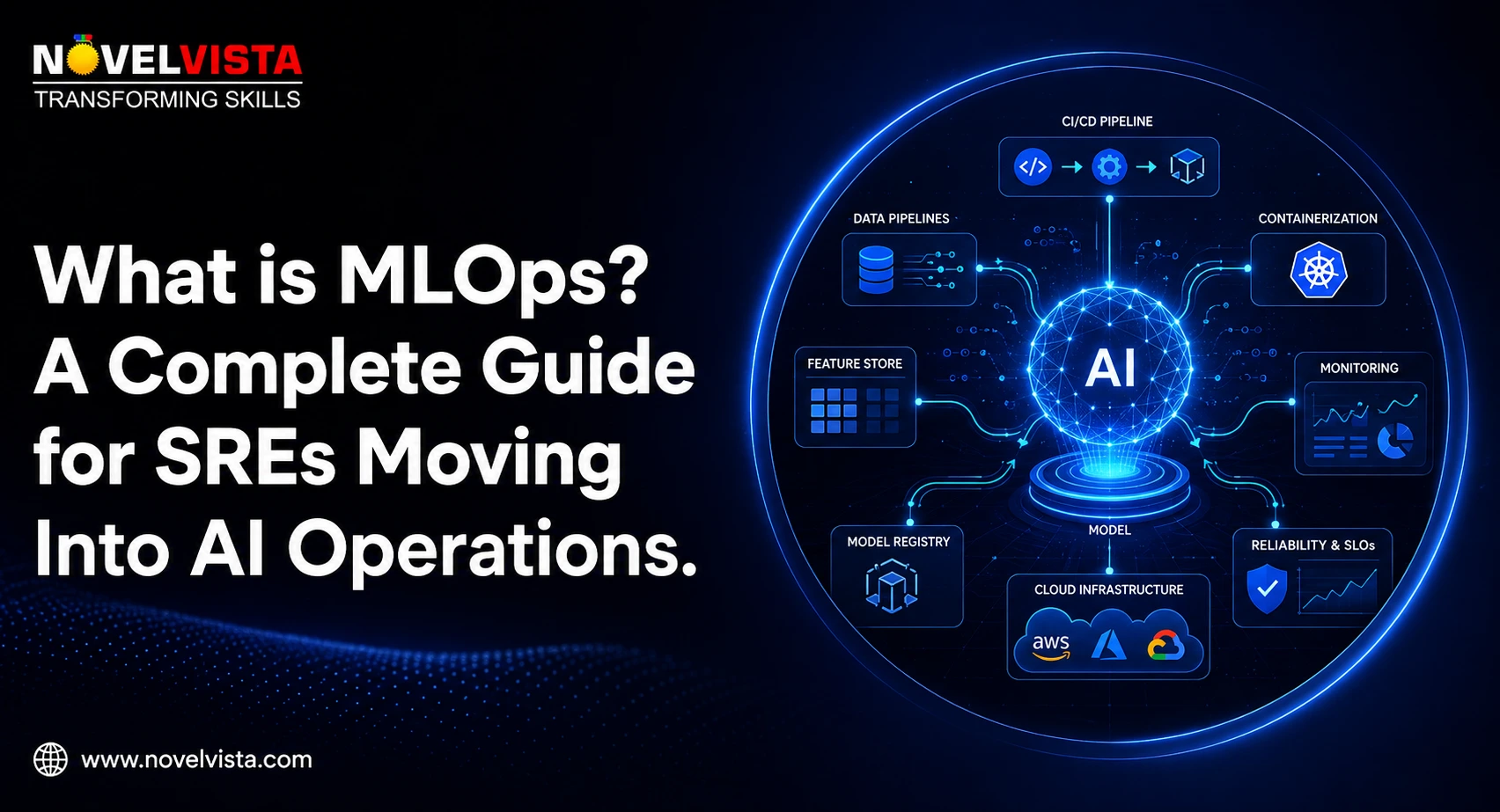
A production architecture must cover the entire chain rather than only model training. The essential capabilities are:
The architecture is mature when teams can reproduce, explain, release, observe, and recover a model without depending on tribal knowledge.
Traditional golden signals remain necessary, but they are not sufficient. An ML endpoint can return successful responses quickly while producing poor decisions.
SLOs should connect technical performance with user impact. Alerts should identify changes that threaten service objectives, policy thresholds, safety, or material business outcomes rather than paging on every statistical movement.
Infrastructure monitoring asks whether the service is running. Model monitoring asks whether the intelligence remains fit for purpose.
A practical stack combines four layers: platform health, pipeline health, model behaviour, and business outcomes. Correlation is critical because a quality decline may originate from stale data, an upstream schema change, a feature pipeline defect, a model regression, or changing user behaviour.
Delayed ground truth creates another challenge. When verified labels arrive later, teams need leading indicators such as input drift, prediction distribution, confidence, proxy outcomes, and human-review rates. Once ground truth becomes available, it should feed evaluation, retraining decisions, and post-incident learning.
Model incidents require runbooks that separate service failure from decision-quality failure. Start by classifying the event: availability, latency, data integrity, drift, harmful output, bias, security, or runaway cost.
Identify the affected model, dataset, feature version, endpoint, tenant, and release window. Containment may involve rolling back a model, disabling a feature, routing traffic to a baseline, increasing human review, rate-limiting expensive inference, or pausing automated retraining.
Preserve evidence for lineage and audit analysis. The post-incident review should examine code, data, model, pipeline, governance, and ownership controls. An endpoint staying online is not a successful outcome when its decisions are unreliable.
The role lens of AI Ops Engineer — Reliability, Performance & Cost captures the operating mandate developing around production AI. Reliability includes availability, prediction quality, safety, recoverability, and governance. Performance includes latency, throughput, accelerator utilisation, batching, and scaling. Cost includes training spend, inference economics, storage, observability volume, and waste.
An effective practitioner turns these dimensions into measurable objectives and explicit trade-offs. A faster model is not better when quality falls below policy. A more accurate model is not better when latency breaks the user journey. Automated retraining is not mature when it can promote an expensive, biased, or unsafe regression without review.
Production ML failures are often quiet, cumulative, and cross-layered. Preventive controls should address the following patterns:
A site reliability engineer can move into MLOps without becoming a research data scientist.
Days 1–30: Learn the ML lifecycle, evaluation metrics, data quality, drift, experiment tracking, and registries. Map every concept to an SRE practice you already understand.
Days 31–60: Build a small pipeline that trains, validates, registers, and releases a model. Add infrastructure metrics, model-quality indicators, lineage, canary controls, and rollback instructions.
Days 61–90: Introduce SLOs, incident simulations, cost dashboards, retraining criteria, security controls, and governance evidence. Present the result as an operating model rather than a demonstration.
The career advantage comes from combining production judgement with enough ML fluency to challenge unsafe assumptions.
Start with capabilities because vendor lists change quickly. Learn one practical option in each category: source and data versioning, orchestration, experiment tracking, registry, feature management, serving, observability, data-quality validation, secrets management, policy enforcement, and cost analytics.
Evaluate tools against interoperability, metadata portability, automation interfaces, access controls, multi-cloud requirements, operational burden, and exit strategy. A platform that makes the first model easy can still make the hundredth model expensive.
Prefer the smallest stack that supports reproducibility, controlled promotion, cross-layer telemetry, and recovery. Tool sprawl is not maturity; it is often distributed toil wearing a conference badge.
LLMOps carries forward the core discipline of MLOps but adds prompt versioning, retrieval pipelines, embedding drift, non-deterministic evaluation, hallucination risk, guardrails, token economics, model routing, and agent or tool traces.
SRE skills remain central because LLM applications still require SLOs, controlled releases, incident response, security, observability, capacity planning, and cost governance. Quality, however, cannot always be represented by a single accuracy score.
Teams moving from predictive ML into generative AI should add reference test sets, evaluation-driven CI gates, prompt and retrieval lineage, end-to-end traces, safety testing, and per-request cost attribution.
Understanding what is MLOps gives SREs a practical bridge into production AI. The familiar disciplines remain: automation, observability, service objectives, safe change, capacity, incident response, and continuous improvement. The new requirement is to govern model and data behaviour alongside infrastructure.
For teams extending these capabilities into generative AI, NovelVista’s LLMOps & AI Engineering for Production course develops practical skills across evaluation, observability, drift detection, incident response, security, cost governance, and platform engineering.
The programme is suitable for SRE, DevOps, platform, cloud, and ML professionals who need to move beyond prototypes and operate reliable enterprise AI systems with measurable controls, clear ownership, and production-ready engineering discipline.
Author Details

Course Related To This blog
LLMOps & AI Engineering for Production
Confused About Certification?
Get Free Consultation Call
Stay ahead of the curve by tapping into the latest emerging trends and transforming your subscription into a powerful resource. Maximize every feature, unlock exclusive benefits, and ensure you're always one step ahead in your journey to success.