Category | AI And ML
Last Updated On 20/07/2026

Forward deployment is becoming one of the most important delivery models in enterprise AI, SaaS, automation, and digital transformation. This blog explains what forward deployment means, what is a forward deployed engineer, why the role matters now, what skills are required, salary expectations, job opportunities, and how teams can build this capability before AI pilots lose momentum.
For years, companies have separated product teams from customer operations. Engineers built from the office, consultants configured from the field, and business teams waited for software to solve practical problems. That model is now under pressure.
As AI systems, cloud platforms, and automation workflows become more complex, organizations need technical professionals who can work close to real users, real data, and real constraints. That is where forward deployment becomes a strategic capability, not just a job title.
Forward deployment means placing technical talent close to the customer, business unit, or operational environment where the solution must create measurable value. Instead of designing technology from a distance, forward-deployed teams work directly with users, workflows, datasets, systems, and stakeholder expectations.
The goal is not only to deliver code. The goal is to make the solution work in the real world. This includes understanding business pain points, configuring platforms, building integrations, adapting workflows, resolving deployment blockers, and collecting feedback for product improvement.
In AI-led transformation, forward deployment is especially valuable because successful implementation depends on context. A model may perform well in a demo but fail in production if workflows, governance, data quality, and user adoption are ignored.
A forward deployed engineer is a technical professional who works directly with customers or internal business teams to design, customize, deploy, and improve solutions in live environments.
To answer what is a forward deployed engineer simply: it is an engineer who owns outcomes, not just tickets. The role combines software engineering, solution architecture, product discovery, customer communication, and deployment ownership.
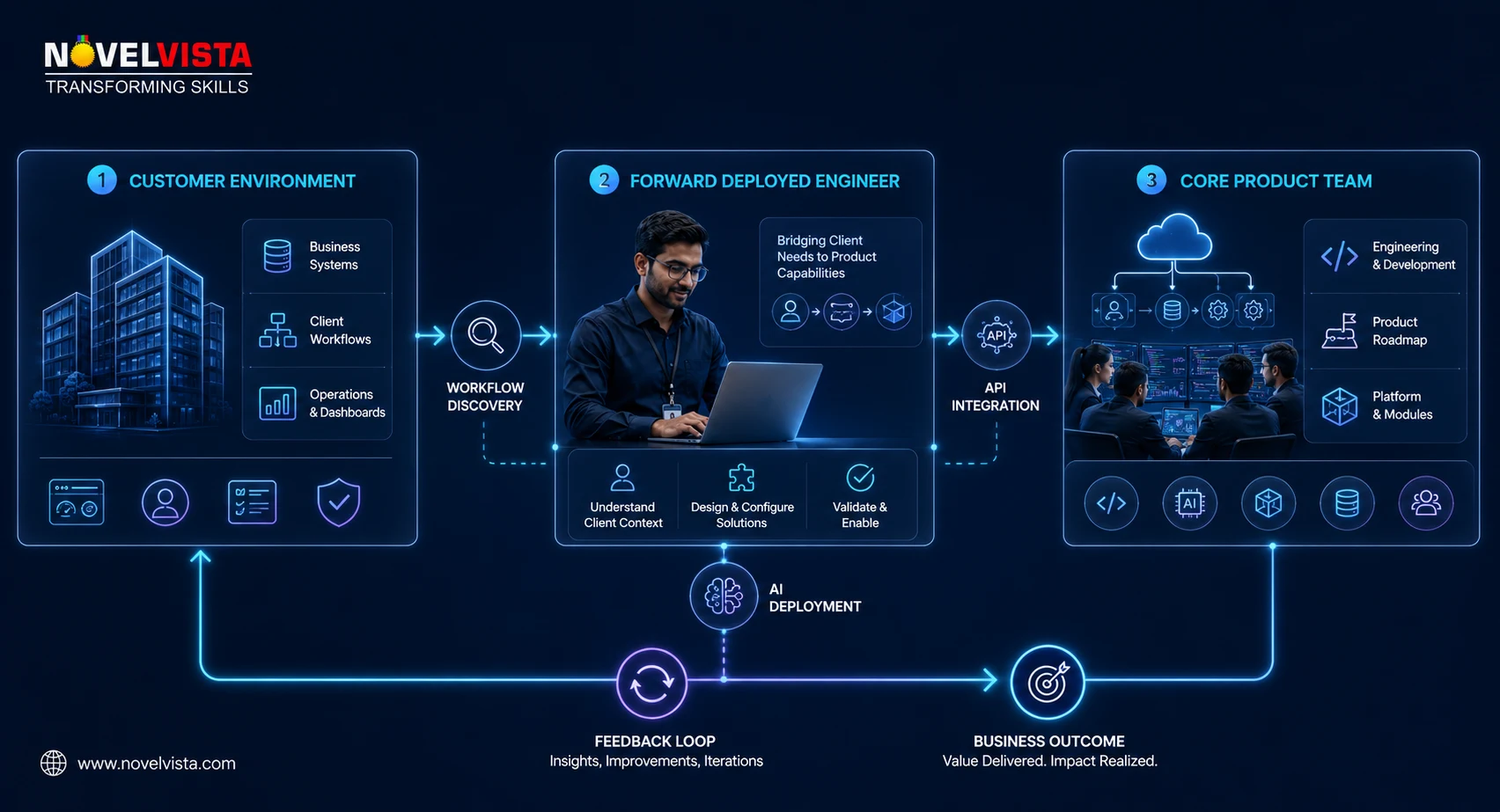
A forward deployed engineer often acts as the bridge between business ambiguity and technical execution. They are close enough to the user to understand the real problem and technical enough to build or adapt the right solution.
Teams need to understand what is a forward deployed engineer because enterprise technology has shifted from standard implementation to highly contextual deployment. AI tools, LLM platforms, automation suites, and data products rarely succeed through simple plug-and-play adoption.
Forward deployment matters now because organizations are trying to move AI from pilot projects to production. That transition is difficult when engineering teams are disconnected from business users, data realities, compliance needs, and workflow constraints.
Forward deployment helps teams reduce implementation friction and increase the chance that new systems become useful, trusted, and scalable.
A forward deployed software engineer is still a strong engineer, but the role is broader than writing features. The person works closer to customers, understands the operating environment, and adapts the solution to achieve business outcomes.
| Area | Traditional Software Engineer | Forward Deployed Engineer |
|---|---|---|
| Primary focus | Build product features | Deliver working customer outcomes |
| Work environment | Internal product or engineering team | Customer or business environment |
| Success metric | Code quality, velocity, release completion | Adoption, impact, deployment success |
| Stakeholder interaction | Limited or indirect | Frequent and direct |
| Skill mix | Engineering depth | Engineering, consulting, product thinking, and communication |
| Feedback loop | Product manager or internal backlog | Real users, live systems, and field observations |
This is why a forward deployed software engineer often becomes critical in complex enterprise environments where technical solutions must be shaped around messy, high-stakes realities.
The responsibilities of a forward deployed engineer usually span discovery, design, build, deployment, and continuous improvement. The role is hands-on, cross-functional, and outcome-driven.
This role is not limited to implementation. It also influences product direction because field insights often reveal what customers actually need, not what teams assumed they needed.
The strongest forward deployed engineers combine technical skill with customer empathy. They can speak to engineers, business users, security teams, product managers, and executives without losing clarity.
| Skill Category | Important Skills |
|---|---|
| Engineering | Python, JavaScript, backend development, APIs, debugging |
| Data | SQL, data pipelines, analytics, data quality checks |
| Cloud and AI | Cloud services, LLM basics, AI deployment, automation platforms |
| Product Thinking | Use-case framing, prioritization, workflow analysis |
| Communication | Stakeholder management, documentation, demos, expectation setting |
| Delivery | Implementation planning, troubleshooting, adoption support |
The best professionals in this role are not only good coders. They are technical problem-solvers who can convert business uncertainty into working systems.
The forward deployed engineer salary varies by country, company maturity, AI exposure, customer-facing responsibility, and technical depth. In high-growth AI and enterprise SaaS companies, compensation can be strong because the role directly affects revenue, implementation success, and customer retention.
A forward deployed engineer salary package is usually higher when the role includes production AI deployment, complex integrations, enterprise accounts, security-sensitive environments, or pre-sales-to-delivery ownership.
Forward deployed engineer jobs are increasing across AI startups, SaaS platforms, cloud consulting firms, automation companies, and enterprise transformation teams. Many forward deployed engineer jobs require Python, SQL, API integration, cloud deployment, and strong communication skills.
For organizations, forward deployed engineer jobs also represent an internal upskilling opportunity. Software engineers, solution architects, data engineers, DevOps professionals, and AI implementation specialists can transition into this role with the right training and project exposure.
If you are exploring how to become a forward deployed engineer, start by building strong technical fundamentals and then add customer-facing delivery experience.
The practical answer to how to become a forward deployed engineer is to become useful at the point where business problems meet technical execution. Build systems, talk to users, learn constraints, and measure outcomes.
The Forward deployed engineer career path can lead into several high-value roles because it builds a rare combination of technical depth, customer context, and business judgment.
The Forward deployed engineer career path is attractive for professionals who do not want to stay limited to isolated coding tasks. It allows them to influence product strategy, customer success, enterprise transformation, and AI adoption outcomes.
For enterprise leaders, the question is no longer only what is a forward deployed engineer. The bigger question is whether the organization has people who can take AI, cloud, data, and automation from concept to measurable business impact.
Without forward deployment capability, teams may experience slow adoption, failed AI pilots, vendor dependency, weak business alignment, poor workflow fit, and limited ROI from technology investments.
| Enterprise Challenge | How Forward Deployment Helps |
|---|---|
| AI pilots not scaling | Brings engineers closer to production workflows |
| Low user adoption | Designs solutions around real user behavior |
| Integration delays | Solves technical blockers in the field |
| Misalignment between IT and business | Creates a shared language between teams |
| Weak measurable outcomes | Connects deployment work to business value |
Forward deployment helps create a faster learning loop between technology teams and business outcomes. In the AI era, that loop is a serious competitive advantage.
Forward deployment is becoming a strategic operating model for organizations that want technology to create real business impact. It brings engineers closer to users, workflows, data, constraints, and decision-making environments.
If you're exploring careers in AI, don't miss our YouTube video explaining the Forward Deployed Engineer (FDE) role and how it fits into modern enterprise AI teams.
Understanding what is a forward deployed engineer helps both professionals and enterprise teams prepare for a future where AI success depends on deployment maturity, not only technical experimentation.
As forward deployed engineer jobs continue to grow, organizations that build this capability internally will be better positioned to move AI initiatives from pilot to production with speed, trust, and measurable value.
Ready to build this capability inside your team? Explore NovelVista’s Forward Deployed Engineer AI Training. The program helps professionals and enterprise teams develop the AI, engineering, deployment, and customer-facing skills required to succeed in modern forward deployment roles.
It is a practical next step for teams that want to turn AI ambition into business-ready execution.
Author Details

Confused About Certification?
Get Free Consultation Call
Stay ahead of the curve by tapping into the latest emerging trends and transforming your subscription into a powerful resource. Maximize every feature, unlock exclusive benefits, and ensure you're always one step ahead in your journey to success.