Category | AI And ML
Last Updated On 15/04/2026
Artificial Intelligence has crossed a critical threshold. What began as simple automation executing predefined tasks is now evolving into systems that can think, decide, and act independently. Industry data shows that more than 70% of enterprises are already leveraging AI-driven automation, while close to 40% are actively investing in systems capable of operating with minimal human oversight. In 2026, this surge is no coincidence with the enforcement of the EU AI Act and the launch of ITIL 5, intelligent autonomy has shifted from a technical experiment to a regulated corporate requirement. At the center of this transformation lies a powerful innovation: the autonomous AI agent.
But is this just another emerging tech term, or does it signal a fundamental shift in how machines interact with the world?
More importantly, who stands to benefit the most from it and who risks falling behind without it?
If you are an IT professional optimizing operations, a business leader driving digital transformation, or an AI enthusiast tracking the next wave of innovation, understanding the autonomous AI agent is no longer optional. These systems are redefining the role of AI from passive tools that assist, to intelligent entities that initiate actions, solve complex problems, and continuously learn without constant human direction.
In essence, the rise of the autonomous AI agent marks the beginning of a new era where AI doesn’t just support decisions, it makes them.
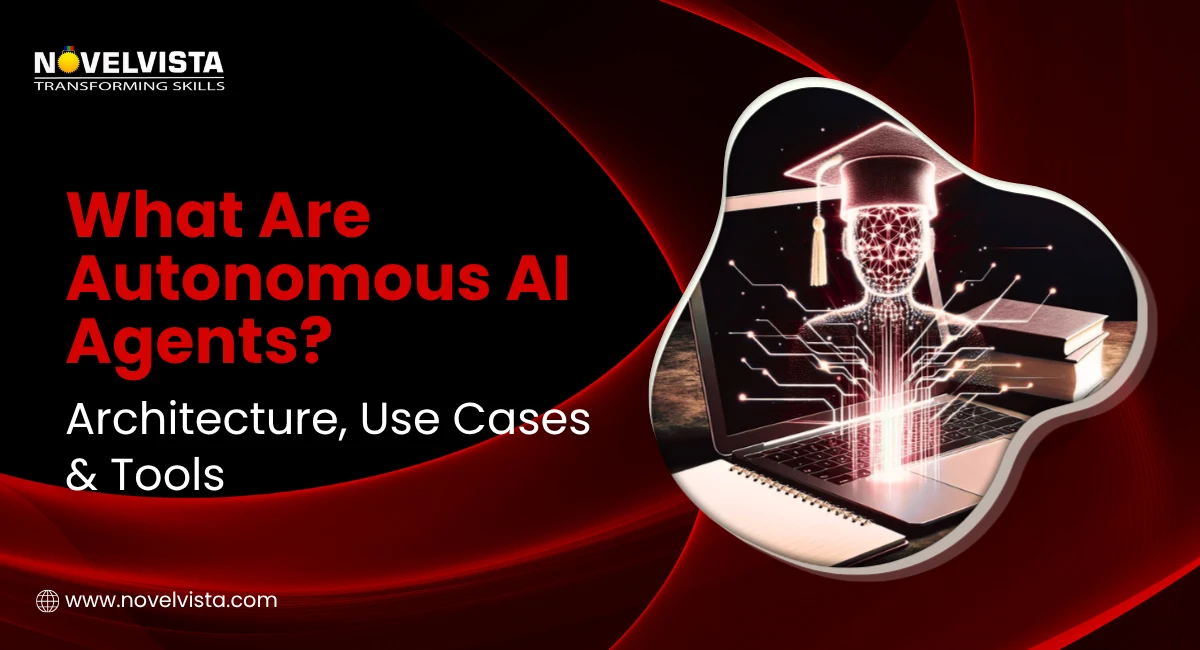
To put it simply, an autonomous AI agent is a system that can perform tasks, make decisions, and adapt to changes in its environment without constant human guidance.
If you are wondering what is autonomous agent in AI, think of it like a self-driving car. Instead of waiting for instructions at every step, it observes the environment, processes information, makes decisions, and acts all on its own.
Unlike traditional AI systems that follow predefined rules, an AI autonomous agent operates with a degree of independence. It can:
This makes the autonomous agent in AI far more dynamic and capable than earlier automation tools.
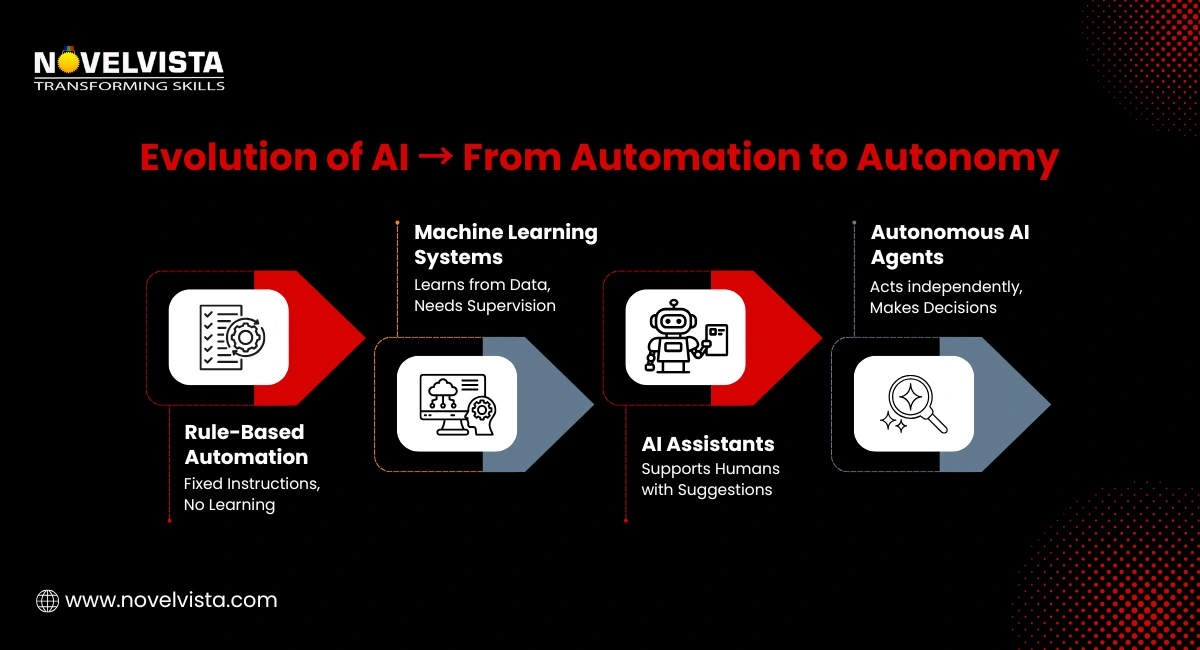
What truly defines an autonomous AI agent is not just automation, but intelligent independence. Here are its core characteristics:
These agents are designed to achieve specific objectives without step-by-step instructions.
An AI autonomous agent evaluates multiple scenarios and selects the best course of action.
Using machine learning, agents improve over time based on feedback and data.
They interact with real-time environments whether digital systems, users, or data streams.
Together, these features make the autonomous agent in AI highly adaptable and efficient.
Understanding the autonomous AI agent architecture helps you see how these systems actually function.
This layer collects data from the environment APIs, sensors, databases, or user inputs. It also incorporates Vector-based Memory (RAG) to retrieve relevant contextual information from large datasets, enabling the autonomous AI agent to make informed, context-aware decisions.
The brain of the autonomous AI agent, where AI models process data and determine actions. This layer leverages advanced Reasoning Chains (such as Chain-of-Thought prompting) to break down complex problems, evaluate multiple possibilities, and arrive at more accurate and logical outcomes.
Executes decisions sending responses, triggering workflows, or updating systems.
Continuously improves performance using feedback and historical data.
This structured autonomous AI agent architecture enables agents to operate independently while improving over time.
Not all autonomous agents in AI are the same. They vary based on complexity and functionality.
Operate on immediate inputs without memory or learning.
Maintain an internal model of the environment to make better decisions.
Focus on achieving specific objectives using planning and reasoning.
Adapt over time, making them the most advanced form of AI autonomous agent.
The real power of an autonomous AI agent lies in its applications.
Agents monitor systems, detect anomalies, and resolve incidents automatically.
AI agents handle queries, resolve issues, and improve customer experience without human intervention.
Used for fraud detection, trading decisions, and risk analysis.
Assist in diagnostics, patient monitoring, and treatment recommendations.
Optimize infrastructure, manage deployments, and control costs.
These use cases highlight how the autonomous agent in AI is transforming industries.
Learn how AI agents think, decide, and act independently
Explore real-world use cases transforming modern businesses
Discover tools and strategies to start building your own AI agents today
To build and deploy an autonomous AI agent, developers rely on specialized frameworks that orchestrate large language models (LLMs), memory, tool usage, and multi-step reasoning. These platforms abstract the complexity of agent design by enabling modular pipelines for planning, execution, and feedback loops.
An experimental open-source framework that enables fully autonomous task execution by chaining LLM prompts with memory, planning modules, and external tool integration. It supports recursive goal decomposition and iterative refinement.
A browser-based platform for creating and running AI agents that execute tasks autonomously. It emphasizes ease of use while still supporting goal-driven workflows, prompt chaining, and real-time execution monitoring.
A widely adopted framework for building LLM-powered applications. It provides components for agent orchestration, including tool calling, vector-based memory (via embeddings), chains, and multi-agent coordination making it highly suitable for scalable autonomous AI agent architecture. In 2026, LangGraph has emerged as the industry standard for building stateful, multi-agent systems on top of LangChain, enabling persistent workflows and complex agent interactions. Additionally, frameworks like CrewAI complement this ecosystem by enabling role-based agent orchestration, where multiple AI agents collaborate as a structured team with defined responsibilities and goals.
A lightweight task-driven agent framework that uses a queue-based system to create, prioritize, and execute tasks dynamically. It demonstrates how autonomous agents can self-manage workflows using iterative planning loops.
These autonomous AI agent platforms enable developers to design systems that go beyond static prompts by incorporating:
As a result, they bring the concept of the AI autonomous agent closer to production-grade systems capable of handling complex, real-world workflows with minimal human intervention.
One of the emerging names in this space is Manus AI.
Following its January 2026 acquisition by Meta, there has been a significant increase in discussions around manus AI claims autonomous agent capabilities, positioning it as a next-generation solution in the AI ecosystem.
What truly differentiates the manus AI autonomous agent capabilities is its breakthrough “VM Takeover” (Virtual Machine) capability a feature that allows the agent to take control of a computing environment to execute code, build applications, and complete complex workflows autonomously. This moves beyond theoretical autonomy into real execution.
The manus AI autonomous agent capabilities now focus on:
With backing from Meta and this powerful execution layer, Manus AI is pushing the boundaries of what an autonomous AI agent can achieve transitioning from intelligent assistants to systems capable of independently delivering end-to-end outcomes in real-world scenarios.
When comparing Agentic AI vs Traditional AI, the key difference lies in autonomy while traditional AI follows predefined rules, agentic AI leverages autonomous AI agents to make decisions, adapt, and execute tasks independently.
Why are businesses investing heavily in the autonomous AI agent model?
Tasks are completed faster without manual intervention.
Agents can handle large volumes of work simultaneously.
Reduces reliance on human labor for repetitive tasks.
Learning capabilities ensure better performance over time.
These advantages make the AI autonomous agent a strategic asset for modern enterprises.
Despite the benefits, the autonomous agent in AI also comes with challenges.
Bias and fairness issues can impact decision-making.
Some AI decisions are difficult to interpret.
Ensuring accountability in autonomous systems is complex. With the rise of global standards like ISO/IEC 42001, organizations are now required to implement structured governance frameworks for AI systems, including autonomous agents. A key requirement is “Human-on-the-loop” oversight, where humans continuously monitor and can intervene in agent decisions to ensure compliance, transparency, and risk control making governance a critical component of any autonomous AI agent deployment.
Errors in decision-making can have significant consequences.
Organizations must address these risks when implementing an autonomous AI agent.
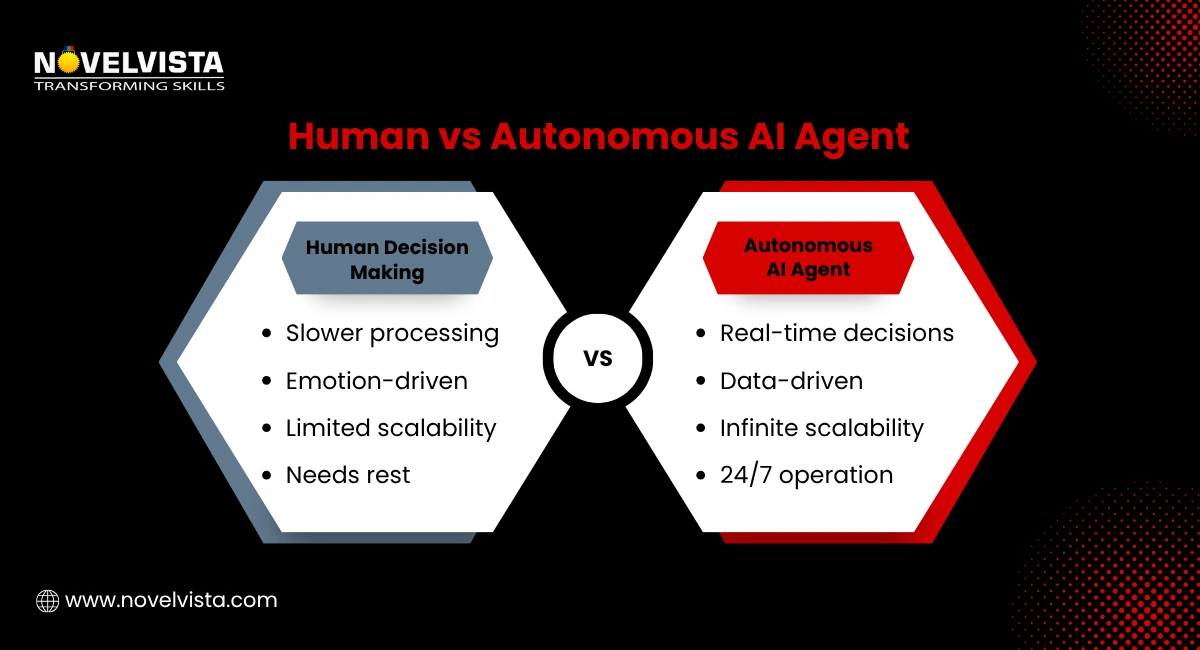
Looking ahead, the autonomous AI agent is set to become a core component of digital transformation strategies.
Key trends include:
As AI evolves, the autonomous AI agent architecture will become more sophisticated, enabling smarter and more reliable systems. With the enforcement of the EU AI Act and the launch of ITIL (Version 5), organizations are now being pushed to adopt autonomous AI agents within structured, compliant, and governance-driven frameworks.
The emergence of the autonomous AI agent is not just an evolution it is a turning point in how technology delivers value. We are moving beyond systems that simply execute commands to intelligent entities that can analyze, decide, and act with purpose. This shift is redefining the boundaries of automation and setting new expectations for speed, efficiency, and innovation.
By understanding autonomous AI agent architecture, real-world applications, and advancements such as manus AI autonomous agent capabilities, businesses can stay ahead in this transformation.
It is also important to clearly distinguish the concepts: an autonomous AI agent is a single intelligent entity a specialist designed to perform specific tasks independently (like a researcher or analyst). In contrast, agentic AI is the broader ecosystem where multiple such agents collaborate as a coordinated system, working together to achieve complex, multi-step goals with minimal human input.
Ready to take your expertise in autonomous and agent-driven AI to the next level?
Join NovelVista’s Agentic AI Certification and gain hands-on experience in building, managing, and scaling intelligent agent systems. This course is designed to help you understand real-world autonomous AI agent architecture, master agentic workflows, and work with modern autonomous AI agent platforms used in today’s AI-driven environments.
Start your journey into the future of intelligent automation today!
Author Details

Course Related To This blog
Generative AI Professional
Agentic AI Certification
Confused About Certification?
Get Free Consultation Call
Stay ahead of the curve by tapping into the latest emerging trends and transforming your subscription into a powerful resource. Maximize every feature, unlock exclusive benefits, and ensure you're always one step ahead in your journey to success.