Category | AI And ML
Last Updated On 26/09/2026
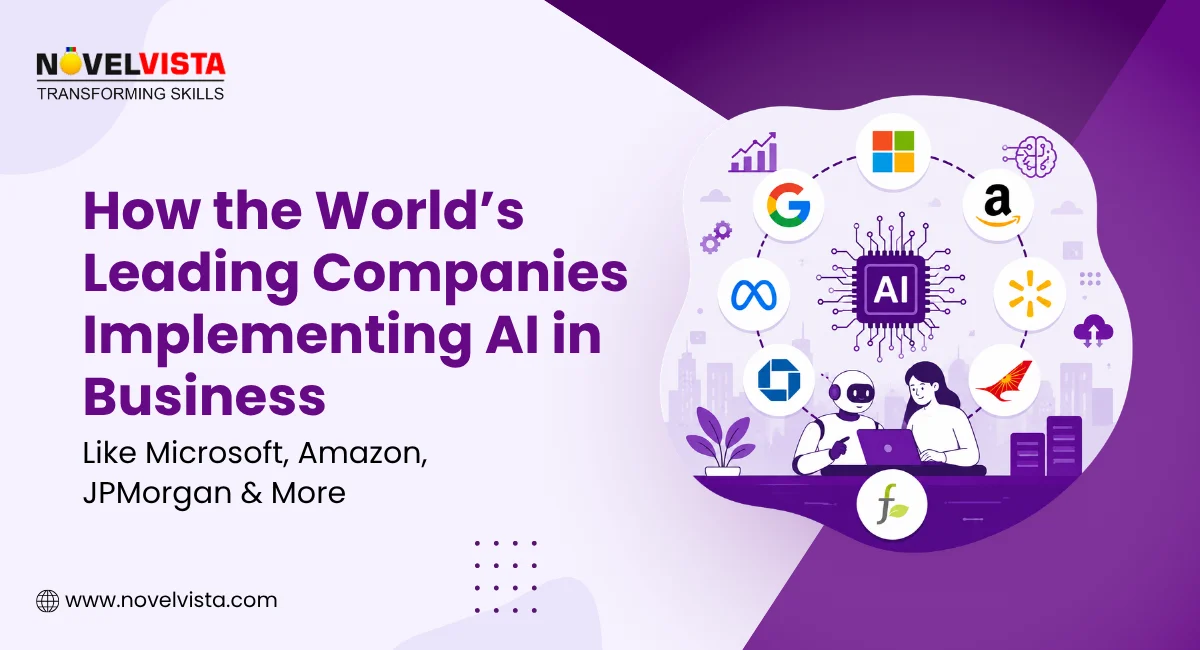
Did you know that a single AI-powered shopping assistant now supports over 300 million active users, or that one bank's fraud-detection AI saves $250 million every year? Numbers like these aren't hype they are proof that AI use cases in business have moved far beyond pilot projects and into the core of how the world's biggest companies operate.
So what exactly counts as a real AI use case in business? How are companies like Microsoft, Google, Amazon, and JPMorgan Chase actually using artificial intelligence day-to-day? And more importantly, what can your own organization learn from them? This blog breaks down ten of the most compelling AI use cases in business today, backed by real operational data, so you can see exactly where the value is coming from and how it applies to you.
AI success isn't measured by how impressive a demo looks.
It's measured by what changes after AI goes into production.
Consider the difference:
97% of interactions automated.
$250 million saved annually.
416% ROI reported.
60% of inquiries resolved autonomously.
50% of support cases automated.
These numbers represent very different industries and workflows, but they point to the same idea:
The real value of AI is operational.
Companies are using AI to reduce the amount of manual work, accelerate decisions, improve customer interactions, detect risks earlier, and connect employees with information faster.
So instead of asking "How are companies using AI?", a better question is:
"Which business problems are companies trusting AI to solve?"
That's what the following 10 examples reveal.

Imagine submitting an IT question and having several specialized AI systems work together behind the scenes to solve it.
That's the direction Microsoft has taken with its multi-agent support framework.
Instead of relying on one general-purpose AI, a primary web agent evaluates the user's request and routes it to specialized agents. One might handle Azure-related questions, while another focuses on Microsoft 365 knowledge.
The system combines Copilot Studio, Azure OpenAI Service, and Azure AI Search to connect these agents with enterprise knowledge.
And developers get another layer of assistance through GitHub Copilot directly inside their IDEs.
The bigger idea: AI doesn't always need to replace an entire support team. It can create a network of specialized digital workers that collaborate on different parts of a problem.
Businesses are drowning in documents.
Contracts sit in folders. Important information is buried inside emails. Employees manually copy details from one system into another.
Google is using Gemini and Vertex AI capabilities to attack exactly this problem.
Employees can use AI to identify contract clauses in documents or turn information buried in unstructured emails into structured records in spreadsheets.
That means less time spent searching, copying, and formatting and more time spent acting on the information.
The bigger idea: One of the most practical AI use cases in business isn't creating something new. It's unlocking the information a company already has.
Traditional online shopping works like a search engine: type something, browse the results, and decide what to buy.
Amazon is trying to make that interaction feel more like a conversation.
Its Rufus shopping assistant, built using Amazon Bedrock, can help customers research products, compare options, track prices, and make purchasing decisions.
The interesting part is what happens when millions of shoppers interact with an AI system simultaneously.
Amazon has used techniques such as parallel token decoding to improve inference efficiency and handle enormous traffic spikes around events such as Prime Day.
The bigger idea: At Amazon's scale, AI isn't just about making the interface smarter. The AI infrastructure itself has to become faster and cheaper to operate.
Digital advertising involves an enormous number of decisions.
Which customer should see an ad? Which creative should be shown? Where should the budget go? Which combination is most likely to convert?
Meta's AI systems are increasingly making those decisions automatically.
Its Advantage+ campaigns use AI-driven matching and recommendation capabilities, while the Andromeda system works with representations of users and ad content to determine which combinations are most relevant.
Instead of marketers manually optimizing every variable, AI continuously evaluates signals and adjusts delivery toward better-performing opportunities.
The bigger idea: AI can turn optimization from a periodic human task into a continuous process.
Retailers have one particularly difficult challenge: consumer preferences can change faster than traditional business processes can respond.
Walmart is using AI across multiple parts of that chain.
Its Sparky shopping assistant helps customers discover and evaluate products, while internal AI tools support employees and developers. Its Trend-to-Product capabilities are designed to help translate emerging trends into product concepts faster.
Even software development gets an AI boost through tools such as ArchiText, which can translate natural-language requirements into UML diagrams.
The bigger idea: The most powerful enterprise AI strategies don't focus on a single chatbot. They connect AI to multiple points across the value chain.
In banking, an incorrect decision can be expensive.
Fraud detection is therefore one of the clearest examples of AI being used for a high-value business problem.
JPMorgan Chase's OmniAI capabilities support fraud detection and other AI applications across the organization. At the same time, its LLM Suite helps employees with knowledge-intensive work, including tasks involved in investment banking.
The bank is also exploring AI for investment research through initiatives such as IndexGPT.
The bigger idea: AI isn't limited to customer-facing applications. Some of its highest-value use cases operate quietly in the background, helping organizations identify risk, process information, and make decisions faster.
There's a major difference between an AI that tells you what to do and an AI that can actually do it.
Salesforce is pushing toward the second model with Agentforce.
Its AI agents can work with enterprise data, reason through a task, retrieve relevant information, and take actions through existing business workflows.
For example, instead of simply telling a customer-service employee that a refund may be appropriate, an agent can potentially work through the required process and execute the action within the organization's existing systems.
The bigger idea: The next phase of enterprise AI isn't just generating answers. It's connecting reasoning to action.
As businesses move from standalone AI assistants to systems that can reason, retrieve information, and execute tasks, choosing the right infrastructure becomes increasingly important. If you're exploring the technologies powering this shift, our guide to Agentic AI Platforms breaks down the platforms enabling organizations to build and deploy autonomous AI systems.
Airlines deal with an enormous volume of repetitive customer questions.
"How do I check in?"
"Can I change my booking?"
"When will I receive my refund?"
Air India has addressed these interactions through AI.g, a multilingual virtual assistant built using Microsoft Azure OpenAI Service.
The assistant handles routine passenger interactions across multiple languages while escalating more complex situations to human employees.
This creates a useful balance: AI handles the predictable volume, while people remain available for cases requiring judgment or intervention.
The bigger idea: Effective automation doesn't mean eliminating humans. It means reserving human expertise for the situations where it matters most.
For many customers across Latin America, WhatsApp is already a primary communication channel.
Grupo Falabella brought AI agents into that existing customer behavior through Salesforce Agentforce.
Instead of forcing customers into a new platform, AI operates inside a channel they already use helping answer questions and support transactions around the clock.
The bigger idea: The best AI experience isn't necessarily a new application. Sometimes it's intelligence added to a channel customers already understand.
Travel company Engine demonstrates another interesting direction for enterprise AI: using agents for both external customers and internal employees.
Its Eva agent helps automate travel-related customer requests, including cancellations. Meanwhile, Slack-integrated AI agents support internal functions such as HR, IT, and finance.
This creates something bigger than a customer-service chatbot.
AI becomes a layer that can interact with multiple business functions, depending on who needs help and what task needs to be completed.
The bigger idea: Once organizations build the infrastructure for AI agents, the same architecture can potentially be extended across departments rather than rebuilt from scratch for every use case.
Building these kinds of multi-functional AI workflows requires more than a capable model. Organizations also need the right development frameworks, orchestration platforms, and automation technologies to turn agents into working business systems. Explore our guide to Agentic AI Tools in 2026 to see which technologies are helping teams build and deploy these AI-powered workflows.

Look closely at these companies and a pattern emerges.
Microsoft isn't simply using AI to answer questions. It's coordinating multiple specialized agents.
Google isn't just generating text. It's converting unstructured information into structured business data.
Amazon isn't merely adding a chatbot. It's building AI-powered commerce at massive scale.
JPMorgan isn't using AI only for productivity. It's applying it to risk and financial decision-making.
And Salesforce isn't stopping at recommendations. It's connecting AI reasoning with real business actions.
That distinction matters.
The most valuable AI use cases in business aren't necessarily the flashiest ones. They are the ones where AI is connected to a real workflow, has access to the right data, and can produce an outcome the business can measure.
That is where AI starts becoming infrastructure rather than just another tool. Turning use cases like these into working systems takes more than picking the right model, it takes deliberate architecture decisions around integration, security, and scale. Our AI Solution Architect prepares professionals to design these enterprise-grade AI systems, connecting vision to a dependable technical foundation.
This shift from AI that assists to AI that acts is only one part of a much larger transformation taking place across enterprise technology. To understand where this evolution is heading next, explore the key Agentic AI Trends 2026 that are shaping how organizations approach autonomous systems, AI workflows, and enterprise adoption.
| Company | Core AI Technology | Primary Use Case |
| Microsoft | Copilot Studio, Azure OpenAI | Multi-agent IT and customer support |
| Gemini Enterprise, Vertex AI | Document and workflow automation | |
| Amazon | Amazon Bedrock (Rufus) | Conversational commerce |
| Meta | Andromeda algorithm | Predictive ad targeting |
| Walmart | Retail LLMs, ArchiText | Inventory and design automation |
| JPMorgan Chase | OmniAI, LLM Suite | Fraud detection and research |
| Salesforce | Agentforce, Atlas Engine | Autonomous customer service |
| Air India | Azure OpenAI Service | Multilingual virtual agent |
| Grupo Falabella | Salesforce Agentforce | WhatsApp customer support |
| Engine | Salesforce Agentforce | Travel and internal HR support |
| Company | Key Result |
| Microsoft | 61% drop in support latency, 70% fewer escalations |
| 416% ROI, $123.7M NPV, 83% fewer IT tickets | |
| Amazon | 50% lower Prime Day inference costs, 60% higher purchase likelihood |
| Meta | 32% reduction in customer acquisition cost |
| Walmart | $55M saved via inventory automation |
| JPMorgan Chase | $250M saved annually from fraud prevention |
| Salesforce | 396% ROI, 15–37% case deflection |
| Air India | 97% of interactions automated |
| Grupo Falabella | 60% of inquiries resolved autonomously |
| Engine | 50% of support cases automated |
A few patterns stand out across every one of these AI use cases in business. First, the biggest wins come from combining generative AI with existing enterprise data through retrieval-augmented generation, not from replacing systems entirely. Second, human escalation paths remain essential even the most automated systems, like Air India's AI.g, still hand off complex cases to people. Third, measurable ROI is achievable within months when AI is scoped to a specific, well-defined problem rather than deployed as a vague, company-wide initiative.
These AI use cases in business also show that success isn't limited to tech giants. Mid-sized companies like Engine and Safari365 achieved strong results with lean teams and fast deployment timelines, sometimes in just a few weeks.
From Microsoft's multi-agent support systems to JPMorgan's fraud-prevention AI, these ten examples make one thing clear: AI use cases in business are no longer experimental; they are becoming core operational infrastructure delivering measurable business impact.
Whether the goal is cutting costs, improving customer experience, reducing risk, or accelerating internal workflows, the common thread is a sharp focus on solving a real problem with the right technology and a clear path to ROI.
As AI moves from simply assisting employees to reasoning, orchestrating workflows, and taking action, understanding how to build and manage agentic AI systems will become increasingly valuable. For professionals looking to turn these concepts into practical capabilities, NovelVista’s Agentic AI Certification can be a natural next step.
The organizations that learn to identify the right problems and equip their teams to build AI solutions around them will be better positioned to turn AI adoption into a lasting competitive advantage.

The most common AI use cases in business include customer support automation, fraud detection, inventory forecasting, and personalized marketing. Companies like Salesforce, JPMorgan, and Amazon are leading examples of each.
AI use cases in business generate ROI by reducing manual labor, cutting error rates, and speeding up resolution times. Case studies like Google's Workspace AI show returns as high as 416% within a few years.
Retail, banking, travel, and technology currently show the strongest results from AI use cases in business. However, HR, legal, and supply chain functions are quickly catching up.
No, mid-sized companies like Engine and Safari365 achieved strong results from AI use cases in business within weeks using lean teams and existing platforms like Salesforce Agentforce
Structured training programs covering AI agent design, prompt engineering, and enterprise AI architecture are the fastest way to learn how to build practical AI use cases in business.
Author Details

Course Related To This blog
Agentic AI Certification
Confused About Certification?
Get Free Consultation Call
Stay ahead of the curve by tapping into the latest emerging trends and transforming your subscription into a powerful resource. Maximize every feature, unlock exclusive benefits, and ensure you're always one step ahead in your journey to success.