Category | AI And ML
Last Updated On 27/08/2026
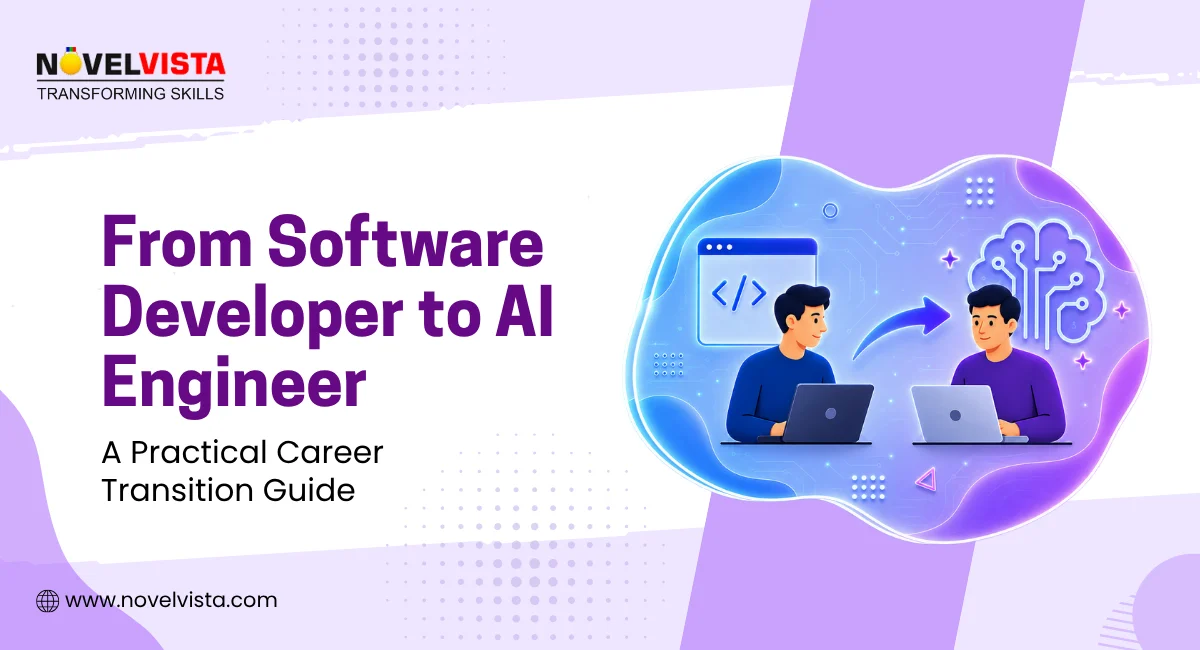
Artificial intelligence is moving into everyday software products, creating a natural opportunity for experienced developers. If you already build APIs, debug production issues, work with databases, design scalable systems, and use CI/CD pipelines, you are not starting from zero. This guide explains what does an AI engineer do, which developer skills transfer, which gaps to close, what to learn, which projects to build, and how to position yourself for an AI-focused role.
The World Economic Forum’s Future of Jobs Report 2025 lists AI and machine learning specialists among the fastest-growing roles through 2030, while software and application developers also remain among the fastest-growing technology roles. That overlap gives software developers a strong foundation for moving toward AI engineering.
A transition to AI engineering is often easier for a working developer than it first appears. Modern AI products still need backend services, authentication, APIs, testing, observability, deployment pipelines, databases, cloud infrastructure, performance tuning, and secure software design.
Your existing experience already covers much of that foundation.
| Software Development Strength | AI Engineering Extension |
|---|---|
| Programming and debugging | Python, model behavior, prompt and inference debugging |
| APIs and backend systems | Model APIs, LLM integration, AI orchestration |
| SQL and databases | Data preprocessing, embeddings, vector databases |
| CI/CD and containers | Model serving, MLOps, evaluation and monitoring |
| System design | RAG pipelines, inference architecture, AI reliability |
| Testing | Model evaluation, guardrails and output quality checks |
This is why the AI engineer career path does not necessarily require you to abandon your software background. Instead, you expand it with machine learning, data, and generative AI capabilities.
In practice, AI engineers do much more than train models. The role often sits between software engineering, machine learning, data engineering, and product development.
Typical responsibilities include:
The real test is whether the complete system works reliably for users, not whether a model works in a notebook.
The most effective way to plan your move is to separate what you already know from what you genuinely need to learn.
Become comfortable with Python, NumPy, Pandas, scikit-learn, data manipulation, and API development.
Learn supervised and unsupervised learning, regression, classification, clustering, feature engineering, training and validation, overfitting, and evaluation metrics. Research-level mathematics is not essential for most applied roles, but model behavior should make sense to you.
Understand neural networks, embeddings, attention, transformers, and the basic mechanics of large language models. Familiarity with PyTorch or TensorFlow is useful.
Modern AI engineering skills include prompt design, structured outputs, tool calling, RAG, vector databases, agent workflows, model evaluation, and responsible LLM use.
Use your DevOps background to learn model serving, containerization, monitoring, versioning, cost management, and AI-specific observability.
A useful AI engineer roadmap should prioritize output over endless coursework. Structure the journey into four stages.
Refresh Python, statistics, data handling, and machine learning fundamentals. Build a small classification or regression project and expose it through an API.
Learn embeddings, transformers, LLM APIs, vector search, RAG, prompt engineering, and evaluation. Build a knowledge assistant that retrieves information from documents and produces grounded responses.
Add authentication, logging, caching, evaluation datasets, rate limits, observability, containerization, deployment, and failure handling.
Publish two or three strong projects with clean repositories, architecture diagrams, READMEs, evaluation results, and deployed demos. Then target internal AI teams, AI product engineering roles, machine learning engineering roles, or applied AI positions.
The goal is to prove you can build and operate an AI-enabled system.
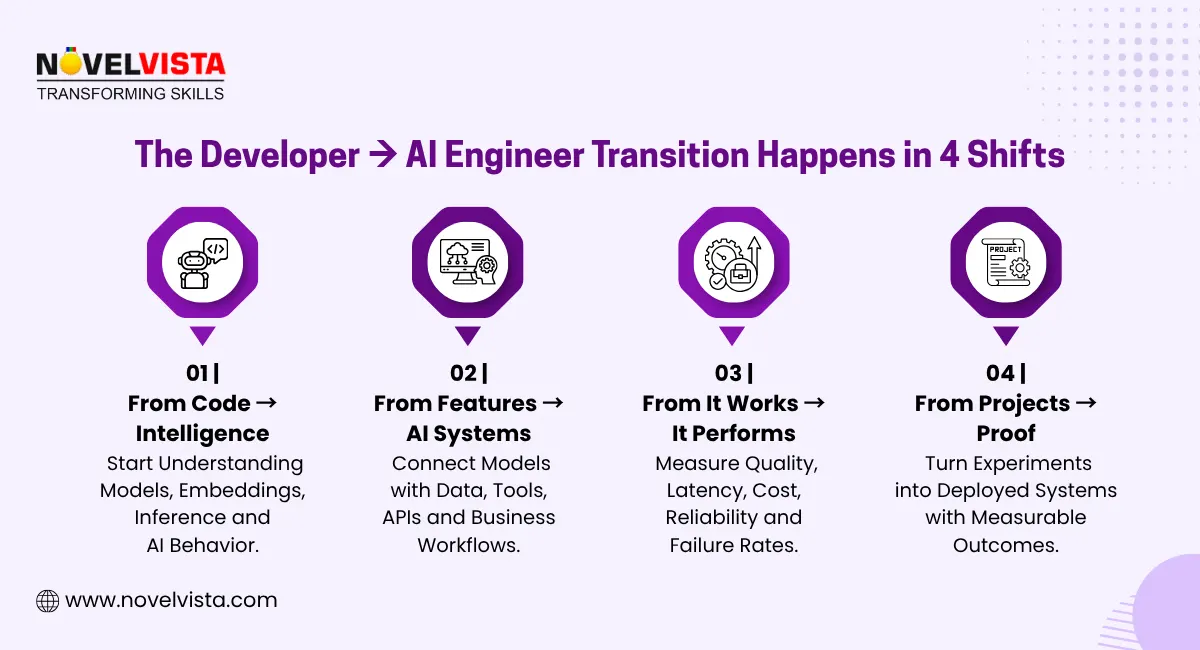
A strong portfolio makes the career switch easier because hiring teams can see evidence instead of relying on course certificates alone.
Ingest documents, create embeddings, retrieve relevant context, generate grounded answers, and measure retrieval quality. Add source citations and basic access controls to make the project feel closer to an enterprise use case.
Classify customer requests, retrieve support content, draft responses, and escalate uncertain cases to a human. Track accuracy, response time, and failure cases rather than presenting only a working demo.
Add structured outputs, caching, retries, authentication, logging, evaluation, and monitoring, then deploy it on a cloud platform.
Together, these projects demonstrate the AI engineering skills employers need: integration, reliability, evaluation, deployment, and business problem solving.
One of the most practical career-switch strategies is to look inside your current organization before immediately applying elsewhere. An internal transfer can reduce the “no AI experience” problem because your company already understands your engineering ability, delivery history, and knowledge of its systems.
Look for opportunities to automate workflows, add semantic search, prototype a support assistant, improve document processing, or contribute to an existing AI initiative. Hackathons and internal proof-of-concept projects can also create visible evidence of your new capability.
The AI engineer career path often begins before your job title changes. A developer who starts owning AI-enabled features can gradually build the experience needed for a formal role change.
Do not try to learn every framework. Tools change quickly; engineering principles last longer. Avoid these traps:
A successful transition to AI engineering comes from combining your existing software engineering discipline with focused AI capability. A structured learning plan, regular project work, and measurable outcomes will usually create more career value than chasing every new tool.
The biggest difference is uncertainty. Traditional software usually follows deterministic rules, while AI systems can produce probabilistic outputs. Engineers therefore need to think about evaluation, grounding, hallucinations, latency, safety, and cost alongside normal software quality.
This changes how systems are tested and operated, but it does not reduce the value of conventional engineering. In fact, production AI systems become stronger when teams apply disciplined software practices to model integration and orchestration.
Understanding this distinction is central to how to become an AI engineer who can build production systems rather than impressive but fragile demonstrations.
Moving from software development into AI engineering is an evolution, not a reset. Your coding, system design, APIs, cloud, testing, debugging, and DevOps experience already provide a strong base. Add machine learning, generative AI systems, data workflows, evaluation, and production deployment.
The practical formula is simple: learn a concept, build with it, deploy it, measure it, and improve it.
For a structured learning path, explore NovelVista’s AI Engineering Professional course to build job-relevant AI engineering capability and apply it in real technical environments.
For developers asking how to become an AI engineer, the most valuable first move is to think like an experienced engineer adding AI to systems you already know how to build.
Ultimately, understanding what does an AI engineer do is less about memorizing a job description and more about extending sound software engineering principles into intelligent, data-driven systems.
Author Details

Confused About Certification?
Get Free Consultation Call
Stay ahead of the curve by tapping into the latest emerging trends and transforming your subscription into a powerful resource. Maximize every feature, unlock exclusive benefits, and ensure you're always one step ahead in your journey to success.