Category | AI And ML
Last Updated On 07/10/2026
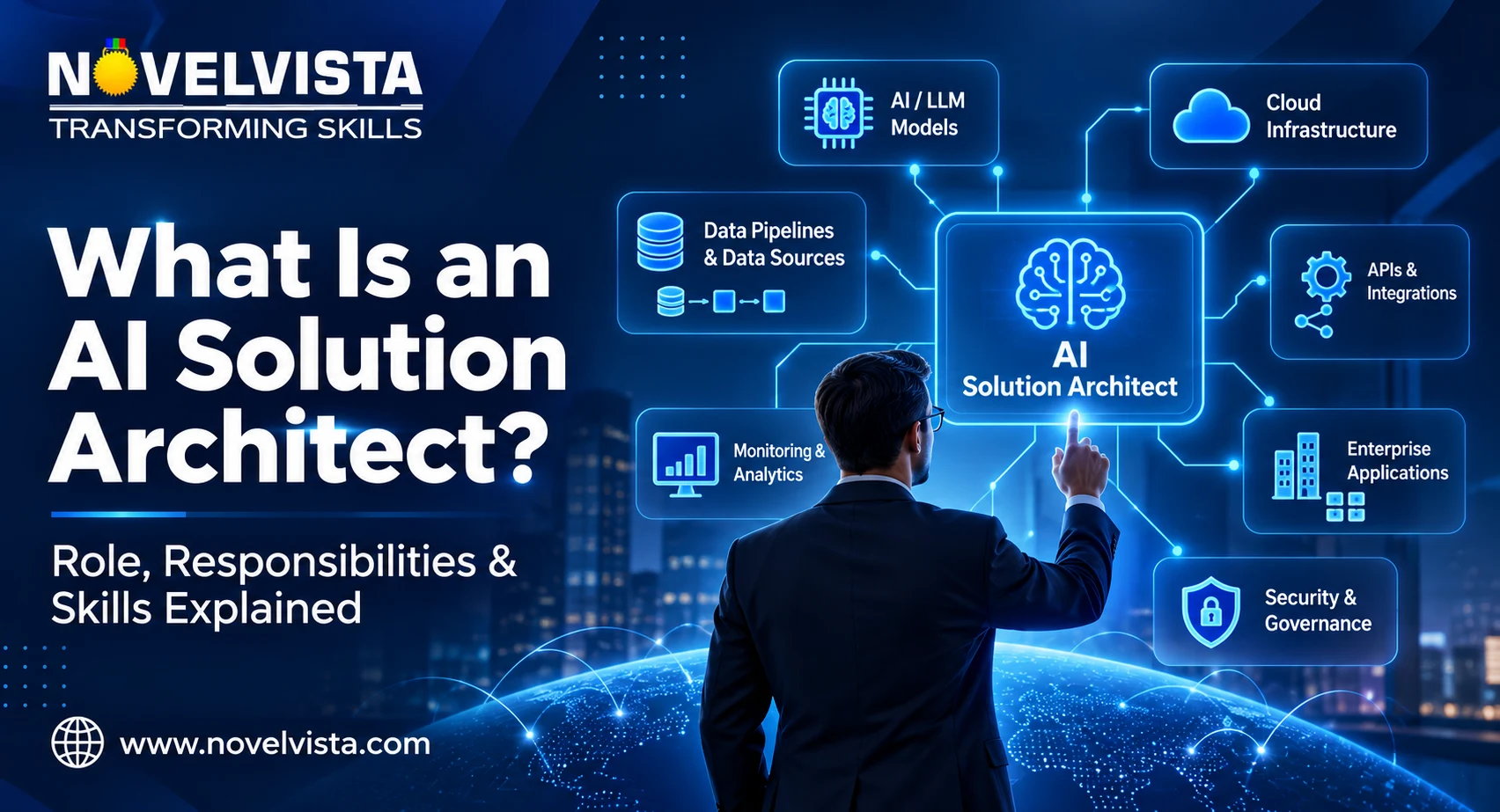
What is an AI Solution Architect, and why is this role becoming important as companies move AI from experiments into real business systems? This guide explains the AI Solution Architect meaning, what the role involves day to day, the main responsibilities, the skills required, the technology stack behind modern AI solutions, and how this position differs from AI engineers, ML engineers, and data scientists. You will also see how an architect turns a business problem into a working AI system, where build-versus-buy decisions matter, and how generative and agentic AI are reshaping the job.
What is an AI Solution Architect in practical terms? It is a professional who designs the end-to-end structure of an AI solution and makes sure the technology supports a real business objective. The architect connects business requirements with data, models, applications, infrastructure, security, governance, integration, and operations.
The AI Solution Architect meaning is broader than choosing an AI model. A strong architect asks whether AI is the right approach, what data is available, how the solution will integrate with existing systems, how users will access it, how it will be secured, and how it will perform once usage grows.
For example, for an internal AI assistant, the architect may design document retrieval, model access, permissions, application integration, monitoring, and cost controls.
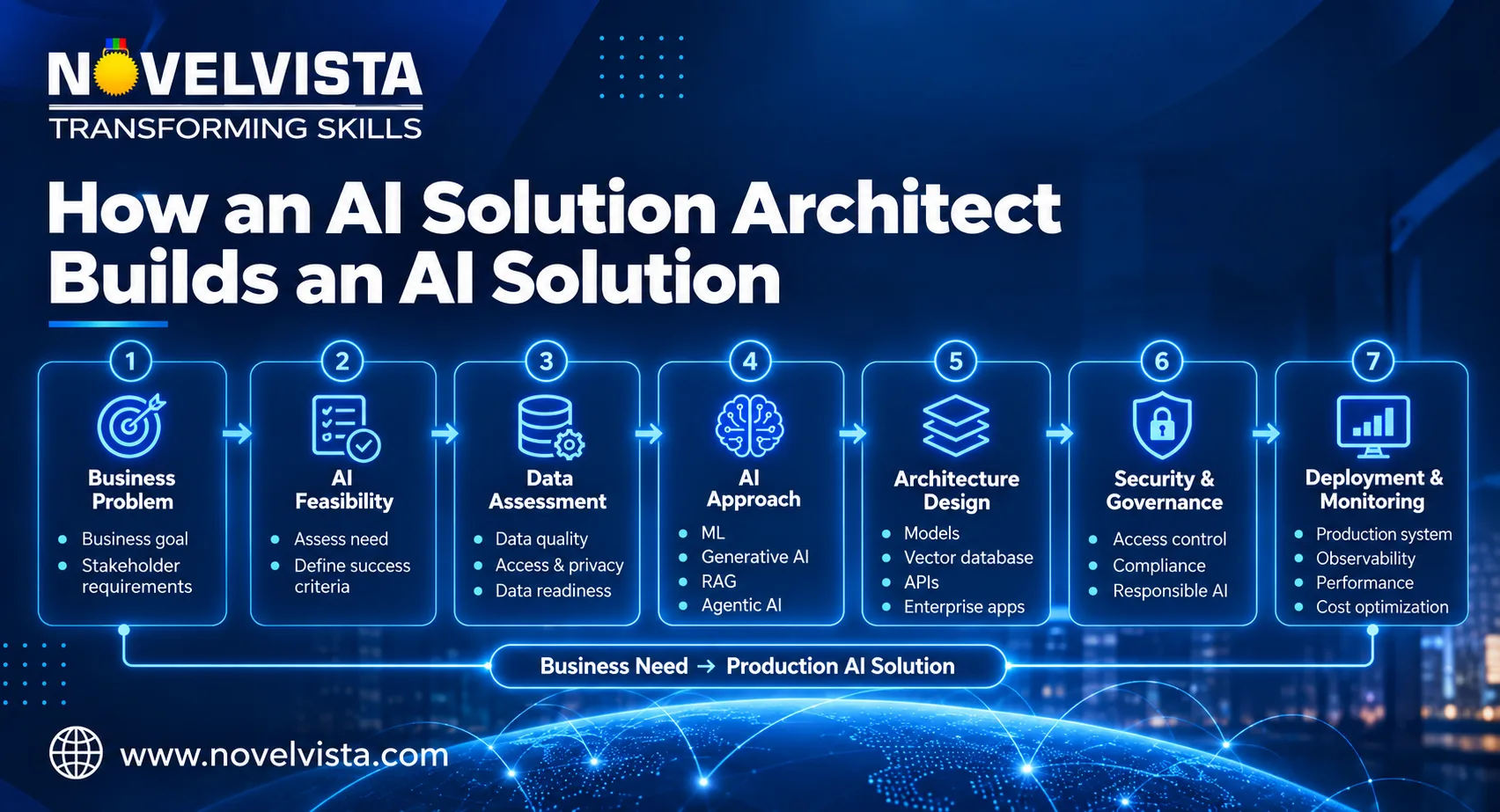
Across a real project, the work normally begins before model development and continues after deployment. The architect helps define the problem, assess feasibility, choose the right AI approach, design the system, guide delivery teams, and establish the controls needed for production use.
A typical AI Solution Architect role includes several stages.
The architect works with business and technical teams to define the outcome, such as reducing support workload, improving search, automating a process, or detecting risk.
The architect maps how data, models, applications, APIs, identity, cloud services, and monitoring work together, turning business needs into a technical blueprint.
The architect evaluates cloud services, models, vector databases, orchestration tools, and third-party products against cost, risk, performance, integration, and maintainability.
The architect coordinates engineers, data teams, developers, security, DevOps, and business stakeholders so the design remains scalable, secure, testable, and supportable.
The AI Solution Architect responsibilities span strategy, architecture, technology, governance, and communication. The role sits between business direction and technical execution.
| Responsibility | What It Involves |
|---|---|
| AI strategy and solution planning | Translating business goals into a realistic AI approach |
| Architecture design | Defining how models, data, applications, and infrastructure connect |
| Technology selection | Choosing suitable models, platforms, cloud services, and tools |
| Data architecture | Planning access, pipelines, storage, retrieval, quality, and governance |
| Enterprise integration | Connecting AI services with existing applications and workflows |
| Scalability and reliability | Designing for production traffic, availability, and performance |
| Security and governance | Managing access, privacy, responsible AI, and compliance controls |
| Cost optimization | Balancing model quality, infrastructure, latency, and operating cost |
| Stakeholder communication | Explaining architectural choices to technical and non-technical teams |
| Monitoring and improvement | Defining how quality, usage, failures, and model behaviour will be tracked |
These AI Solution Architect roles and responsibilities matter because production AI depends on data, software, infrastructure, security, and operations working together.
What is an AI Solution Architect expected to contribute before development starts? One of the most valuable contributions is turning an unclear business request into a solution that teams can actually build.
A practical sequence looks like this:
This keeps teams from starting with a model and searching for a problem later.
AI Solution Architect skills must cover both technical breadth and business judgement. The architect does not need to build every component, but must understand enough to make sound design decisions.
Knowledge of supervised and unsupervised learning, deep learning, foundation models, LLMs, embeddings, prompt design, RAG, and agent patterns helps the architect decide which approach fits the use case.
Architects need a working understanding of platforms such as Microsoft Azure, AWS, or Google Cloud, along with APIs, distributed systems, containers, microservices, networking, identity, availability, and scalability.
AI quality depends heavily on data. Useful capabilities include understanding databases, data pipelines, vector stores, data quality, metadata, access controls, retention, and governance.
Production AI requires deployment, versioning, testing, monitoring, rollback, automation, and lifecycle management. The architect should understand how these practices affect reliability and long-term support.
Architects must account for privacy, model access, data leakage, prompt injection, bias, auditability, compliance, and appropriate human oversight.
The role also depends on requirements analysis, stakeholder management, prioritization, communication, leadership, and cost-benefit thinking. Technical excellence alone is not enough if the architecture cannot be explained or aligned with business goals.
A modern stack may include cloud platforms, model services, ML platforms, data stores, vector databases, APIs, orchestration frameworks, containers, CI/CD, identity, monitoring, and security controls.
For generative AI, architects increasingly work with RAG, context engineering, tool calling, guardrails, evaluation, and agent orchestration. Microsoft and AWS architecture guidance now treats these as distinct solution and design concerns.
The stack should follow the business problem. A classification service needs a very different architecture from a multi-agent enterprise assistant.
A major architectural decision is how much of the solution should be custom-built.
The architect may recommend:
The best choice depends on data sensitivity, differentiation, cost, latency, accuracy, control, implementation speed, and internal capability. Building everything can create unnecessary complexity, while buying without checking integration and governance can create other problems.
These roles often work together, but their scope is different.
| Role | Primary Focus | Typical Responsibility |
|---|---|---|
| AI Solution Architect | End-to-end AI system design | Defines the overall architecture and technical direction |
| AI Engineer | AI-enabled applications | Builds and integrates AI capabilities into products |
| ML Engineer | Production ML systems | Deploys, serves, monitors, and maintains ML models |
| Data Scientist | Data analysis and modelling | Develops models, experiments, and analytical insights |
What does an AI Solution Architect do that is different? The architect usually works across the entire system and coordinates decisions that affect multiple teams, rather than focusing mainly on one model, service, or application component.
Consider an organization building an AI assistant for customer-support employees.
The architect first defines the goal, then assesses knowledge sources, permissions, data sensitivity, expected traffic, and the existing support platform.
If RAG is suitable, the architect designs document retrieval, model grounding, authentication, interface integration, guardrails, and answer evaluation.
During implementation, the architect coordinates engineering, security, compliance, and business teams. After launch, monitoring covers latency, retrieval quality, failures, cost, and user feedback.
This example shows why architecture is broader than selecting a model. The architect must consider how every layer of the solution operates together.
What is an AI Solution Architect protecting the business from? Often, it is expensive architectural mistakes that are easy to make during early AI experimentation.
Common problems include:
An architect brings these questions into the design before they become expensive production issues.
Generative AI has expanded AI Solution Architect responsibilities to include grounding, context, model selection, tool access, agent behaviour, evaluation, guardrails, and inference economics.
Agentic systems add another layer because models can select tools, call APIs, retrieve information, and sequence actions. Architecture must therefore consider permissions, tool boundaries, state, failures, auditability, and action risk.
Current Microsoft and AWS guidance also emphasizes agent architecture, orchestration, RAG, and secure access to enterprise data.
For architects, this means understanding the model is only one part of the job. They must design the controls, context, integrations, and operational boundaries around increasingly autonomous AI systems.
People often move into this role from AI engineering, machine learning, cloud architecture, data engineering, software architecture, solution architecture, or senior development positions.
The transition is easier with production-system experience. AI specialists may need stronger cloud and security knowledge, while traditional architects may need deeper ML, generative AI, RAG, and model-operations expertise.
There is no single career path. What matters is developing enough breadth to understand how business requirements, AI capabilities, data, applications, infrastructure, governance, and operations fit together.
What is an AI Solution Architect worth to an organization that is investing heavily in AI? The value comes from connecting experimentation with production.
A capable architect helps the business:
Without that architectural view, impressive demos can become difficult to secure, integrate, scale, or operate.
What is an AI Solution Architect ultimately responsible for? The role is about designing AI systems that are useful, secure, scalable, governable, and aligned with business needs. It combines AI knowledge with cloud architecture, data design, integration, security, operations, and stakeholder communication.
If you are building toward this role, a structured AI Solution Architect Learning Roadmap can help you organize the technical and architectural capabilities you need to develop.
NovelVista's AI Solution Architect Certification is designed for professionals who want a structured path to understanding AI solution design, architecture decisions, enterprise integration, and the skills required to move from AI concepts to practical solutions.
Author Details

Confused About Certification?
Get Free Consultation Call
Stay ahead of the curve by tapping into the latest emerging trends and transforming your subscription into a powerful resource. Maximize every feature, unlock exclusive benefits, and ensure you're always one step ahead in your journey to success.