Category | AI And ML
Last Updated On 21/10/2026
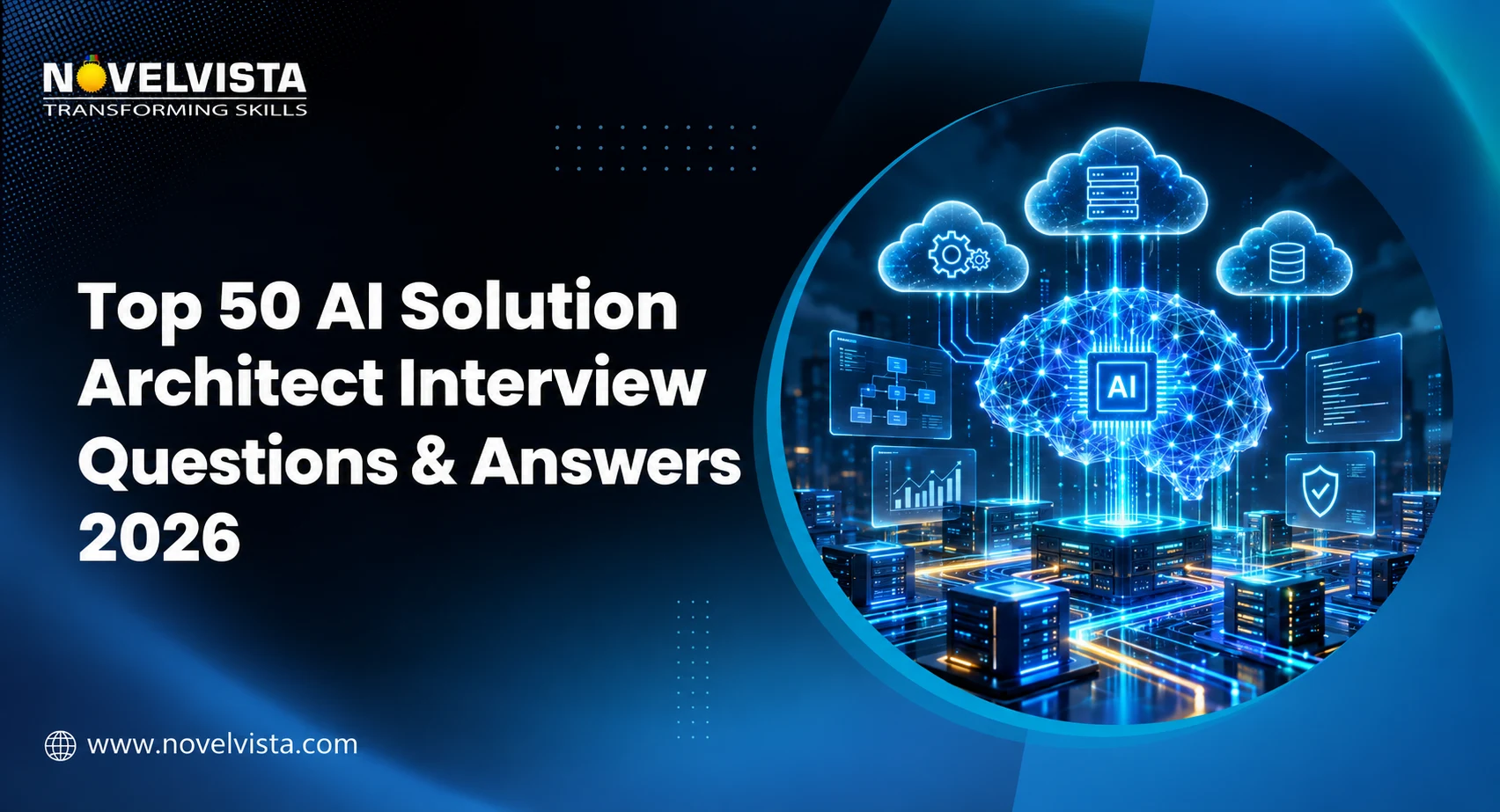
Preparing for an AI Solution Architect interview in 2026 requires more than understanding machine learning algorithms. Employers want professionals who can design scalable AI systems, integrate large language models, secure enterprise data, and connect technical decisions with business outcomes. This guide covers the top 50 AI Solutions Architect interview questions with practical answers across AI fundamentals, machine learning, generative AI, RAG, cloud architecture, and real-world scenarios.
Whether you're an experienced cloud architect moving into AI or a technical professional seeking an architecture role, these AI Solution Architect interview questions and answers will help you explain complex concepts with clarity and confidence.
An AI Solution Architect translates business requirements into secure, scalable, and maintainable AI solutions. Interviewers evaluate how well candidates combine technical expertise with architectural decision-making.
Understanding What is an AI Solution Architect helps establish the responsibilities and technical expectations associated with the role.
| Skill Area | What Interviewers Evaluate |
|---|---|
| AI and Machine Learning | Model selection, training, evaluation |
| System Architecture | Scalability, performance, integration |
| Generative AI | LLMs, RAG, agents, prompt engineering |
| Cloud Computing | AWS, Azure, Google Cloud |
| Security and Governance | Privacy, compliance, responsible AI |
| Business Understanding | Cost, ROI, stakeholder alignment |
| Communication | Architecture explanation, trade-offs |
A strong candidate explains not only which technology to use but also why that technology fits the organization's requirements.
These foundational AI Solutions Architect interview questions assess your understanding of AI architecture, model selection, and architectural responsibilities.
Answer: An AI Solution Architect designs end-to-end AI solutions that solve business problems. Responsibilities include selecting models, defining data architecture, choosing infrastructure, integrating services, and managing security, scalability, and reliability.
The architect also coordinates with data scientists, engineers, business stakeholders, and security teams to ensure successful implementation.
Answer: A typical AI architecture includes data ingestion, storage, preprocessing, model training or selection, inference services, APIs, monitoring, and security controls.
For generative AI, additional components may include vector databases, retrieval pipelines, prompt management, and content safety mechanisms. Each component should support clear business and operational requirements.
Answer: An AI Engineer primarily builds, tests, deploys, and maintains AI applications or models. An AI Solution Architect defines the overall system design, integration approach, technology selection, and architectural standards.
Both roles collaborate, but architects are accountable for broader system-level trade-offs and alignment with business needs.
Answer: An AI Architect specializes in intelligent systems, including machine learning pipelines, LLMs, and model operations. A traditional Solution Architect designs broader enterprise applications, infrastructure, and integrations.
The distinction depends on organizational responsibilities. Read AI Architect vs Solution Architect for a detailed comparison.
Answer: Artificial Intelligence is the broader field of building systems that perform tasks associated with human intelligence.
Machine learning uses data to learn patterns and make predictions. Deep learning is a subset of machine learning that uses multilayer neural networks, commonly applied to language, vision, and complex pattern recognition.
Answer: Start with the business objective, available data, accuracy requirements, latency, privacy, and operating budget.
Compare candidate models using representative evaluation datasets. Choose the simplest model that satisfies requirements, rather than automatically selecting the largest or most expensive option.
Answer: The lifecycle generally includes problem definition, data collection, preprocessing, model development or selection, evaluation, deployment, monitoring, and continuous improvement.
Architects should include governance and security throughout the lifecycle instead of treating them as final deployment activities.
Answer: Scalability depends on request volume, model size, inference latency, infrastructure capacity, data throughput, and concurrency.
Common solutions include autoscaling, caching, asynchronous processing, request batching, and distributed workloads. Architecture decisions should be validated using realistic load testing.
Answer: Supervised learning uses labeled examples to predict outcomes such as customer churn or fraudulent transactions.
Unsupervised learning identifies patterns within unlabeled data, including customer segments and unusual behavior. The appropriate approach depends on the data available and the business question.
Answer: Translate business goals into measurable requirements such as accuracy, response time, availability, compliance, cost, and expected value.
Document constraints, compare architectural alternatives, and establish acceptance criteria with stakeholders before implementation.
These AI Solutions Architect interview questions focus on data pipelines, model management, deployment, and operational reliability.
Answer: I would design a pipeline covering ingestion, validation, transformation, feature engineering, training, evaluation, model registration, and deployment.
Automation should include reproducible workflows, version tracking, testing, and monitoring. The pipeline must support retraining and safe rollback when performance deteriorates.
Answer: Batch inference processes multiple records periodically, making it suitable for scheduled predictions and large datasets.
Real-time inference generates predictions for individual requests with low latency. It suits applications such as fraud detection and live personalization but requires reliable serving infrastructure.
Answer: Overfitting occurs when a model learns training-specific patterns but generalizes poorly. Underfitting occurs when a model cannot capture important relationships.
Techniques include cross-validation, regularization, appropriate model complexity, better features, and systematic evaluation on unseen data.
Answer: Feature engineering transforms raw data into useful inputs for machine learning models.
Examples include extracting transaction frequency, encoding categorical variables, and generating time-based features. Good feature engineering improves predictive value and can reduce unnecessary model complexity.
Answer: I would implement validation checks for missing values, duplicates, inconsistent formats, outliers, and unexpected distributions.
Data lineage, quality monitoring, and automated alerts help detect upstream problems. Sensitive data also requires appropriate access controls and retention policies.
Answer: Model drift broadly describes changes that reduce model reliability over time. Data drift refers to changing input distributions, while concept drift involves changes in relationships between inputs and outcomes.
Detection involves tracking distributions, prediction quality, operational metrics, and ground-truth performance when labels become available.
Answer: MLOps combines automation, version control, continuous integration, deployment processes, monitoring, and governance.
I would establish reproducible training pipelines, model registries, automated validation, deployment approvals, and monitoring dashboards to support reliable model operations.
Answer: I would place stateless inference services behind an API gateway and load balancer.
Container orchestration, autoscaling, caching, rate limiting, and request queues can improve performance. Monitoring p95 latency, throughput, errors, and resource utilization helps guide capacity decisions.
Answer: Accuracy measures overall correct predictions. Precision measures how many predicted positives are correct. Recall measures how many actual positives are detected.
F1-score balances precision and recall through their harmonic mean. The right metric depends on the business consequences of false positives and false negatives.
Answer: Maintain a registry containing model versions, evaluation results, training configurations, and deployment metadata.
Use staged releases, canary deployments, or shadow testing to reduce risk. Define rollback triggers based on accuracy, latency, errors, and business performance.
These AI Solutions Architect interview questions examine how architects design reliable generative AI applications.
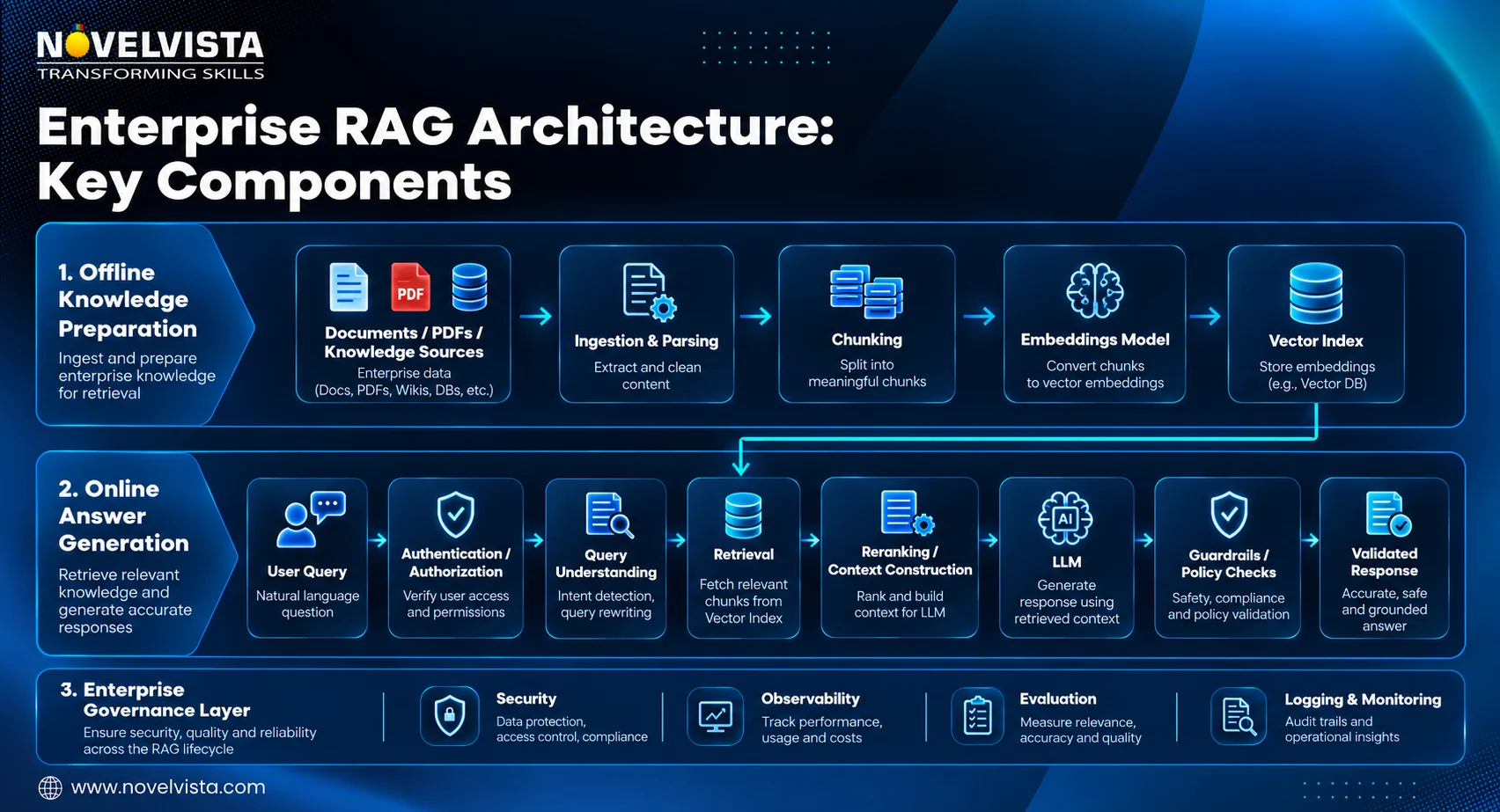
For effective AI architecture interview preparation, candidates should understand the complete flow from retrieving enterprise knowledge to generating, validating, and monitoring responses.
Answer: A Large Language Model is a neural network trained on substantial amounts of text and other supported data to learn language patterns.
Many modern LLMs use transformer architectures and generate output by predicting tokens based on context. Their capabilities depend on training, alignment, architecture, and inference configuration.
Answer: RAG combines information retrieval with language generation.
A retrieval system finds relevant documents or passages and supplies them as context to an LLM. This helps applications answer questions using organization-specific or updated information without requiring model retraining.
Answer: I would create a document ingestion pipeline, validate and chunk content, generate embeddings, and store searchable representations in an index.
At query time, the system retrieves authorized information, reranks results where needed, and sends relevant context to an LLM. Citations, access controls, evaluation, and monitoring complete the architecture.
Answer: RAG supplies external knowledge during inference. Fine-tuning updates model parameters using additional training data. Prompt engineering structures instructions and context to guide model behavior.
RAG often suits changing enterprise knowledge, while fine-tuning can help specialized behavior or output patterns. These techniques can complement one another.
Answer: Embeddings represent information as numerical vectors that capture useful semantic relationships.
Vector databases or vector search indexes retrieve similar representations efficiently. They support semantic search, recommendation systems, and retrieval pipelines used by generative AI applications.
Answer: Experiment with chunk size, overlap, metadata filters, hybrid search, and reranking.
Evaluate retrieval relevance using representative queries, including ambiguous and difficult examples. Measure whether retrieved evidence actually supports the final answer, not just whether retrieval scores appear high.
Answer: Use reliable retrieval, explicit grounding instructions, source citations, structured outputs, and validation rules.
Allow the model to abstain when evidence is insufficient. Evaluate factual correctness using test cases and human review, especially for regulated or high-impact applications.
Answer: A traditional chatbot primarily responds to conversational inputs. An AI agent can use tools, manage intermediate steps, and execute bounded workflows toward a goal.
Agentic capabilities require additional safeguards, including restricted permissions, execution limits, audit logs, and human approval for sensitive actions.
Answer: I would assign agents clearly defined responsibilities and connect them through controlled orchestration.
Each agent receives least-privilege tool access, validated inputs, and restricted execution capabilities. Shared tracing, timeout policies, and human approval gates reduce operational and security risks.
Answer: Evaluation should measure task success, factual accuracy, groundedness, safety, response latency, and cost.
For RAG, I would separately test retrieval quality and answer generation. Automated evaluation should be complemented by representative human-reviewed datasets and ongoing production monitoring.
These AI Solutions Architect interview questions assess enterprise deployment, security, integration, and infrastructure choices.
Strong Enterprise AI architecture interview questions require candidates to explain trade-offs between reliability, governance, performance, and cost.
Answer: Start by comparing business requirements, existing cloud investments, security policies, integration capabilities, and costs.
AWS, Azure, and Google Cloud provide managed AI and machine learning services. Select components based on workload requirements rather than provider preference alone.
Answer: Microservices separate capabilities such as ingestion, inference, retrieval, and monitoring into independently deployable services.
This can improve scalability and team autonomy, but introduces network overhead and operational complexity. A simpler architecture may be preferable for smaller applications.
Answer: Use APIs, event-driven integration, middleware, or message queues according to system requirements.
I would define authentication, data contracts, failure handling, and audit requirements early. Compatibility testing ensures AI services operate reliably alongside ERP, CRM, and other enterprise platforms.
Answer: Cloud deployment offers managed services and flexible infrastructure. On-premises deployment provides greater direct infrastructure control.
Hybrid deployment combines both environments, often to meet latency, data residency, or integration requirements. The best choice depends on security, operating complexity, and total cost.
Answer: Apply encryption, identity-based access, network isolation, secrets management, and data minimization.
Classify sensitive information before ingestion and monitor how it moves through training, retrieval, and inference. Define retention and deletion processes according to organizational and regulatory requirements.
Answer: Authenticate each user and preserve their identity throughout retrieval.
Apply document-level or row-level permissions before evidence reaches the model. Retrieval filters must enforce authorization server-side so users cannot obtain restricted information through prompts.
Answer: Establish governance policies covering bias evaluation, privacy, transparency, human oversight, and accountability.
Document model limitations, intended use, and risk assessments. Frameworks such as the NIST AI Risk Management Framework can guide risk identification, measurement, and management.
Answer: Separate tenant identities, permissions, data, and resource quotas.
Depending on sensitivity and scale, use isolated databases, tenant-specific indexes, or shared infrastructure with enforced logical isolation. Test tenant boundaries and prevent cross-tenant data exposure.
Answer: Monitor token consumption, GPU utilization, model selection, retrieval costs, and request patterns.
Apply caching, batching, right-sized models, autoscaling, and routing to cheaper models when appropriate. Compare cost per successful task rather than optimizing infrastructure cost alone.
Answer: Remove single points of failure, deploy redundant services, and establish backup and recovery procedures.
Use health checks, retries with limits, failover strategies, and tested restoration processes. Define recovery time and recovery point objectives according to business needs.
Advanced AI Solutions Architect interview questions test whether candidates can handle real-world complexity and defend architectural decisions.
During AI Architect interview preparation, practice explaining requirements, design alternatives, failure scenarios, and measurable outcomes.
Answer: I would combine a conversational interface, enterprise knowledge retrieval, an LLM, and existing customer support APIs.
The system would enforce access permissions, provide source-grounded responses, and escalate uncertain cases to human agents. Success metrics include resolution rate, satisfaction, latency, and operating cost.
Answer: I would design secure document ingestion, OCR, classification, information extraction, validation, and human review.
Encryption, document-level authorization, audit logs, and data retention controls are essential. Low-confidence or financially sensitive outputs should require human verification before downstream processing.
Answer: I would use streaming ingestion, real-time feature computation, a low-latency scoring service, and an alerting workflow.
A rules engine can complement ML predictions. The system should monitor false positives, detection rates, drift, latency, and feedback from fraud investigators.
Answer: I would start with workload modeling and load testing to identify bottlenecks.
Then introduce autoscaling, caching, workload isolation, queue-based processing, and capacity management. Scaling must account for inference concurrency, model quotas, availability, latency, and financial limits.
Answer: I would investigate data distribution changes, data leakage, integration problems, and differences between testing and production.
Review input quality, logs, model versions, and performance metrics. If business risk is significant, roll back to a stable version while investigating the cause.
Answer: I would build an abstraction layer for model access, policy enforcement, request routing, and observability.
Normalize core interfaces while supporting provider-specific capabilities. Routing decisions can consider model quality, latency, region, availability, and cost, with fallback strategies tested before production.
Answer: First, measure latency across retrieval, prompt construction, model inference, and downstream tools.
Potential improvements include response caching, smaller models, shorter prompts, optimized retrieval, streaming responses, and fewer sequential tool calls. Changes must preserve acceptable answer quality.
Answer: Identify a valuable use case, evaluate available data, and establish measurable success criteria.
Introduce AI through modular APIs rather than immediately rebuilding the application. Start with a controlled pilot, validate performance and risk, and expand incrementally.
Answer: I would clarify shared objectives, constraints, and measurable outcomes.
Present architectural alternatives with cost, implementation effort, security implications, and expected business value. When uncertainty remains, a limited proof of concept can provide evidence for a decision.
Answer: Establish baseline performance and measure improvements against defined business goals.
Relevant metrics include reduced processing time, cost savings, revenue impact, quality improvements, and user adoption. Include infrastructure, maintenance, monitoring, and human oversight costs in the ROI assessment.
Effective interview question practice combines theoretical understanding with hands-on architecture exercises.
A structured AI Solution Architect interview guide should address both technical design and business communication. Reviewing AI Architect questions and answers also helps candidates identify gaps in their knowledge.
Review cloud services, API design, data engineering, system integration, scalability, security, and observability.
Create a working RAG application, deploy a machine learning model, or build a small agent-based workflow.
Document architecture decisions, performance limitations, and security controls.
Explain system components, data movement, expected traffic, failure handling, and trade-offs.
Don't focus exclusively on drawing diagrams. Explain why each component exists.
Use the STAR method: Situation, Task, Action, Result.
Prepare examples involving technical decisions, cross-functional communication, delivery challenges, and measurable business impact.
An AI Solution Architect Roadmap can help organize cloud, machine learning, generative AI, security, and enterprise architecture knowledge.
For stronger AI Architect interview questions practice, rehearse answers aloud and ask a colleague to challenge your design assumptions.
Strong AI architecture interview preparation involves recognizing weak answers before an interviewer does.
| Common Mistake | Better Approach |
|---|---|
| Discussing algorithms without architecture | Explain complete system design |
| Choosing complex models automatically | Justify model choice through requirements |
| Ignoring data security | Address authorization and privacy early |
| Overlooking operational costs | Discuss cost-performance trade-offs |
| Giving theoretical answers only | Add practical examples |
| Ignoring failure scenarios | Include resilience and fallback designs |
| Missing business outcomes | Connect architecture to measurable value |
When practicing Enterprise AI architecture interview questions, emphasize how your proposed solution would operate under real production constraints.
Success in an AI Solution Architect interview requires more than memorizing definitions. Candidates must demonstrate sound architectural judgment, technical depth, communication skills, and the ability to connect AI investments with business value.
These 50 AI Solutions Architect interview questions provide a foundation for understanding the technologies and decisions involved in enterprise AI systems.
For further AI Architect questions and answers, focus on realistic case studies and practice defending your design choices.
A clear AI Solution Architect interview guide also becomes more valuable when paired with hands-on projects and structured learning.
NovelVista's AI Solution Architect Learning Roadmap provides a structured route for developing relevant skills.
You can also explore AI Solution Architect Certification to strengthen your understanding of enterprise AI architecture, generative AI, and solution design.
Use this article as a practical reference, refine your answers through implementation experience, and approach your next interview with greater confidence.
Author Details

Course Related To This blog
Certified AI Solutions Architect
Confused About Certification?
Get Free Consultation Call
Stay ahead of the curve by tapping into the latest emerging trends and transforming your subscription into a powerful resource. Maximize every feature, unlock exclusive benefits, and ensure you're always one step ahead in your journey to success.