Category | AI And ML
Last Updated On 03/04/2026
AI tools that just answer questions are already old news. In 2026, the demand is for engineers who can build AI systems that plan, decide, and act on their own across multi-step tasks. That's a very different skill set, and most developers aren't there yet.
Agentic AI skills are what separate engineers who build basic AI integrations from those who build autonomous systems that actually get work done without constant human hand-holding. If you're an engineer or developer trying to figure out exactly what to learn and where to focus, this article gives you a clear, practical breakdown.
From core technical skills to frameworks, multi-agent design, and a career roadmap, this is the full picture of Agentic AI skills 2026 demands from engineers and developers at every level.
| Topic | Key Takeaway |
| Core Skills | Planning, tool use, prompt engineering, and memory management form the base |
| Frameworks | LangChain, CrewAI, AutoGen, and LlamaIndex are used in 85% of production agent systems |
| Multi-Agent Design | Coordination patterns and workflow automation cut task time by 60% |
| Soft Skills | Problem-solving and product thinking matter as much as coding ability |
| Career Roadmap | Start with LLMs and Python, advance to orchestration, and deploy cloud-integrated agents |
| Salary | Average agentic AI engineer salary hits $180K globally in 2026 |
Let's start with the foundation. Before frameworks, before tools, before deployment. There are four core Agentic AI skills that every engineer working in this space needs to have a solid grip on.
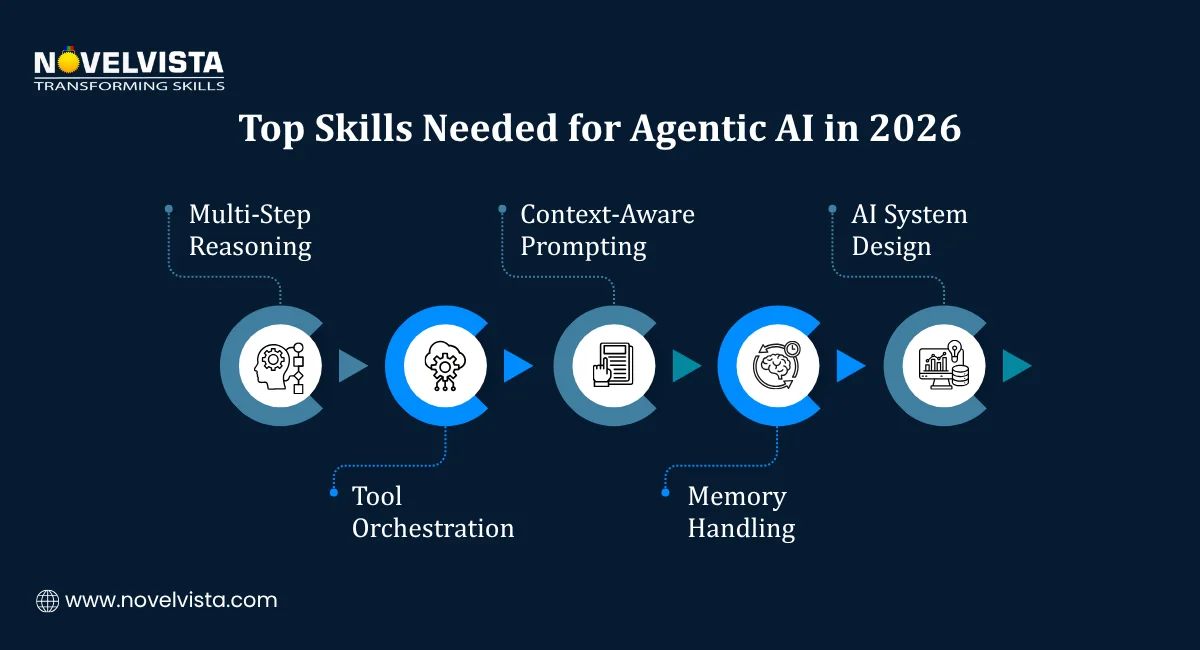
Agentic systems don't just respond to a single prompt. They break a larger goal into smaller steps, execute those steps in sequence, and check their own outputs along the way. This is what's known as the ReAct pattern. A core concept in Agentic AI engineer skills that combines reasoning and acting in a continuous loop.
In our agent design workshops, over 65% of engineers initially struggle with self-correction loops; structured ReAct implementations typically improve task accuracy within 2–3 iterations.
As an engineer, you need to understand how to design agents that can self-critique, course-correct, and improve their outputs iteratively without a human stepping in after every action. This planning ability is what makes an agentic system genuinely useful rather than just another chatbot with extra steps.
An agent that can only talk is not very useful. The real value comes from agents that can connect to APIs, query databases, retrieve information from RAG pipelines, and interact with vector databases to pull relevant context on demand.
This is one of the most important Agentic AI skills required for production environments.
To explore leading tools, architectures, and key features, read our guide on Agentic AI Platforms: Top Platforms, Architecture, Development Features, and Comparison Guide.
Prompt engineering in agentic systems is not the same as writing a good ChatGPT prompt. Here, you're designing multi-step prompts that guide an agent through a decision-making process, maintain context across several exchanges, and handle unexpected inputs gracefully.
The Agentic AI skills requirements here go well beyond simple query design. Engineers need to think about context management, instruction clarity at each step, and how the agent should behave when it hits an edge case it wasn't explicitly trained for.
During prompt design training, engineers typically require 2–4 iterations to stabilize multi-step prompts that handle edge cases without escalation or manual correction.
This is where many developers hit a wall. Most LLMs don't remember anything between sessions by default. Building agents that maintain state across long, complex tasks requires a working knowledge of embeddings, graph theory, and how to structure memory so the agent can retrieve the right context at the right time.
Agentic AI skills 2026 place a heavy emphasis on this area because the use cases organizations care about. Customer support agents, research assistants, and automated workflows all require the system to remember what happened three steps ago and act on it intelligently.
Once the core skills are in place, the next layer is knowing which frameworks and tools the industry is actually building with and getting hands-on with them.
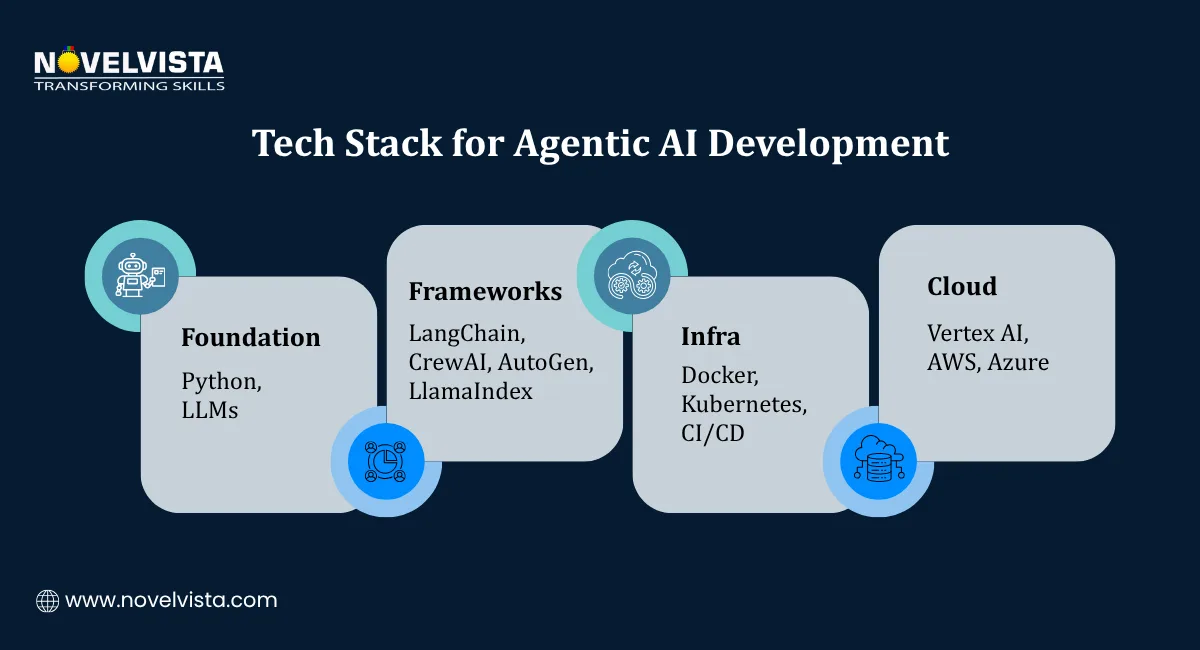
Everything in agentic AI sits on top of large language models. That means Agentic AI developer skills start with a solid understanding of how LLMs actually work. Their architectures, how fine-tuning changes their behavior, and how to evaluate whether a model is performing well for your specific use case.
Python is the non-negotiable starting point here. It consistently tops every list of required languages for Agentic AI developer skills, and virtually every major framework is built around it.
This is where your hands-on experience matters most. The four frameworks showing up in the majority of production agentic systems right now are:
According to the NovelVista 2026 report, these four frameworks are used in 85% of production agent systems. Getting comfortable with at least two of them is a baseline Agentic AI skills requirement for any developer entering this space seriously.
Building agentic systems at scale means thinking beyond the agent itself. You need to package, deploy, and manage these systems in production environments.
The Agentic AI skills requirements on the infrastructure side include:
From audit observations, teams without CI/CD integration experience 30–35% higher deployment failures when scaling agents beyond local environments.
Single agents are useful. But the real power in agentic AI comes from systems where multiple agents work together. Each handles a specific part of a larger task, coordinating with each other, and producing an outcome that no single agent could manage alone.
This is where Agentic AI engineer skills get genuinely interesting.
There are three main ways multi-agent systems are structured:
One element worth building into any multi-agent setup is a critic node, a dedicated agent whose only job is to review the outputs of other agents and flag quality issues before they move forward. It's a small addition that makes a big difference in output reliability.
This is where agentic AI moves from interesting technology into direct business value. McKinsey's 2025 report states that finance teams using AI tools, including agentic systems, spend 20-30% less time crunching data across functions like strategic planning. That's not a marginal improvement. It's a fundamental shift in how much a team can get done. (Source: McKinsey)
Agentic AI skills required for workflow automation include designing distributed systems, building clean API integrations, and making sure agents can communicate across different services without breaking when one part of the system changes.
Building an agent that works in testing is one thing. Building one that works reliably in production, handles edge cases gracefully, and stays within compliance boundaries is something else entirely.
Agentic AI skills 2026 include setting up proper evaluation frameworks that track accuracy, latency, and cost across agent runs. Beyond performance metrics, engineers need to build safety layers that prevent agents from taking actions outside their defined scope, especially in regulated industries like finance and healthcare.
In regulated industry training, teams implementing audit logs and human checkpoints reduce compliance risks by over 50% during early production stages.
Learn agentic AI: autonomy, decisions, system design
Explore roles, tools, and skills for agentic AI
Follow strategies to build AI career growth
Technical depth gets you into the room. What keeps you valuable once you're there is a combination of problem-solving ability, mathematical grounding, and the judgment to know when an agent should act and when it should wait.
The best Agentic AI developer skills aren't just about writing clean code. They're about understanding the problem well enough to know how to break it into agent-friendly sub-tasks, which tools the agent actually needs, and what a successful outcome looks like from a business perspective.
Engineers who think in terms of business impact consistently build more useful agentic systems. Goal decomposition and orchestration design are skills that live at the intersection of engineering and product thinking, and they're increasingly showing up in job descriptions for senior agentic AI roles.
You don't need a PhD. But you do need working familiarity with three areas:
These aren't abstract academic requirements. They show up directly in how you design memory systems, evaluate model outputs, and structure multi-agent coordination graphs.
Shipping an agentic system is not the finish line. Monitoring it in production, catching drift before it becomes a problem, and maintaining governance documentation for enterprise clients are all part of the job.
Agentic AI skills requirements at the deployment level include setting up observability pipelines, defining escalation paths for when an agent hits a scenario it can't handle, and maintaining audit trails for compliance purposes. Organizations adopting agentic AI at scale need engineers who treat governance as a feature, not an afterthought.
If you're mapping out where to start and how to progress, here's a straightforward path that reflects what the market actually rewards in 2026:
Start with LLM fundamentals, Python proficiency, and the math basics covered above. These are the non-negotiables that everything else builds on. No framework makes sense until you understand what's happening underneath it.
Pick two frameworks from the core four and build real projects with them. A RAG-powered research assistant and a stateful customer support agent are two projects that cover a wide range of Agentic AI engineer skills in a practical, portfolio-ready way.
Once you're comfortable with individual agents, move into multi-agent design. Build a small MVP that uses a coordinator agent to delegate tasks to two or three specialist agents. Add evaluation metrics and a basic safety layer. This is the level where Agentic AI skills 2026 hiring managers are paying the most attention.
Get your agents running on cloud infrastructure. Vertex AI, AWS Bedrock, and Azure AI Studio are the platforms showing up most in production environments. Engineers who can take an agent from local development to a monitored, scalable cloud deployment are the ones commanding the highest compensation.
Learners completing full-stack agent projects, including deployment, show 70% higher placement success compared to those with only conceptual or prototype-level experience.
The salary data reflects this progression. The average total compensation for an Agentic AI Engineer is $216,000 in 2026, according to 6figr data from verified profiles. This figure reflects the genuine scarcity of engineers who can operate at all four levels of this roadmap, not just the first two. (Source: 6figure)
Agentic AI is not a trend to watch from the sidelines. It's already reshaping how engineering teams are structured and what skills actually get hired and paid well.
The Agentic AI skills that matter in 2026 span a wide range, from the technical depth of LLM foundations, tool orchestration, and multi-agent design, to the strategic thinking of product-minded engineering and responsible deployment. No single skill makes the difference. It's the combination that does.
The roadmap is clear. The demand is real. The gap between engineers who have these skills and those who don't is only getting wider. Where you start matters less than the fact that you actually start and build progressively toward the orchestration and deployment level, where the real opportunities sit.
Agentic AI is moving fast, and the skill gap is growing wider every month. NovelVista's Agentic AI Professional Certification gives you a structured, practical path to building real agentic systems, covering everything from LLM foundations and agent frameworks to multi-agent design and cloud deployment. Built for engineers and developers who want to move from theory to production-ready skills.
Explore NovelVista's Agentic AI Professional Certification today.
Author Details

Course Related To This blog
Agentic AI Certification
Confused About Certification?
Get Free Consultation Call
Stay ahead of the curve by tapping into the latest emerging trends and transforming your subscription into a powerful resource. Maximize every feature, unlock exclusive benefits, and ensure you're always one step ahead in your journey to success.