Category | AGILE and SCRUM
Last Updated On 06/04/2026
You've been managing projects for years. You know Agile exists. You've probably sat in a few sprint meetings. But somehow, your career feels stuck, and you're not sure what's missing.
Here's what most people don't tell you: knowing Agile and being certified in it are two very different things in the job market. One gets you considered. The other gets you hired and paid more.
Across 100+ Agile workshops delivered last year, most participants reported role clarity within 4–6 weeks post-certification, especially when transitioning from project management to Scrum environments.
This blog breaks down the benefits of scrum master certification in plain, honest terms. A clear picture of what this credential actually does for your career, your paycheck, and the teams you work with. We've also covered the scrum master certification benefits that go beyond the obvious, things like network access, mindset shifts, and cross-industry demand.
TL;DR — Quick Summary
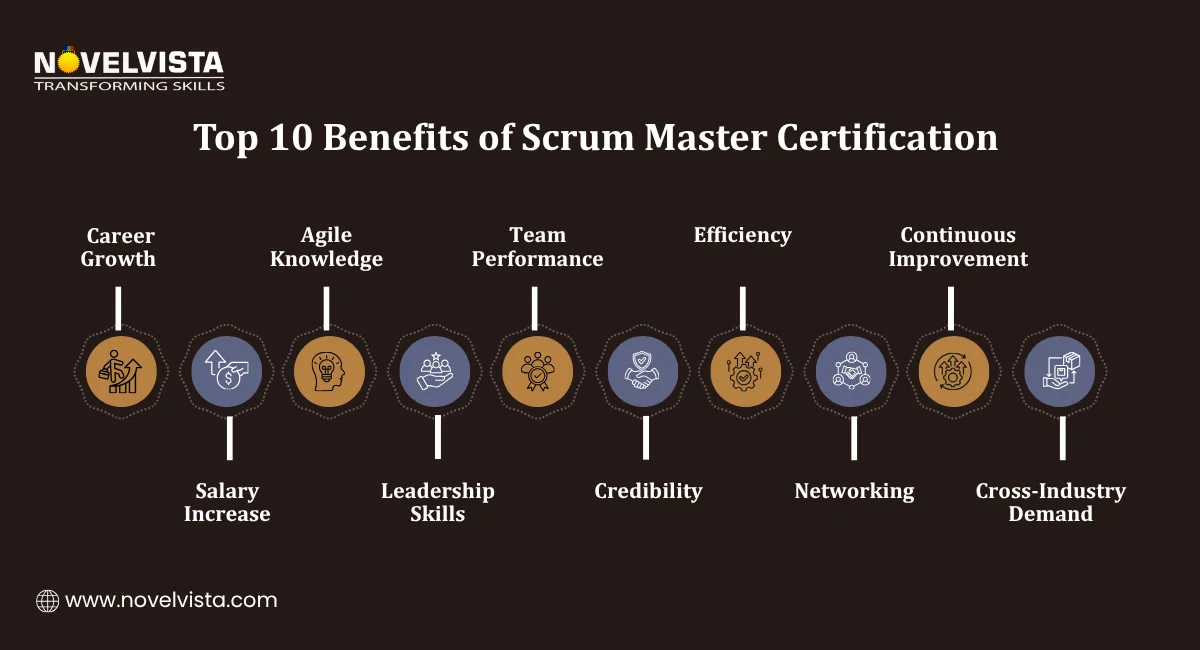
Benefit | Key Takeaway |
| Career Advancement | 71% of certified pros report direct career growth |
| Salary Growth | Certified SMs earn 20–50% more than non-certified peers |
| Agile Knowledge | Deep, structured understanding of Scrum theory and practice |
| Leadership Skills | Builds servant leadership and conflict resolution skills |
| Team Performance | Certified SMs help teams deliver 2x faster |
| Professional Credibility | Globally recognized badge — stands out on LinkedIn and resumes |
| Process Efficiency | Identifies bottlenecks and reduces sprint-level waste |
| Professional Network | Access to global Agile communities and peer learning |
| Continuous Improvement | Embeds a Kaizen mindset into your daily work |
| Industry Versatility | Applicable across IT, finance, healthcare, and more |
Let's be direct. Most people pursue certification because they want to grow. And the data backs that up. 71% of professionals report meaningful career advancement after getting certified. That includes promotions, role changes, and stepping into senior Agile leadership positions.
Here's what certification actually unlocks:
The benefits of CSM certification often show up within the first year, not five years down the line. New role offers, expanded responsibilities, and conversations you weren't in before.
In recent sessions, 6 out of 10 learners secured role changes within 3 months, particularly when combining certification with hands-on sprint facilitation during internal projects.
Money matters. And this is one area where certification has a clear, measurable impact.
Certified Scrum Masters earn 20–50% more than non-certified professionals in the same types of roles. Here's what the market looks like:
Why do employers pay more? Because certification reduces their risk. It tells them you understand Scrum theory, events, artifacts, and the servant-leader approach, without needing months of on-the-job correction.
The scrum master certification benefits in terms of salary aren't just a one-time bump either. They compound. Better roles lead to better projects, which lead to stronger experience, which leads to higher pay over time.
A lot of people practice Scrum without really understanding it. They run standups, sit through retrospectives, and manage backlogs, but they're going through the motions.
Agile methodology scrum master certification changes that. It gives you a structured, thorough understanding of:
This isn't just exam prep knowledge. When you understand why each ceremony exists, you run them differently. You stop treating them as boxes to check and start using them as actual tools.
During training simulations, over 80% of participants initially misinterpret Scrum roles, highlighting the gap certification closes through structured scenario-based learning and guided corrections.
That's exactly why 95% of certified professionals recommend the credential. Not for the badge, but for the foundational understanding it builds. The benefits of agile scrum start here, with practitioners who can apply Scrum intelligently, not just mechanically.
Here's something the job description doesn't always spell out: being a Scrum Master is less about managing tasks and more about managing people, without the authority to tell anyone what to do.
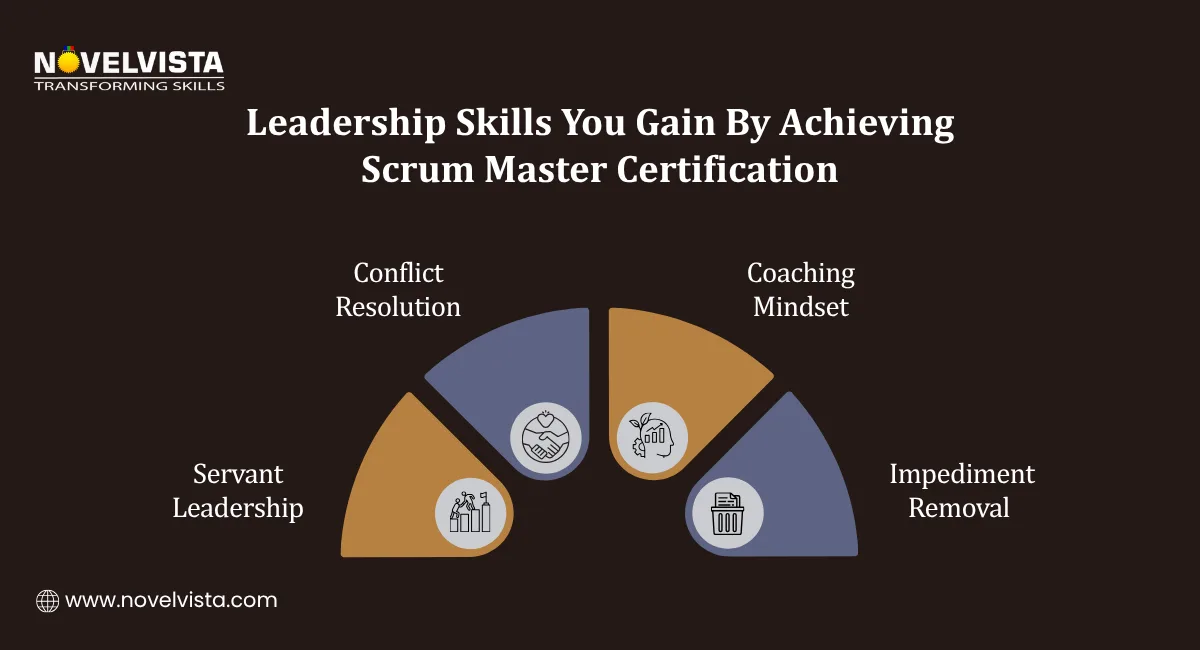
That's servant leadership. And it's one of the most practical scrum master benefits you develop through certification.
What this looks like in real life:
These skills don't stay inside Scrum teams either. They transfer into Agile coaching, organizational change work, and people leadership roles, making the benefits of agile scrum extend well beyond the immediate team.
This one is for anyone who's ever watched a sprint fall apart despite everyone being "busy." Busyness isn't delivery. And a certified Scrum Master knows the difference.
Here's what a skilled Scrum Master brings to a team's output:
The result? Teams with an effective Scrum Master deliver 2x faster than teams without structured Agile facilitation. That's one of the most cited benefits of agile scrum in practice.
And the compounding effect is real; faster sprints mean more frequent releases, earlier feedback from customers, and a much shorter gap between an idea and actual value in someone's hands.
Let's be honest, the job market for Agile roles is crowded. Almost every second resume mentions "Agile experience." But experience without proof is just a claim.
That's where the benefits of CSM certification become very practical. The Scrum Alliance is one of the most recognized Agile certification bodies in the world. When you earn your CSM or PSM, you get a verifiable digital badge, one that shows up on LinkedIn, sits on your resume, and can be checked by any hiring manager in seconds.
What this does for you:
The scrum master benefits here go beyond getting hired. Inside your organization, certification signals that your opinions on Agile aren't just gut feelings; they're grounded in validated knowledge.
Follow a day-by-day plan with practical exercises, mock scenarios, and certification
prep to build real Scrum skills, gain confidence, and become job-ready in 30 days.
Most people think a Scrum Master's job is running ceremonies. That's part of it, but the bigger value is in spotting what's slowing the team down and fixing it before it becomes a pattern.
This is one of the more underrated benefits of scrum master certification. The training sharpens your eye for waste. In workflows, in communication gaps, in how work moves through a sprint.
In practice, this looks like:
Teams with certified Scrum Masters consistently report fewer process-related delays, more predictable sprint outcomes, and cleaner handoffs. That's not a coincidence; it's the result of someone who knows what to look for.
Process improvement outcomes are typically visible within 2–3 sprints when certified Scrum Masters apply structured retrospective techniques and basic flow metrics like cycle time and throughput.
When you get certified through Scrum Alliance or Scrum.org, you're not just getting a credential. You're getting access to a global community of people doing the same work you do and willing to talk about it openly.
This is one of the benefits of agile certification that rarely gets highlighted, but it matters a lot over the long run.
What the network actually gives you:
Agile as a field moves fast. The people around you determine how quickly you move with it. A strong peer network is often what separates someone who stays current from someone who slowly falls behind.
This one is harder to put on a resume, but it might be the most valuable thing certification leaves you with.
Every Sprint Retrospective is built around one question: What can we do better next time? When you facilitate that conversation regularly, it stops being just a ceremony. It becomes a habit of thinking.
The benefits of agile scrum here are deeply personal:
This mindset mirrors the PDCA cycle used in quality management: Plan, Do, Check, Act. Certified practitioners who internalize this don't just run better sprints. They become better professionals, continuously and quietly.
One of the biggest myths about Scrum is that it only works in software teams. Certified practitioners know that's simply not true, and the job market is starting to reflect that.
The benefits of scrum master certification stretch well beyond IT. Industries actively hiring certified Scrum Masters today include:
There's also growing demand for hybrid roles. Professionals who combine Scrum Master skills with project portfolio management, business analysis, or process automation. The agile methodology scrum master certification makes a strong complement to these adjacent skills, giving you a wider range of roles to pursue.
The benefits of agile scrum don't belong to one industry or one type of team. Wherever projects run, change happens, or products get delivered to customers, there's a place for a certified Scrum Master.
So there you have it. 10 real, practical reasons why Scrum Master certification is worth your time and investment.
From a salary bump and faster career growth to sharper leadership skills, better team delivery, and a network that keeps you ahead, the benefits of CSM certification and agile certification build on each other over time. Each role you take, each team you support, and each retrospective you run adds to something that compounds quietly in the background.
If you've read this far, you already know certification is worth it. The only thing left is choosing where to start.
NovelVista's Scrum Master Certification program is built for working professionals, practical, structured, and recognized globally. Whether you're stepping into your first Scrum Master role or looking to validate years of Agile experience, NovelVista gives you the training, support, and credentials to move forward with confidence.
Explore NovelVista's Scrum Master Certification today.
Author Details

Confused About Certification?
Get Free Consultation Call
Stay ahead of the curve by tapping into the latest emerging trends and transforming your subscription into a powerful resource. Maximize every feature, unlock exclusive benefits, and ensure you're always one step ahead in your journey to success.