Category | Project Management
Last Updated On 04/02/2026

Projects today don’t fail because teams lack tools. They fail because decisions get messy, ownership becomes unclear, and governance breaks under pressure. That’s why PRINCE2 in different industries is still a serious conversation in 2026, not a legacy debate.
AI-driven delivery, automation, compliance pressure, and global teams have made structure more important, not less. PRINCE2 continues to work because it focuses on why a project exists, who owns decisions, and when to stop or course-correct.
In PRINCE2 training and practitioner workshops, professionals from IT, construction, finance, and healthcare consistently highlight one reason for adoption, clear decision ownership during uncertainty.
This guide explains where PRINCE2 fits best today, why industries still trust it, how adoption is evolving, and why PRINCE2 is no longer seen as rigid, but adaptable and business-first.
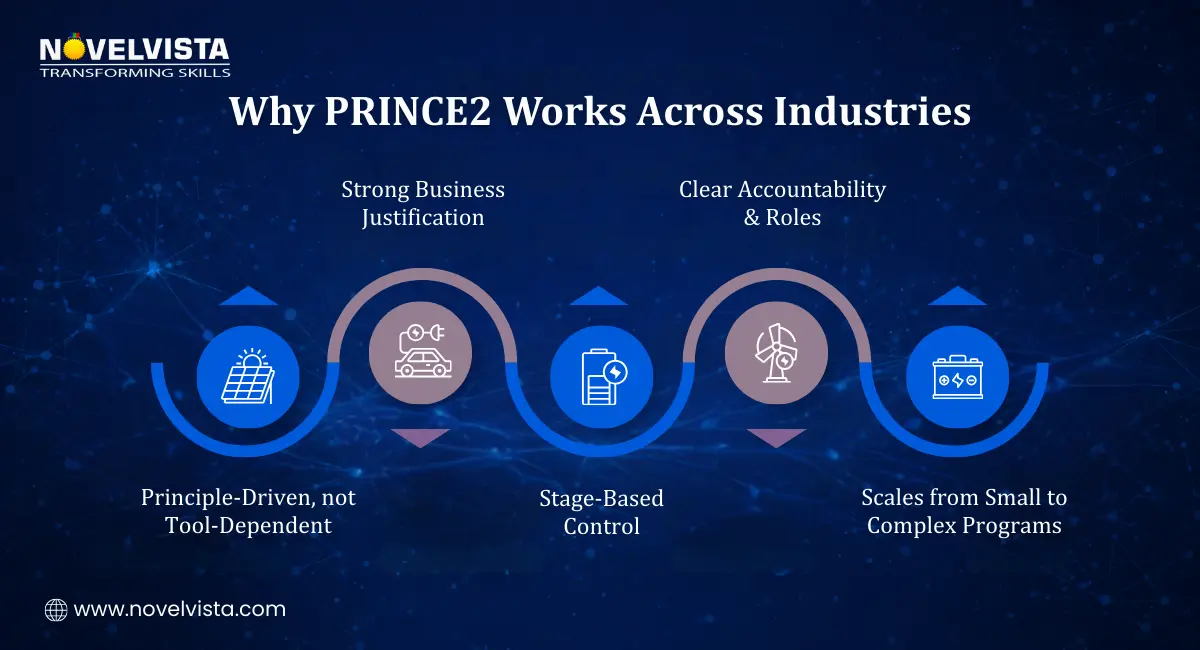
PRINCE2 survives across sectors because it isn’t tied to tools, technologies, or delivery styles. It’s driven by principles.
Here’s why PRINCE2 works so well across industries:
This is why PRINCE2 in different industries looks consistent in structure but flexible in execution.
IT was one of the earliest adopters, and PRINCE2 still plays a strong role in modern tech programs.
In enterprise IT programs, PRINCE2 is often applied as a governance layer while delivery teams operate using Agile or DevOps practices, balancing speed with accountability.
Construction projects rarely get second chances. Delays, scope changes, or weak documentation can lead to massive cost overruns. This is where PRINCE2 fits naturally.
Governments and regulators often prefer PRINCE2 because it provides traceability. This makes PRINCE2 in different industries especially strong in infrastructure-heavy sectors.
Financial institutions operate under constant regulatory and audit pressure. Informal project methods simply don’t survive here.
Financial institutions frequently apply PRINCE2 to ensure traceable decision-making, especially for regulatory change and risk-sensitive transformation programs.
Compare PRINCE2, PMP, and Agile side by side with clarity.
Healthcare projects deal with complex stakeholders, strict regulations, and real-world safety impacts. This environment demands controlled change.
Healthcare organizations use PRINCE2 in different industries not because it’s heavy, but because it reduces uncertainty in high-risk environments.
The public sector is one of the strongest adoption areas for PRINCE2, and that hasn’t changed.
PRINCE2’s continued adoption in public sector environments is reinforced by its compatibility with audit frameworks, transparency requirements, and cross-department governance models, which explains why PRINCE2 in different industries remains especially strong here.
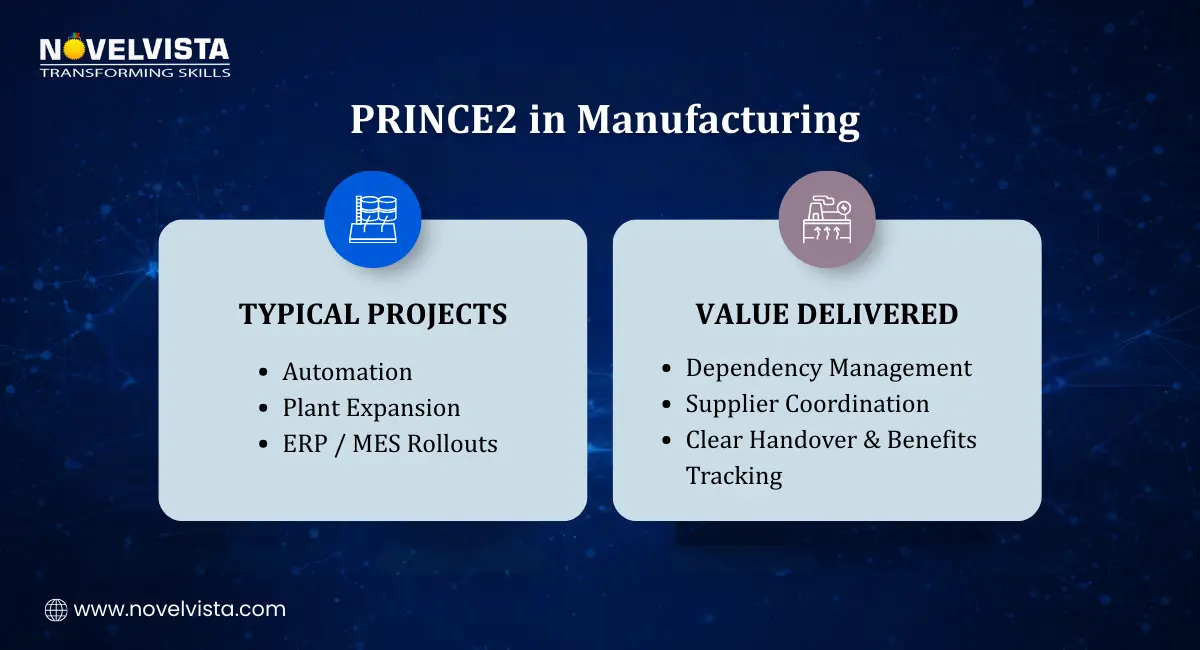
Manufacturing projects deal with tight dependencies, suppliers, and production risks. A missed decision can impact operations directly.
Manufacturers use PRINCE2 in different industries because it supports control without slowing execution.
Compare PRINCE2, PMP, and Agile side by side with clarity. Understand focus, effort, career fit, and real-world usage, so you choose what aligns with your role, industry, and goals.
Telecom projects are large, capital-heavy, and stakeholder-intensive. PRINCE2 fits naturally into this environment.
PRINCE2 is most effective when positioned above delivery frameworks, ensuring strategic alignment and decision control without constraining how teams execute work.
Many teams ask why they shouldn’t just use Agile or industry-specific approaches.
The answer is simple: PRINCE2 isn’t a delivery method, it’s a governance layer.
This is why PRINCE2 in different industries often sits above Agile, DevOps, or technical frameworks rather than replacing them.
PRINCE2 is evolving with how organizations deliver value.
Key trends include:
PRINCE2’s strength lies in decision-making and governance, needs that are growing, not shrinking.
|
Region |
Industries with Strong Adoption |
Why PRINCE2 Remains Strong |
|
UK & Europe |
Public sector, infrastructure, finance |
Government endorsement, strong governance culture |
|
Middle East |
Construction, government programs |
Large-scale projects, high compliance needs |
|
Australia & New Zealand |
Public sector, utilities |
Standardized project governance across agencies |
|
Asia (Growing) |
Manufacturing, digital transformation |
Shift toward enterprise-level project control |
PRINCE2 remains regionally strong where governance, auditability, and decision control matter more than speed alone.

PRINCE2 continues to thrive because it solves a timeless problem, how to make the right decisions at the right time. Across sectors, PRINCE2 in different industries proves that structure and flexibility can coexist.
PRINCE2’s continued relevance comes from consistent governance outcomes across industries, not from rigid process enforcement or tool dependency.
It’s especially valuable for professionals working in regulated, large-scale, or governance-heavy environments where clarity, accountability, and business alignment matter.
If you want to apply PRINCE2 confidently across industries, NovelVista’s PRINCE2 Foundation and PRINCE2 Practitioner Certification Training Courses are the right next step. The programs focus on real-world decision-making, governance scenarios, and practical application, helping you manage projects with clarity, control, and confidence in today’s complex environments.
Author Details

Course Related To This blog
PRINCE2 Agile® Foundation
PRINCE2 Agile® Foundation & Practitioner
PRINCE2® Foundation & Practitioner
PRINCE2® Foundation
PRINCE2® Practitioner
Confused About Certification?
Get Free Consultation Call
Stay ahead of the curve by tapping into the latest emerging trends and transforming your subscription into a powerful resource. Maximize every feature, unlock exclusive benefits, and ensure you're always one step ahead in your journey to success.