Category | Project Management
Last Updated On 27/08/2026
What if two professionals walk into the same organization with two very different goals?
One is asked to deliver a complex project on time, manage stakeholders, control risks, and keep the team aligned.
The other is asked to find why a process keeps failing, reduce variation, eliminate waste, and make the process more predictable.
Both can create measurable business value. But they are solving different problems.
That is the simplest way to understand PMP vs Six Sigma.
The Project Management Professional (PMP) certification is designed around project leadership, while Six Sigma focuses on process improvement, quality, variation reduction, and data-driven problem-solving. The distinction becomes especially important when professionals are deciding which certification can support their next career move.
So, which is better?
PMP or Six Sigma?
Is one more valuable than the other? Which offers better career opportunities? How different are the certification requirements and costs? And should you choose Lean Six Sigma vs PMP based on your current role or your long-term career goals?
This guide answers these questions by comparing the two paths across methodology, eligibility, certification structure, costs, career opportunities, salaries, and practical business applications.
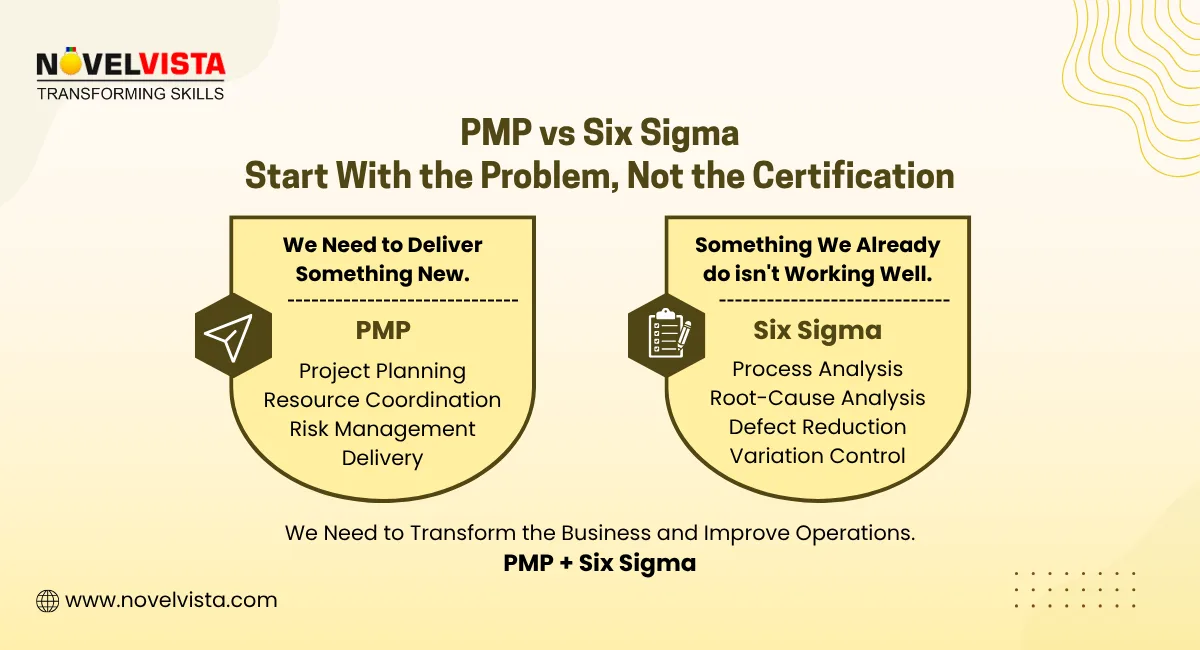
The easiest way to understand PMP vs Six Sigma is to look at the problem each approach is designed to solve.
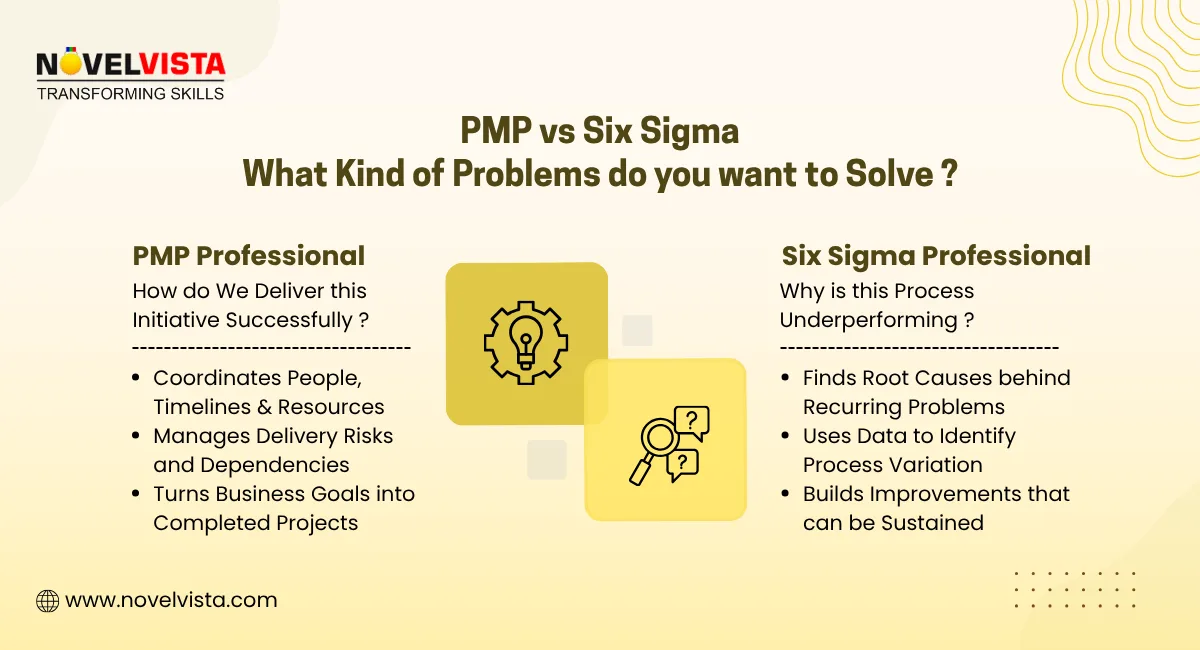
PMP focuses primarily on project delivery.
A project is a temporary initiative with a defined objective, beginning, and end. Project professionals coordinate people, resources, schedules, risks, budgets, stakeholders, and deliverables to achieve that objective.
Six Sigma focuses primarily on process performance.
Instead of asking, "How do we deliver this project successfully?", a Six Sigma practitioner is more likely to ask, "Why is this process producing defects, delays, variation, or unnecessary costs?"
This creates a useful distinction:
| Area | PMP | Six Sigma |
|---|---|---|
| Primary objective | Successful project delivery | Process improvement |
| Focus | Scope, schedule, cost, risk, stakeholders | Quality, variation, defects, waste |
| Typical environment | Temporary projects | Ongoing business processes |
| Core approach | Project management | Data-driven process improvement |
| Common methodology | Predictive, Agile, Hybrid | DMAIC, DMADV |
| Typical tools | WBS, risk register, schedule, EVM | Control charts, FMEA, process maps, DOE |
| Typical outcome | Project delivered successfully | Process becomes more efficient and predictable |
In other words, PMP vs Six Sigma is not necessarily an either-or comparison. The two approaches can complement each other.
A project manager might use Six Sigma techniques to improve a project-related process, while a process improvement professional may need project management practices to coordinate a major transformation initiative.
The methodologies reveal an even clearer distinction between the two.
PMP prepares professionals to manage projects through different delivery approaches. Depending on the project and organization, this can include predictive, Agile, or hybrid approaches.
A project manager may be responsible for:
The focus is on coordinating multiple moving parts to achieve a defined business outcome.
Six Sigma uses structured approaches to improve process performance.
The most widely recognized methodology is DMAIC:
For designing new processes, organizations may use DMADV or Design for Six Sigma approaches.
The Six Sigma philosophy is strongly associated with reducing variation and defects. At the six-sigma level, the commonly cited benchmark is approximately 3.4 defects per million opportunities (DPMO).
This difference explains why six sigma vs pmp is ultimately a comparison between two different professional disciplines.
The daily work of a PMP professional and a Lean Six Sigma practitioner can look very different.
PMP tools | Six Sigma tools |
|---|---|
| Work Breakdown Structure (WBS) | Process mapping |
| Gantt charts | Value Stream Mapping |
| Risk registers | Control charts |
| RAID logs | Pareto analysis |
| Earned Value Management | Fishbone diagrams |
| Stakeholder analysis | FMEA |
| Change control | Regression analysis |
| Project schedules | Design of Experiments |
| Communication plans | Statistical process analysis |
Lean Six Sigma combines Lean thinking, which emphasizes waste reduction and flow, with Six Sigma, which emphasizes variation and quality improvement.
For example, if a manufacturing process consistently produces defective components, Six Sigma tools can help identify the source of variation.
If an organization is implementing a new manufacturing facility, however, project management becomes essential for coordinating the initiative from planning through delivery.
That is where the two disciplines can overlap.
Another major difference in six sigma certification vs pmp is the structure of the credentials.
PMP is a specific professional certification administered by the Project Management Institute (PMI).
Six Sigma is different. There are multiple certification providers and different belt levels, so requirements, examination formats, project requirements, and pricing can vary considerably.
A typical Six Sigma progression looks like:
However, professionals should always examine the requirements of the specific certification body rather than assuming every Six Sigma belt has identical standards.
For example, ASQ's Certified Six Sigma Green Belt currently requires three years of full-time paid work experience in areas covered by its Body of Knowledge. Its computer-based examination has 110 questions, with 100 scored questions and 10 unscored questions.
This is important because Lean Six Sigma vs PMP comparisons can become misleading when "Six Sigma certification" is treated as one standardized credential.
PMP has clearly defined eligibility requirements established by PMI.
Under PMI's 2026 PMP examination requirements, candidates with a bachelor's degree or equivalent generally need 36 months of non-overlapping experience leading projects within the past 10 years, while candidates with secondary education generally need 60 months of project leadership experience. PMI also requires project management education as part of the eligibility pathway.
Six Sigma requirements depend on the belt and certification organization.
Some introductory programs are accessible to beginners, while advanced credentials may require professional experience and demonstrated improvement-project work.
For example, ASQ's Yellow Belt is positioned for people new to Six Sigma, while its Green Belt requires three years of relevant work experience.
Therefore, if you are comparing PMP vs Six Sigma based on entry barriers, you should compare a specific Six Sigma belt and certifying organization rather than Six Sigma as a whole.
Certification cost is another important consideration, but there is no single universal "Six Sigma cost."
PMP pricing depends on PMI membership and other factors, while Six Sigma pricing depends heavily on the certification provider, belt level, training package, examination, and whether a project component is included.
For example, ASQ currently lists its certification examination fees at $434 for Yellow Belt, $483 for Green Belt, and $585 for Black Belt, before considering training or other preparation costs.
| Cost consideration | PMP | Six Sigma |
| Certification body | PMI | Multiple providers |
| Pricing structure | Relatively standardized by PMI | Varies by provider and belt |
| Training cost | Depends on provider | Depends on provider and belt |
| Exam cost | PMI-set pricing | Provider-specific |
| Project requirement | Not generally a certification project requirement | May apply to certain programs |
| Renewal | 3-year renewal cycle | Depends on provider |
This means candidates should avoid comparing only the headline examination fee. The total certification investment may include training, study materials, examination fees, project requirements, membership, and renewal costs.
PMP certification requires ongoing professional development.
PMI requires PMP holders to earn 60 Professional Development Units (PDUs) during each three-year renewal cycle, with specific requirements around education and giving back to the profession.
Six Sigma maintenance varies by certification organization. Some credentials have different renewal policies, while others may not require periodic renewal.
This makes it important to check the specific certification provider's current policy before making a decision.
Career direction is arguably the most important part of the PMP vs Six Sigma decision.
PMP is particularly relevant when your career involves managing projects, programs, teams, stakeholders, budgets, and delivery timelines.
Common career paths include:
Six Sigma is particularly relevant when your work involves quality, operations, process optimization, continuous improvement, or operational excellence.
Typical roles include:
The right certification therefore depends less on which credential sounds more impressive and more on what kind of problems you want to solve professionally.
Both certifications can cross industry boundaries, but their strongest applications can differ.
There is also significant overlap.
A technology company implementing a large enterprise transformation may need project managers to coordinate delivery and process improvement specialists to optimize the processes affected by that transformation.
Salary should be considered carefully because certification alone does not determine compensation.
Experience, geography, industry, job title, company size, leadership responsibility, and technical expertise can all influence salary.
Still, certification can correlate with stronger earning potential.
PMI's recent reporting says respondents with PMP certification reported median salaries 17% higher on average than non-certified respondents across 21 countries surveyed.
Six Sigma also has evidence of salary differences across certification levels. ASQ's cited Quality Progress salary survey found U.S. respondents with Six Sigma training earned an average of $16,411 more than respondents without Six Sigma training, although these figures should not be interpreted as a guaranteed salary increase from certification alone.
The practical lesson is simple: certification can strengthen your professional profile, but career outcomes depend on how you apply the capability. Salary can be an important factor when deciding whether PMP is the right investment for your career. If you want to go beyond the certification comparison and explore current earning potential, roles, and salary trends, our detailed guide to PMP Salary 2026 provides a closer look at what project professionals can expect at different career stages.
There is no universal winner in the PMP vs Six Sigma debate.
Choose PMP if you want to:
Choose Six Sigma if you want to:
And there is a third option: earn both over time.
For professionals involved in transformation, operations, technology delivery, or enterprise improvement, the combination can be powerful. PMP provides a structured approach to managing the initiative, while Six Sigma provides tools for improving the processes involved. Once you have decided that PMP aligns with your career goals, the next step is understanding what the certification exam demands. Before committing to your preparation strategy, you can test your current knowledge with 200+ Free PMP Mock Test Questions covering key areas of the PMP examination.

| If your primary goal is... | Better starting point |
|---|---|
| Managing projects | PMP |
| Managing project stakeholders | PMP |
| Leading project teams | PMP |
| Improving process quality | Six Sigma |
| Reducing defects | Six Sigma |
| Reducing process variation | Six Sigma |
| Continuous improvement | Six Sigma |
| Moving into project management | PMP |
| Moving into quality management | Six Sigma |
The PMP vs Six Sigma decision becomes much easier when you stop asking, “Which certification is better?” and start asking, “What business problems do I want to become better at solving?”
PMP is centered on project leadership and successful delivery, while Six Sigma focuses on process improvement, quality, and variation reduction. If your ambition is to lead projects, manage stakeholders, and deliver complex initiatives, PMP may be the stronger fit. If you want to optimize processes, eliminate defects, and drive operational excellence, Six Sigma may align better with your career.
For professionals working at the intersection of transformation and continuous improvement, combining both approaches can provide a broader professional toolkit.
Ultimately, the best choice in PMP vs Six Sigma depends on your current experience, target role, industry, and long-term career goals. If project leadership is the direction you want to pursue, NovelVista’s PMP Training can help you build the knowledge and preparation needed to take the next step toward becoming a confident project professional.
Neither is universally better. PMP is better suited to project leadership, while Six Sigma is designed for process improvement, quality, and operational excellence.
The difficulty depends on the belt level and certification provider. PMP has defined eligibility and examination requirements, while Six Sigma requirements vary by belt and organization.
Yes. PMP and Six Sigma complement each other well, particularly for professionals working in transformation, operations, technology, and continuous improvement.
PMP is generally the more directly relevant credential for project management because its focus is project leadership, delivery, stakeholders, risk, and project performance.
Choose based on your career goal. Select PMP for project leadership and Six Sigma for process improvement, quality, and operational excellence.
Author Details

Confused About Certification?
Get Free Consultation Call
Stay ahead of the curve by tapping into the latest emerging trends and transforming your subscription into a powerful resource. Maximize every feature, unlock exclusive benefits, and ensure you're always one step ahead in your journey to success.