Category | Project Management
Last Updated On 27/08/2026

What if adding one professional credential to your profile could make a measurable difference to your earning potential?
For project professionals, that question is becoming increasingly relevant. The PMP salary advantage is not simply a marketing claim. According to the Project Management Institute’s (PMI) salary survey, professionals with PMP certification reported a 17% higher median salary than non-certified professionals across 21 countries. In the United States, PMP-certified professionals reported a median salary of $135,000, which was 24% higher than their non-certified peers.
But salary is only one part of the story.
Does PMP certification automatically guarantee a higher salary? No.
Does experience still matter? Absolutely.
Does your industry, location, project complexity, leadership responsibility, and ability to deliver business outcomes influence your compensation? Very significantly.
So, what can professionals realistically expect from a PMP salary in 2026?
Let's examine the numbers, career factors, geographic differences, and role progression that shape PMP earning potential.
Project management is no longer limited to tracking schedules, budgets, and task lists. Modern project professionals are increasingly expected to manage transformation, technology adoption, AI initiatives, organizational change, risk, stakeholders, and business outcomes.
PMI's latest research surveyed 14,628 project professionals across 21 countries, providing one of the strongest current benchmarks for project management compensation. PMI also projects that the global economy may need 30 million additional project professionals by 2035.
This creates an important career equation:
Growing project demand + specialized skills + leadership capability = stronger earning potential.
PMP certification supports this equation by validating project leadership expertise across predictive, agile, and hybrid approaches rather than tying professionals to one methodology. If you are planning to pursue the certification, having a structured preparation strategy can make the process more manageable. A comprehensive PMP Study Guide can help you understand the exam requirements, organize your preparation, and build a focused study plan.
PMP certification demonstrates that a professional understands how to lead projects, manage people and processes, and connect project execution with organizational objectives.
It can strengthen a professional's credibility in areas such as:
Therefore, the PMP salary premium should be viewed as an outcome associated with certification, experience, and professional capability—not as a guaranteed salary increase simply for passing an exam.
The latest PMI salary survey confirms that PMP-certified professionals generally report stronger median compensation than non-certified professionals.
| Salary Indicator | Current PMI Finding |
| Countries surveyed | 21 |
| Professionals surveyed | 14,628 |
| PMP salary advantage | 17% higher median salary |
| U.S. PMP median salary | $135,000 |
| U.S. salary advantage | 24% |
| PMP holders worldwide | 1.7M+ |
| Additional project professionals needed by 2035 | 30M+ |
Source: PMI's 14th edition Project Management Salary Survey and current PMP certification information.
These numbers establish an important point: the PMP salary advantage exists across a broad international sample, although the size of that advantage differs by country.
That difference matters because project management compensation is influenced heavily by local economies, industries, experience levels, project sizes, and job responsibilities.
There is no single global PMP salary.
A project manager working on a large technology transformation in the United States may have a very different compensation package from a project manager performing a similar role in India, Singapore, Germany, or the UAE.
PMI's research covers countries including the United States, Canada, India, Germany, the United Kingdom, Singapore, Australia, Japan, Saudi Arabia, the UAE, South Africa, Colombia, and others. The latest survey confirms that both salary levels and the certification premium vary significantly between markets.
The following figures provide a practical market-oriented snapshot based on commonly reported salary ranges and the supplied regional benchmarks. Actual compensation can vary by employer, city, industry, experience, and total compensation structure.
| Region | Indicative PMP Salary Range | Key Salary Driver |
| United States | Around $135,000 median | Seniority, industry, project scale |
| Canada | CAD 85,000–140,000 | Experience and sector |
| United Kingdom | £74,000–92,000 for experienced PMP roles | London and seniority premiums |
| Germany | Around €80,000 in reported benchmarks | Industry and experience |
| UAE | AED 302,000–330,000 in reported benchmarks | Infrastructure, technology and transformation |
| Singapore | Around $79,000+ USD equivalent | Technology and enterprise projects |
| India | ₹12 lakh–₹42 lakh in reported market ranges | Experience, location and organization |
| Australia | Around AU$136,000 median in reported benchmarks | Industry and leadership responsibility |
| Japan | Around $78,000 USD in reported benchmarks | Experience and employer |
The most reliable comparison is not simply currency conversion. Salary purchasing power, taxation, benefits, bonuses, and local living costs can substantially change the real value of compensation.
For this reason, professionals should use PMP salary data as a benchmarking tool rather than a guaranteed compensation figure.
India has become an important market for project management professionals because organizations across IT services, consulting, financial services, healthcare, manufacturing, infrastructure, and digital transformation continue to run large-scale projects.
Reported market ranges place PMP-certified professionals broadly between ₹12 lakh and ₹42 lakh per year, with experienced professionals and senior project leadership roles potentially moving considerably higher.
However, the difference between an entry-level project manager and an experienced program leader can be substantial.
For example, professionals who combine PMP certification with skills in:
can position themselves for more complex responsibilities.
Therefore, the PMP salary in India should be evaluated alongside years of experience, employer type, project complexity, and technical or business specialization.
Certification can strengthen your profile, but experience determines how effectively you can apply that knowledge.
PMI's salary research has consistently shown that compensation increases with experience and responsibility. Earlier PMI salary research also found that PMP holders with longer certification tenure generally reported higher median salaries.
Consider the typical progression:
| Career Stage | Typical Responsibility | Earning Potential |
| Project Coordinator | Supports project execution | Entry level |
| Project Manager | Owns project delivery | Mid-level |
| Senior Project Manager | Leads complex projects | Higher |
| Program Manager | Coordinates multiple projects | High |
| Portfolio Manager | Aligns investments with strategy | Very high |
| PMO / Transformation Leader | Drives enterprise execution | Executive |
The important lesson is that PMP salary tends to increase as the professional moves from project execution toward strategic leadership.
A PMP-certified project manager who manages a $500,000 project and a PMP-certified program leader responsible for a multi-million-dollar transformation may hold the same certification but their compensation expectations are naturally different.
As PMP professionals gain experience, the next question is often where these skills can lead in the job market. From project management and program leadership to PMO and transformation roles, understanding the PMP Jobs in 2026 can help professionals identify the career paths and opportunities that align with their experience.
Career progression is another major factor behind compensation growth.
Project managers typically focus on delivering individual initiatives. Program managers coordinate interconnected projects and ensure that benefits are achieved across a broader business objective. Portfolio leaders operate at an even higher strategic level.
This creates a potential career pathway:
Project Manager → Senior Project Manager → Program Manager → Portfolio Manager → Transformation Leader
As responsibility increases, employers are often paying for decision-making capability, leadership, business alignment, risk ownership, and the ability to manage organizational complexity—not merely project administration.
That is why professionals evaluating PMP salary should consider the role they want three to five years after certification, rather than focusing only on their immediate salary.
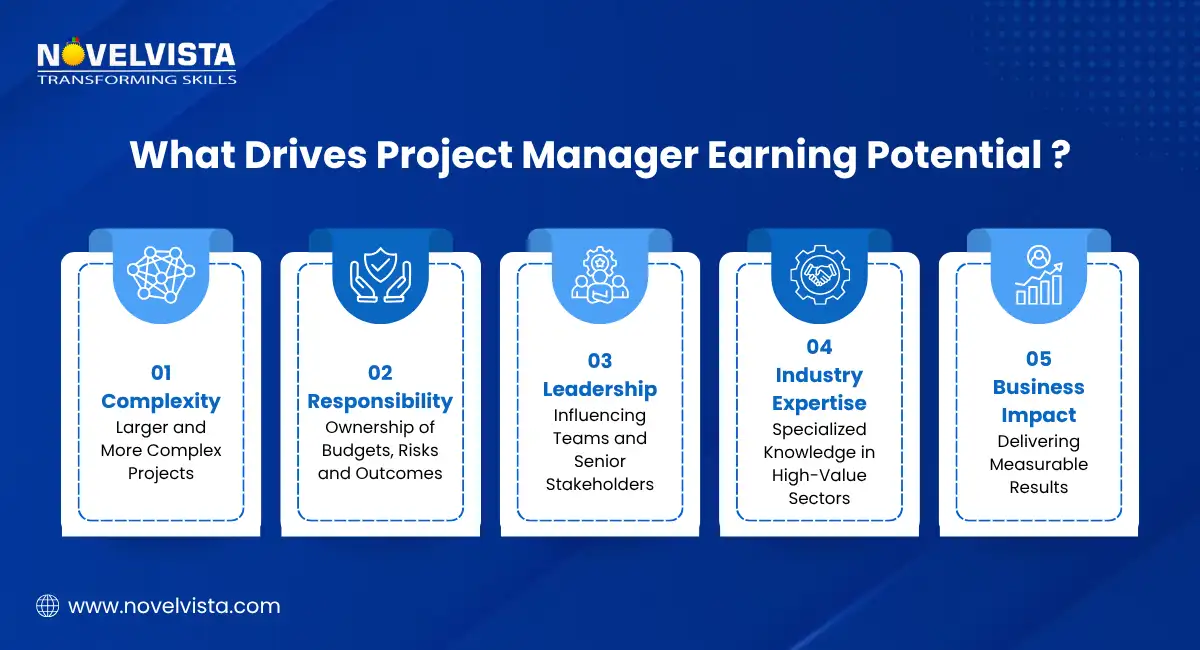
Industry specialization can have a significant impact on compensation.
Complex and highly regulated industries often require project professionals to manage substantial budgets, compliance requirements, operational risks, and large stakeholder groups.
Common high-value sectors include:
Technology organizations need project leaders who can coordinate cloud migration, software development, cybersecurity, AI adoption, data platforms, and enterprise transformation.
Projects often involve strict regulatory requirements, clinical operations, technology modernization, and complex stakeholder environments.
Large infrastructure projects can involve significant capital expenditure, regulatory oversight, engineering complexity, and long project lifecycles.
These environments often require rigorous project governance, risk management, quality control, and compliance.
Consulting organizations value professionals who can manage multiple stakeholders, deliver transformation programs, and communicate effectively with senior executives.
This is why the best way to increase your PMP salary is not simply to collect credentials. It is to combine certification with an industry where project leadership creates measurable business value.
No. This distinction is essential for anyone considering PMP certification.
PMI's research establishes an association between PMP certification and higher reported median salaries. However, correlation does not mean that certification alone causes every individual to receive a salary increase.
Your compensation can depend on:
The certification can strengthen your professional credibility, but you still need to demonstrate results.
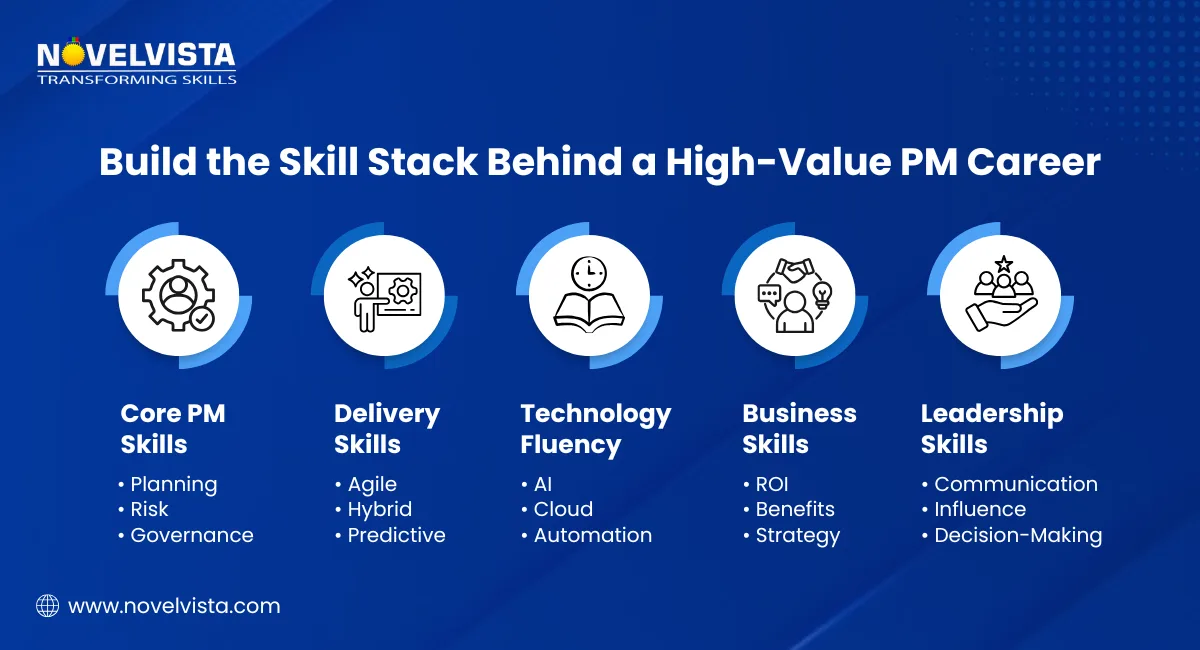
If your goal is career advancement rather than simply passing the PMP examination, consider a broader capability-building strategy.
Certification becomes more valuable when supported by measurable delivery experience.
Track outcomes such as cost savings, schedule improvements, risk reduction, productivity improvements, and successful stakeholder outcomes.
Modern organizations rarely operate using one delivery approach exclusively. Understanding predictive, agile, and hybrid methods can make you more adaptable.
Project managers increasingly work alongside cloud, data, AI, automation, cybersecurity, and software engineering teams.
You do not necessarily need to become a developer, but understanding technology can significantly improve your effectiveness.
Senior project professionals need to understand budgets, benefits, ROI, organizational strategy, and business priorities.
One of the strongest ways to increase earning potential is to progress from managing tasks to managing outcomes.
Instead of asking, "Did we finish the project?"
Senior leaders ask:
"Did the project create the intended business value?"
That shift can fundamentally change your career trajectory.
For experienced project professionals, PMP certification can be a valuable career investment when it is aligned with a clear career objective.
The latest PMI data provides strong evidence of its market value: PMP-certified respondents reported a 17% higher median salary across 21 countries, while U.S. PMP-certified professionals reported a $135,000 median salary and a 24% premium over non-certified peers.
At the same time, certification should not be treated as a shortcut.
The strongest professionals combine credentials with experience, leadership, domain knowledge, technology awareness, and measurable project outcomes.
That combination is what can turn a certification into long-term career leverage.

The global project economy is expanding, and organizations increasingly need professionals who can translate strategy into successful execution.
The latest PMI salary research shows that PMP salary levels are generally stronger than those reported by non-certified peers, with a 17% median salary advantage across 21 countries and a $135,000 U.S. median salary for PMP-certified professionals.
But the real value of PMP certification extends beyond the first salary increase. It can support progression into senior project management, program management, portfolio leadership, PMO, transformation, and strategic delivery roles.
If you want to maximize your PMP salary, focus on the complete equation:
PMP Certification + Experience + Leadership + Business Acumen + Industry Expertise = Long-Term Career Growth
Building these capabilities through structured training can help you prepare for certification while developing practical skills for long-term project leadership. NovelVista’s PMP Training can support this journey with focused certification preparation and project management learning.
The certification can open the door. Your ability to deliver meaningful business outcomes determines how far you go.
PMI's latest survey reports a median salary of $135,000 for PMP-certified professionals in the United States. Globally, salaries vary significantly by country, experience, industry, and role.
Yes, PMI reports that PMP-certified respondents earned a 17% higher median salary than non-certified professionals across 21 surveyed countries. However, individual salary growth depends on experience and career progression.
Reported Indian market ranges for PMP-certified professionals are approximately ₹12 lakh to ₹42 lakh annually, depending on experience, location, industry, employer, and role.
Yes. Experience, project complexity, leadership responsibility, and career level have a major influence on PMP certification salary. Senior program and portfolio roles generally command higher compensation than project manager positions.
PMP certification can be valuable for professionals seeking project, program, PMO, and transformation leadership roles. PMI's latest research also shows a measurable salary advantage associated with PMP certification.
Author Details

Course Related To This blog
PMP Training Certification
Confused About Certification?
Get Free Consultation Call
Stay ahead of the curve by tapping into the latest emerging trends and transforming your subscription into a powerful resource. Maximize every feature, unlock exclusive benefits, and ensure you're always one step ahead in your journey to success.