Category | AI And ML
Last Updated On 22/07/2026
Choosing between two frontier AI platforms is no longer a simple benchmark contest. This guide compares Kimi vs Claude across response speed, reasoning accuracy, coding, agentic workflows, long-context work, multimodal tasks, pricing, deployment control, safety, and enterprise readiness. It also explains where ChatGPT fits, so individuals and organizations can choose according to workload, risk, and total cost rather than hype.
Claude is Anthropic’s product family, while Kimi is developed by Moonshot AI. As of July 20, 2026, Kimi K3 is available through its API with a one-million-token context window and native visual understanding. Anthropic’s current line includes Claude Sonnet 5 and Claude Opus 4.8 for coding, agents, and professional knowledge work.
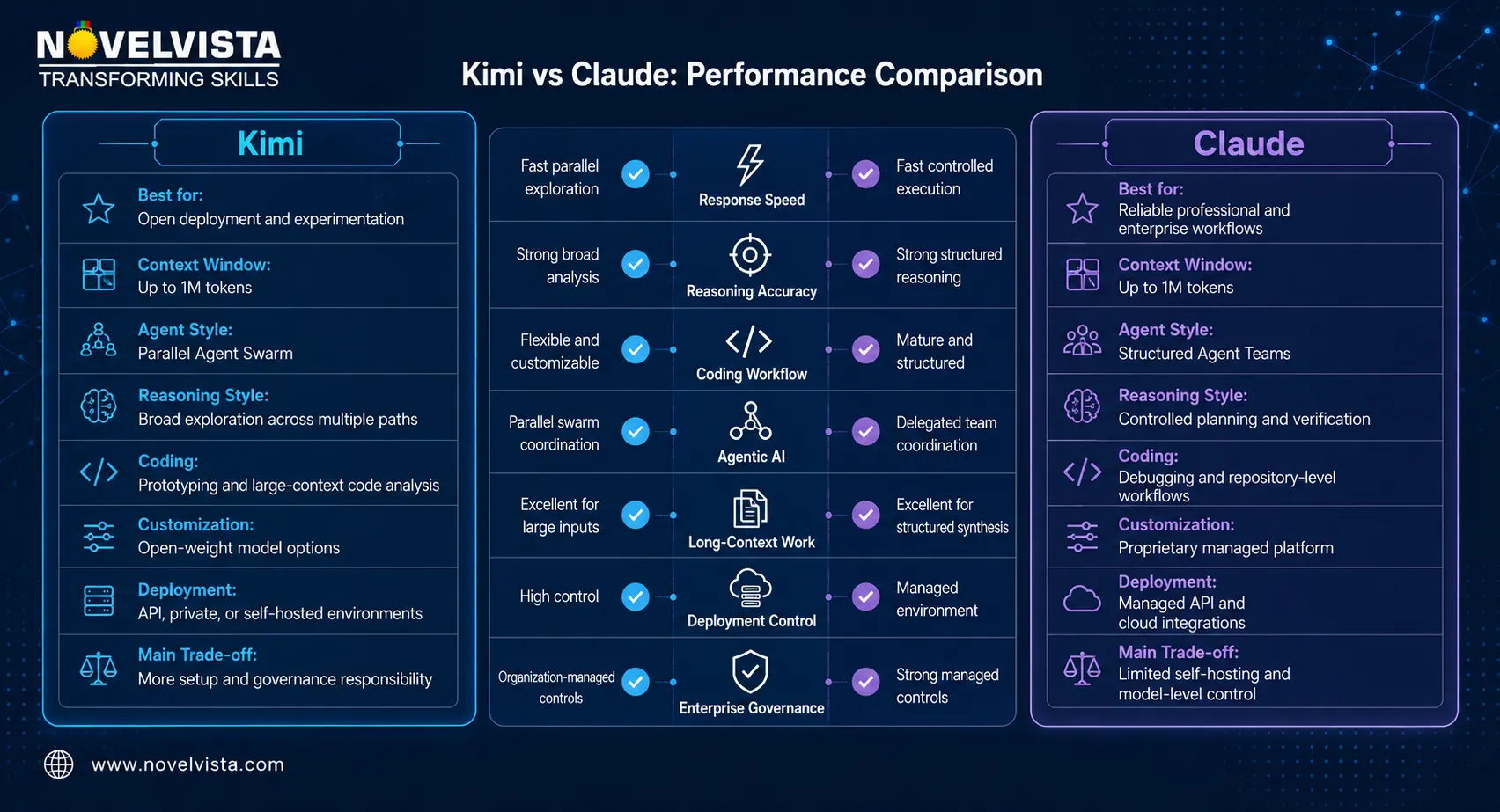
The practical difference is strategic. Kimi emphasizes model openness, very large context, flexible deployment, and parallel agent experimentation. Claude emphasizes managed reliability, instruction-following, safety, professional writing, and mature coding workflows.
| Comparison area | Kimi | Claude | Practical edge |
|---|---|---|---|
| Fast interactive work | Strong, but K3 always reasons | Sonnet is optimized for cost and speed | Claude Sonnet 5 |
| Complex reasoning | Strong frontier positioning | Consistent planning and self-checking | Claude for controlled work |
| Long context | K3 supports one million tokens | Sonnet 5 supports one million tokens | Tie on advertised capacity |
| Coding | K3, K2.7 Code, Kimi Code | Sonnet 5, Opus 4.8, Claude Code | Claude for managed workflows |
| Multi-agent work | Swarm and Claw Groups | Dynamic workflows and parallel subagents | Depends on coordination needs |
| Self-hosting | K2.6 is open source, K3 weights are scheduled | Proprietary managed models | Kimi |
| Enterprise governance | More customer responsibility | Stronger managed controls | Claude |
| API economics | K3 has competitive flat pricing | Sonnet 5 offers a strong price-performance tier | Workload-dependent |
The capabilities and availability shown above reflect official Moonshot AI and Anthropic documentation available on July 20, 2026.
There is no permanent winner. A Kimi AI comparison should separate the chatbot, API, open models, agents, and coding tools. A Claude AI comparison should distinguish Sonnet, Opus, Claude Code, and the consumer application. The Kimi vs Claude AI debate only becomes useful when model tier and task type are matched.
Kimi is a work platform, not only a chat interface. It includes agents for websites, documents, slides, spreadsheets, and research, plus Kimi Code and model APIs. Kimi K2.6 is open source and supports coding, long-horizon execution, and Agent Swarm. Kimi K3 is the newest flagship, built with 2.8 trillion parameters.
The most important Kimi AI features are large-context processing, visual input, adjustable reasoning effort, structured output, tool calling, automatic caching, and parallel agents.
Claude Sonnet 5 is the balanced option for coding, agents, and professional work, while Claude Opus 4.8 targets more demanding reasoning and autonomous workflows. Sonnet can plan and use tools, while Opus adds greater judgment, effort controls, and dynamic Claude Code workflows.
The most relevant Anthropic Claude features include instruction-following, tool use, long-context reasoning, multimodal analysis, professional writing, Claude Code, prompt caching, and enterprise cloud access. Anthropic also publishes system cards and alignment evaluations for risk teams.
A fair Kimi AI vs Claude review compares K3 with Claude Sonnet 5 or Opus 4.8, not an older Claude release. K2.6 still matters because its open weights create deployment choices Claude does not offer. Moonshot says K3’s full weights will be released by July 27, 2026, so self-hosting plans should wait for final technical and licensing details.
Speed means response latency, total completion time, and the correction effort afterward. A fast answer that misses constraints can be slower in practice than a deliberate first-pass result.
K3 always reasons and offers low, high, and max effort settings. Claude also offers effort controls, while Opus 4.8 has a premium fast mode that Anthropic says can reach 2.5 times normal output speed.
| Test scenario | Kimi advantage | Claude advantage | What to measure |
|---|---|---|---|
| Long report summary | Large-context ingestion and broad synthesis | Strong structure and concise executive output | Missed facts and correction time |
| Market research | Parallel exploration through Agent Swarm | Controlled search and verification | Source quality and duplicated work |
| App prototype | Rapid generation and visual coding | Strong repository discipline | Tests passed and defects introduced |
| Multi-step automation | Flexible tools and agent orchestration | Reliable plan execution | Completion rate and human interventions |
The first Kimi vs Claude performance test should therefore track successful task completion, not tokens per second alone. The second Kimi vs Claude performance test should repeat the same business prompt several times because consistency matters as much as the best single output.
Claude’s clearest advantage is controlled execution. Anthropic reports that Sonnet 5 checks its own work more often and completes multi-step tasks that earlier Sonnet models sometimes left unfinished. Opus 4.8 is designed to flag uncertainty, challenge weak plans, and catch flaws in its own code. These are vendor-reported findings, so companies should still validate them on internal tasks.
Kimi’s strength is breadth. K3 targets long-horizon coding and knowledge work, while K2.6 coordinates agents across research, documents, slides, and spreadsheets. Parallel systems can produce richer options, but they may repeat work or amplify a weak assumption without a strong validation step.
For an accurate Kimi AI comparison, test constraint retention, factual precision, citation quality, uncertainty handling, and the number of corrections required. For a useful Claude AI comparison, test the same factors at matched effort and price levels. Neither vendor benchmark can substitute for a controlled evaluation using your own policies, data, tools, and expected outputs.
K3 targets long-running engineering tasks and large codebases. Kimi Code can edit files, run shell commands, search repositories, fetch documentation, and create subagents. K2.6 appeals to teams that want to inspect, adapt, or self-host a model.
Claude provides a more managed coding path. Sonnet 5 handles sustained coding, debugging, and tool use at a lower price than Opus. Opus 4.8 suits complex migrations and tasks where judgment matters. Claude Code can plan jobs, run parallel subagents, and verify results.
| Coding task | Better starting point | Reason |
|---|---|---|
| Fast front-end prototype | Kimi | Strong visual and full-stack generation |
| Brownfield debugging | Claude | Focused diagnosis and controlled edits |
| Large codebase exploration | Either | Both support long-context engineering work |
| Private coding assistant | Kimi | Open-source and deployment flexibility |
| Managed enterprise coding | Claude | Mature Claude Code workflow and controls |
| Experimental multi-agent build | Kimi | Swarm-oriented parallel execution |
The practical Kimi AI vs Claude choice is control versus operational simplicity. Kimi allows more stack customization, while Claude offers a more integrated path from prompt to tested code.
Kimi Agent Swarm is designed for parallel exploration. K2.6 has showcased more than 50 specialized agents, while Claw Groups adds coordination and dependency management. This pattern suits broad research and problems where several approaches should be explored.
Claude’s dynamic workflows emphasize planning, controlled execution, and verification. Anthropic says Claude Code can run hundreds of parallel subagents for large migrations, then validate work against the test suite.
The distinction between AI Agents vs Agentic AI is useful here. A single agent may call tools and complete a defined task. An agentic system coordinates planning, memory, tools, permissions, evaluation, and multiple agents over a longer workflow.
Choose Kimi when broad exploration, open orchestration, and parallel creativity matter. Choose Claude when the task needs a disciplined plan, controlled tool use, and a strong verification loop. In both cases, restrict permissions and require human approval before financial, legal, security, or customer-facing actions.
Both K3 and Sonnet 5 advertise one-million-token context windows. K3 accepts images and video, while Claude supports document, diagram, and browser-based analysis.
A larger context window does not guarantee a better answer. Teams should remove irrelevant material, label sources, separate instructions from evidence, and require citations to the exact section used.
The second set of Kimi AI features becomes valuable here: slide creation, document generation, spreadsheet work, deep research, and visual coding. The second set of Anthropic Claude features is strongest when those assets must be turned into concise professional decisions, controlled software changes, or policy-aligned outputs.
Kimi K2.6 gives developers access to weights and code. K3 is also presented as open source, although its full weights are scheduled after this article’s publication date. This supports private hosting, tuning, and custom inference.
Claude is proprietary and managed. Teams gain less model-level control but avoid GPU provisioning, model serving, upgrades, and much of the low-level operational work.
A broader Generative AI Platforms Comparison helps buyers examine hosting, regional availability, integration support, security, and ecosystem maturity before selecting a model.
Self-hosting adds GPU expenses, observability, patching, scaling, access control, and specialist staffing. Compare full cost per successful task, not only API prices or free weights.
API pricing can make Kimi look cheaper or more expensive depending on which Claude model you compare it with. The difference becomes clearer when input tokens, cached context, output tokens, batch discounts, agent activity, and infrastructure expenses are evaluated together.
The following prices are listed in US dollars per one million tokens. They reflect official platform pricing available in July 2026 and may change over time.
| Model | Cached input | Standard input | Output | Context window | Pricing notes |
|---|---|---|---|---|---|
| Kimi K3 | $0.30 | $3.00 | $15.00 | 1 million tokens | Flat pricing across the full context window, with automatic context caching |
| Claude Sonnet 5, introductory price through August 31, 2026 | $0.20 | $2.00 | $10.00 | 1 million tokens | Temporary introductory pricing for API workloads |
| Claude Sonnet 5, from September 1, 2026 | $0.30 | $3.00 | $15.00 | 1 million tokens | Standard pricing matches Kimi K3 at the token level |
| Claude Opus 4.8 | $0.50 | $5.00 | $25.00 | 1 million tokens | Premium model intended for demanding reasoning, coding, and agentic tasks |
| Claude Opus 4.8 Fast Mode | Not listed as a separate cache-hit rate | $10.00 | $50.00 | Full supported context | Higher-cost option for faster output in latency-sensitive workflows |
Kimi K3 uses separate prices for cache hits, uncached inputs, and outputs. Its pricing remains flat across its one-million-token context window. Claude Sonnet 5 also includes its one-million-token context at standard per-token rates. Anthropic applies different prices for cache creation and cache reads, while cache hits generally cost 10 percent of the model’s base input rate.
Claude Sonnet 5 currently costs less than Kimi K3 under its introductory pricing. From September 1, 2026, both models will have the same standard input, cache-hit, and output rates. Claude Opus 4.8 remains more expensive because it targets tasks that require greater reasoning depth, judgment, and autonomous execution.
Prompt caching can reduce costs when the same long instructions, documents, code repositories, or knowledge bases are reused across several requests.
| Caching factor | Kimi K3 | Claude Sonnet 5 | Claude Opus 4.8 |
|---|---|---|---|
| Cache management | Automatic context caching | Automatic or explicit cache control | Automatic or explicit cache control |
| Cache-hit price | $0.30 per million tokens | $0.20 promotional, then $0.30 | $0.50 per million tokens |
| Five-minute cache write | Included through Kimi’s caching model | $2.50 promotional, then $3.75 | $6.25 per million tokens |
| One-hour cache write | Not presented as a separate public tier | $4 promotional, then $6 | $10 per million tokens |
| Best use case | Repeated long contexts without manual cache configuration | Repeated documents, prompts, and agent instructions | High-value workflows using large reusable contexts |
Kimi automatically attempts to cache an unchanged prompt prefix when the previous prompt contains more than 256 tokens. Claude allows automatic caching or explicitly placed cache breakpoints. Anthropic charges 1.25 times the normal input rate for a five-minute cache write, twice the input rate for a one-hour cache write, and 0.1 times the normal input rate for a cache read.
Consider a report-generation workflow using:
| Model | Uncached input cost | Cached input cost | Output cost | Estimated total |
|---|---|---|---|---|
| Kimi K3 | $0.30 | $0.015 | $0.30 | $0.615 |
| Claude Sonnet 5, introductory price | $0.20 | $0.01 | $0.20 | $0.41 |
| Claude Sonnet 5, standard price | $0.30 | $0.015 | $0.30 | $0.615 |
| Claude Opus 4.8 | $0.50 | $0.025 | $0.50 | $1.025 |
This example shows that Claude Sonnet 5 has a temporary price advantage. Once standard pricing begins, its basic token cost aligns with Kimi K3. Claude Opus 4.8 costs more, but it may still offer better value when its additional reasoning capability reduces failed attempts, corrections, or human review.
| Cost factor | Kimi | Claude | Business impact |
|---|---|---|---|
| Self-hosting infrastructure | Possible for released open models | Model weights are not available for self-hosting | Kimi may require GPUs, storage, networking, and inference software |
| Engineering and maintenance | Higher for customized deployments | Lower with a managed API | Internal staffing can exceed token expenses |
| Parallel agent usage | Swarms may generate many simultaneous calls | Subagents and long-running tasks can also increase consumption | Agent count and retry behavior must be monitored |
| Batch processing | Depends on the selected Kimi service and model | Claude Batch API provides a 50 percent token discount | Useful for non-urgent, high-volume workloads |
| Fast inference | Depends on provider and deployment configuration | Opus 4.8 Fast Mode uses premium token rates | Faster output can be valuable for customer-facing applications |
| Web search and tools | Tool-specific charges may apply | Web search costs $10 per 1,000 searches, plus token charges | Research agents may cost more than chat-only workloads |
| Data residency | Depends on deployment and region | US-only Claude inference applies a 1.1-times pricing multiplier | Compliance requirements can increase operating cost |
| Human review | Depends on output reliability | Depends on output reliability | More corrections can eliminate savings from cheaper tokens |
Anthropic offers a 50 percent Batch API discount on input and output tokens. It also applies additional charges for certain server-side tools, regional inference, and premium fast mode. Kimi’s open-model options can reduce dependence on per-token API billing, but private deployment introduces hardware, security, scaling, monitoring, and maintenance costs.
Kimi may provide better value when an organization needs:
Claude Sonnet may provide better value when a team needs:
Claude Opus may justify its premium when:
The most useful financial metric is cost per successfully completed task. Organizations should include token charges, agent calls, search tools, infrastructure, failed attempts, employee review time, security, and maintenance before deciding which platform offers better value.
Claude has the clearer managed-governance story. Anthropic publishes model and alignment assessments and provides enterprise access through its platform and cloud partners. That gives risk and procurement teams more documentation, although customers remain responsible for safe deployment.
Kimi offers another privacy route through controlled private deployment, but model hardening, monitoring, abuse prevention, patching, and compliance shift toward the deploying organization.
Before approving either platform, ask:
| Use case | Recommended starting point | Why |
|---|---|---|
| Professional writing | Claude | Strong structure, tone, and instruction-following |
| Broad market research | Kimi | Parallel exploration and long-context synthesis |
| Complex managed coding | Claude | Claude Code and strong verification workflows |
| Private customization | Kimi | Open-source options and deployment control |
| Regulated enterprise use | Claude | Stronger documented governance position |
| High-volume experimentation | Kimi | Flexible model and API choices |
| Large document analysis | Test both | Effective retrieval matters more than context size |
| Agentic product development | Test both | Coordination pattern should match the workflow |
A second direct assessment should run on five to ten representative tasks. Score factual accuracy, completion, latency, cost, security fit, and reviewer effort. The Kimi vs Claude AI choice should be based on this evidence, not a polished demo.
A three-way view adds ecosystem breadth. Kimi favors openness, long context, and swarm-style agents. Claude favors professional reasoning, coding, and controlled tool use. ChatGPT remains a broad general-purpose product with familiar multimodal workflows and integrations.
| Area | Kimi | Claude | ChatGPT |
|---|---|---|---|
| Open model strategy | Strong | Proprietary | Proprietary |
| Professional writing | Strong | Very strong | Very strong |
| Managed coding workflow | Growing | Very strong | Strong |
| Private deployment options | Stronger | Limited | Limited |
| Parallel agent experimentation | Strong | Strong | Strong |
| General user ecosystem | Growing | Established | Broad |
The first Kimi AI vs ChatGPT vs Claude decision should focus on the product experience your employees can adopt safely. The second Kimi AI vs ChatGPT vs Claude decision should focus on APIs, governance, integration, and total cost for production workloads.

Kimi vs Claude is ultimately a choice between two different AI strategies. Kimi pushes openness, scale, and agent experimentation. Claude emphasizes dependable execution, refined knowledge work, and managed governance. Many advanced organizations may use Kimi for broad exploration or private customization, then use Claude for structured refinement, verification, or production workflows.
Whichever platform you select, successful agentic AI requires more than prompt writing. Teams need skills in workflow design, tool integration, memory, evaluation, permissions, security, and human oversight. NovelVista’s Agentic AI Professional Certification helps professionals build that practical foundation and apply agentic systems responsibly across real business scenarios.
Author Details

Course Related To This blog
Generative AI Professional
Certified Generative AI Expert
Certified Generative AI Foundation
Generative AI in Risk & Compliance
Generative AI in Retail
Generative AI in Marketing
Generative AI in Finance and Banking
Generative AI for HR and L&D
Generative AI in Cybersecurity
Agentic AI Certification
Confused About Certification?
Get Free Consultation Call
Stay ahead of the curve by tapping into the latest emerging trends and transforming your subscription into a powerful resource. Maximize every feature, unlock exclusive benefits, and ensure you're always one step ahead in your journey to success.