Category | AI And ML
Last Updated On 25/07/2026
Artificial Intelligence is no longer just a productivity tool it is becoming a digital teammate. According to recent industry reports, more than 70% of enterprises are actively experimenting with generative AI, while nearly 45% have already integrated AI into at least one business function. Customer support, HR, sales, IT, marketing, and operations teams are increasingly relying on AI assistants to automate repetitive work, retrieve organisational knowledge, and improve decision-making.
But here's an important question.
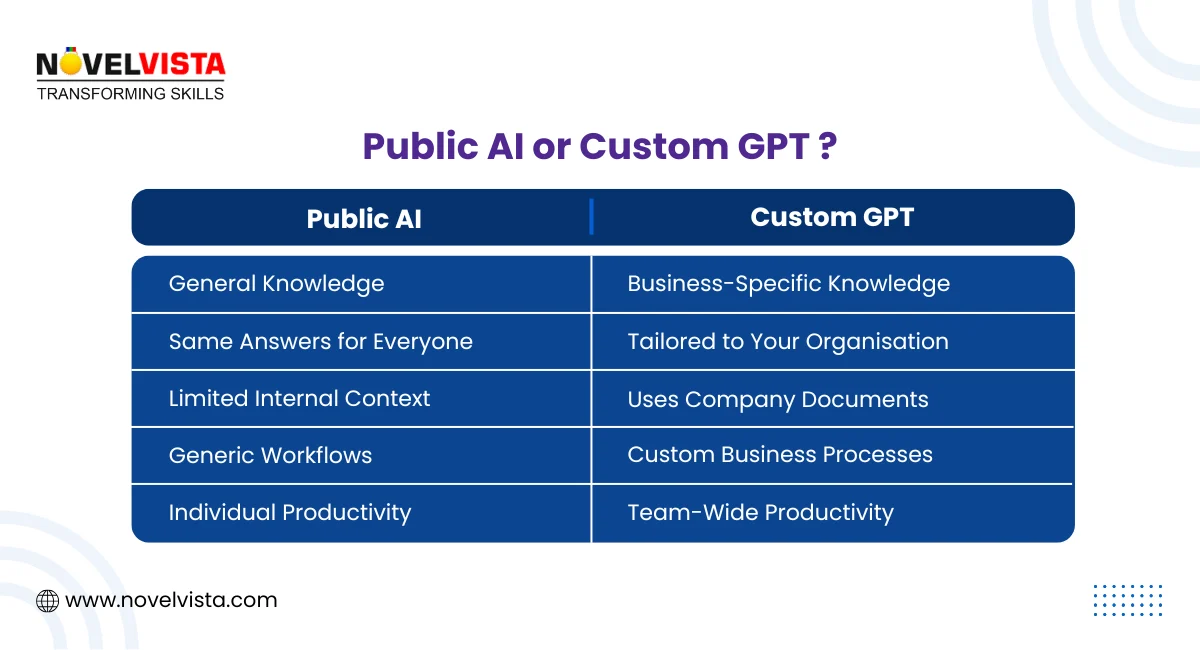
Why should every employee use the same public AI assistant when your organisation has unique processes, documentation, policies, and workflows?
This is exactly where a Custom GPT for Your Business Team becomes valuable.
Imagine an AI assistant that understands your internal SOPs, product documentation, compliance guidelines, onboarding material, and customer FAQs. Instead of generic answers, it provides responses aligned with your organisation's knowledge and business goals.
In this guide, you'll learn how to build a Custom GPT for Your Business Team step by step, the technologies involved, best practices, security considerations, and common mistakes to avoid.
A Custom GPT for Your Business Team is a tailored AI assistant built using a large language model and customised with your company's knowledge, instructions, workflows, and business rules.
Unlike public AI tools that rely on general internet knowledge, a custom GPT can:
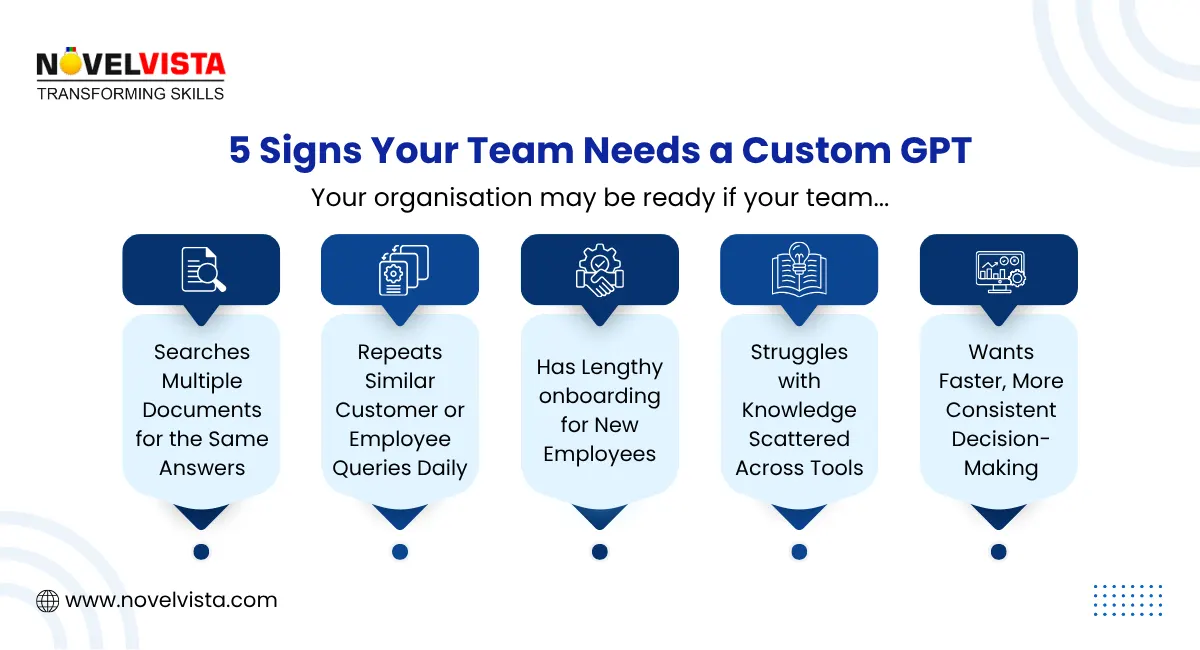
Instead of searching through hundreds of documents, employees simply ask the AI assistant.
Enterprise AI adoption has moved beyond experimentation.
Businesses are investing in custom AI assistants because they improve productivity while preserving organisational knowledge.
| Business Challenge | How a Custom GPT Helps |
| Time spent searching documentation | Instant knowledge retrieval |
| Inconsistent employee responses | Standardised answers |
| Lengthy onboarding | AI-powered employee assistant |
| Repetitive customer queries | Automated support |
| Internal process confusion | Step-by-step guidance |
| Knowledge silos | Centralised organisational intelligence |
A well-designed Custom GPT for Your Business Team reduces operational friction while improving employee efficiency.
Step 1: Define the Business Problem
Before building anything, identify what problem your AI assistant should solve.
Ask questions like:
Common business use cases include:
Starting with one focused use case makes the implementation more successful.
The quality of your GPT depends on the quality of your data.
Collect all relevant knowledge sources, including:
Remove outdated or duplicate information before using it.
Remember a simple principle:
Better data produces better AI responses.
Several enterprise AI platforms allow organisations to build customised assistants.
Your selection should consider:
Many organisations combine Large Language Models (LLMs) with Retrieval-Augmented Generation (RAG) to ensure the AI retrieves current internal information instead of relying only on model memory.
Related technologies include:
These technologies work together to create a reliable Custom GPT for Your Business Team. Choosing the right model is just as important as selecting the right platform. Different AI models excel at different types of business tasks, from coding and research to content creation and workflow automation. If you're evaluating which model best fits your enterprise use case, read our detailed comparison: GPT-5.6 Sol vs Claude Fable 5: Which AI Model Wins for Real Work? GPT-5.6 Sol vs Claude Fable 5: Which AI Model Wins for Real Work?. It explores the strengths, trade-offs, and ideal business scenarios for both models, helping you make a more informed AI adoption decision.
A GPT performs according to the instructions it receives.
Clearly define:
For example:
Instead of saying:
"Answer employee questions."
Use:
"Answer HR questions using only approved HR documentation. If the answer is unavailable, inform the employee and recommend contacting HR."
Detailed instructions significantly improve response consistency.
One of the biggest mistakes organisations make is expecting the AI model to memorise company documents.
Instead, modern enterprise AI systems use Retrieval-Augmented Generation (RAG).
The workflow looks like this:
Benefits include:
RAG has become one of the most important components of a Custom GPT for Your Business Team.
Never deploy directly into production.
Conduct testing across multiple scenarios.
| Test Area | Example |
| Accuracy | Does the answer match company policy? |
| Security | Can confidential information be accessed? |
| Reliability | Does it answer consistently? |
| Edge Cases | Can it handle unclear questions? |
| Performance | Is response time acceptable? |
Gather employee feedback and improve prompts, knowledge sources, and workflows before organisation-wide deployment.
Building a GPT is not a one-time project.
Business knowledge changes regularly.
Update:
Monitor:
Continuous improvement keeps your Custom GPT for Your Business Team accurate and useful over time.
Enterprise AI should never compromise business security.
Follow these best practices:
| Best Practice | Why It Matters |
| Role-based access | Protect sensitive information |
| Encrypt business data | Prevent unauthorised access |
| Audit AI interactions | Maintain compliance |
| Human review for critical decisions | Reduce business risk |
| Regular model evaluation | Ensure ongoing accuracy |
Organisations should also establish AI governance policies covering responsible AI usage, privacy, and regulatory compliance.
Many businesses struggle because they overlook basic implementation principles.
Avoid these mistakes:
A successful Custom GPT for Your Business Team complements employees rather than replacing them.
Once implemented correctly, organisations experience measurable improvements.
Some key benefits include:
As enterprise AI continues to evolve in 2026, customised AI assistants are becoming a competitive advantage rather than an experimental technology.
Building a Custom GPT for Your Business Team is no longer limited to AI specialists or large technology companies. With the right planning, high-quality business knowledge, effective prompt engineering, Retrieval-Augmented Generation (RAG), and strong governance, organisations of all sizes can deploy AI assistants that improve productivity and streamline everyday operations.
The key to success is focusing on a real business problem, maintaining accurate knowledge sources, prioritising security, and continuously evaluating performance. As businesses increasingly embrace enterprise AI, investing in a Custom GPT for Your Business Team can help create a smarter, more efficient, and future-ready workforce.
For organisations looking to accelerate AI adoption and equip their teams with practical, real-world ChatGPT skills, NovelVista's ChatGPT Mastery for Professionals Corporate Training offers hands-on learning focused on enterprise AI implementation, prompt engineering, and business productivity helping teams confidently turn AI concepts into measurable business outcomes.
A Custom GPT for Your Business Team is an AI assistant customised with your company's documents, processes, and knowledge to provide accurate, organisation-specific support for employees.
Not always. Many enterprise AI platforms offer no-code or low-code tools, although advanced integrations may require technical expertise.
RAG allows the AI to retrieve information from your latest business documents before generating responses, improving accuracy and reducing incorrect answers.
Yes, when implemented with proper access controls, encryption, governance policies, and regular monitoring, it can securely support business operations.
HR, IT, customer support, sales, marketing, operations, and finance teams can all benefit by automating repetitive tasks and providing faster access to business knowledge.
Author Details

Course Related To This blog
ChatGPT Mastery for Professionals
Confused About Certification?
Get Free Consultation Call
Stay ahead of the curve by tapping into the latest emerging trends and transforming your subscription into a powerful resource. Maximize every feature, unlock exclusive benefits, and ensure you're always one step ahead in your journey to success.