Category | AI And ML
Last Updated On 26/09/2026
Enterprise teams are surrounded by AI tools, but tool volume does not automatically create business value. This blog explains how to reduce AI tool sprawl, build practical selection judgment, apply governance before adoption, and create a smarter operating model for workplace AI productivity.
You will learn how to evaluate AI tools by workflow value, data risk, integration, governance controls, and team readiness. The article also includes a practical scorecard, a 5-layer selection framework, a 30-day rationalization plan, and a training-led approach for enterprise adoption.
Most enterprise teams do not fail because they have too few AI applications. They fail because every function buys a different assistant, automation layer, meeting summarizer, document generator, search tool, and analytics copilot without a shared decision system. This blog covers why tool sprawl hurts productivity, how enterprise ai governance supports smarter selection, what framework leaders can use, and how teams can build practical judgment before adding another subscription.
The issue is not whether AI is useful. It is whether each tool solves a clear business problem, protects enterprise data, fits existing workflows, and produces measurable outcomes. Without that discipline, AI becomes another noisy shelf of software.
AI tools enter companies quickly because they promise speed. One team tests a chatbot, another buys a workflow assistant, and another subscribes to a design or analytics platform. Soon, the organization has enthusiasm but no operating model.
This is where enterprise ai governance becomes a business enabler. Governance is not a brake pedal. It is the steering system that helps teams choose fewer tools with higher confidence.
The leading competitor pages define governance as policies, controls, accountability, risk management, responsible AI, auditability, and model oversight. NICE emphasizes governance across policies, accountability, monitoring, and regulatory control. Workato focuses on enterprise-wide AI management and workflow governance. Databricks highlights practical governance across data, models, and lifecycle controls. IBM frames AI governance around trust, responsible adoption, and business value. Liminal adds a 2026 implementation view with governance processes and risk-based AI oversight.
The missing gap is practical tool-selection judgment. Most articles explain how to govern AI after adoption. This article goes earlier: how to decide what deserves adoption in the first place.
Before comparing the best ai-powered digital workplace tools, leaders should ask one tougher question: what decision or workflow must improve? A content assistant, code helper, meeting copilot, research tool, or automation platform may all look impressive in demos. But the right tool is the one that removes friction from a priority workflow.
For example, a sales team may need faster proposal creation, not a generic chatbot. A service team may need answer accuracy from approved knowledge, not open-ended summarization. A finance team may need controlled analysis, not unrestricted uploads. This reframes enterprise ai adoption strategy around outcomes instead of novelty.
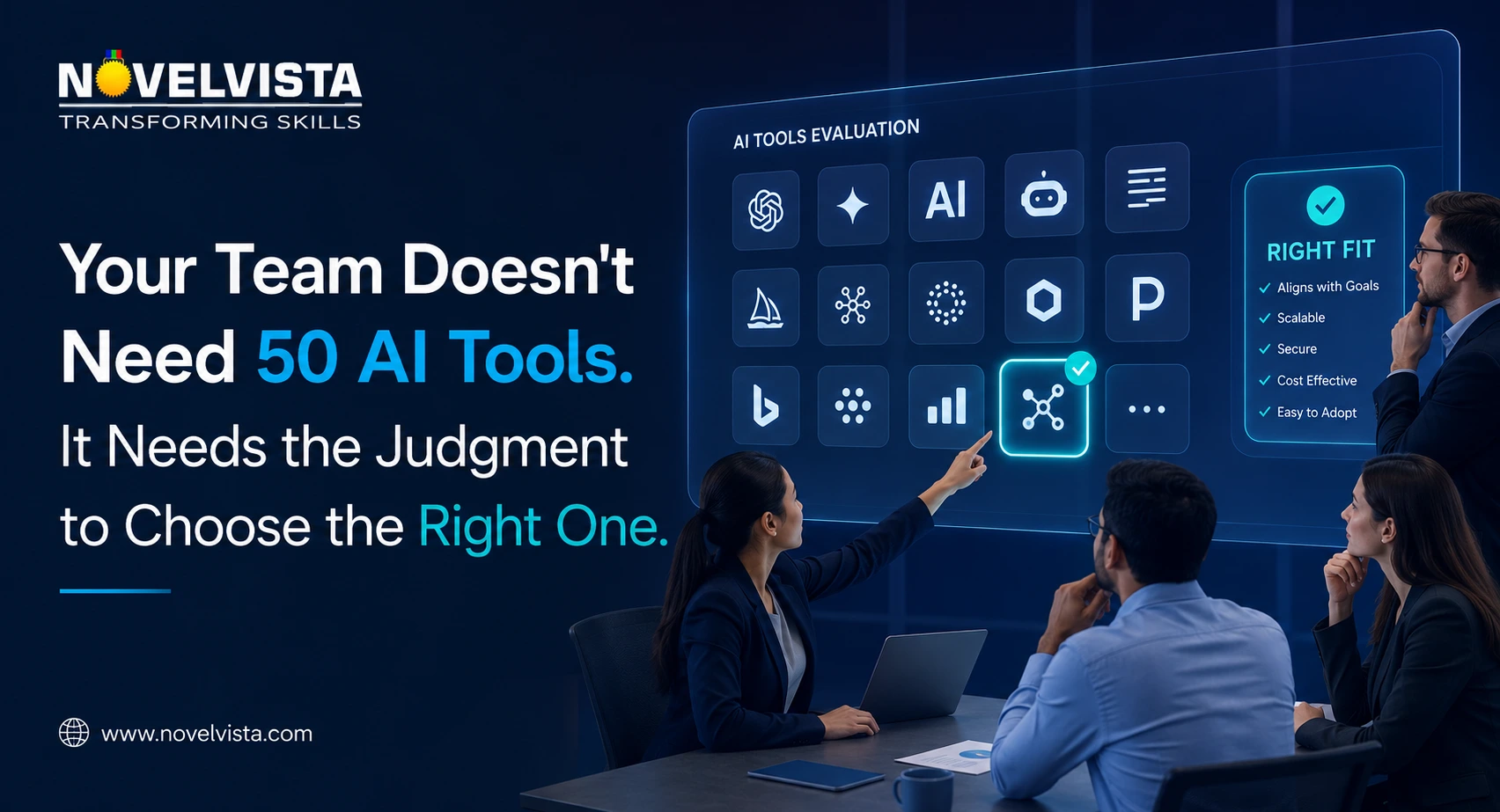
A lightweight scorecard helps teams avoid emotional buying. It also gives procurement, IT, security, HR, and business leaders a shared language.
| Evaluation Area | Question to Ask | Why It Matters |
|---|---|---|
| Business Fit | Which workflow improves and by how much? | Prevents tool buying without a measurable use case. |
| Data Safety | What data will users upload, process, or generate? | Reduces privacy, IP, and compliance exposure. |
| Integration | Does it work inside existing tools and systems? | Improves adoption and lowers context switching. |
| Governance | Can usage, access, audit logs, and policies be managed? | Supports AI governance at scale. |
| Skill Readiness | Do employees know when and how to use it? | Turns tool access into business value. |
This is the practical heart of an enterprise ai governance framework: every tool must earn its place through usefulness, control, and capability.
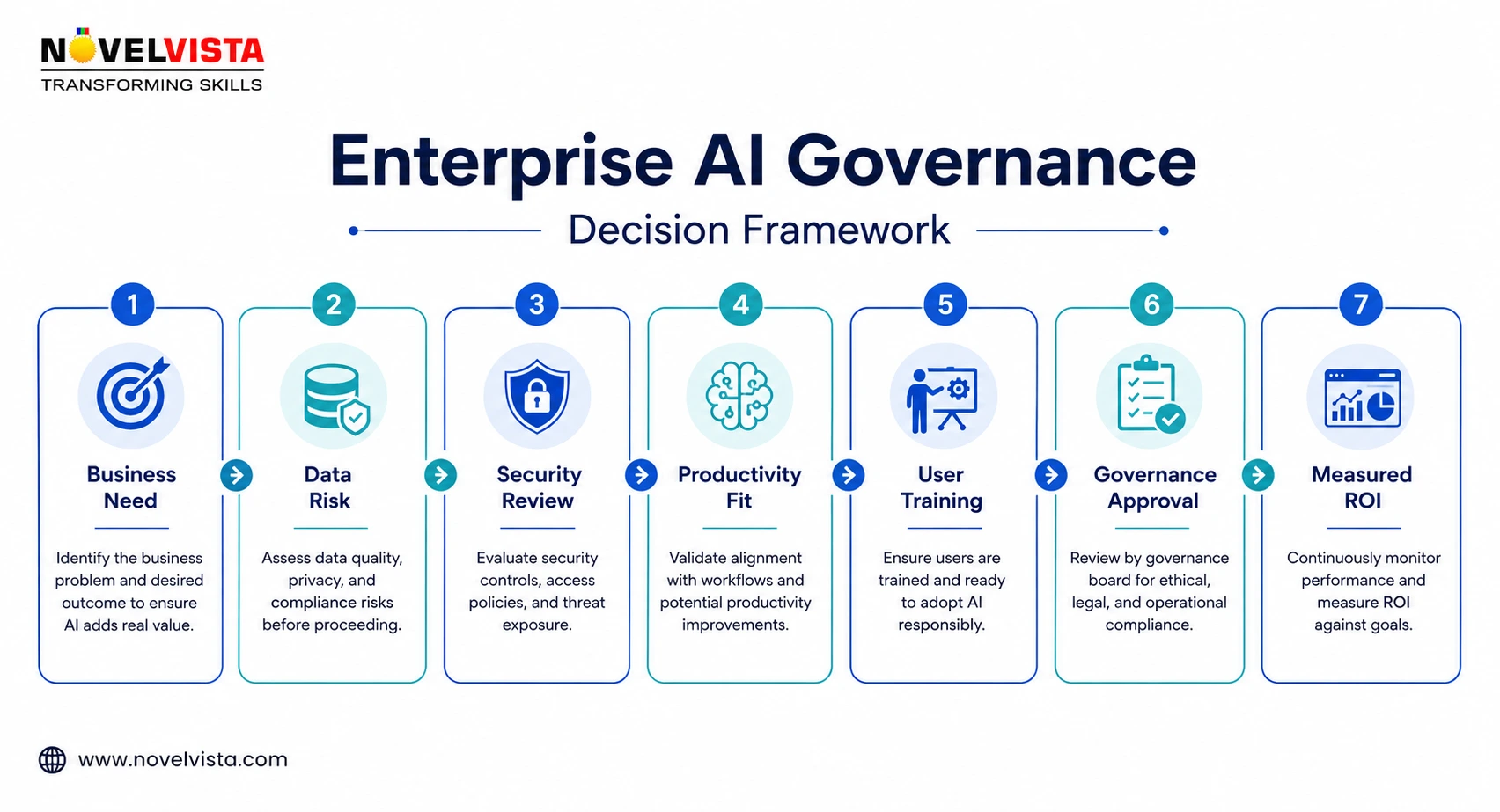
Many companies treat governance as something for data science teams. That is outdated. Everyday AI now lives in documents, spreadsheets, search bars, messaging apps, CRM workflows, HR platforms, and customer support environments.
An ai governance framework enterprise leaders can actually use should cover both advanced models and daily workplace tools. That includes prompts, outputs, human review, approved data sources, role-based access, vendor evaluation, and escalation when AI produces risky or incorrect content.
This is why enterprise ai governance must sit close to productivity, not far away in policy documents nobody reads.
A strong selection model does not require a 60-page policy. It requires five practical layers that every team can understand.
This framework turns enterprise ai governance into daily judgment rather than occasional review.
Applying a framework like this consistently takes architectural judgment, not just a checklist. Our AI Solution Architect Training trains professionals to make these evaluation, integration, and governance decisions systematically, turning ad hoc tool selection into a repeatable, enterprise-ready architecture practice.
Not every AI tool belongs in the same category. Some tools generate content, some automate workflows, some search enterprise knowledge, and some support decision-making. Treating them equally creates confusion.
| Tool Category | Typical Use Case | Governance Focus |
|---|---|---|
| AI Assistants | Drafting, summarizing, research, ideation | Prompt quality, data boundaries, review rules |
| Productivity Copilots | Email, documents, meetings, spreadsheets | Access control, user training, output validation |
| Automation Platforms | Workflow triggers, handoffs, integrations | Approval flows, error handling, audit trails |
| Knowledge AI | Enterprise search and Q&A | Source quality, permissions, freshness |
| Specialized AI Apps | Legal, HR, finance, support, design | Domain accuracy, compliance, accountability |
Tools like chatgpt enterprise can be powerful when placed inside clear usage boundaries and supported by employee training.
The strongest gains from ai for enterprise productivity rarely come from isolated experimentation. They come from repeatable workflows: faster first drafts, cleaner meeting summaries, better knowledge retrieval, quicker analysis, and reduced manual handoffs.
But enterprise ai productivity depends on standardization. A team using five tools in five different ways will not scale learning. A team using selected tools with shared playbooks, prompt patterns, quality checks, and review rules will compound value over time.
This is the difference between AI usage and AI capability. One is access. The other is maturity.
When employees use unapproved AI tools, it is easy to blame them. A better response is to ask why official systems are not meeting the need. Shadow AI often signals unmet demand for speed, clarity, and modern workflows.
The answer is not blanket restriction. The answer is smarter enterprise ai governance: approved tool catalogs, clear do-and-do-not examples, secure alternatives, and training that helps employees make good decisions in real work moments.
The goal is not to eliminate experimentation. It is to move experimentation into safe, observable, and value-driven channels.
A practical AI tool council should be small, cross-functional, and fast. Include business owners, IT, security, data, legal or compliance, procurement, and L&D. The council should not approve every prompt. It should approve categories, standards, vendors, training paths, and review checkpoints.
This operating model keeps enterprise ai governance visible without turning it into corporate quicksand.
Many enterprises buy AI licenses before teaching employees how to think with AI. That reverses the sequence. Training should happen before wide deployment, during rollout, and after teams discover real use cases.
Employees need to know how to select the right tool, write effective prompts, identify weak outputs, protect confidential data, and decide when human review is mandatory. The most valuable ai workplace productivity tools are only as effective as the judgment of the people using them.
This is where an enterprise ai governance framework becomes cultural. It moves from policy to behavior.
Organizations do not need a year-long transformation to reduce AI tool noise. A focused 30-day review can create clarity.
| Week | Action | Output |
|---|---|---|
| Week 1 | List all active AI tools, pilots, and employee-reported use cases. | Current AI inventory |
| Week 2 | Map each tool to workflow value, risk level, data type, and user group. | Risk and value matrix |
| Week 3 | Retain, consolidate, replace, or retire tools based on evidence. | Decision shortlist |
| Week 4 | Launch training, usage guidelines, and success metrics. | Adoption playbook |
This approach supports enterprise ai governance while improving speed, cost discipline, and user confidence.
Your team does not need 50 AI tools. It needs the judgment to select the right tool for the right workflow, with the right controls and the right human review. That is the practical future of enterprise ai governance. It is not only about compliance. It is about helping people work better without creating unmanaged risk.
If your organization wants to build practical AI confidence across teams, explore NovelVista’s AI Tools Mastery — Multi-Tool Practitioner course. The course helps professionals compare AI tools, apply them to real workplace scenarios, improve productivity workflows, and use AI responsibly within enterprise expectations.
The smartest companies will not be the ones with the longest AI tool list. They will be the ones whose people know exactly which tool to trust, when to use it, and when to challenge the output.
Author Details

Confused About Certification?
Get Free Consultation Call
Stay ahead of the curve by tapping into the latest emerging trends and transforming your subscription into a powerful resource. Maximize every feature, unlock exclusive benefits, and ensure you're always one step ahead in your journey to success.