Category | AI And ML
Last Updated On 02/06/2026
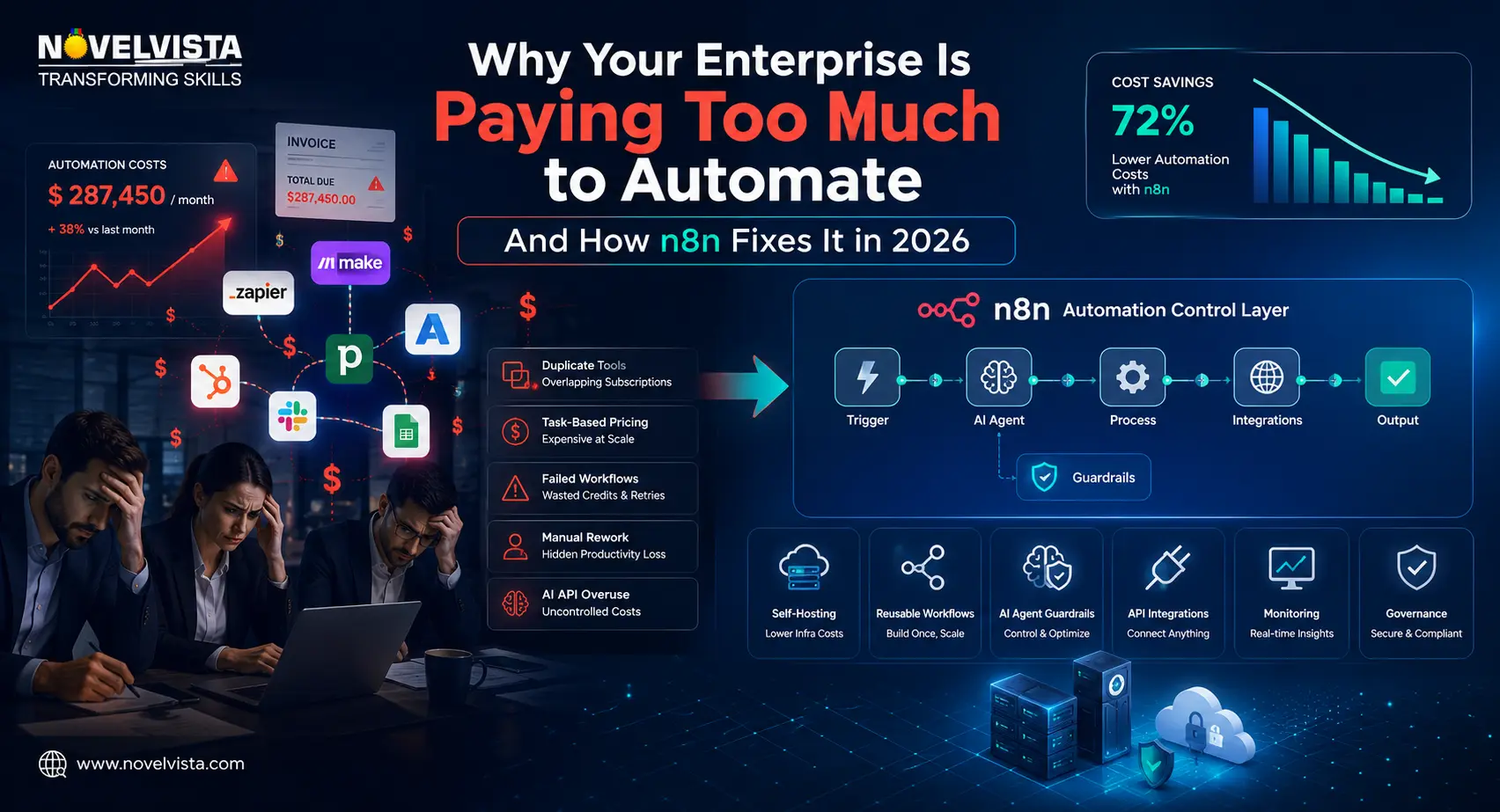
Enterprise automation was supposed to reduce costs. Yet many organizations now carry another expensive software layer: multiple automation tools, rising task-based pricing, disconnected workflows, SaaS sprawl, vendor lock-in, and teams that still depend on IT for every small process change.
This blog explains why automation costs are rising, where traditional platforms create hidden spend, how n8n automation offers a more flexible alternative, and why enterprise teams need structured skills to use it safely in 2026.
The core issue is not automation itself. The issue is unmanaged automation. When every department builds workflows differently, enterprises pay for duplicated tools, failed workflows, repeated integrations, manual rework, and expensive AI calls that do not always create business value.
Most enterprises do not overspend because they chose one bad tool. They overspend because automation grows without a clear operating model.
Sales buys one connector platform. Marketing adds another. Finance uses spreadsheets plus scripts. IT builds custom integrations. HR creates approval flows elsewhere. Then AI tools enter the picture, and every department wants bots, agents, webhooks, data syncs, and reporting workflows.
The result is not automation maturity. It is automation fragmentation.
In 2026, this is becoming a board-level efficiency issue. Enterprises are no longer asking, “Can we automate this?” They are asking, “Can we automate this without creating a cost monster?” That is where n8n automation becomes relevant.
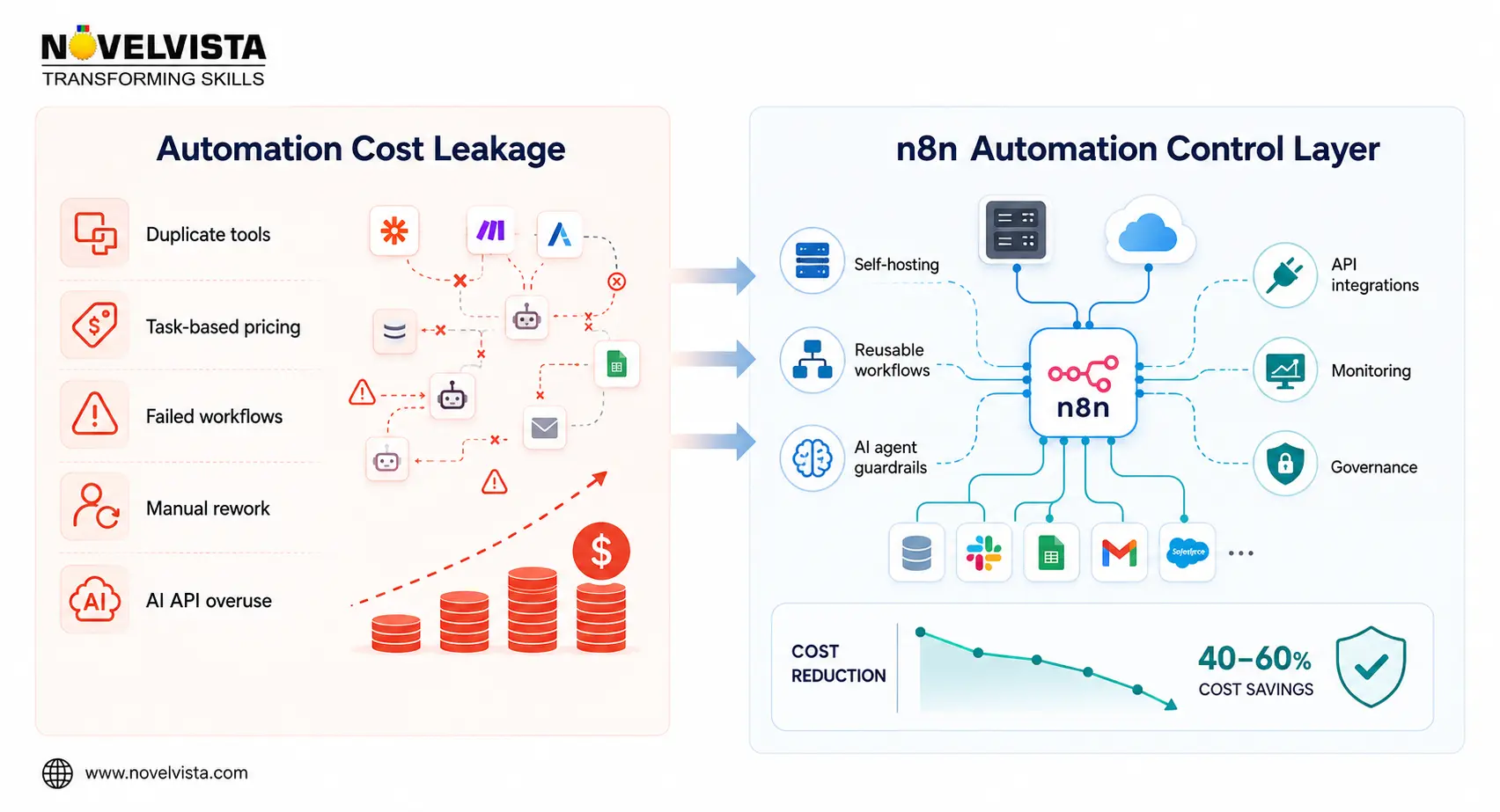
Many automation tools are excellent for quick wins. A simple “when this happens, do that” workflow can save hours. The problem starts when those workflows become business-critical and high-volume.
A task-based pricing model can look affordable during a pilot. But when customer updates, CRM syncs, invoice alerts, ticket routing, lead enrichment, AI summaries, and reporting flows run thousands of times per month, costs can scale faster than value.
Enterprises also need more than basic triggers. They need branching logic, approvals, retries, environment controls, auditability, custom APIs, secure credential handling, and deployment governance.
This is why the n8n vs zapier conversation is not simply about which tool has more integrations. It is about cost architecture, control, and long-term automation ownership.
n8n is a workflow automation platform designed for teams that want visual automation without losing technical control. The real value of n8n automation is that it sits between no-code convenience and developer-grade flexibility.
Business teams can use visual workflows. Technical teams can extend logic with JavaScript, Python, HTTP requests, APIs, databases, and custom nodes. That matters because enterprise automation rarely stays simple for long.
A workflow may begin as a Slack alert. Soon it needs to enrich CRM data, check customer status, call an AI model, create a ticket, wait for human approval, update a dashboard, and log the outcome. In many platforms, that becomes messy or expensive. In n8n, it can remain visible, modular, and maintainable.
This is why n8n automation is gaining attention from operations, IT, data, marketing, finance, and AI teams at the same time.
Zapier is popular because it is simple, polished, and fast for everyday app-to-app automation. For small teams and straightforward workflows, that ease of use is valuable.
But enterprise teams often hit a different wall. They need deeper logic, better data control, custom integration paths, and predictable cost management. That is where n8n vs zapier becomes a strategic evaluation.
| Evaluation Area | Zapier | n8n |
|---|---|---|
| Best Fit | Fast SaaS-to-SaaS automation | Flexible enterprise workflows and technical automation |
| Customization | Easy for standard use cases | Strong support for custom logic, APIs, and code |
| Cost Scaling | Can rise with task volume | More control through workflow design and hosting choices |
| Hosting | Cloud-first | Cloud and self-hosted options |
| AI Workflows | Useful AI features for productivity | Strong fit for custom AI agents, tools, and controlled execution |
| Enterprise Control | Convenient, but more platform-managed | Better suited when teams need infrastructure and data control |
The point is not that one tool is universally better. The point is that n8n automation gives enterprises more levers to control cost, governance, and complexity when automation moves beyond simple productivity workflows.
For many enterprises, n8n self hosting is the breakthrough.
Self-hosting allows organizations to run n8n within their own infrastructure, private cloud, or controlled environment. This can be important for companies with strict data residency, security, compliance, or cost requirements.
The economic advantage is not free automation. Self-hosting still requires infrastructure, maintenance, monitoring, backup, upgrades, and security hardening. But it changes the cost model from pure SaaS consumption to controlled infrastructure ownership.
n8n self hosting also supports a stronger automation center of excellence model. IT can define standards, security teams can review architecture, and business users can still build governed workflows inside approved boundaries. That is how n8n automation helps enterprises move from scattered experiments to controlled capability.
AI has changed the automation conversation. A traditional workflow follows rules. An AI-enabled workflow can classify requests, summarize documents, draft responses, search knowledge bases, call tools, and make decisions within defined limits.
This creates value. It also creates new cost and risk. Every AI call has a cost. Every prompt can send data outside a system boundary. Every agent needs guardrails. Every autonomous action needs monitoring.
An n8n ai agent can help enterprises combine deterministic workflow steps with AI reasoning. For example, a support workflow can receive an email, classify urgency, retrieve account context, draft a response, route exceptions to a human, and update the ticketing system.
The key is control. n8n automation allows teams to place AI inside a structured workflow instead of letting it run as a black-box assistant. Teams can add filters before model calls, use human approval steps, set retry rules, log outputs, and limit what systems the agent can access.
That is practical AI governance. Not a policy PDF gathering dust in SharePoint.
n8n automation can reduce spend in several high-impact areas when implemented correctly.
Many departments buy automation platforms independently. Consolidating repeat use cases into one governed platform can reduce subscription overlap and simplify vendor management.
Not every workflow needs a full development sprint. With reusable nodes, APIs, and templates, teams can deliver operational workflows faster while reserving engineering time for complex systems.
Poorly designed AI workflows send too much data too often. n8n automation can filter, route, compress, cache, and conditionally call models only when needed.
Failed automations are expensive because people stop trusting them. n8n supports visible workflow logic, logs, retries, and error paths, making issues easier to diagnose.
With n8n enterprise training, teams can learn how to design secure workflows, manage credentials, document logic, review changes, and avoid shadow automation.
Tools do not fix broken ownership. A company can deploy n8n and still create chaos if every team builds without standards.
A mature n8n automation operating model should include:
This is where n8n enterprise training becomes essential. Business users need to understand workflow logic. Developers need extension patterns. IT needs secure deployment. Leaders need to measure business value, not just workflow count.
Without training, n8n becomes another tool. With training, it becomes an enterprise automation capability.
n8n is most valuable where workflows are repetitive, cross-system, data-driven, and too customized for basic automation tools.
| Business Function | High-Value Use Case | Business Impact |
|---|---|---|
| IT Operations | Incident enrichment, alert routing, ticket updates | Faster response and reduced manual triage |
| Sales | Lead scoring, CRM enrichment, follow-up automation | Better pipeline hygiene and faster sales action |
| Finance | Invoice checks, payment alerts, exception routing | Lower manual reconciliation effort |
| HR | Onboarding workflows, access requests, document collection | Smoother employee experience |
| Customer Support | AI-assisted ticket classification and response drafting | Shorter resolution cycles |
| Marketing | Campaign reporting, content approvals, data syncs | Cleaner execution and better visibility |
These use cases show why n8n automation is not just an IT tool. It is an operating system for connected work.
A balanced view matters. n8n is powerful, but it is not a magic wand.
Enterprises should plan for:
The biggest mistake is treating n8n as cheap Zapier. That undersells it and creates the wrong implementation strategy. n8n is better understood as a flexible automation platform for organizations that want more control over cost, data, logic, and AI-enabled execution.
Enterprises can start small without thinking small.
Identify departments with repetitive, high-volume, cross-system work. Shortlist workflows based on cost, frequency, risk, and business impact.
Choose five to ten workflows. Include at least one AI-assisted use case, one approval workflow, and one data synchronization use case. Establish basic documentation and review standards.
Move successful workflows into production. Define owners, monitoring, escalation paths, and reusable templates. Begin formal n8n enterprise training for business and technical teams.
This approach avoids the automation theater trap, where teams celebrate workflow count but fail to measure actual savings.
Enterprise automation costs are rising because organizations are scaling disconnected tools, unmanaged workflows, and expensive AI experiments without a clear architecture. The answer is not to stop automating. The answer is to build a smarter operating model.
n8n automation helps enterprises regain control by combining visual workflow design, developer flexibility, AI agent capability, and hosting choice. It is especially valuable for teams that need more than simple app connectors and want to reduce long-term automation waste.
For many organizations, n8n automation also creates a stronger bridge between traditional workflow automation and agentic AI execution. With the right governance, training, and architecture, n8n automation can become a scalable foundation for enterprise-wide productivity.
To turn this into business value, your teams need more than tool access. They need structured capability in workflow design, AI agents, governance, and production-ready automation.
If your organization is preparing to build intelligent automation and agentic workflows in 2026, explore NovelVista’s Agentic AI Engineering Bootcamp. The course helps enterprise teams understand how to design, build, and govern AI-powered automation workflows with practical skills that connect directly to modern business execution.
Author Details

Confused About Certification?
Get Free Consultation Call
Stay ahead of the curve by tapping into the latest emerging trends and transforming your subscription into a powerful resource. Maximize every feature, unlock exclusive benefits, and ensure you're always one step ahead in your journey to success.