Category | AI And ML
Last Updated On 22/06/2026
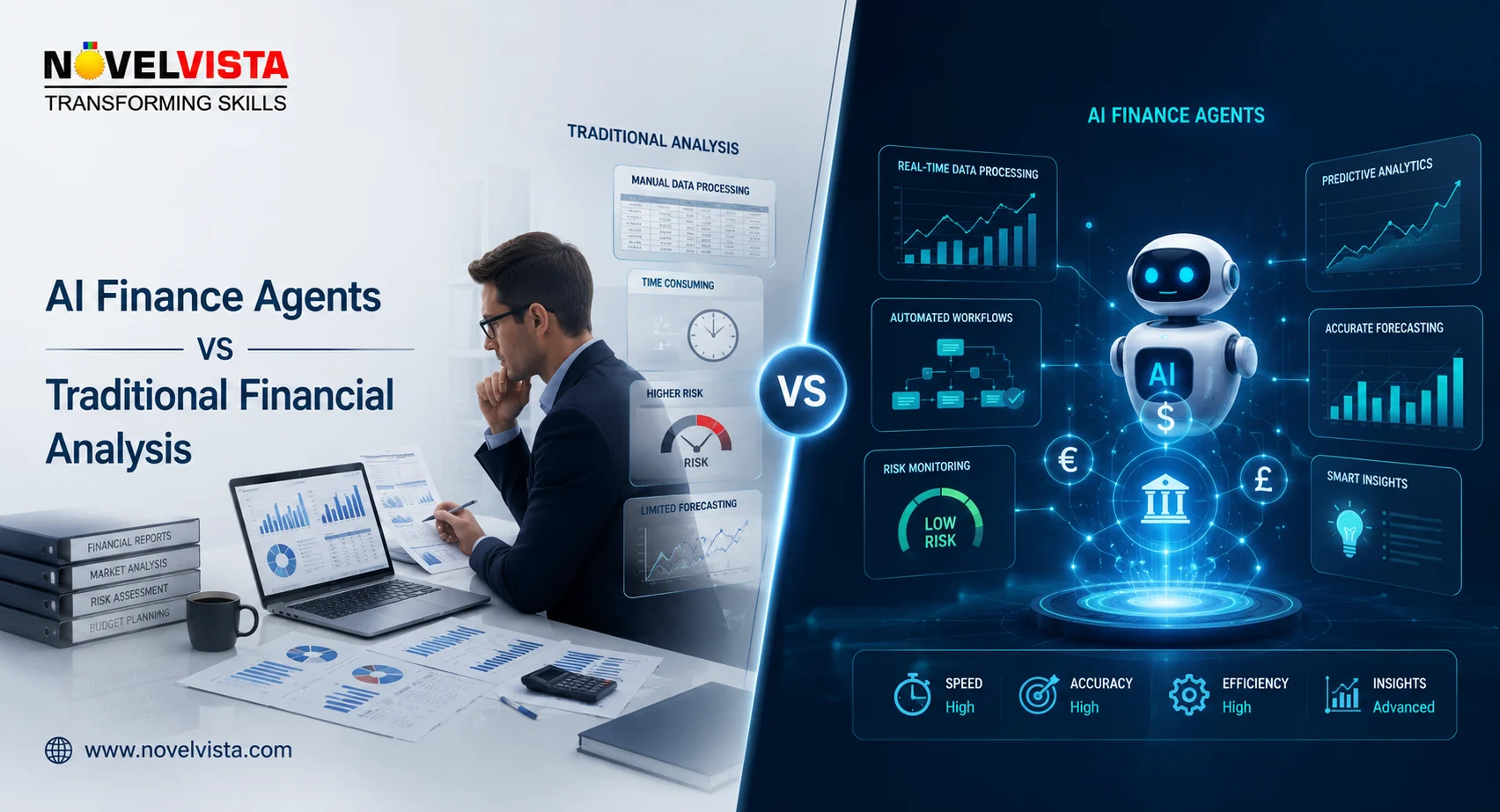
Finance teams are entering a new operating model where intelligent systems can review transactions, generate forecasts, detect anomalies, and recommend actions faster than manual analysis. This blog explains how AI finance agents compare with traditional financial analysis, what changes for analysts and CFOs, where automation adds value, and what organizations should prepare for in 2026.
AI for Finance is no longer limited to dashboards or basic reporting. It is moving toward agent-based workflows that can support budgeting, risk monitoring, treasury, compliance, and executive decision-making.
The real question is not whether AI will replace finance professionals. The sharper question is how finance teams can combine human judgment with AI-powered speed, scale, and consistency.
Traditional financial analysis has always depended on structured data, analyst expertise, spreadsheet models, business assumptions, and leadership judgment. Analysts collect data, validate numbers, build forecasts, compare performance, and explain what the numbers mean for the business.
AI for Finance changes the workflow by adding systems that can process financial data continuously, identify exceptions, summarize patterns, and produce recommendations in near real time.
This shift does not remove the need for finance professionals. It changes their work from manual preparation to strategic interpretation, governance, and decision support.
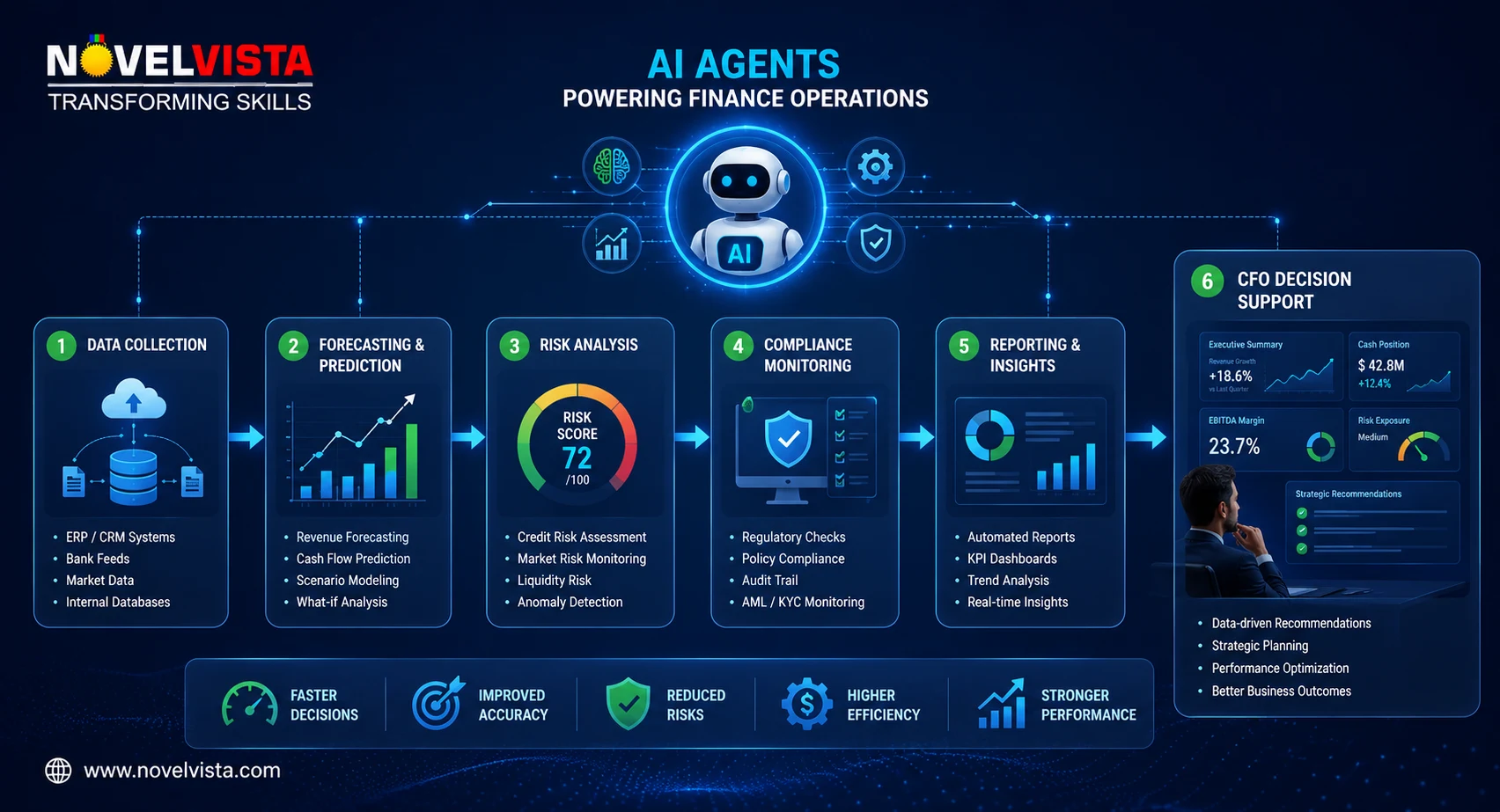
AI finance agents are intelligent software systems designed to complete finance-related tasks with a higher level of autonomy than traditional automation tools. Instead of only following fixed rules, they can analyze context, use connected data sources, prioritize tasks, and suggest the next best action.
AI Agents for Finance can support activities such as cash flow monitoring, variance analysis, invoice review, expense anomaly detection, forecasting, and management reporting.
In practical terms, Agentic AI in Finance helps finance teams move from reactive reporting to proactive financial intelligence.
Traditional financial analysis depends heavily on human expertise. Analysts study financial statements, business performance, market movement, cost behavior, and operational data to understand what happened and what may happen next.
This approach remains valuable because finance decisions are not only mathematical. They involve judgment, organizational context, negotiation, stakeholder priorities, and risk appetite.
A strong analyst can challenge assumptions, interpret unusual market signals, and explain financial outcomes in language executives can act on.
The difference between AI finance agents and financial analysts is not simply technology versus people. It is a difference in speed, scale, consistency, judgment, and accountability.
| Comparison Area | AI Finance Agents | Traditional Financial Analysts |
|---|---|---|
| Speed | Can process large datasets and generate outputs quickly | Requires manual review, validation, and interpretation time |
| Scale | Works across large transaction volumes and multiple systems | Limited by team size and workload capacity |
| Consistency | Produces standardized outputs based on configured logic | Output may vary by experience, method, and assumptions |
| Contextual Judgment | Limited by data quality, instructions, and model design | Strong in business nuance, stakeholder context, and judgment |
| Best Use | Automation, monitoring, pattern detection, reporting support | Strategy, interpretation, governance, and decision-making |
AI for Finance performs best when it supports analysts rather than replaces accountability. The analyst remains the owner of interpretation, while the agent accelerates the analytical groundwork.
The most immediate benefit of AI Financial Automation is the reduction of repetitive, high-volume work. Finance teams often spend too much time gathering data, reconciling reports, checking exceptions, and preparing recurring updates.
AI systems can automate much of this work while improving visibility across departments, cost centers, and business units.
This gives finance professionals more bandwidth for advisory work, business partnering, and performance improvement.
Autonomous Finance refers to finance operations where systems can monitor conditions, analyze data, recommend decisions, and in some cases execute approved actions with minimal manual intervention.
Examples include self-updating forecasts, automated cash position monitoring, intelligent fraud alerts, and dynamic budget controls.
Autonomous Finance is powerful, but it must be designed with human oversight. Finance is too sensitive for unchecked automation, especially where compliance, investor reporting, taxation, or regulatory exposure is involved.
The winning model is not fully hands-off finance. It is governed autonomy, where AI handles repetitive intelligence work and humans control policy, accountability, and judgment.
AI for CFOs is becoming a boardroom priority because finance leaders are under pressure to deliver faster reporting, stronger controls, better forecasts, and clearer strategic insights.
AI agents can help CFOs move from periodic reporting to continuous financial visibility. Instead of waiting for monthly reports, finance leaders can track risk indicators, cost movement, and forecast changes as they happen.
AI for CFOs also supports better resource allocation. When finance teams understand where margins are shifting, where costs are rising, and where cash flow is tightening, leaders can act earlier.
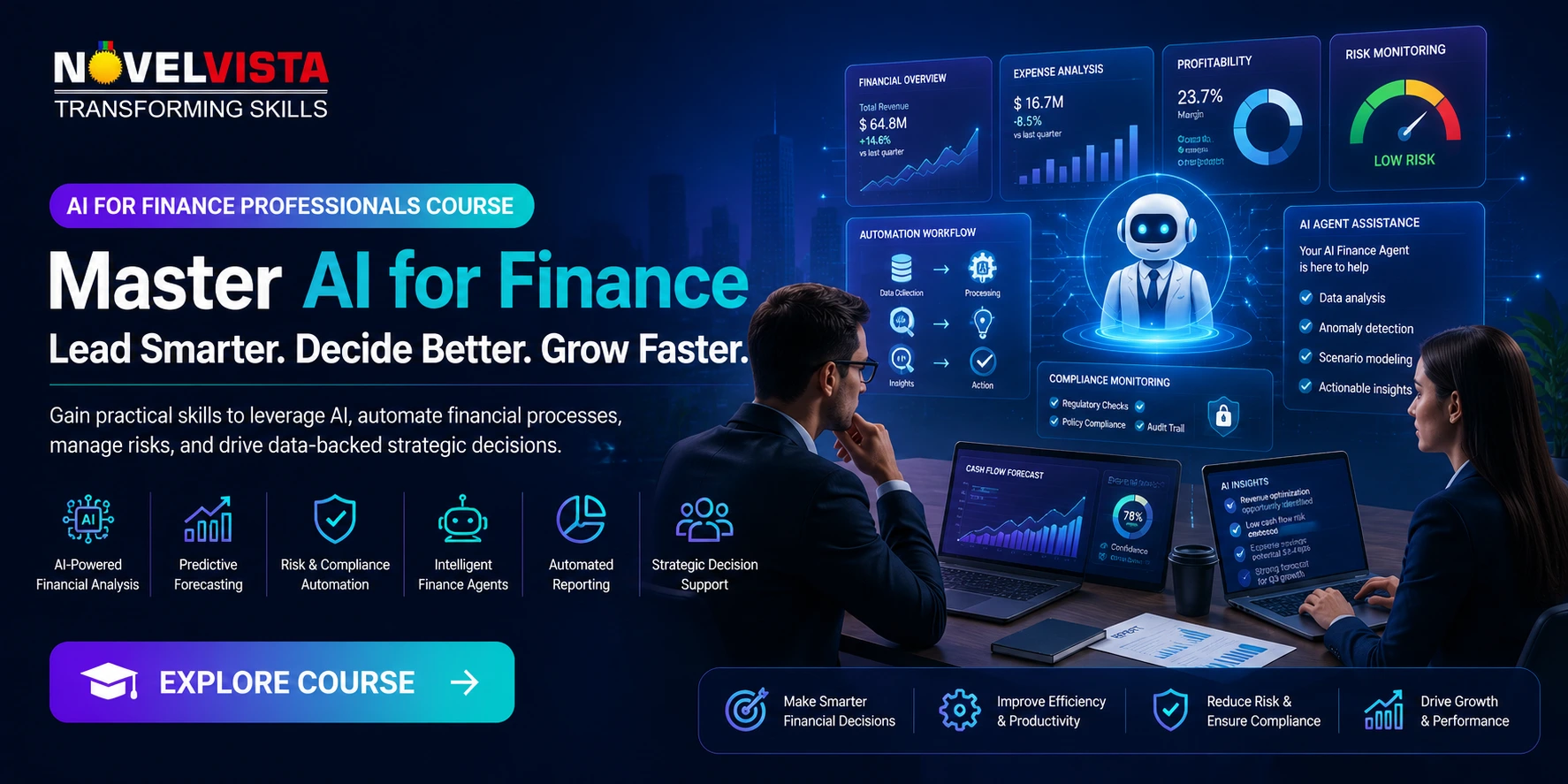
Finance AI Trends 2026 point toward more integrated, agent-based, and decision-oriented finance systems. AI will not remain a separate tool used occasionally by analysts. It will increasingly sit inside ERP, planning, treasury, audit, and reporting workflows.
Another major part of Finance AI Trends 2026 will be workforce redesign. Finance teams will need professionals who understand data, controls, AI use cases, and business strategy together.
AI will replace some tasks, not the full role of the financial analyst. Activities such as data extraction, formatting, variance highlighting, report generation, and basic forecasting are highly automatable.
However, strategic interpretation, stakeholder communication, ethical review, business negotiation, and final decision-making still require human accountability.
AI Agents for Finance will become co-workers for analysts. They will prepare the ground, surface insights, and reduce manual workload. Analysts will focus on asking better questions, validating outputs, and advising leaders.
The safest career move is not to compete against AI. It is to become the finance professional who can use AI responsibly and effectively.
Organizations that want to adopt Agentic AI in Finance should begin with practical readiness, not hype. The first step is identifying high-volume workflows where automation can reduce effort without creating unacceptable risk.
AI for Finance succeeds when technology, people, data, and governance move together. Without that foundation, even advanced tools can produce unreliable outcomes.
AI finance agents and traditional financial analysts are not enemies. They represent two sides of the modern finance function. AI brings speed, automation, scale, and pattern recognition. Human analysts bring judgment, context, ethics, communication, and strategic thinking.
The future of finance will belong to teams that combine both. Routine reporting and monitoring will increasingly be handled by AI agents, while finance professionals will move toward higher-value advisory and governance roles.
To build these capabilities, explore NovelVista’s AI for Finance Professionals Course. The course is designed for finance leaders, analysts, managers, and decision-makers who want to understand AI-powered financial workflows, practical use cases, governance needs, and the future of intelligent finance operations.
For organizations preparing for smarter financial operations, the best time to build AI-ready finance capability is now.
Author Details

Course Related To This blog
AI for Finance Professionals
Confused About Certification?
Get Free Consultation Call
Stay ahead of the curve by tapping into the latest emerging trends and transforming your subscription into a powerful resource. Maximize every feature, unlock exclusive benefits, and ensure you're always one step ahead in your journey to success.