Category | AI And ML
Last Updated On 22/07/2026
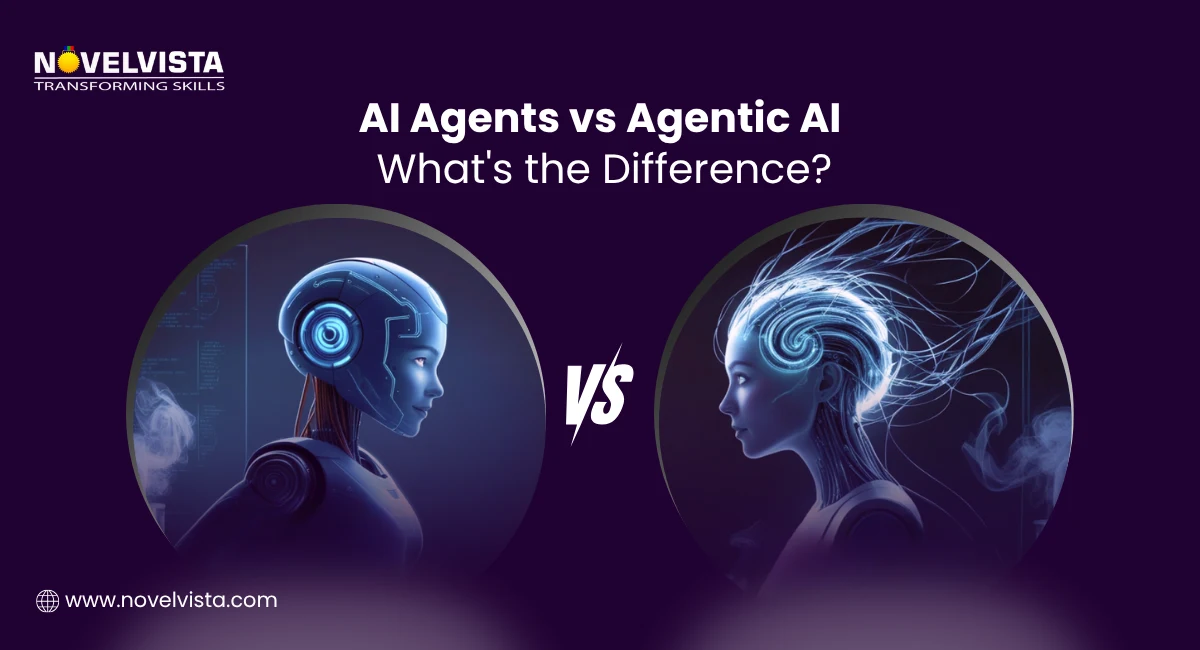
| Synopsis: AI Agents vs Agentic AI is one of the most important distinctions in enterprise artificial intelligence in 2026. AI agents execute specific tasks, while agentic AI autonomously plans, reasons, and coordinates multiple actions to achieve broader goals. This guide explains the key differences between AI agents and agentic AI, compares their architecture, autonomy, use cases, and governance requirements, and helps businesses determine which approach best fits their AI strategy in 2026. |
Most teams deploying AI in 2026 are using agents but very few are actually using agentic AI. The gap is not just technical. It determines whether your AI executes tasks or achieves goals.
According to Gartner, 33% of enterprise software applications will embed agentic AI by 2028, up from less than 1% in 2024. That prediction is driving massive interest in understanding the real Agentic AI vs AI Agents difference. Enterprises want to know whether they need simple task-based automation or fully autonomous systems capable of planning, reasoning, orchestration, and adaptive decision-making.
This comparison explains how AI agents and agentic AI differ, how each architecture works, where they deliver business value, and what organizations should consider before adopting autonomous AI systems at scale.
TL;DR
| Aspect | Key Difference |
| Autonomy | AI agents are reactive; agentic AI is goal-driven and proactive |
| Planning | AI agents follow workflows; agentic AI creates execution strategies |
| Scope | AI agents handle narrow tasks; agentic AI manages multi-step objectives |
| Memory | AI agents use short-term context; agentic AI maintains persistent memory |
| Tool Use | AI agents connect to limited tools; agentic AI orchestrates multiple systems |
| Best For | AI agents suit repetitive automation; agentic AI suits enterprise orchestration |
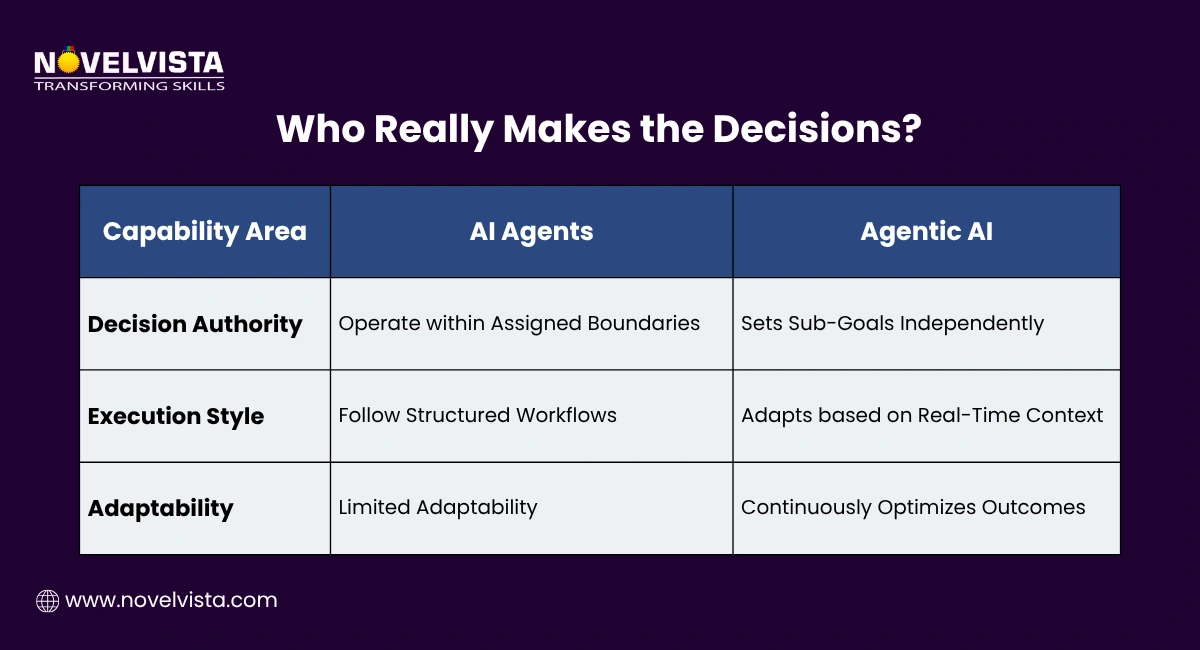
AI agents are specialized systems designed to perform specific tasks using prompts, APIs, or predefined workflows. Agentic AI refers to autonomous systems capable of planning, reasoning, coordinating multiple agents, managing memory, and adapting dynamically to achieve larger objectives. The core difference between AI agents and agentic AI is the level of autonomy and orchestration capability.
| Aspect | AI Agents | Agentic AI |
|---|---|---|
| Definition | Task-focused intelligent systems | Goal-oriented autonomous systems |
| Autonomy | Limited autonomy | High autonomy |
| Planning | Minimal | Multi-step strategic planning |
| Adaptability | Rule or prompt-driven | Dynamic reasoning and adaptation |
| Scope | Single-purpose execution | Multi-agent orchestration |
| Memory | Session-based context | Persistent memory and learning |
| Tool Use | Limited integrations | Broad system orchestration |
| Example | FAQ chatbot | Autonomous customer support platform |
AI agents typically execute one defined function efficiently. Examples include recommendation engines, scheduling assistants, code generators, or document summarizers.
Agentic AI operates at a higher orchestration layer. It can decompose goals into subtasks, coordinate autonomous AI agents, evaluate outcomes, retry failed actions, and optimize workflows continuously.
This distinction becomes critical in enterprise AI automation. An AI agent may generate a report. An agentic system may gather data, validate sources, create dashboards, notify stakeholders, escalate anomalies, and refine future reporting logic automatically.
In short: AI agents execute tasks, while agentic AI manages objectives. Most enterprise systems in 2026 combine both approaches, using specialized agents coordinated by larger agentic orchestration layers.
Generative AI, AI agents, and agentic AI represent different stages of operational intelligence.
Generative AI models focus on producing content such as text, code, images, or summaries. AI agents use generative models to execute specific tasks through workflows or APIs. Agentic AI coordinates multiple agents, tools, memory systems, and reasoning layers to autonomously pursue goals across complex environments.
| Technology | What it does | Example |
|---|---|---|
| Generative AI | Creates content from prompts | ChatGPT generating marketing copy |
| AI Agents | Executes defined tasks | AI scheduling assistant |
| Agentic AI | Coordinates autonomous workflows | Autonomous IT operations system |
Generative AI alone does not create autonomy. It generates outputs. AI agents add execution capability. Agentic AI introduces orchestration, adaptive planning, memory management, and proactive decision-making.
For example:
McKinsey estimates that enterprise AI automation could contribute up to $4.4 trillion annually in productivity gains globally. Much of that value depends on moving beyond standalone generative models toward orchestrated agentic systems.
Summing it up, Generative AI creates outputs, AI agents execute tasks, and agentic AI manages autonomous workflows. The biggest enterprise shift in 2026 is the move from reactive AI tools toward proactive orchestration systems.
A practical way to understand the Agentic AI vs AI Agents difference is through the “toolbox vs architect” metaphor.
Imagine a construction site.
AI agents are the tools inside the toolbox, drills, hammers, measuring tapes, and cutters. Each performs a specific task efficiently.
Agentic AI is the architect or project manager coordinating the entire construction process. It decides which tools are needed, when to use them, how to sequence activities, and how to adapt when problems arise.
An AI agent might generate code or send an email.
An agentic AI system could:
This is why the distinction between reactive vs proactive AI matters. AI agents respond. Agentic AI strategizes.
Summing it up, AI agents are specialized workers. Agentic AI acts as the coordinator managing workflows, memory, reasoning, and execution across systems.
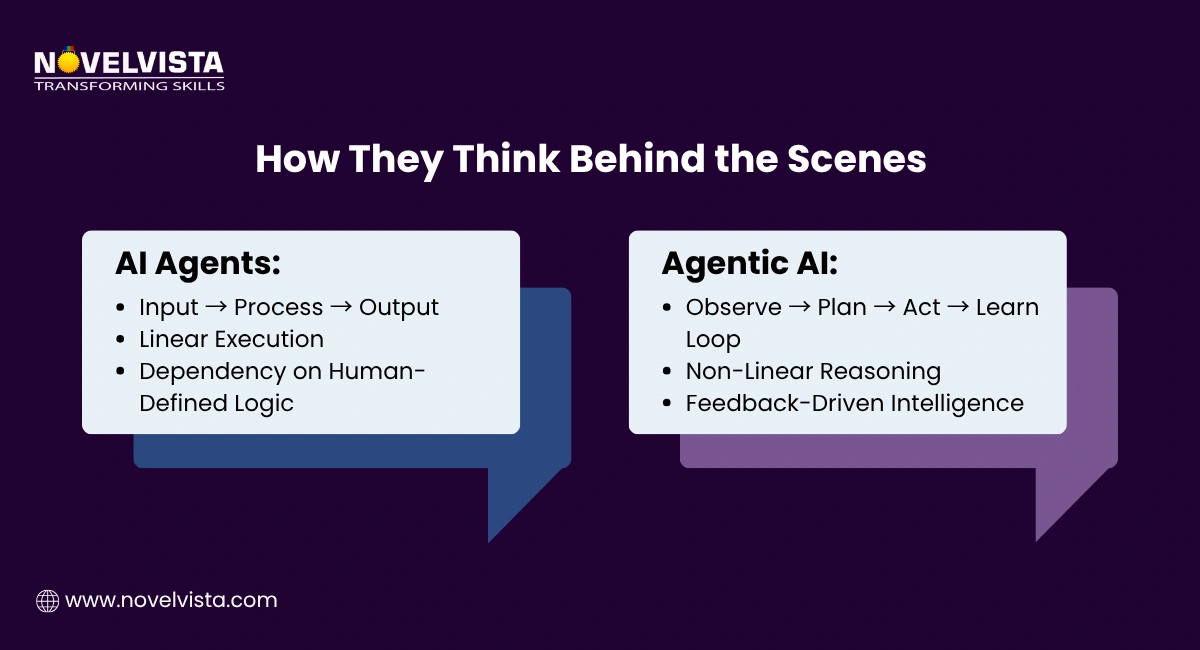
Most AI agents operate through:
They are typically reactive systems.
Input arrives → the agent processes it → the system returns an output.
Examples include:
These systems are efficient but constrained. They usually lack persistent memory, long-term planning, or adaptive orchestration capabilities.
Agentic AI introduces:
Consider a real-world enterprise travel scenario.
A sales executive says:
“Plan my Singapore trip for next week's client summit while minimizing travel costs and avoiding overnight layovers.”
An AI agent may only book flights.
An agentic AI system could:
This shift from single-task execution to autonomous workflow automation defines the difference between AI agent and agentic AI.
| Workflow Capability | AI Agents | Agentic AI |
| Single-step execution | Yes | Yes |
| Multi-step planning | Limited | Extensive |
| Memory retention | Short-term | Persistent |
| Retry logic | Minimal | Adaptive |
| Tool orchestration | Limited | Broad |
| Dynamic decision-making | Restricted | Advanced |
In short: AI agents process instructions. Agentic AI systems interpret goals, orchestrate workflows, and continuously optimize outcomes through adaptive reasoning loops.
The biggest distinction in Agentic AI vs AI Agents is autonomy.
Level | Description |
| Reactive | Responds only to prompts |
| Semi-autonomous | Executes workflows independently |
| Fully agentic | Plans, adapts, and optimizes goals autonomously |
Most AI agents remain reactive or semi-autonomous.
Agentic AI systems move toward proactive intelligence capable of:
Even highly autonomous systems still require governance.
Large enterprises rarely allow unrestricted autonomous execution. Instead, they implement human-in-the-loop AI checkpoints for sensitive workflows.
For example, a cybersecurity agentic AI system may:
But before shutting down production infrastructure, the system requests human approval.
This balance between autonomy and oversight is becoming standard in enterprise AI governance. Organizations deploying agentic architectures increasingly follow frameworks such as:
Governance Area | Enterprise Control |
| Financial approvals | Human validation |
| Security actions | Escalation checkpoints |
| Compliance workflows | Audit logging |
| Customer communication | Review constraints |
| Infrastructure changes | Permission-based execution |
Agentic AI increases autonomy, but enterprises still maintain strategic oversight. Human-in-the-loop governance remains essential for safety, accountability, and compliance.
AI Agent Example
Agentic AI Example
This reduces operational workload while improving customer satisfaction and resolution speed.
Teams building this typically start with CrewAI or LangGraph.
AI Agent Example
Agentic AI Example
This accelerates engineering velocity while reducing repetitive developer tasks.
Teams implementing this often use AutoGen or LangGraph.
AI Agent Example
Agentic AI Example
This improves operational resilience and reduces downtime.
Organizations typically combine LangGraph with enterprise orchestration layers.
AI Agent Example
Agentic AI Example
This speeds up scientific research, legal analysis, and financial investigation workflows.
Research teams often use AutoGen or DSPy.
AI Agent Example
Agentic AI Example
This increases efficiency across logistics and manufacturing operations.
Teams building industrial orchestration often use ROS integrations with custom agentic layers.
AI agents automate isolated tasks where as Agentic AI orchestrates complex operational workflows involving planning, memory, coordination, and adaptive execution across enterprise systems.
If your workflows are repetitive and clearly defined → choose AI agents because narrow automation delivers faster ROI with lower operational complexity.
If your business processes require dynamic adaptation → choose agentic AI because static workflows cannot handle changing conditions effectively.
If you need human approval for sensitive actions → choose semi-autonomous AI agents because governance remains easier to manage.
If you want enterprise-scale workflow orchestration → choose agentic AI because it supports multi-agent coordination, memory management, and autonomous planning.
If your budget and infrastructure are limited → choose AI agents because agentic systems require stronger observability, orchestration, and governance layers.
If your organization already uses multiple AI tools → choose agentic AI because orchestration can unify fragmented workflows into coordinated operational systems.
| Decision Area | Recommended Approach |
| Simple automation | AI Agents |
| Multi-step orchestration | Agentic AI |
| Low-risk workflows | AI Agents |
| Enterprise optimization | Agentic AI |
| Limited AI maturity | AI Agents |
| AI-native operations | Agentic AI |
In short: Start with AI agents for narrow automation. Move toward agentic AI when workflows require orchestration, adaptation, memory, and autonomous decision-making at scale.
Agentic systems require significantly more sophisticated architecture than standalone AI agents.
Component | Role |
| Orchestrator | Coordinates workflows |
| Planner | Breaks goals into tasks |
| AI Agents | Execute specialized actions |
| Tool Connectors | Integrate APIs and applications |
| Memory Layer | Stores context and history |
| Evaluation Loop | Measures outcomes and retries |
Tools like LangGraph and AutoGen implement this orchestration pattern natively.
API-Centric Architecture
Most enterprises connect autonomous AI agents through APIs.
Benefits include:
Event-Driven Systems
Large organizations increasingly use message-bus architectures where multiple agents communicate asynchronously.
Frameworks like CrewAI and AutoGen support multi-agent systems effectively.
Centralized vs Federated Control
Model | Characteristics |
| Centralized | One orchestrator controls workflows |
| Federated | Multiple autonomous systems collaborate |
Architecture Taxonomy
Architecture Type | Description |
| Single-Agent | One autonomous system handles tasks |
| Multi-Agent | Specialized agents collaborate |
| Vertical | Domain-specific orchestration |
| Horizontal | Cross-functional orchestration |
| Hybrid | Combines centralized and distributed logic |
Organizations implementing agentic AI must manage:
AIMultiple benchmarking found that stateful LangGraph workflows reduced redundant token usage by up to 35% compared with linear prompt-chain architectures in complex multi-step workflows.
Agentic AI requires orchestration infrastructure, memory systems, observability, and governance layers. Architecture quality determines whether autonomous systems remain reliable at enterprise scale.
As organizations move from AI agents toward agentic AI, governance complexity increases significantly.
Agentic systems may behave unexpectedly because of:
Autonomous systems may fail when:
Broad system access introduces risk:
Organizations must secure:
Governance Area | Recommended Action |
| Safety Constraints | Define operational boundaries |
| Human Oversight | Add approval checkpoints |
| Explainability | Maintain audit trails |
| Access Control | Restrict permissions |
| Monitoring | Track agent behavior continuously |
| Rollback Mechanisms | Enable rapid recovery |
The EU AI Act, NIST AI RMF, and ISO 42001 are becoming foundational governance frameworks for enterprise AI automation in regulated industries.
Higher autonomy creates higher governance responsibility. Organizations deploying agentic AI need strong oversight, monitoring, access controls, and rollback mechanisms from day one.
Gartner predicts that by 2028, 15% of daily business decisions at large enterprises will be made autonomously by AI agents - up from near zero in 2024.
This shift will push organizations toward production-ready AI agents capable of handling operational workflows independently.
McKinsey research suggests enterprise AI maturity increasingly depends on orchestration rather than standalone models.
Companies are moving toward:
Regulated industries will increasingly differentiate based on AI governance maturity.
Organizations adopting strong:
will scale faster with fewer operational incidents.
Forrester predicts that enterprise software vendors will rapidly embed agentic orchestration directly into ERP, CRM, and ITSM platforms by 2027.
This will make autonomous enterprise workflows mainstream rather than experimental.
In short: The future of enterprise AI is orchestrated autonomy. Businesses succeeding with agentic AI will combine automation, governance, observability, and human oversight effectively.
The discussion around Agentic AI vs AI Agents is not about replacing one technology with another. It is about understanding how each fits into modern enterprise automation.
AI agents excel at focused, repetitive tasks with predictable workflows. Agentic AI introduces a broader layer of autonomy capable of planning, orchestrating tools, coordinating autonomous AI agents, and adapting dynamically to changing objectives.
Organizations that understand this distinction will build stronger AI strategies in 2026 and beyond.
Businesses moving toward enterprise-scale automation should not ask:
“Do we need AI?”
They should ask:
“How autonomous should our systems become?”
The companies answering that question effectively will gain major advantages in productivity, operational efficiency, and intelligent decision-making.
Ready to build practical expertise in autonomous AI systems?
NovelVista’s Agentic AI Training helps professionals learn:
Designed for developers, architects, consultants, and business leaders, the program focuses on production-ready implementation skills for the future of intelligent enterprise operations.
Author Details

Confused About Certification?
Get Free Consultation Call
Stay ahead of the curve by tapping into the latest emerging trends and transforming your subscription into a powerful resource. Maximize every feature, unlock exclusive benefits, and ensure you're always one step ahead in your journey to success.