Category | AI And ML
Last Updated On 09/03/2026
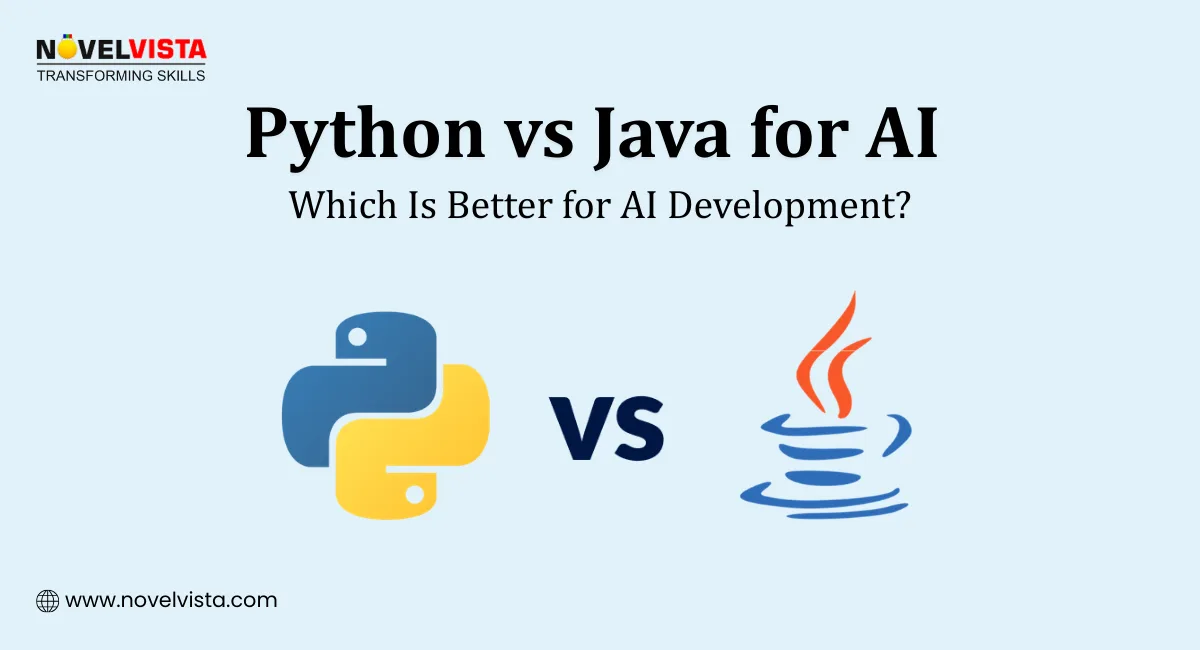
Choosing the wrong language for AI doesn’t fail loudly. It fails slowly when models don’t scale, systems break under load, or teams struggle to move from demo to production. That’s why Python vs Java for AI is still one of the most searched and debated topics in 2026.
Developers are no longer just asking which language is easier. They’re asking tougher questions:
This blog gives you a clear, practical comparison of Python vs Java for AI, based on ecosystem maturity, performance, enterprise adoption, and how AI is actually built and deployed today.
| Area | Python | Java |
| Primary Use | AI research & experimentation | Enterprise AI deployment |
| Ecosystem | Rich, AI-first libraries | Strong JVM & enterprise tools |
| Performance | Slower runtime | Faster, stable at scale |
| Scaling | Limited for long-running systems | Designed for large systems |
| Best Fit | Training & prototyping | Serving & production AI |
The real takeaway from Python vs Java for AI: most teams don’t choose one, they use both.
AI has moved far beyond experiments and notebooks. Today, models must integrate with APIs, handle traffic, meet compliance rules, and run reliably for years.
That shift is why Python vs Java for AI keeps resurfacing.
Python dominates early-stage AI work. Java dominates enterprise systems. When AI crosses from labs into business-critical systems, language choice directly affects speed, stability, and long-term cost.
This comparison helps you decide where each language fits, not which one “wins.”
Python remains the default starting point for AI engineers, data scientists, and researchers.
Python’s position in AI is backed by real adoption data:
Python appears in 82% of AI/ML job postings (Kaggle Survey)
Over 5 million of AI GitHub repositories are Python-based (2025 data)
These numbers explain why Python vs Java for AI often starts with Python as the obvious choice.
Python excels because it removes friction.
Key advantages include:
Simple and readable syntax: Faster learning, faster experiments, fewer lines of code.
Unmatched AI ecosystem: NumPy, Pandas, scikit-learn, TensorFlow, PyTorch, all built with Python first.
Research-friendly workflow: Jupyter Notebooks make testing, visualization, and iteration easy.
Massive community support: Over 2 million AI-related Python tags on Stack Overflow.
So, is Python good for AI development?
Yes, especially for research, prototyping, and training models.
During hands-on ML bootcamps, participants typically build and evaluate working models 30–40% faster in Python compared to Java-based experimentation environments.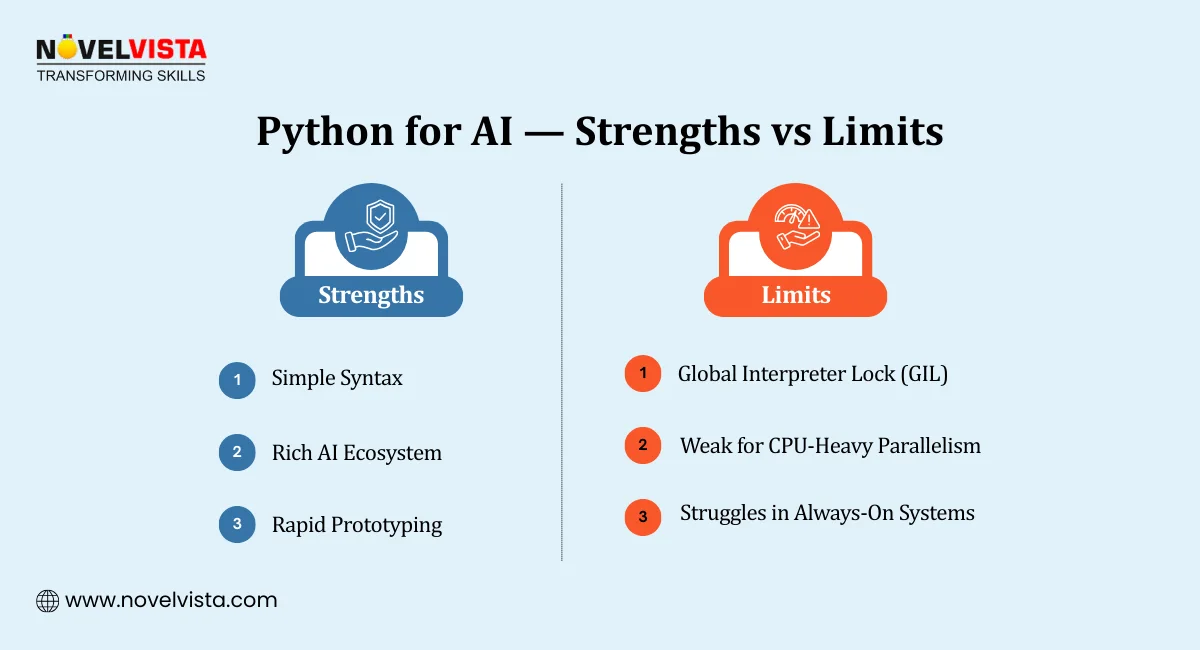
While Python leads experimentation, Java for AI becomes important when AI systems must run reliably in production.
Java may not dominate AI research, but it quietly powers large-scale AI deployments:
25% of production AI systems use Java (Gartner 2025)
Strong adoption in banking, finance, telecom, and regulated sectors
Preferred for long-running services and backend platforms
This is where Python vs Java for AI shifts from experimentation to execution.
Java shines when AI systems move into real-world operations.
Key strengths include:
Higher runtime performance: Benchmarks show Java runs 30–50% faster than Python for many workloads.
True multithreading: No Global Interpreter Lock (GIL), enabling parallel processing.
Stable JVM ecosystem: Ideal for services that run continuously under load.
Enterprise integration: Frameworks like Spring AI simplify model serving and system integration.
So, can I use Java for artificial intelligence?
Absolutely.
Is Java good for AI?
Yes, especially when AI must scale, integrate, and comply.
In enterprise AI implementation programs we support, Java-based services consistently handle sustained production loads with 20–35% lower latency variance than Python microservices.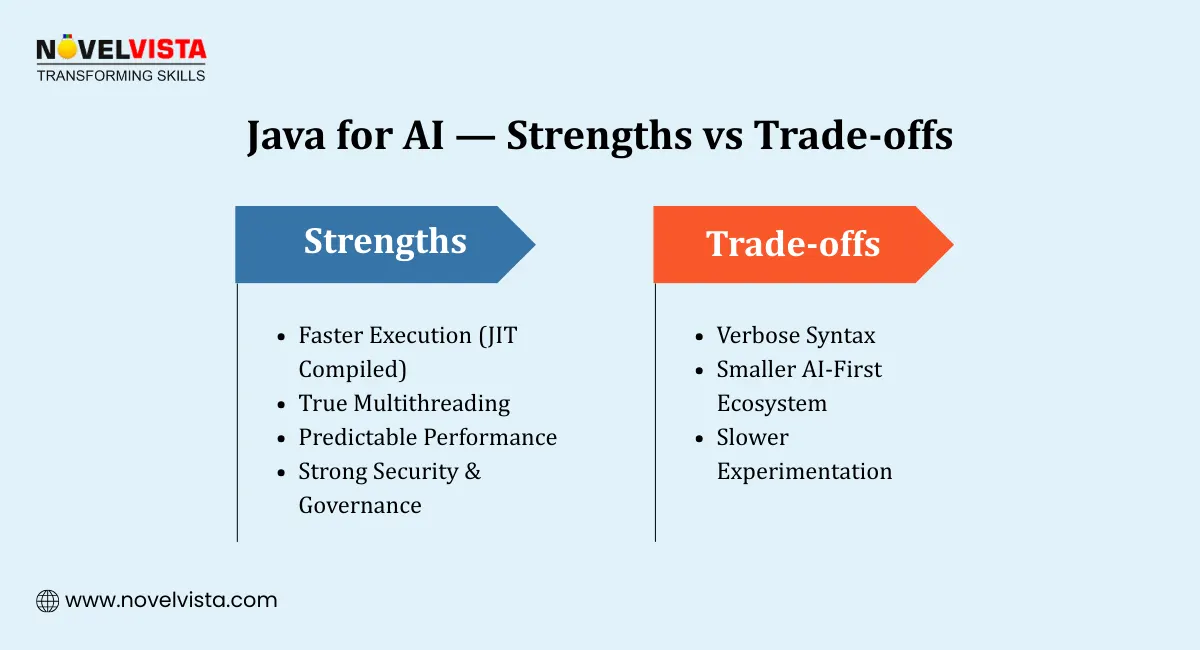
A direct Java vs Python for AI comparison makes the differences clear.
| Feature | Python | Java |
| Primary AI Use | Research, prototyping | Enterprise deployment |
| Libraries | PyTorch, TensorFlow, scikit-learn | Deeplearning4j, JVM tools |
| Performance | Slower (interpreted) | Faster (JIT compiled) |
| Parallelism | Limited by GIL | Native multithreading |
| Typing | Dynamic | Static |
| Community Focus | AI & data science | Enterprise systems |
| Adoption | 67% AI GitHub repos | 18% enterprise AI systems |
This Java vs Python for AI view shows why both languages continue to coexist rather than replace each other.
The debate around Python vs Java for AI becomes clearer when you look at strengths and limits without bias.
Pros
Fast learning curve: Python lets teams move from idea to model quickly.
Strong link to AI research: Most new AI papers and models appear in Python first.
Excellent tooling for data work: Data prep, visualization, and experimentation are smoother.
Cons
Global Interpreter Lock (GIL): Limits CPU-bound parallel processing.
Weaker for long-running systems: Python struggles with large, always-on enterprise services.
Across multiple AI audits, we observed Python services requiring refactoring once concurrent users crossed 5,000–10,000 daily active sessions in production environments.
This doesn’t weaken Python’s role. It simply defines where it fits best in Python vs Java for AI.
Pros
High stability at scale: Java handles heavy workloads for long periods without issues.
Better performance: Faster execution and true multithreading.
Strong governance and security: Ideal for regulated industries.
Many still ask, what is the future of Java in AI?
The answer is growth. Forrester projects a 15% increase in Java-based AI systems by 2027, driven by enterprise needs.
Cons
Verbose syntax: Slows early experimentation.
Smaller AI-first ecosystem: Fewer cutting-edge research tools than Python.
This is why Java for AI focuses on production, not exploration.
Most teams don’t choose between languages. They combine them.
According to the O’Reilly AI Survey 2025, 60% of organizations use a hybrid AI approach:
Python for model training and experimentation
Java for serving models through APIs
Java for scaling, monitoring, and governance
In our advanced AI deployment labs, hybrid stacks reduce time-to-production by nearly 25% because model training and API scaling are optimized independently.
It also answers another common question: Is Java good for AI?
Yes, when AI leaves notebooks and enters real systems.
• In-depth comparison of leading AI language models
• Performance analysis across accuracy, speed, and reliability
• Real-world evaluation using industry-standard benchmarks
The decision depends on what you are building.
Choose Python if:
You work on AI research or data science
Fast iteration matters most
You build and train models
Choose Java if:
You deploy AI in enterprise systems
Performance and uptime matter
You need compliance and control
In short:
Python leads AI development
Java strengthens AI production
Professionals completing our AI engineering pathway typically learn Python first, then add Java for deployment within six months to align with real enterprise hiring demands. This balance defines modern Python vs Java for AI strategies.
Python continues to drive AI innovation, research, and experimentation. Java ensures those innovations survive real-world scale, security, and performance demands.
So the real answer to Python vs Java for AI is not “either-or.” It’s “use both wisely.”
Python helps you build intelligence.
Java helps you run it.
Teams that understand this build AI systems that don’t just work, they last.
If you want to move beyond language debates and start building real AI solutions, NovelVista’s Generative AI Professional Certification focuses on hands-on, industry-ready skills. The course covers model fundamentals, prompt engineering, AI system design, governance considerations, and real-world use cases. It’s ideal for developers, architects, and professionals who want to confidently design, deploy, and scale generative AI solutions across modern enterprise environments.
Author Details

Course Related To This blog
Generative AI Professional
Generative AI in Project Management
Generative AI in Risk & Compliance
Generative AI in Retail
Generative AI in Marketing
Generative AI in Finance and Banking
Generative AI for HR and L&D
Generative AI in Cybersecurity
Generative AI in Business
Generative AI in Software Development
Confused About Certification?
Get Free Consultation Call
Stay ahead of the curve by tapping into the latest emerging trends and transforming your subscription into a powerful resource. Maximize every feature, unlock exclusive benefits, and ensure you're always one step ahead in your journey to success.