Category | AI And ML
Last Updated On 10/01/2026
Hiring for AI roles in 2026 has flipped completely. Recruiters don’t ask for resumes first anymore. They ask for links. GitHub repositories, live demos, and deployed apps matter more than titles or years of experience. A strong Generative AI portfolio shows proof. It shows how you think, how you build, and how you solve real problems.
In resume-review sessions with GenAI learners, most rejections happen not due to weak skills, but because resumes fail to show impact fast. Recruiters respond better when projects are framed around outcomes, metrics, and deployment, not tool lists.
A resume can list tools. A Generative AI portfolio shows outcomes. It tells a story of how you turned an idea into a working system, handled data, managed errors, and improved results. That’s what hiring managers trust.
This guide explains what AI projects get you hired in 2026, how to choose the right projects, and how to present them so recruiters immediately see your value.
A Gen AI portfolio is not a collection of random notebooks or half-finished experiments. It is a clean, focused set of end-to-end projects that feel close to production use.
Strong portfolios usually include:
Recruiters don’t expect perfection. They expect clarity, intent, and responsibility. That’s what a solid Generative AI portfolio delivers.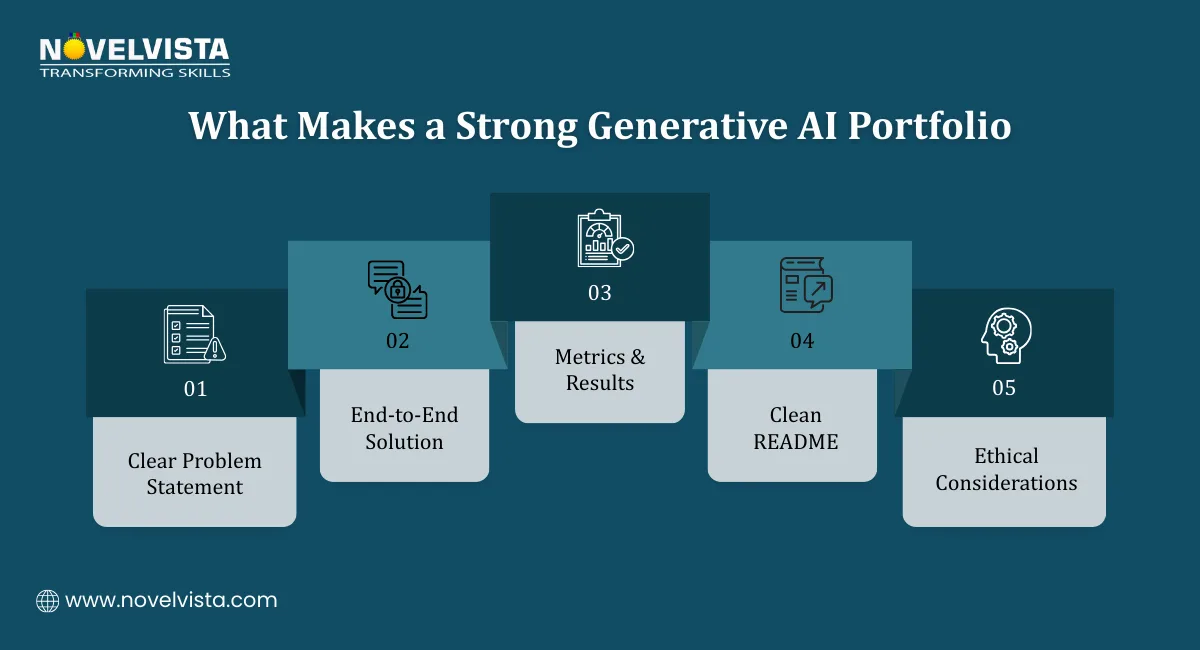
When recruiters scan portfolios, they are not looking for flashy demos. They look for patterns that signal real-world readiness. The most effective Generative AI portfolio examples 2026 usually fall into a few proven project types.
| Project Type | Generative AI Portfolio Examples 2026 |
| RAG Systems | Document Q&A bots using LangChain and vector databases |
| Content Generation | Controlled text generation for business use |
| Image / Video | Fine-tuned models for custom visual output |
| Multimodal AI | Assistants handling text, image, or audio together |
These projects show that you understand data pipelines, model orchestration, evaluation, and deployment. They answer the recruiter’s real question: Can this person build something that works beyond a demo?
That’s why knowing what AI projects get you hired in 2026 matters more than knowing every new tool.
One thing recruiters love to see is clear decision-making. Explaining RAG vs fine-tuning for portfolio projects shows maturity and judgment.
| Approach | Pros | Cons | Hireability Signal |
| RAG | Fast to build, easy updates, lower cost | Depends on data quality | Strong signal for enterprise roles |
| Fine-tuning | Custom behavior, task-specific accuracy | Expensive, data-heavy | Strong signal for research-heavy roles |
If you choose RAG, explain why freshness and control mattered. If you choose fine-tuning, explain why customization was needed. This reasoning strengthens your Generative AI portfolio more than the model choice itself.
Recruiters don’t want many projects. They want a few strong, well-explained ones. Below are the most valuable project types and why they work so well in a Generative AI portfolio.
This is one of the most powerful projects you can build in 2026. A RAG-based system that answers questions from PDFs, policies, or manuals shows real enterprise relevance.
Why recruiters like it:
Shows understanding of embeddings, vector databases, and retrieval logic
Demonstrates how to control hallucinations
Reflects real business use cases like compliance, HR, or support
What to include:
Accuracy benchmarks
Source citation logic
Explanation of chunking and retrieval strategy
This project alone can anchor an entire Generative AI portfolio.
A coding assistant that generates or fixes code based on context shows strong reasoning and evaluation skills.
Why recruiters like it:
Shows applied understanding of LLM reasoning
Demonstrates prompt design and error handling
Signals value to engineering teams
What to include:
Supported languages or frameworks
Examples of bug fixing or refactoring
Limitations and failure cases
This project directly answers what AI projects get you hired in 2026? for developer-focused roles.
A chatbot that understands both text and images shows advanced capability and system integration.
Why recruiters like it:
Shows ability to handle multimodal inputs
Reflects future-facing AI use cases
Demonstrates orchestration between models
What to include:
Clear use case (support, analysis, search)
Input-output examples
Latency and accuracy notes
A content generator that maintains tone, brand voice, or audience targeting is highly valued.
Why recruiters like it:
Shows control, not just generation
Reflects marketing and business use cases
Demonstrates prompt engineering depth
What to include:
Style controls
Brand constraints
Evaluation samples
This is a strong addition to Generative AI portfolio examples 2026 for non-pure-tech roles.
Want to see how AI is reshaping marketing outcomes? Read our blog on how generative AI is transforming campaigns, personalization, and performance across modern marketing teams.
An AI agent that answers questions on datasets using natural language is a big signal of production readiness.
Why recruiters like it:
Shows structured reasoning
Demonstrates data handling and visualization
Bridges AI and analytics
What to include:
Supported queries
Dataset description
Accuracy and response-time metrics
Summarizing long videos into insights or highlights shows strong applied AI thinking.
Why recruiters like it:
Shows pipeline design
Demonstrates multimodal reasoning
Reflects media and enterprise use cases
A shopping assistant that helps users find products or compare options mirrors real business needs.
Why recruiters like it:
Shows user-focused design
Demonstrates recommendation logic
Reflects revenue-driven AI use
This project signals maturity and responsibility.
Why recruiters like it:
Shows awareness of privacy and ethics
Demonstrates structured output generation
Signals trustworthiness
Each of these projects strengthens your Generative AI portfolio because they mirror real hiring needs, not academic exercises.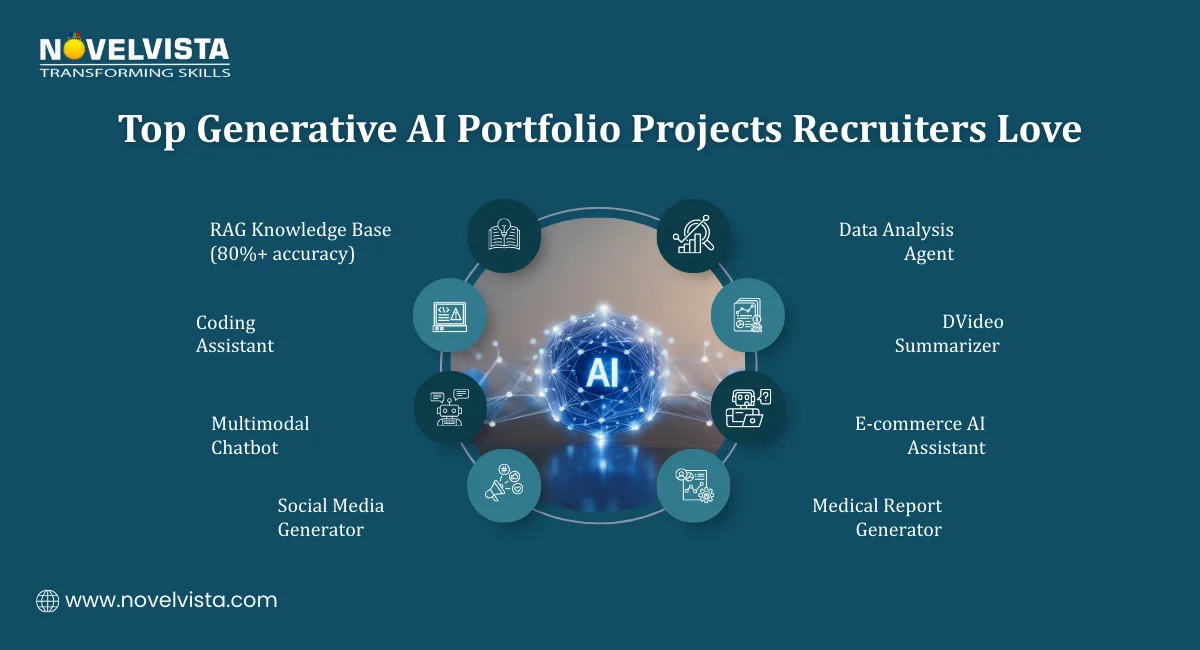
When recruiters open your project, clarity decides everything.
| Component | Best Practice |
| README | Problem, solution, metrics, limits, ethics |
| Demo | Streamlit or Gradio app |
| Code | Modular, documented, reproducible |
Strong structure turns a Gen AI portfolio from “interesting” into “hire-ready.”
A strong Generative AI portfolio only works when recruiters can quickly connect it to your resume. Most hiring managers spend less than 30 seconds scanning a profile before opening links. That’s why knowing how to show GenAI on a resume matters just as much as building the project itself. Your resume should not explain everything. It should point clearly to the proof. Instead of listing tools, focus on outcomes and links.
“Worked on generative AI models using LangChain.”
“Built RAG-based document Q&A system with 85% answer accuracy and source citations. Reduced manual search time by 60%. (GitHub link)”
From a hiring-aligned perspective, resumes that quantify performance latency, accuracy, and cost reduction are shortlisted more often. Metrics help recruiters quickly assess whether a Generative AI project can survive real production constraints.
Generative AI Engineer | 2026
Built RAG Q&A system using LangChain + ChromaDB with 85% accuracy and sub-2s latency
Developed a multimodal chatbot handling text and images for support use cases
Fine-tuned Stable Diffusion model achieving 40% improvement in brand-style consistency
Portfolio: github.com/yourname/gen-ai-projects
This approach shows:
Real-world impact
Clear metrics
Direct access to your Gen AI portfolio
That’s exactly what recruiters expect when reviewing Generative AI portfolio examples 2026. During portfolio mentoring programs, candidates who linked their resumes directly to GitHub projects with clean READMEs consistently received faster interview callbacks. Clear traceability between resume bullets and working code builds immediate credibility.
A step-by-step blueprint to create
real GenAI projects recruiters
want in 2026.
Hiring patterns have become very clear over the last year. Recruiters are not guessing anymore. They follow repeatable signals.
Here’s what’s shaping what AI projects get you hired in 2026?
GitHub-first screening: Many recruiters open repositories before reading resumes. Clean code and clear READMEs matter.
RAG dominates production hiring: Most enterprise teams prefer RAG over fine-tuning for speed, cost, and control.
Fine-tuning signals depth, not volume: One strong fine-tuning project is better than five shallow demos.
Ethics is now a silent filter: Portfolios that ignore data privacy, bias, or misuse risks quietly get rejected.
Deployment beats notebooks: Streamlit apps, APIs, Dockerized setups beat Jupyter notebooks every time.
These hiring signals are aligned with what enterprise AI teams and certification-aligned programs emphasize today: production readiness, governance awareness, and measurable reliability over experimental demos.
Want to know where the AI opportunities are heading? Read our blog on the latest generative AI jobs to explore in-demand roles, skills employers want, and where the market is moving.
Many good engineers don’t get callbacks, not because they lack skills, but because their portfolios send the wrong signals.
Here are the mistakes recruiters flag immediately:
Toy projects with no real problem framing: “Chatbot for fun” doesn’t explain business value.
No measurable outcomes: If there are no metrics, recruiters assume there was no testing.
Missing or weak READMEs: If a reviewer can’t understand the project in two minutes, they move on.
Ignoring ethics and data responsibility: Especially important for healthcare, finance, and enterprise roles.
Too many unfinished experiments: Five half-built projects look weaker than two complete ones.
These mistakes are repeatedly observed across portfolio reviews and mock hiring panels. Addressing them early reduces rejection risk and helps candidates present an honest, audit-ready view of their GenAI work. A strong Generative AI portfolio is focused, intentional, and honest about limitations.
In 2026, hiring decisions are no longer based on claims. They’re based on proof. A well-built Generative AI portfolio shows how you think, how you build, and how you solve real problems under real constraints.
The strongest portfolios answer three questions clearly:
What problem did you solve?
How did you solve it end-to-end?
What measurable value did it deliver?
Choosing the right mix of RAG systems, content generators, multimodal tools, and agent-based workflows matters more than chasing trends. Build fewer projects, go deeper, and document them well.
That’s how you clearly answer what AI projects get you hired in 2026? and stand out without shouting.

Author Details

Course Related To This blog
Generative AI Professional
Generative AI in Project Management
Generative AI in Risk & Compliance
Generative AI in Retail
Generative AI in Marketing
Generative AI in Finance and Banking
Generative AI for HR and L&D
Generative AI in Cybersecurity
Generative AI in Business
Generative AI in Software Development
Confused About Certification?
Get Free Consultation Call
Stay ahead of the curve by tapping into the latest emerging trends and transforming your subscription into a powerful resource. Maximize every feature, unlock exclusive benefits, and ensure you're always one step ahead in your journey to success.