Category | AI And ML
Last Updated On 15/01/2026
Manufacturing teams today are under pressure from every direction. Products must be smarter. Downtime must be lower. Costs must be controlled. Traditional automation helps, but it often stops at efficiency. This is where generative AI in manufacturing is changing the conversation.
From our experience training manufacturing professionals and operations leaders, the interest in generative AI usually starts with a real pain point: downtime, design delays, or planning gaps. Teams exploring AI today are not chasing trends; they are looking for practical ways to improve daily decision-making and operational stability.
Instead of just following rules, AI is now helping manufacturers design better products, predict failures earlier, and make smarter decisions across the factory floor. This guide explains how generative AI is being used in manufacturing today, where it delivers value, and why adoption is accelerating.
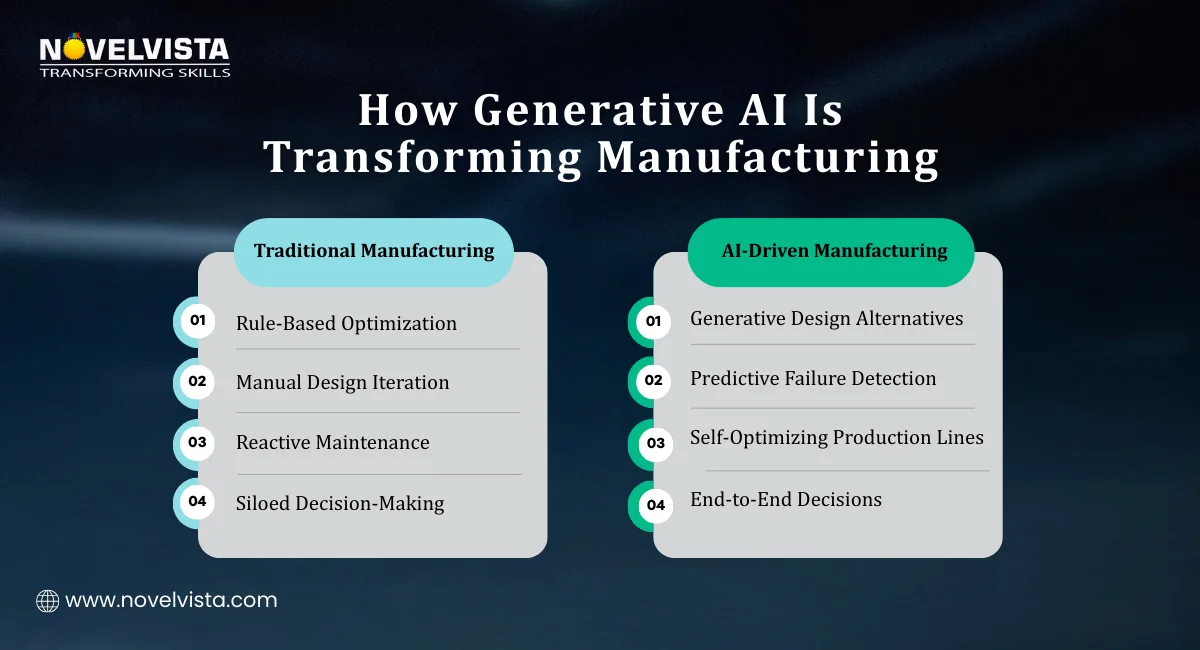
For years, manufacturers focused on automation to speed up production. That solved one part of the problem. But today’s challenges go beyond speed. Product complexity, supply chain volatility, workforce gaps, and rising customer expectations demand a different approach.
Generative AI in manufacturing moves beyond task automation. It supports thinking, planning, and optimization across the entire operation. Instead of reacting to problems, manufacturers can anticipate them.
What’s driving interest right now:
This is why generative AI in manufacturing industry discussions are no longer experimental. They are becoming part of strategic planning.
This article focuses on:
 So what does generative AI for manufacturing actually mean?
Generative AI refers to systems that don’t just analyze data but create outputs. These outputs can be designs, predictions, recommendations, simulations, or summaries, based on large volumes of historical and real-time data.
In manufacturing, this means AI can:
This is a big shift from rule-based systems. Instead of fixed logic, generative AI for manufacturing adapts as data changes. The more it learns, the better its recommendations become.
Across the generative AI in manufacturing industry, this shift is helping teams move from reactive decision-making to proactive planning.
In our generative AI training programs, we focus heavily on explaining how these systems learn from production, quality, and maintenance data. This helps learners understand why generative AI behaves differently from traditional automation tools and how it adapts as manufacturing conditions change.
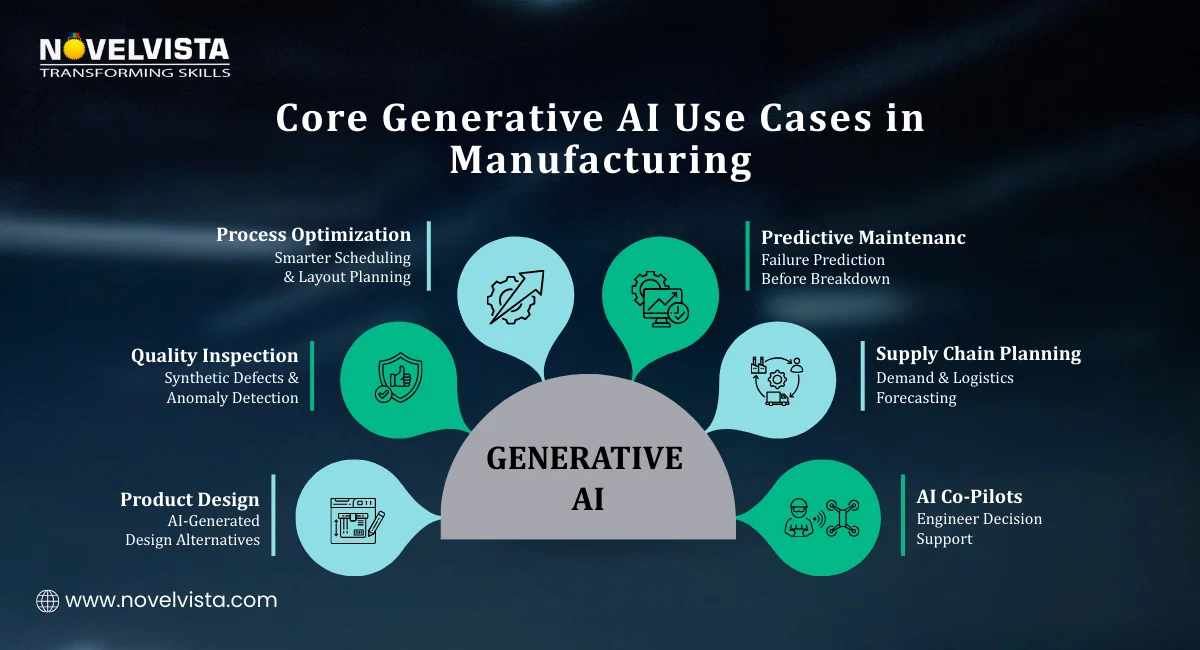 The real value of generative AI shows up in how it’s applied. Below are the most impactful generative AI use cases in manufacturing seen today.
Generative AI can create and test thousands of design variations quickly.
In training sessions, design engineers often relate most to this use case because it mirrors real challenges they face. Limited testing time and high prototyping costs. Seeing how generative AI supports early design decisions helps teams trust AI as a design partner, not a replacement.
Quality teams often struggle with limited defect data. Generative AI solves this by:
This is one of the fastest-growing generative AI use cases in manufacturing because it directly impacts cost and customer satisfaction.
Factories generate huge amounts of operational data. Generative AI helps turn that data into action.
Data-driven planning approaches, like those used in large industrial environments, show how generative AI in manufacturing improves daily decision-making.
Unexpected downtime is expensive. Generative AI uses sensor and historical data to:
Platforms such as advanced industrial analytics solutions show how generative AI for manufacturing supports more reliable operations.
Supply chains are no longer predictable. Generative AI helps by:
This makes generative AI in manufacturing industry adoption especially valuable during disruptions.
Generative AI also supports people, not just machines.
This use case helps bridge skill gaps and improve response time across teams.
The value of generative AI in manufacturing becomes clearer when you look at how real companies are using it on the ground. These are not lab experiments. They are operational deployments with measurable impact.
U.S. Steel uses generative AI to improve predictive maintenance and provide advisory insights across its supply chain. By analyzing production and logistics data together, teams can anticipate issues earlier and adjust plans before disruptions escalate. (Source: Steel Market Updated)
GE Appliances applies generative AI to optimize service operations and sales recommendations. AI models analyze product usage patterns and service history to suggest better maintenance actions and improve customer experience. (Source: GE Appliences)
Siemens promotes conversational AI to support maintenance decisions. Engineers can ask questions in natural language and receive guidance based on historical data, manuals, and past incidents, reducing downtime and closing skill gaps. (Source: Siemens)
These generative AI in manufacturing industry examples highlight a broader industry shift. Large manufacturers are moving generative AI from pilot projects into daily operations, which signals growing confidence in both the technology and the governance frameworks supporting its use.
See where generative AI truly delivers value in manufacturing. Learn real-world use cases across design, quality, maintenance, and operations, without wasting time on hype or guesswork.
When applied well, generative AI in manufacturing delivers benefits that go beyond efficiency.
Key advantages include:
Higher efficiency: Automates repetitive analysis and decision-making, freeing teams to focus on higher-value work.
Lower costs: Reduces waste, minimizes rework, and cuts down on expensive physical prototypes.
Faster innovation: Shortens design and testing cycles, helping teams move from idea to production quicker.
Improved quality: Detects defects earlier and predicts failures before they affect customers.
These outcomes explain why interest in generative AI for manufacturing continues to grow across sectors.
Despite the promise, adopting generative AI in manufacturing is not plug-and-play. Manufacturers need to address a few common challenges.
Data quality and integration: Legacy systems often store data in silos, making AI training harder.
Change management: Teams may resist AI-driven recommendations if trust is not built early.
Governance and accountability: Clear rules are needed to define how AI decisions are reviewed and approved.
Cross-functional alignment: Success requires IT, operations, and leadership to work together.
Organizations that plan for these challenges see smoother adoption and better results from generative AI use cases in manufacturing.
Based on real implementation discussions shared during training programs, most challenges with generative AI adoption are organizational rather than technical. Addressing data readiness, trust, and cross-team collaboration early leads to far more sustainable results.
Looking ahead, the generative AI in manufacturing industry is expected to evolve rapidly.
By 2026:
Factories will move toward self-optimizing systems
AI agents will simulate production, maintenance, and supply scenarios continuously
Planning and optimization will become more adaptive and less manual
Manufacturers that embed generative AI in manufacturing deeply into operations will gain a strong edge, especially as supply chains remain unpredictable and competition intensifies.
(Source: TCS)
Generative AI in manufacturing is no longer about experimentation. It is becoming a practical tool for design, quality, maintenance, and planning. Real-world examples already show how manufacturers are improving efficiency, reducing costs, and accelerating innovation.
By focusing on the right generative AI use cases in manufacturing and addressing adoption challenges early, organizations can turn AI into a long-term capability—not just a technology trend.
This guidance is shaped by practical training experience, industry use cases, and real adoption patterns seen across manufacturing organizations. The intent is to help professionals understand where generative AI fits realistically, not to oversell its capabilities.

If you want to understand how generative AI for manufacturing works in real business scenarios, NovelVista’s Generative AI Professional Certification Course is a strong next step. The program focuses on practical use cases, real-world tools, and decision-making with AI, not just theory. It’s designed for professionals who want to apply generative AI confidently across operations, analytics, and innovation initiatives.
Author Details

Confused About Certification?
Get Free Consultation Call
Stay ahead of the curve by tapping into the latest emerging trends and transforming your subscription into a powerful resource. Maximize every feature, unlock exclusive benefits, and ensure you're always one step ahead in your journey to success.