Category | AI And ML
Last Updated On 10/08/2026
In 2026, content is no longer just a marketing asset it is the engine that drives customer engagement, brand visibility, and business growth. However, the demand for fresh, personalized, and high-quality content across blogs, social media, email campaigns, videos, and digital channels has grown faster than most teams can keep up with. This is where generative AI content creation is changing the game.
Powered by advanced artificial intelligence models, generative AI enables organizations to create text, images, audio, and video content in a fraction of the time traditional methods require. Rather than replacing human creativity, it acts as a powerful collaborator helping teams brainstorm ideas, generate first drafts, repurpose existing assets, and deliver personalized experiences at scale. What once took days or weeks can now be accomplished in hours, allowing creators to focus on strategy, storytelling, and innovation.
From startups and digital agencies to global enterprises, businesses are increasingly adopting generative AI in content creation to improve productivity, reduce production costs, and accelerate content operations. At the same time, the rapid rise of AI-powered tools is reshaping how marketers think about content strategy, workflow automation, and audience engagement.
In this blog, we'll explore the biggest advantages of generative AI for content creation, the leading AI-powered platforms available today, best practices for integrating AI into your workflows, and how organizations can use these technologies responsibly to scale content without compromising quality or authenticity.
Generative AI content creation refers to the use of advanced AI models to automatically generate blogs, social media posts, marketing copy, images, videos, and audio assets. Instead of starting from a blank page, creators use AI-generated drafts and ideas that can be customized and refined, helping teams accelerate production, overcome creative blocks, and deliver highly personalized experiences at scale.
Modern content operations involve planning, creating, editing, distributing, and repurposing content. Generative AI in content creation streamlines each stage by:
AI dramatically reduces the time required to produce high-quality content by generating outlines, drafts, captions, and creative concepts in minutes.
Businesses can create audience-specific messaging, localized campaigns, and personalized email or social content without multiplying manual effort. The AI can translate the content into multiple languages without losing the context. This helps in reaching a global audience. For video content specifically, tools like invideo's AI video translator extend this to existing videos, letting creators localize their content across languages without re-recording.
With well-crafted prompts and style guides, AI helps maintain a consistent tone and voice across channels and teams.
Organizations reduce dependency on lengthy manual processes while enabling content teams to focus on strategic and creative tasks.
AI acts as a brainstorming partner, helping creators overcome writer's block and explore new campaign angles.
One idea can become a blog, infographic, social media thread, podcast script, video script, and email campaign through AI-powered repurposing.
AI tools help generate keyword-rich outlines, optimize readability, and identify content gaps for improved search performance.
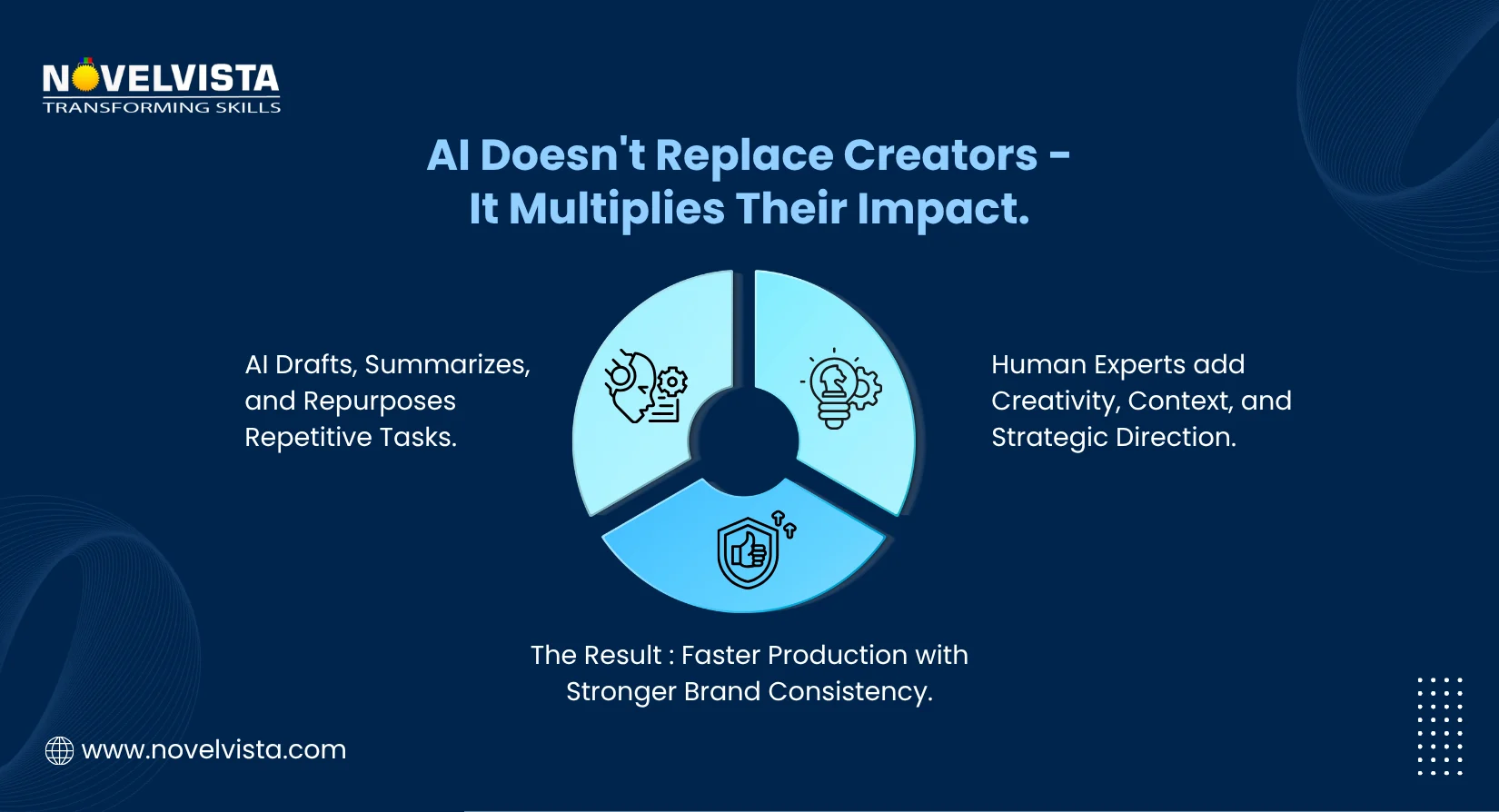
Organizations are increasingly building AI-enabled content workflows where AI handles repetitive production tasks while humans focus on strategy, creativity, and quality assurance.
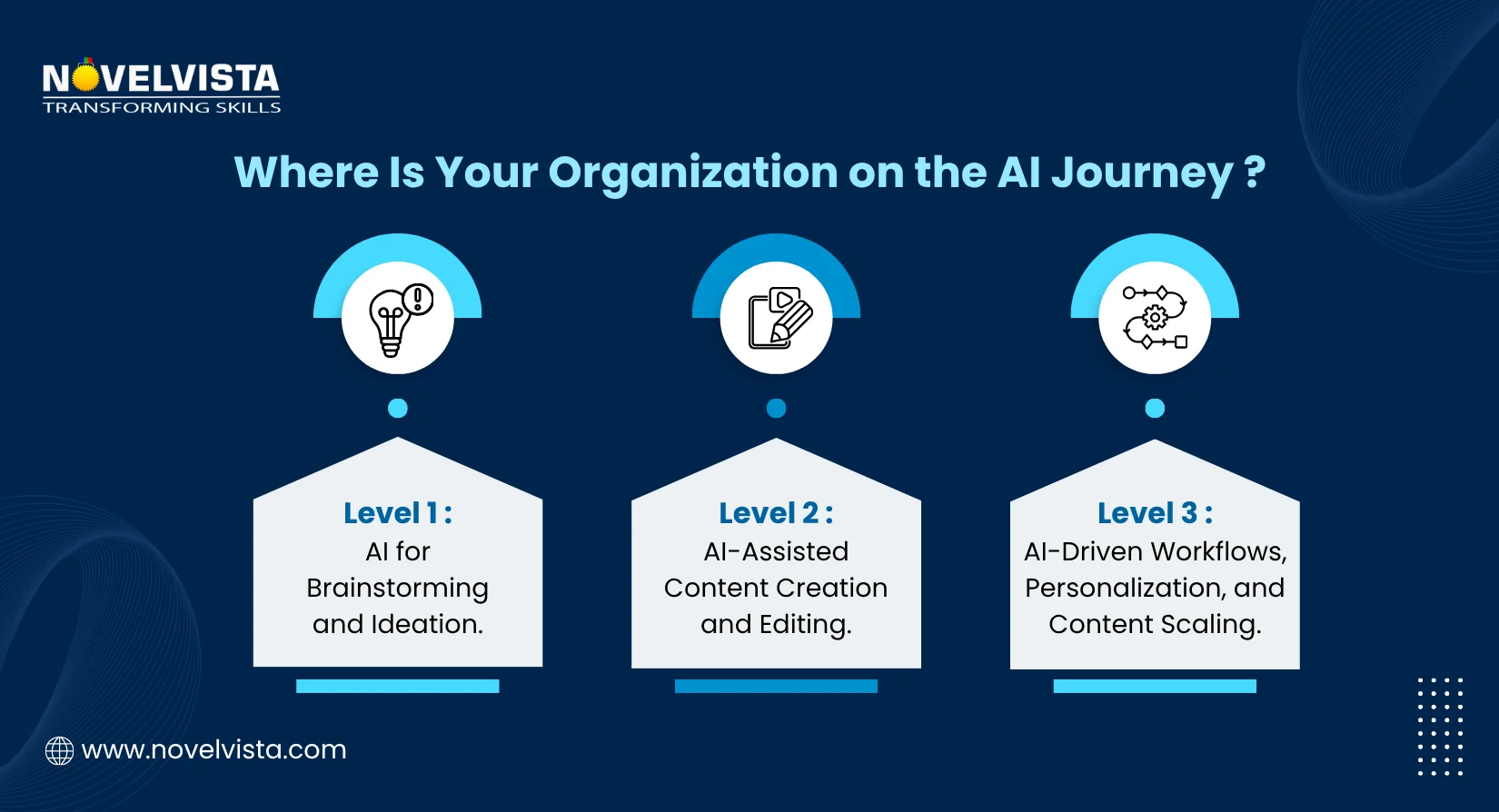
A scalable AI content operation typically follows this process:
Today's generative AI content creation tools support a fully multimodal content pipeline.
Tool | Primary Use Case | Best For |
| ChatGPT | Writing and ideation | Blogs, emails, social media |
| Claude | Long-form content | Reports, documentation, research |
| Midjourney | AI image generation | Marketing visuals and creative assets |
| Adobe Firefly | Graphic design | Commercial image creation and editing |
| Synthesia | AI video creation | Training videos and corporate communication |
When evaluating the top generative AI tools for content creation, look for these capabilities:
The ability to create text, images, audio, and video from a unified workflow.
Support for prompts, templates, and custom style guidelines.
Compatibility with existing marketing, CMS, and productivity platforms.
Data privacy, access controls, and compliance features for business use.
The ability to generate and manage large volumes of content efficiently.
As organizations continue investing in AI-driven content operations, the demand for professionals with validated generative AI skills is also growing. If you're planning to build a career in this rapidly evolving field, our comprehensive Generative AI Exam Guide covers certification pathways, preparation tips, and what to expect from leading AI credentialing programs.
Generative AI should not replace strategy it should amplify it. Successful organizations use AI to:
Despite its advantages, AI-generated content comes with important considerations:
Let AI handle roughly 70% of the groundwork research, outlines, transcription, and first drafts while humans dedicate the remaining 30% to editing, fact-checking, and adding brand authenticity. When AI-generated drafts are created for coursework or educational projects, an AI detector for students can serve as an additional review step before final submission to encourage academic integrity.
Start with a broad prompt and gradually refine it by specifying audience, tone, structure, style, and desired outcomes.
Turn one piece of long-form content into multiple assets, such as converting podcasts into blogs, blogs into social posts, and webinars into video snippets.
Always perform editorial reviews to ensure accuracy, originality, compliance, and alignment with brand messaging.
Define internal standards for AI usage, data privacy, attribution, and content approval workflows.
The future of generative AI for content creation lies in collaborative intelligence, where humans and AI work together. AI will become increasingly multimodal, context-aware, and integrated into enterprise workflows, enabling organizations to create personalized, high-quality content at an unprecedented scale. Businesses that invest in AI literacy, governance, and responsible implementation today will gain a significant competitive advantage in the content-driven economy of 2026 and beyond. As the adoption of generative AI accelerates across industries, organizations are actively looking for professionals who can build and manage AI-powered solutions. If you're preparing for your next AI role, exploring these commonly asked Generative AI Interview Questions can help you understand the concepts and skills employers are prioritizing in 2026.
Generative AI content creation is no longer a futuristic concept it is quickly becoming the foundation of modern content operations. From accelerating production and reducing costs to enabling hyper-personalization and multimodal storytelling, AI is helping businesses rethink how content is planned, created, and scaled. The organizations that successfully combine powerful AI capabilities with human creativity, strategic oversight, and ethical governance will be best positioned to thrive in an increasingly digital and content-driven world.
As generative AI continues to evolve, the real competitive advantage will not come from simply adopting AI tools, but from building the skills and expertise needed to use them effectively. For professionals and organizations looking to move beyond experimentation and implement enterprise-grade AI solutions, investing in structured, hands-on learning can help bridge the gap between AI potential and real-world business impact. Programs such as NovelVista's AWS Generative AI Developer Professional course are designed to equip teams with the practical knowledge required to build, deploy, and scale modern generative AI applications with confidence.
Generative AI content creation is the process of using artificial intelligence to create or assist in creating content such as blogs, social media posts, images, videos, emails, and marketing copy. It helps teams produce content faster while supporting creativity and personalization.
No. Generative AI works best as a collaborative tool rather than a replacement. While AI can generate drafts and automate repetitive tasks, human expertise is still essential for strategy, creativity, fact-checking, and maintaining an authentic brand voice.
Some of the most widely used generative AI content creation tools include ChatGPT and Claude for writing, Midjourney and Adobe Firefly for image generation, and Synthesia and Pictory for AI-powered video creation. The right choice depends on your specific content needs and workflow.
Businesses can use generative AI to streamline research, generate first drafts, repurpose existing content, personalize campaigns, and improve content production speed. Combining AI with human review and clear editorial guidelines ensures better quality and consistency.
As AI adoption grows, valuable skills include prompt engineering, AI-assisted content strategy, fact-checking AI-generated outputs, understanding ethical AI practices, and knowing how to integrate AI tools into existing content workflows.
Author Details

Course Related To This blog
Generative AI Certification
Confused About Certification?
Get Free Consultation Call
Stay ahead of the curve by tapping into the latest emerging trends and transforming your subscription into a powerful resource. Maximize every feature, unlock exclusive benefits, and ensure you're always one step ahead in your journey to success.